
Inside Airline Labor Disputes: What Workers Face at 30,000 Feet
The people who keep you safe in the sky operate under a set of rules that makes it nearly impossible to strike, drags contract negotiations out for years, and, as of a major 2024 ruling, just stripped an entire class of ground workers of protections they'd relied on for four decades.

Inside Airline Labor Disputes: What Workers Really Face at 30,000 Feet
The people who keep you safe in the sky operate under a set of rules that makes it nearly impossible to strike, drags contract negotiations out for years, and, as of a major 2024 ruling, just stripped an entire class of ground workers of protections they'd relied on for four decades. Airline labor disputes aren't abstract policy debates. They're fights over wages, rest, safety, and basic dignity, waged by workers who can't simply walk off the job without a federal judge potentially holding them in contempt.
I've spent months digging into the legal framework, the recent regulatory shifts, and the lived experience of cabin crews and ground staff. What I found is a system that's creaking under pressure, one that demands more attention from anyone who cares about workers' rights in this country.
The Law That Governs Everything (And Why It's Different)
If you work in a warehouse, a restaurant, or a tech company, your labor rights fall under the National Labor Relations Act. Airlines are different. The Railway Labor Act, originally passed in 1926 for railroads and extended to airlines in 1936, governs virtually every aspect of labor relations in aviation. And it was designed with one overriding priority: keeping planes in the air.
The RLA's structure is unlike anything most workers encounter. Contracts don't expire. They become "amendable." That word does a lot of heavy lifting. When a contract becomes amendable, the airline and the union enter a marathon negotiation process that can stretch for years. According to a 2003 GAO report on airline labor relations, the median time to reach a labor agreement at major U.S. airlines jumped from 9 months to 15 months after 1990. Some negotiations drag on far longer.
The process works like this: direct bargaining first, then mediation through the National Mediation Board, then possible arbitration, then a 30- to 90-day cooling-off period. Only after every single one of these steps has been exhausted can workers engage in "self-help" actions like a strike. The whole apparatus is built to delay, mediate, and prevent work stoppages. That might sound reasonable in the abstract. For workers waiting years for a raise while inflation eats into their paychecks, it feels like a trap.
When Workers Can't Strike, They Get Creative
The RLA's restrictions haven't stopped workers from pushing back. They've just changed the shape of resistance.
In early 1999, American Airlines pilots launched a sickout over a dispute tied to the integration of Reno Air operations. A federal judge ordered them back to work on February 10. They didn't fully comply. By February 13, the judge held the pilots' union in contempt of court. The airline reported massive cancellations and financial losses. That GAO report documented this episode as part of a broader trend: while full-scale airline strikes have become rare since deregulation in 1978, nonstrike work actions have actually increased. All 10 court-recognized nonstrike actions and all six presidential interventions in airline disputes occurred after 1993.
These actions hit harder than drawn-out negotiations. The same GAO analysis found that nonstrike work actions produced clearer negative effects on passengers, including reduced on-time performance, spikes in complaints, and drops in passenger traffic. The lesson is plain: when the legal system forces workers into a corner, the disruptions that eventually come tend to be more chaotic, not less.
What Flight Attendants Are Actually Fighting For
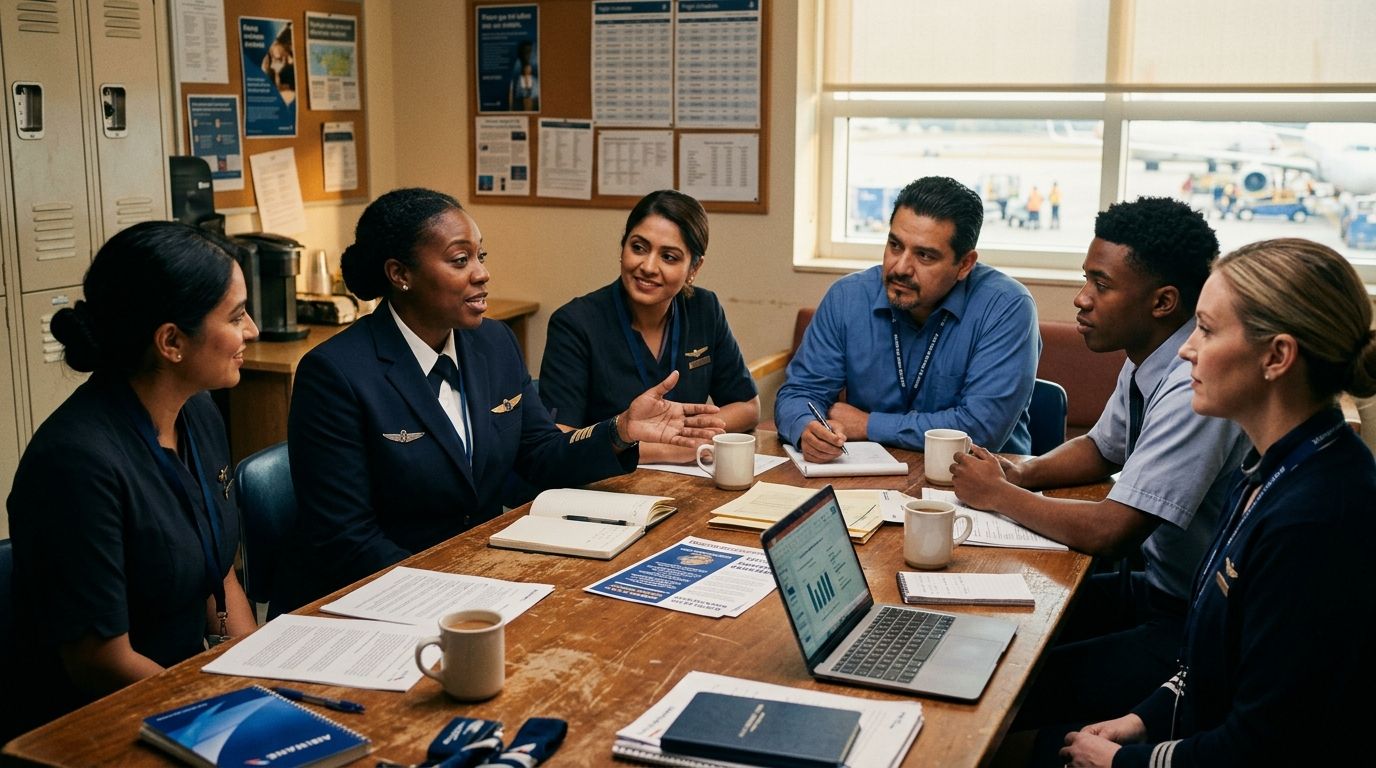
There's a persistent misunderstanding about flight attendant union campaigns. People assume it's primarily about money. Pay matters, absolutely. Through collective bargaining, unions fight for fair wages and work to close pay disparities, especially for the women who make up the majority of the cabin crew workforce. But the issues go deeper than base pay rates.
Scheduling is a relentless pressure point. Many flight attendant associations have pushed for more reasonable working hours and better scheduling practices, and for good reason. Under many agreements, flight attendants are only paid for "block time," meaning the period from when the aircraft door closes at the departure gate to when it opens at the arrival gate. All that time spent boarding passengers, handling bags, dealing with delays on the tarmac? Unpaid. A flight attendant might be "at work" for 14 hours and get paid for 8.
Rest is another battleground. Collective bargaining agreements spell out requirements for crew rest seats on long-haul flights. Under one major carrier's agreement, flights over eight hours require dedicated sleeper seats for crew, curtained off from passengers. When those accommodations aren't available because of equipment swaps or irregular operations, the crew absorbs the cost in exhaustion and degraded safety margins.
And then there's the simple matter of being treated like a professional. Flight attendants are safety workers first. They train for evacuations, medical emergencies, security threats. But the public, and sometimes the airlines themselves, treat them like beverage servers who happen to know where the exits are.
Mergers: Where Boardroom Deals Create Shop Floor Wars
If you want to understand why airline workers rights remain so contested, look at what happens after mergers. The history here is brutal.
When American Airlines' parent company acquired Trans World Airlines, the boardroom deal was clean enough. But as Aviation Pros documented, TWA flight attendants were still so angry about their treatment by new colleagues that they were picketing outside the American union hall years later. Seniority lists, which determine everything from routes to schedules to layoff order, become toxic when two workforces are forced together. Workers who built careers at one airline suddenly find themselves at the bottom of a combined list, losing bidding power they'd earned over decades.
This pattern repeats with almost every major airline merger. Peace in the boardroom, rancor at 30,000 feet. Management gets operational synergies on paper. Workers get years of internal conflict, grievances, and resentment. The Railway Labor Act's mediation structure wasn't built to handle the emotional and professional devastation that comes with having your career fundamentally restructured overnight.
The 2024 Ruling That Changed Everything for Ground Workers
The most consequential recent development in airline labor relations happened in December 2024, and it hasn't gotten nearly enough attention. The National Mediation Board ruled in Swissport Cargo Services LP that the Railway Labor Act does not apply to airline service providers. These are the companies airlines contract with for ground handling, baggage, and cargo operations.
This ended 40 years of precedent. For four decades, these workers were organized under the RLA's system-wide bargaining structure. Now they fall under the NLRA, which allows location-specific bargaining units. The NMB justified the decision by arguing that these workers lack the "community of interest" needed for system-wide representation because their workforces are "disparate, dispersed, and decentralized."
Here's what that means in practice: a group of baggage handlers at Newark could now organize and potentially strike independently of their counterparts at other airports. Under the old system, any labor action had to be coordinated nationally, which made strikes virtually impossible for these workers. Under the new framework, localized disruptions become far more likely.
The implications ripple outward. Workers at these service providers face some of the toughest conditions in the industry. Labor costs make up roughly 80% of operating expenses for ground service providers, creating constant downward pressure on wages. Research has linked these working environments to cardiovascular risks from noise and pollution exposure, high stress, poor retention, and chronic underreporting of safety incidents. Airlines often contract with the lowest-cost provider, and the workers absorb the consequences.
Why the "Just Be Grateful You Can Fly" Argument Falls Apart
There's a strain of public commentary that treats airline workers' complaints as entitled whining. The argument goes something like: you get to travel the world, you get flight benefits, stop complaining. This fundamentally misunderstands the economics and the physical toll of the work.
Entry-level flight attendants at several major carriers start at wages that, when adjusted for the unpaid hours of duty time, put them close to minimum wage in expensive hub cities. The "travel benefits" are standby tickets, meaning you might spend your day off sitting in an airport hoping for an open seat. The schedule is built around the airline's needs, not yours. Holidays, weekends, and predictable sleep patterns are luxuries that come only with decades of seniority.
As People's World reported during the pandemic, when the industry hit crisis, it was the workers who bore the immediate cost. Frontline staff faced layoffs while fighting for basic economic protections. The contrast between executive compensation packages and the wages of the people actually operating the aircraft has only widened since.
Ground workers have it worse. Ramp agents handle bags in extreme heat and bitter cold, work around running jet engines, and face injury rates that rival warehouse work. The contracted-out model means many of them don't even work directly for the airline whose logo is on the plane. They're employees of a third party, one step removed from any power they might otherwise have.
What Actually Improves Things
Research consistently shows that positive labor-management relationships improve service quality, employee commitment, and financial performance. Southwest Airlines built much of its early competitive advantage on exactly this principle: invest in your people, give them ownership and voice, and you get operational stability in return. The adversarial model, where management treats labor costs as a line item to minimize, produces exactly the kind of sickouts, slowdowns, and morale crises that end up costing far more than a fair contract would have.
The RLA's mediation framework can work when both sides engage in good faith. The statute requires labor and management "to exert every reasonable effort to make and maintain agreements and to settle all disputes." The Supreme Court has called that duty the "heart" of the act. But a duty to bargain means nothing if one side is content to let the clock run for years while workers wait.
Three things would make a real difference:
Enforce timelines. Open-ended mediation gives airlines every incentive to stall. Binding deadlines for reaching agreements would shift the power balance.
Pay for all duty time. The practice of only compensating flight attendants for block time is indefensible. Workers should be paid from the moment they're required to be at the airport.
Extend protections to contracted workers. The 2024 NMB ruling created a coverage gap. Whether through legislation or regulatory action, ground service workers need clear, enforceable protections regardless of who signs their paycheck.
What This Means If You Work in the Industry or Fly Regularly
If you're a worker in the airline industry, know your rights under whatever framework governs your employment. If you're under the RLA, understand that the process is long but that your union's ability to build solidarity during that process is your most powerful tool. If you're a ground worker now covered by the NLRA after the Swissport ruling, talk to an organizer about what the new rules mean for your specific situation.
And if you're a passenger who just wants your flight to leave on time, understand this: the stability of the air travel system depends directly on whether the people who run it are treated fairly. Every shortcut on labor costs eventually shows up as a delay, a cancellation, or a safety incident. The workers at 30,000 feet aren't asking for special treatment. They're asking to be paid for the hours they work, to rest when they're exhausted, and to have a genuine voice in the conditions of their employment. That shouldn't be a radical demand in any industry, let alone one where the stakes are measured in lives.
The Union Edge Staff
Also in the paper