
Can Manufacturing Jobs Come Back? What Workers Need to Know
The promise is always the same. A politician stands at a podium, points at a closed factory, and swears those manufacturing jobs are coming back. The president himself said factories would "come roaring back" thanks to tariffs.

Can Manufacturing Jobs Come Back? What Workers Need to Know
The promise is always the same. A politician stands at a podium, points at a closed factory, and swears those manufacturing jobs are coming back. The president himself said factories would "come roaring back" thanks to tariffs. But here's what nobody at that podium tells you: the jobs that return won't look anything like the ones that left. And if workers aren't prepared for that reality, the reshoring wave everyone keeps talking about will pass them right by.
I've spent years writing about labor issues, talking to factory workers, union reps, and plant managers. The picture they paint is far more complicated than any campaign speech. So let me give you the honest version.
The Numbers Don't Lie — But They Don't Tell the Whole Story Either
U.S. manufacturing employment peaked at 19.5 million workers in 1979. By April 2020, during the pandemic, it had cratered to 11.4 million. As of December 2024, it had rebounded to about 12.9 million, which sounds encouraging until you realize that manufacturing's share of total U.S. employment dropped from 38.9% in 1943 to just 8.1%.
That's the core tension. Manufacturing output in the U.S. has actually grown substantially over the decades. We're making more stuff than ever. We're just making it with fewer people.
Automation explains much of this. A single robotic welding cell now does the work that once required a team of skilled welders. AI-driven quality inspection catches defects that human eyes miss. The factory floor of 2026 has more screens than wrenches.
But there's real investment happening. Construction spending on manufacturing facilities hit a record $225 billion in January 2024, a 37% year-over-year jump. The CHIPS and Science Act, the Inflation Reduction Act, and the Infrastructure Investment and Jobs Act have collectively triggered announcements for nearly 300 new clean tech and semiconductor facilities, expected to create over 234,000 new manufacturing jobs by 2031 and represent more than $430 billion in investment.
So yes, factory jobs are being created. Just not the kind your grandfather worked.
What "Reshoring" Actually Means for Workers
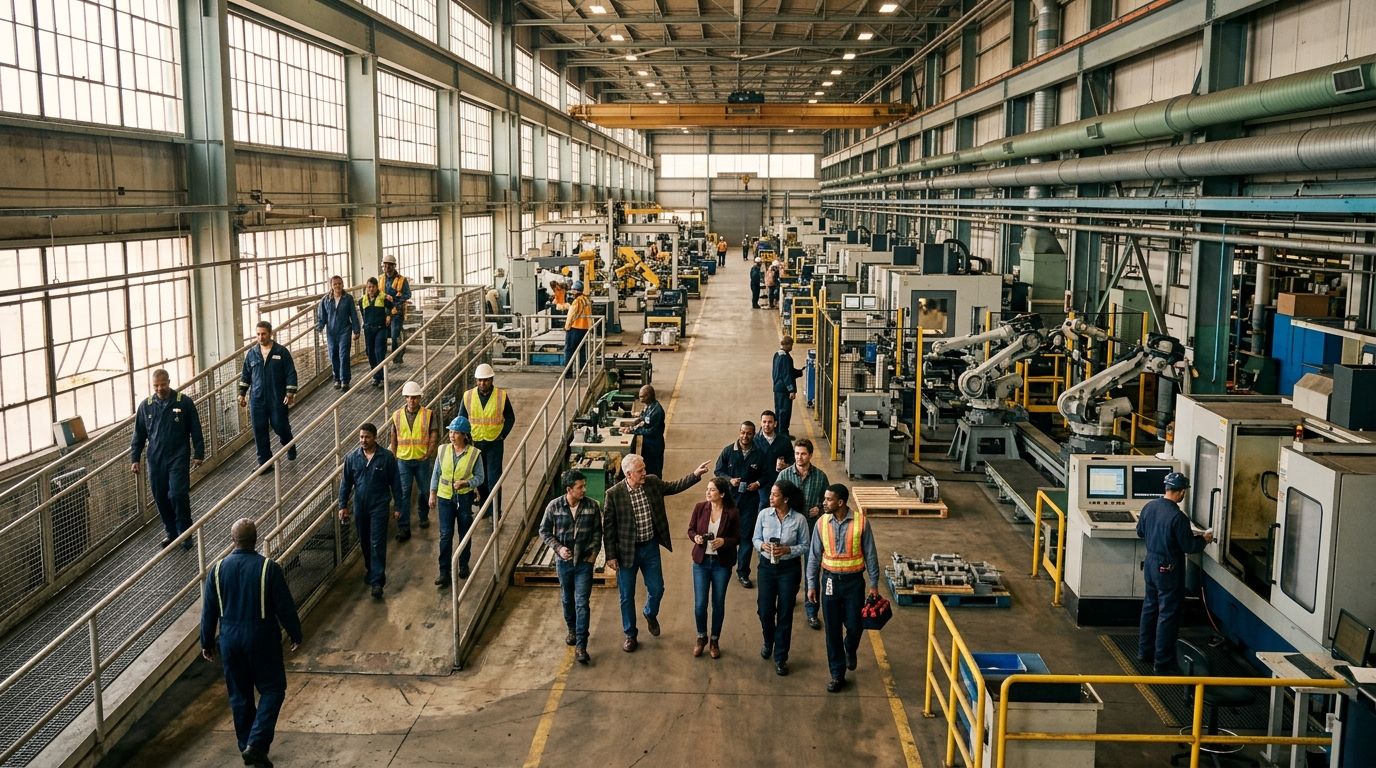
Reshoring manufacturing has become a bipartisan buzzword, and there's genuine substance behind it. Supply chain disruptions during the pandemic proved that depending on factories 8,000 miles away carries real risk. Companies got burned. Governments took notice.
The Reshoring Initiative's 2025 survey of over 500 manufacturers found that several policy levers could accelerate the trend: a weaker U.S. dollar, lower corporate tax rates, regulatory reform, and tariffs on imports. The number of U.S. manufacturing establishments grew by over 11% between Q1 2019 and Q2 2023, reaching nearly 393,000.
As Brookings researchers have documented, federal programs can catalyze reshoring efforts through guaranteed government contracting and strategic supply chain investment. The PPE shortage during the pandemic became a case study in why domestic production capacity matters.
And consumers are playing a role too. People increasingly want to support brands that prioritize ethical practices and local production, which gives companies a market incentive to bring work back stateside.
But here's what reshoring doesn't mean: it doesn't mean millions of assembly line positions opening up at $25 an hour with a pension. The jobs coming back are different animals entirely.
The Skills Gap Is the Real Crisis
The National Association of Manufacturers projects that 3.8 million manufacturing jobs will need to be filled over the next decade. Here's the staggering part: 1.9 million of those could go unfilled because there simply aren't enough qualified workers.
In January 2025 alone, there were 462,000 open manufacturing positions in the U.S. That's not a labor shortage in the traditional sense. It's a skills mismatch. Factories need people who can program CNC machines, analyze production data, maintain robotic systems, and troubleshoot AI-driven processes. They're not finding them fast enough.
Robert Half's research shows that 43% of manufacturers are reskilling existing staff and 40% are investing in upskilling programs. Deloitte found that 75% of manufacturers now prioritize simulation software skills. These aren't your traditional factory competencies.
What does this mean for workers? It means the path into manufacturing increasingly runs through technical training, not just physical stamina. And if you're a displaced worker trying to get back into the industry, the learning curve is steep.
MIT Technology Review put it bluntly: the nation needs to do more to retrain displaced workers for jobs in expanding industries. Programs like Trade Adjustment Assistance offer wage insurance of up to $10,000 a year during transition periods, but coverage remains limited. Workers need broader, more accessible programs.
What Workers Should Actually Do Right Now

Enough about trends. If you're working in manufacturing, trying to break into it, or worried about your plant closing, here's the practical playbook.
Build Digital and Technical Skills
The in-demand skills list for factory jobs now reads like an IT job posting:
AI and machine learning fundamentals
Robotics operation and maintenance
3D printing and additive manufacturing
ERP systems and data analytics
CAD software proficiency
You don't need a four-year degree for most of these. Community colleges, union apprenticeship programs, and industry certifications in Six Sigma or lean manufacturing can get you there. Micro-credentials are gaining traction with employers who care more about demonstrated competence than diplomas.
Know Your Rights on the Job
If you're already working in a plant, understand that manufacturing remains one of the more hazardous employment sectors. Whether you're operating heavy machinery or working near automated systems, knowing your workplace safety fundamentals isn't optional. New technology introduces new risks, and your employer has a legal obligation to train you properly.
Consider the Roles You Haven't Thought Of
Manufacturing isn't just the production line. The sector has growing demand for finance professionals, supply chain analysts, IT specialists, legal staff, and procurement experts. If you have skills in accounting, inventory management, or cost optimization, manufacturers are hiring aggressively for those positions. Robert Half's 2025 Salary Guide identified manufacturing as one of the hottest industries for finance and accounting professionals.
Get Organized
Unionized manufacturing workers earn more, have better benefits, and work in safer conditions. Period. The data on how organized labor reduces workplace injuries is overwhelming. If your plant doesn't have a union, talk to your coworkers. If it does, get involved. Collective bargaining gives you a voice in how new technology gets implemented, how retraining programs work, and whether automation displaces people or augments them.
The Retention Problem Nobody Talks About
Even when companies create good manufacturing jobs, keeping people in them is another story. Twenty-seven percent of manufacturers expect voluntary turnover to increase or remain high. Among salaried workers, 61% of manufacturers reported average voluntary turnover rates between 5.1% and 10% in 2023.
Why are people leaving? Low pay explains some of it, but not all. The bigger issue is working conditions, unpredictable schedules, and the sense that management views floor workers as interchangeable parts. Smart manufacturers are starting to offer nonwage benefits like childcare support, transportation assistance, and housing help. Some are taking advantage of the 45F tax incentive for employer-provided childcare and reporting reduced absenteeism as a result.
Gardner Carrick, Chief Program Officer at The Manufacturing Institute, has argued that the industry must redefine the entire worker experience to compete with other sectors for talent. He's right. You can build all the shiny new semiconductor plants you want, but if the jobs inside them pay poorly, offer no advancement, and grind people down, those 462,000 openings will stay open.
The Honest Assessment
Here's where I level with you. Manufacturing jobs are not "coming back" in the way most people imagine when they hear that phrase. The era of a high school graduate walking into a plant and earning a middle-class living with minimal training is largely over. Automation has permanently changed the labor equation, and pretending otherwise helps no one.
But manufacturing is not dead. It's changing. And the workers who position themselves for the new reality will find genuine opportunity. The 234,000 jobs expected from clean energy and semiconductor investments alone represent real paychecks for real families. Reshoring manufacturing is happening, driven by supply chain logic, government policy, and consumer demand.
The question isn't whether manufacturing jobs can come back. Some will. The real question is whether workers will have the training, the protections, and the bargaining power to make those jobs worth having.
Policymakers need to expand retraining programs and wage insurance beyond their current inadequate scope. Employers need to invest in their people, not just their machines. And workers need to skill up, organize, and refuse to accept a version of "reshoring" that means new factories staffed by robots and a skeleton crew earning $15 an hour.
The opportunity is real. But it won't hand itself to you. Start building those skills, know your rights, and don't wait for a politician to save your career. They won't.
The Union Edge Staff
Also in the paper