
How Immigration Executive Orders Impact Working Families
A meatpacking plant in rural Nebraska lost 30% of its workforce in a single week. Not because of layoffs. Not because of automation. Because a wave of immigration executive orders made it impossible for experienced, legal TPS holders to keep showing up to work. The plant scrambled.

How Immigration Executive Orders Are Tearing Through Working Families
A meatpacking plant in rural Nebraska lost 30% of its workforce in a single week. Not because of layoffs. Not because of automation. Because a wave of immigration executive orders made it impossible for experienced, legal TPS holders to keep showing up to work. The plant scrambled. Remaining workers picked up dangerous double shifts. Production slowed. Prices for consumers went up. And the families of those displaced workers? They're still figuring out what comes next.
This isn't an abstract policy debate. It's a labor crisis hiding in plain sight, and it's hitting the families who can least afford it.
What Actually Happened: The Orders and Their Reach
Starting on January 20, 2025, the Trump administration issued a rapid series of executive actions targeting immigration at nearly every level. As ProPublica documented in their detailed breakdown, these orders revived and expanded policies from the first Trump term, going well beyond border enforcement into the daily lives of people who've been living and working in the U.S. for years.
The scope is staggering. A declared national emergency at the border. Termination of Temporary Protected Status for hundreds of thousands of Venezuelans. Severe restrictions on asylum. Near-total suspension of refugee resettlement. Mandatory registration and fingerprinting for foreign nationals over 14. And a constitutionally dubious attempt to end birthright citizenship that federal courts quickly blocked.
But here's what most coverage misses: these orders don't just affect undocumented immigrants. They reach deep into communities of legally authorized workers, mixed-status families, and the employers who depend on them. The immigration policy labor consequences are enormous, and they're being felt in hospitals, construction sites, farms, and food processing plants across the country.
When Legal Status Vanishes Overnight
Temporary Protected Status has allowed people from countries facing war, natural disasters, or other crises to live and work legally in the United States. These aren't people hiding in the shadows. They have Social Security numbers, pay taxes, and hold jobs in industries that desperately need them.
The February 2025 termination of TPS for Venezuelans affected roughly 500,000 people. Their Employment Authorization Documents expired on April 2, 2025. Think about that timeline. Workers who'd been legally employed for years suddenly had weeks to figure out their lives.
The situation with Haitian TPS holders was arguably worse. DHS reduced the designation period and moved up benefit expiration dates, even though workers were carrying documents showing validity through early 2026. Employers got conflicting guidance. Workers got conflicting guidance. The result was chaos.
The Center for American Progress estimates that over 400,000 U.S.-born children have at least one parent holding TPS. These are American kids whose stable, two-parent households are being dismantled by executive fiat. When a parent loses work authorization, the whole family's income disappears. Rent doesn't get paid. Health insurance vanishes. Kids change schools or stop attending altogether.
This is the kind of family-level stress that compounds over months and years. If you've read about how workplace instability ripples through households, you know the pattern. Except here, the instability isn't coming from a bad employer. It's coming from the federal government.
Fear Becomes the Enforcement Strategy

ICE arrests have more than quadrupled since January 2025. Average daily detention has doubled. DHS reported 622,000 deportations by December 2025, though that number likely includes expedited removals and border turnbacks.
What's different now isn't just volume. It's strategy. The administration has deputized state and local law enforcement to carry out immigration enforcement, a move that the Center for Migration Studies has flagged as a serious risk for racial profiling and constitutional violations.
An Urban Institute survey found that 68% of mixed-status families reported avoiding public spaces, schools, or hospitals due to fear of deportation. More than two-thirds of these families are pulling their kids out of normal life because they're terrified.
This fear isn't irrational. The February 19 executive order targeting immigrants' access to federal assistance programs claims to focus on undocumented immigrants, but the National Immigration Law Center noted it scapegoats immigrants while doing nothing to address actual family needs. The chilling effect extends to citizens and legal residents in mixed-status households who avoid programs they're fully entitled to.
The Labor Market Fallout Nobody Wants to Talk About
Here's where immigration policy and labor economics collide in ways that hurt everyone, not just immigrant workers.
The NILC's analysis of the Day 1 executive orders was blunt: these policies deprive essential industries of needed workers. That's not activist hyperbole. Both the Federal Reserve Bank of Dallas and the Congressional Budget Office have reported negative economic impacts, including acute labor shortages in agriculture, technology, and healthcare.
Consider the numbers in tech alone. Foreign nationals earned 74% of computer science master's degrees in 2023, according to the National Foundation for American Policy. Expanded vetting requirements and a hostile policy environment are pushing these graduates toward Canada, the UK, and Australia. We're not just losing current workers. We're losing the pipeline.
In healthcare, the situation is critical. Immigrant workers make up a disproportionate share of home health aides, nursing assistants, and hospital support staff. When those workers disappear from the labor market, the burden falls on remaining staff and on patients. Anyone following the fight for fair pay among home care workers or the crisis of rural hospital closures already knows these systems were stretched thin before the executive orders hit.
Agriculture tells the same story. Construction tells the same story. Food processing tells the same story. Remove a significant chunk of the workforce through policy, and you don't get American workers rushing to fill the gap. You get production slowdowns, rising costs, and worsening conditions for whoever's left on the job.
What Legal Protections Still Exist for Immigrant Workers
So what legal protections remain? More than many people realize, though the enforcement landscape makes exercising those rights genuinely dangerous.
The National Labor Relations Board still recognizes immigrant worker rights regardless of immigration status. If your employer is retaliating against you for organizing or reporting unsafe conditions, the NLRB can issue a Statement of Interest to support immigration relief at that worksite. This protection exists specifically so that employers can't weaponize immigration status to silence complaints.
The Department of Labor's wage and hour protections also apply to all workers, documented or not. The Deferred Action for Labor Disputes guidance was designed to let immigrant workers assert basic workplace rights without fear of deportation. Whether that guidance survives the current administration's priorities is an open question, but it hasn't been formally rescinded.
Understanding your rights under the NLRB matters more now than it has in decades. Unscrupulous employers are already using the enforcement climate to suppress organizing and tolerate unsafe conditions, knowing their workforce is too afraid to speak up.
The Mandatory Registration Requirement
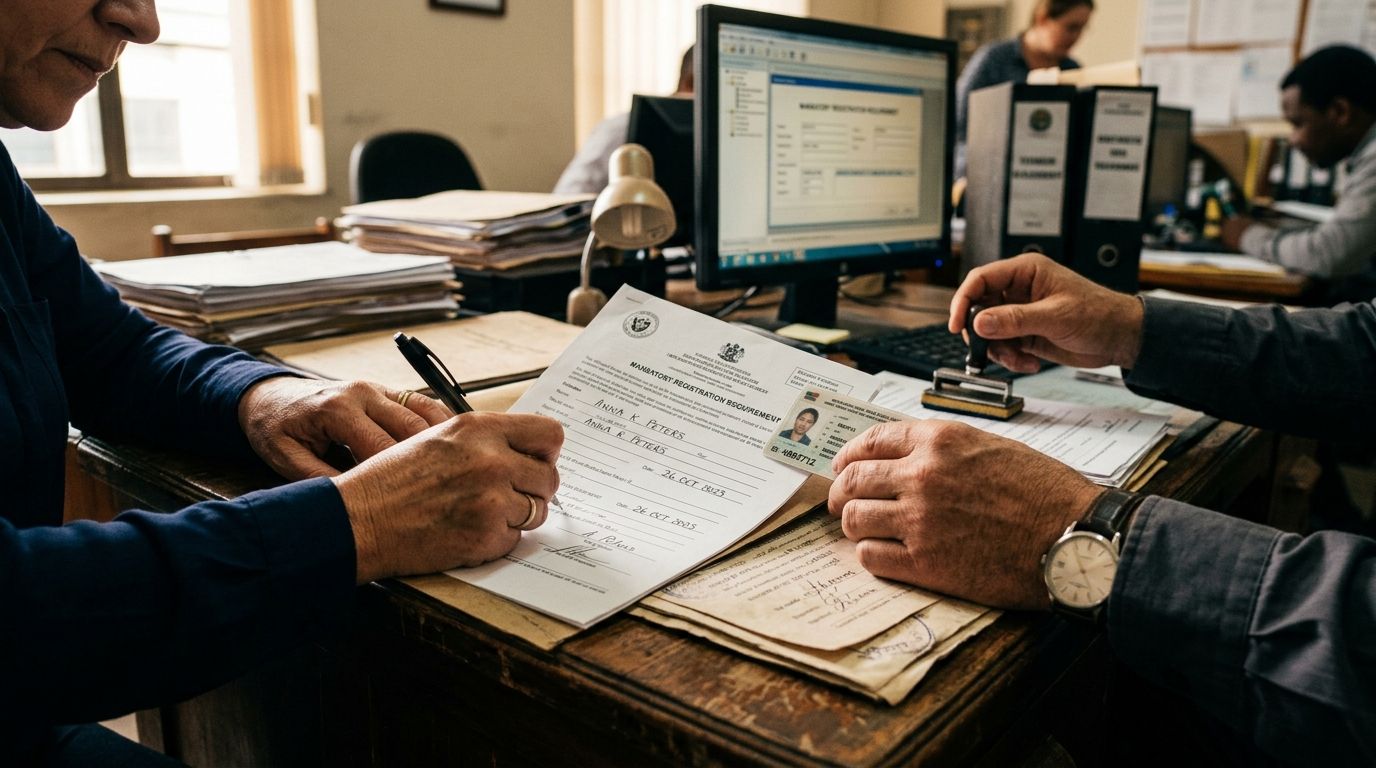
One of the less-discussed orders requires all foreign nationals aged 14 and older who've been in the U.S. for 30 days or more to register with USCIS and undergo biometric collection. Adults must carry proof of registration at all times. Non-compliance can result in civil fines or misdemeanor charges.
This policy has enormous practical implications. Many longtime residents who entered legally but whose status has lapsed may not know about the requirement. Those who do know may be afraid that registering will flag them for enforcement. And the requirement to carry papers at all times creates a two-tiered system that civil rights organizations, including the ACLU, have warned will inevitably lead to racial profiling.
For working families, this means every interaction with authority carries new risk. A traffic stop. A school enrollment. A trip to urgent care. The daily friction of existing in public space becomes weighted with potential consequences that citizens never have to think about.
Concrete Steps for Employers and Families
I'm not going to pretend there are easy fixes here. But there are concrete steps that make a real difference for working families caught in this policy environment.
For employers:
Audit your I-9 records now, not when enforcement shows up at the door
Track EAD expiration dates for all TPS holders and proactively communicate with affected employees
Offer access to immigration legal resources through Employee Assistance Programs
Train managers never to make immigration-related threats or inquiries beyond what I-9 compliance requires
If ICE arrives at your workplace, know your rights and your employees' rights before that moment comes
For families:
Create a family preparedness plan that includes power of attorney, custody designations, and emergency contacts
Consult an immigration attorney now to explore any alternative status options
Connect with local know-your-rights workshops run by legal aid organizations
Keep copies of important documents in a secure location accessible to a trusted person
For everyone else:
Support the organizations doing this work. Local mutual aid networks, immigrant-serving nonprofits, and legal aid groups are overwhelmed. They need money, volunteers, and political backing.
The Bigger Picture for Labor
The connection between immigration executive orders and the broader labor movement isn't complicated. When any group of workers can be threatened with deportation for asserting their rights, it drags down conditions for all workers. Employers who know they can silence immigrant employees with a phone call to ICE have less reason to maintain safe conditions, pay fair wages, or respect organizing efforts.
This is why labor history is inseparable from immigration history. The same industries that built the American middle class did so on the backs of immigrant workers who fought for the protections we now take for granted. Anyone interested in the deep roots of this connection will find it runs through every major labor victory of the past century.
The practical takeaway is this: immigration policy isn't someone else's problem. If you work for a living, these executive orders affect your bargaining power, your workplace safety, and your economic future. The most useful thing you can do right now is learn the specific rights that still exist, help the people around you understand theirs, and push back every time an employer tries to use immigration status as a weapon against workers.
The Union Edge Staff
Also in the paper