
Voter Registration and the Labor Movement: Every Vote Counts
The labor movement and voter registration have been linked since the earliest days of organized labor in the United States.

Why Unions Have Always Been About the Ballot Box
The labor movement and voter registration have been linked since the earliest days of organized labor in the United States. Before the National Voter Registration Act of 1993, unions were among the few institutions that systematically registered working people to vote — particularly in communities where election infrastructure was deliberately kept out of reach.
According to data from the Bureau of Labor Statistics, union members consistently vote at rates 5 to 12 percentage points higher than non-union workers in comparable demographics. That gap is not accidental. It is the product of decades of institutional effort.
How Unions Register Voters
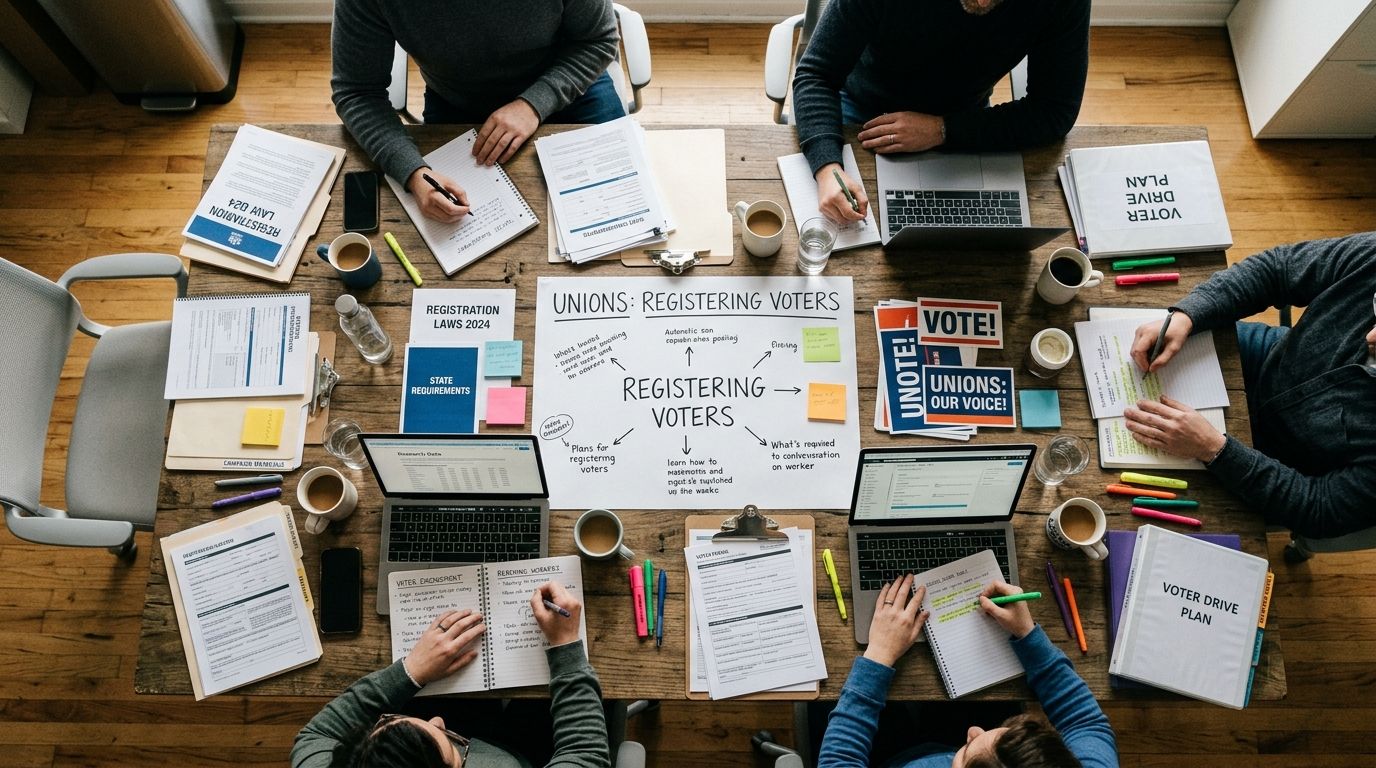
The mechanics of union voter registration are straightforward but effective. Shop stewards and union representatives bring registration forms to workplaces, union halls, and community events. Some unions operate phone banks in the weeks before registration deadlines. Others partner with nonpartisan organizations like the League of Women Voters to co-host registration drives.
The International Brotherhood of Electrical Workers (IBEW), for example, runs registration drives at every local meeting in the months before major elections. The Service Employees International Union (SEIU) has invested in multilingual registration outreach in states with large immigrant worker populations — a strategy that has registered tens of thousands of first-time voters.
The American Federation of Teachers (AFT) runs campus registration drives that reach young workers and student workers simultaneously. These efforts are not limited to presidential election years. Union voter registration campaigns operate during midterm and local election cycles, where turnout gaps between union and non-union workers are often even wider.
The Numbers Behind Union Voter Engagement
Research from the Center for American Progress found that workers in union households are 12 percent more likely to be registered and 10 percent more likely to vote than workers in non-union households, controlling for income, education, and race. The effect is even stronger among workers without college degrees — a demographic where voter participation has declined over the past three decades.
A 2020 study published in the Industrial and Labor Relations Review found that union decline accounts for between one-third and one-half of the drop in voter turnout among working-class Americans since the 1970s. The study estimated that if union density had remained at 1970s levels, approximately 2.5 million more working-class voters would participate in each presidential election.
These are not marginal effects. In close elections, union voter registration and turnout efforts can be decisive. In the 2022 midterm elections, union households accounted for a disproportionate share of the electorate in key swing states like Michigan, Pennsylvania, and Wisconsin.
Beyond Registration: Education and Mobilization

Registration is only the first step. Unions also invest heavily in voter education — informing members about candidates' records on wages, workplace safety, healthcare, and labor rights. This education takes many forms: printed voter guides distributed at worksites, candidate forums hosted at union halls, digital campaigns, and peer-to-peer conversations.
The AFL-CIO's political program, for instance, deploys thousands of worksite volunteers who talk with coworkers about issues on the ballot. These conversations are effective because they happen between people who share a workplace and economic interests, not between strangers or professional canvassers.
This model of political engagement — member-to-member, issue-focused, and grounded in shared economic experience — produces durable changes in civic participation. Workers who register to vote through union programs tend to remain active voters, even after they leave union employment.
Barriers to Worker Voter Participation
Despite these efforts, millions of working Americans face obstacles to voter registration and participation. Restrictive registration deadlines, limited registration hours, and same-day registration restrictions all disproportionately affect hourly and shift workers who cannot easily take time away from work.
Voter purges — the removal of registered voters from rolls, often without adequate notice — also hit working-class communities hard. A Brennan Center for Justice analysis found that jurisdictions with histories of voter discrimination conducted purges at significantly higher rates than other jurisdictions.
Unions have responded by advocating for automatic voter registration, same-day registration, extended early voting, and national mail-in voting standards. These policy positions reflect a pragmatic calculation: reducing barriers to voting increases participation among the demographics most likely to benefit from pro-worker policies.
What Workers Can Do
Every worker, union or not, can take concrete steps to strengthen voter participation in their community. Register to vote and verify your registration status before every election. Help a coworker register. Learn about candidates' positions on wages, safety, and worker protections before you vote.
If you are a union member, ask your local about voter registration drives and volunteer opportunities. If you are not in a union, nonpartisan organizations like Vote.org and the League of Women Voters offer registration tools and voter information.
The right to vote is one of the most powerful tools working people have. The labor movement has understood this for generations. Whether the next election is national or local, every vote from a working person carries the weight of a movement that has always fought for a voice at the table.
The Union Edge Staff
Also in the paper