
Google DeepMind Employees in London Vote to Unionize Over Military AI Contracts
Employees at Google DeepMind's London office have voted to unionize and asked the company to recognize the Communication Workers Union and Unite the Union as joint representatives, citing opposition to the AI lab's contracts with US and Israeli militaries, according to WIRED. The workers delivered t

Google DeepMind Employees in London Vote to Unionize Over Military AI Contracts
Employees at Google DeepMind's London office have voted to unionize and asked the company to recognize the Communication Workers Union and Unite the Union as joint representatives, citing opposition to the AI lab's contracts with US and Israeli militaries, according to WIRED. The workers delivered their request to Google's UK managing director on May 5, 2026, warning they would seek arbitration if the company refuses to engage.
The organizing drive began in February 2025 after Google's parent company Alphabet removed a pledge against using AI for weapons development and surveillance from its ethics guidelines, a DeepMind employee told WIRED. Workers who joined the company under the tagline "to build AI responsibly to benefit humanity" now express concern about what they describe as "further militarization" of the models they develop.
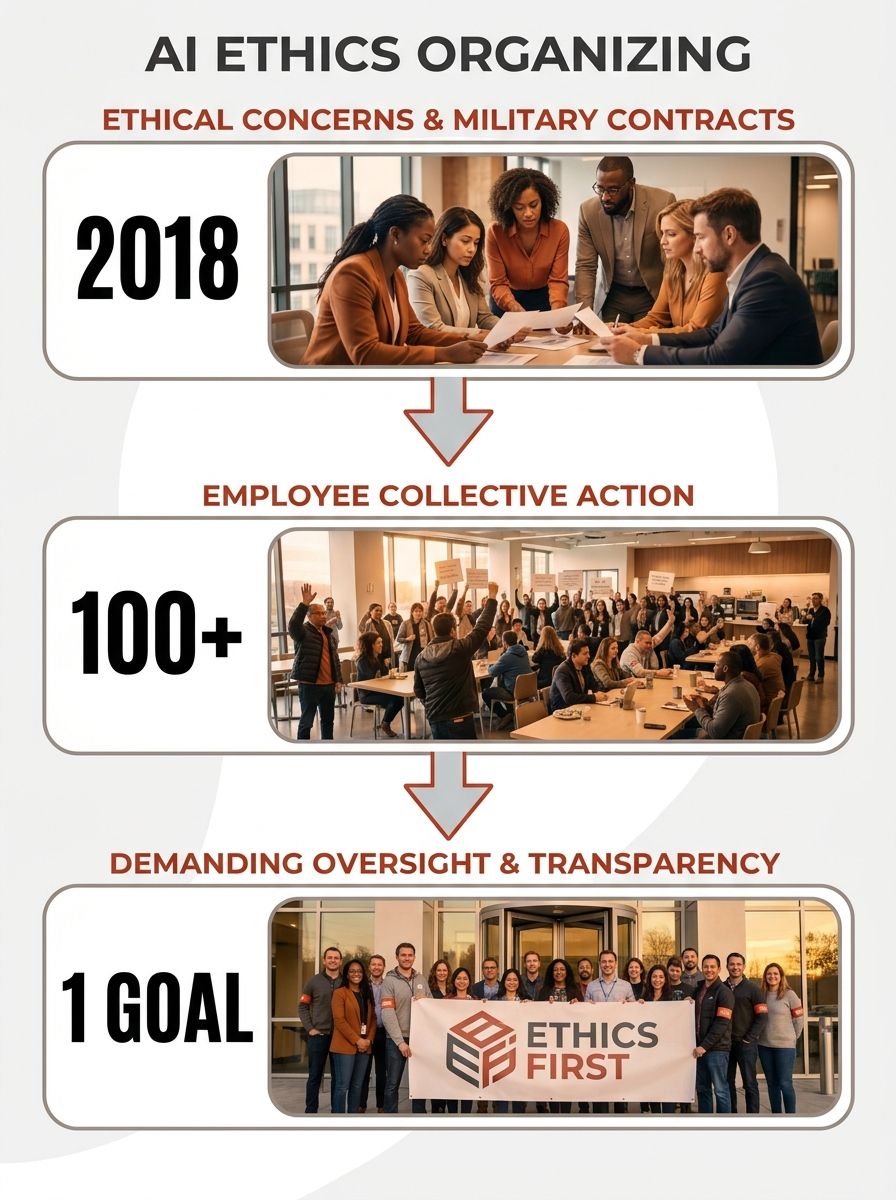
Ethics Guidelines Removal Sparks Organizing Campaign
The decision to strip military-use restrictions from Alphabet's AI ethics standards marked a turning point for employees who had believed the company's public commitments to responsible AI development. "A lot of people here bought into the Google DeepMind tagline," the anonymous employee said, explaining that the policy change revealed a disconnect between corporate messaging and actual business practices.
John Chadfield, national officer for technology at the Communication Workers Union, told WIRED that the unionization effort centers on accountability. "Fundamentally, the push for unionization is about holding Google to its own ethical standards on AI, how they monetize it, what the products do, and who they work with," he said. The organizing campaign mirrors broader patterns documented in tech worker unionization efforts across the industry, where employees increasingly challenge management decisions through collective action.
Pentagon Deals and Industry-Wide Protest
The unionization vote follows recent revelations about Google's expanded government contracts. Last week, The New York Times reported that Google entered a deal allowing the Pentagon to use its AI for "any lawful government purpose." The US Department of Defense confirmed on Friday it had reached agreements with seven major AI companies—including Google, SpaceX, OpenAI, and Microsoft—to deploy their models on classified networks.
Approximately 600 US-based Google employees signed a letter protesting the Pentagon arrangement, arguing the "any lawful purpose" language provides insufficient safeguards. In late February, staff at DeepMind and OpenAI signed an open letter supporting Anthropic after the Defense Department sought to designate that lab a supply chain risk over its refusal to allow AI use in autonomous weapons or mass surveillance.
Google spokeswoman Jenn Crider defended the company's government partnerships in a statement to The New York Times. "We are proud to be part of a broad consortium of leading AI labs and technology and cloud companies providing AI services and infrastructure in support of national security," she said, adding that Google remains "committed to the private and public sector consensus that AI should not be used for domestic mass surveillance or autonomous weaponry without appropriate human oversight."
Google did not respond to a request for comment from WIRED about the unionization vote.
Worker Demands and Next Steps
If Google recognizes the unions, DeepMind employees plan to demand the company withdraw from its contract with the Israeli military, establish greater transparency requirements for AI product usage, and provide assurances against automation-driven layoffs. The letter to management states that workers will petition an arbitration committee to compel union recognition if the company refuses voluntary engagement.
The London organizing effort builds on previous unionization activity within Alphabet. In 2021, Google employees in the United States formed the Alphabet Workers Union, which the company does not recognize for collective bargaining purposes but which has successfully negotiated agreements on behalf of Google contractors. The recognition strategy differs in the UK, where workers are pursuing formal collective bargaining rights through established unions with existing legal standing.
Tech Sector Expansion Fuels Organizing Momentum
The Communication Workers Union sees the DeepMind campaign as a catalyst for organizing at other AI laboratories. Both Anthropic and OpenAI announced large-scale expansions of their London operations earlier this year, creating new concentrations of AI workers in the city.
"These conversations are happening," Chadfield said. "The workers at other frontier labs have seen what Google DeepMind workers have done. They've come to us asking for help as well." The union is positioning itself to support organizing efforts across multiple AI companies as workers at competitor labs observe the DeepMind campaign.
Context and Outlook
The Google DeepMind unionization vote demonstrates how ethical concerns can drive concrete organizing action in high-skill technical workplaces, particularly when corporate decisions contradict stated values. Workers who joined AI labs expecting to advance humanitarian applications increasingly confront business models that prioritize military and surveillance contracts, creating organizing opportunities unions can leverage.
The campaign's success will depend on whether Google agrees to voluntary recognition or whether workers must pursue the arbitration route outlined in their letter. Either path establishes precedent for how tech workers can challenge management decisions through collective bargaining structures rather than individual resignations or public letters. For organizers working with technical employees, the DeepMind case shows that tech worker unionization can advance when campaigns frame collective action as the mechanism to enforce ethical standards management claims to support.
The expansion of AI operations in London creates geographic concentration that facilitates cross-company organizing. If DeepMind workers secure recognition, unions gain a foothold to organize the thousands of AI researchers and engineers OpenAI and Anthropic are hiring in the same labor market, potentially establishing pattern bargaining dynamics across the frontier AI sector.
The Union Edge Staff
Also in the paper