
From Hashtags to Membership: Building a Digital-First Union Organizing Strategy in 2026
Going viral on social media has wrecked more organizing campaigns than any union-busting law firm. The standard advice for unions entering the digital space tells organizers to build a following, grow a hashtag, and let the algorithm do the work.

From Hashtags to Membership: Building a Digital-First Union Organizing Strategy in 2026
Going viral on social media has wrecked more organizing campaigns than any union-busting law firm. The standard advice for unions entering the digital space tells organizers to build a following, grow a hashtag, and let the algorithm do the work. That sequence produces exactly the wrong foundation for turning online attention into signed membership cards, won elections, and enforceable contracts.
We've watched this pattern repeat across industries over the past four years. A workplace grievance catches fire on TikTok or Instagram. Thousands of people share it. Media outlets run a story. And then the employer waits out the news cycle. The workers who posted the original video never connected with an actual organizing infrastructure. The moment passes. The conditions that sparked the outrage stay the same, and the boss now has a screenshot folder of who spoke up.
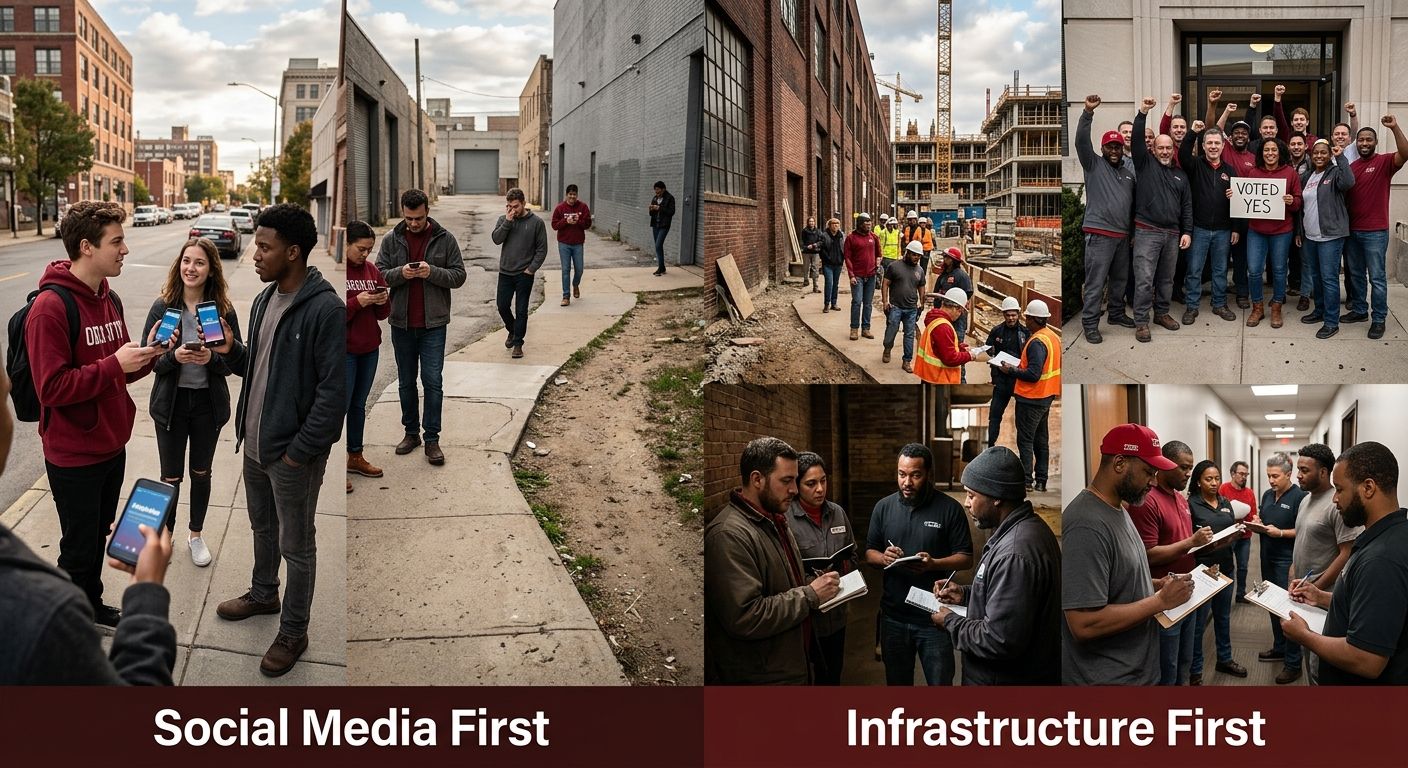
The problem here isn't that unions should stay off digital platforms. The problem is that the dominant playbook has the sequence backwards. Effective digital union organizing starts with secure communication infrastructure and relationship-building tools, then deploys social media as one channel among many. Starting with the hashtag is like printing bumper stickers before you've built the car.
Three distinct bodies of evidence explain why, and they point toward a very different digital-first strategy than the one most unions are running.
Algorithms Sell Advertising, and Organizers Keep Forgetting That
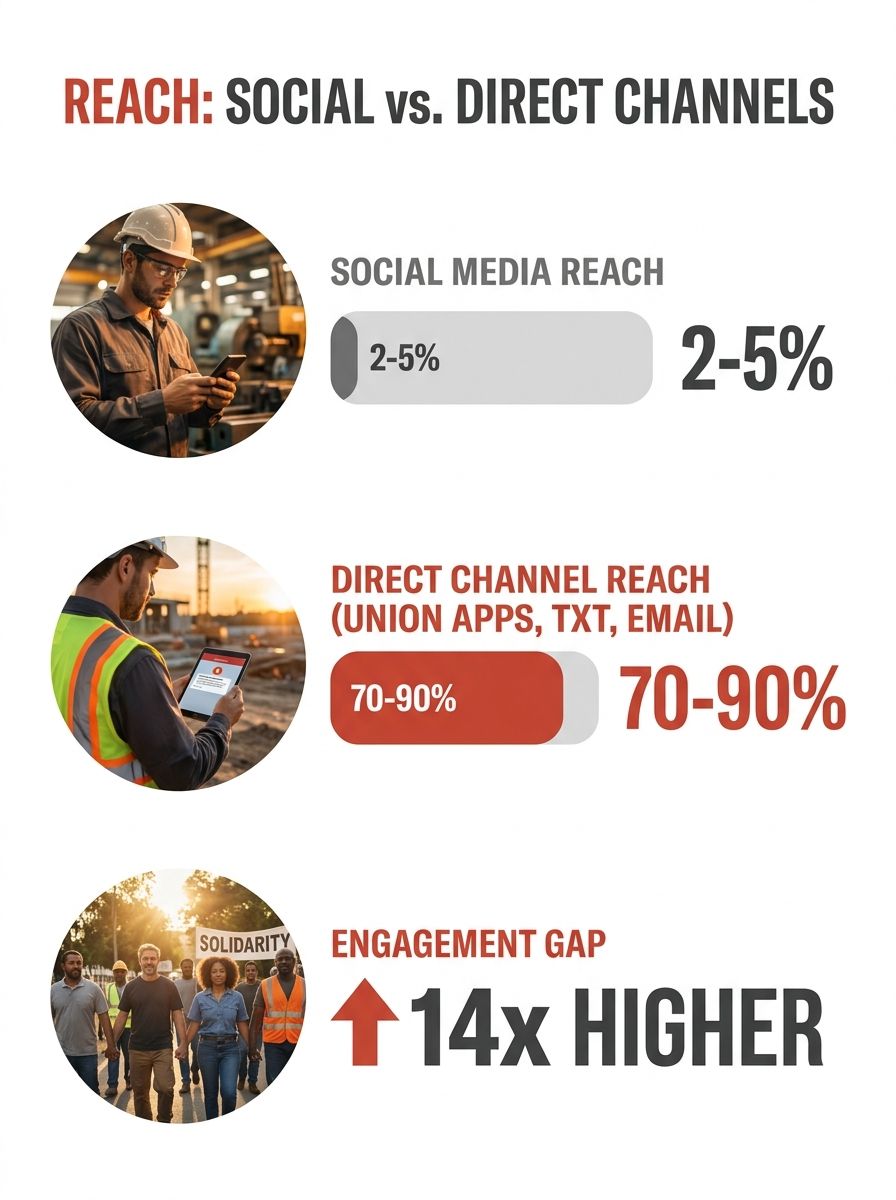
The most important number in any conversation about social media labor campaigns is this one: platforms show organic posts to roughly 20% of a creator's followers. That figure has been declining for years as Instagram, TikTok, and Facebook push paid promotion harder. For a union local with 3,000 followers, a carefully crafted post about a contract fight might reach 600 people if the algorithm is feeling generous.
Compare that to a direct text message sent through a secure union app, which lands in someone's pocket with a push notification. The delivery rate is closer to 98%. The engagement gap between these two channels is enormous, and yet most union digital strategies still pour the majority of their volunteer hours into content creation for platforms they don't control.
There's a deeper structural problem with platform dependency. As MIT Technology Review has documented, organizing in the tech sector resembles organizing in "industry" in the 1930s, when the Congress of Industrial Organizations shifted the labor movement's focus from skilled trades to bringing entire industries into the fold. The parallel holds for digital strategy: unions are trying to organize on platforms owned by the same corporate interests that benefit from keeping labor weak. Relying on Instagram's algorithm to spread your message about Amazon working conditions is a strategic contradiction that most organizers acknowledge privately but rarely address in their campaign plans.
And the content itself carries risk. The Washington Post reported that even the U.S. Department of Labor's own social media campaign drew sharp criticism for depicting a workforce that was overwhelmingly white and male, sending messages that felt exclusionary to the very workers the department is supposed to serve. If a federal agency with professional communications staff can get representation wrong on social media, volunteer-run union accounts face even steeper odds. A poorly conceived Instagram campaign can alienate potential members faster than it recruits them. The workers who see themselves reflected in the content engage. Everyone else scrolls past, or worse, forms a negative impression of the union before anyone has a one-on-one conversation with them.
Hashtags like #RedForEd and #FightFor15 built real visibility in their time. But the 2026 reality is that platforms now favor fewer, niche-specific hashtags for categorization rather than discovery. The era when a trending hashtag could functionally introduce thousands of unconnected workers to a campaign is largely over. Hashtags reinforce identity for people already inside a movement. They don't recruit the skeptical coworker in the next department who isn't on labor Twitter.
The Missing Middle: Where Followers Become Members
Between a viral post and a dues-paying union member sits an infrastructure gap that most locals haven't addressed. Someone sees your content, maybe shares it, maybe comments "solidarity forever." Now what? If the answer is "they can DM us" or "there's a link in our bio to a Google Form," you've already lost the thread.
This is where membership management systems become the actual backbone of a digital-first strategy. Purpose-built platforms like eMembership centralize membership data, dues tracking, contracts, grievances, and organizing workflows in a single system. UnionWare offers similar centralization for member data, dispatch, collective bargaining records, and compliance. UnionTrack's ENGAGE platform adds real-time grievance tracking with status updates that members can follow, plus document management with tagging. These aren't glamorous tools. They don't go viral. But they're the difference between a campaign that converts interest into power and one that generates engagement metrics while the boss hires a consulting firm.
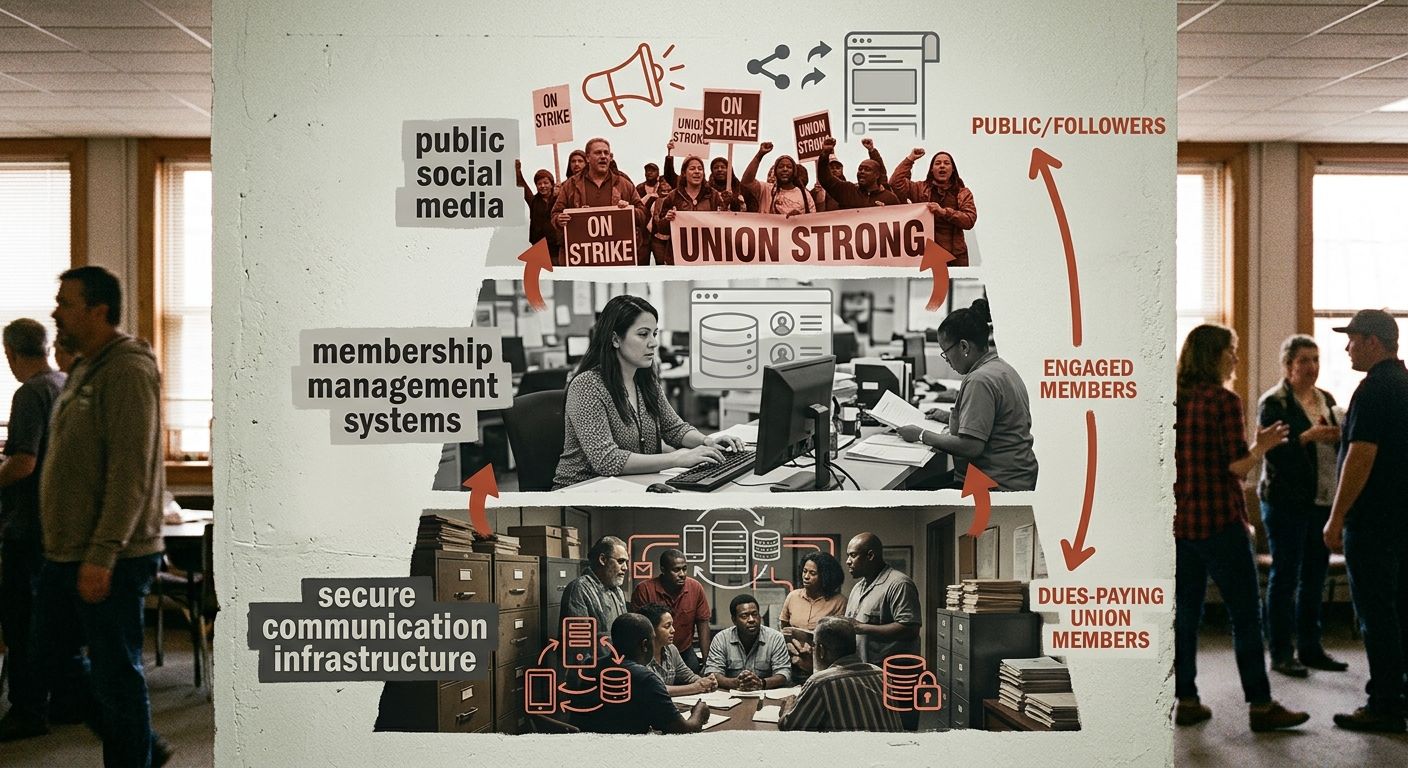
The concept of a union tech stack deserves the same seriousness that organizing committees give to their internal structure. Think of it in layers. The bottom layer is your secure communication platform, whether that's a branded union app, Signal channels organized by worksite, or encrypted email lists. The middle layer is your membership management system, where you track who's signed cards, who's attended meetings, who's paying dues, and who's gone quiet. The top layer, and only the top layer, is your public-facing social media presence.
Most unions have built only the top layer and wonder why their digital strategy feels like shouting into a void.
We've written before about how building digital infrastructure for union compliance requires organizers to mobilize supporters through technology in deliberate, structured ways rather than hoping for algorithmic luck. As UnionTrack's analysis points out, union leaders have to reach workers when, where, and how they communicate, or risk not reaching them at all. That means meeting workers in the apps they already use daily, with systems on the back end that turn casual contacts into organized relationships.
The conversion funnel for digital organizing looks something like this: a worker encounters your content (social media, a coworker's share, a QR code on a breakroom flyer). They land on a secure intake form. An organizer follows up within 48 hours with a personal message. The worker is added to a communication channel for their specific worksite. They're invited to a virtual or in-person meeting. They sign a card. Each step requires infrastructure, and each step is where campaigns without proper systems lose people.
Remote and distributed workers make this infrastructure even more critical. Organizing someone who works from home in a different state than their coworkers means you can't rely on breakroom conversations or parking lot leaflets. You need video calls, messaging apps, and organizing software that create the digital equivalent of the shop floor. The game developers and tech workers leading the AI-era organizing wave figured this out early, in part because they were already comfortable with digital collaboration tools. Adapting that approach for healthcare workers, warehouse employees, or service industry staff requires more deliberate onboarding, but the principle is identical.
Winning Campaigns Built Infrastructure Before They Built an Audience
The campaigns that have successfully converted digital attention into real union power share a common trait: they treated social media as a megaphone for an already-functioning organizing operation, not as the operation itself.
The Tech Workers Coalition, a network of tech industry workers, labor organizers, and community allies, operates on exactly this model. Their public-facing web presence is minimal compared to the internal infrastructure of encrypted channels, regular meetings (both virtual and in-person), and structured political education. The coalition's strength comes from the relationships cultivated in those private spaces, not from any particular tweet going viral.
This is what effective organizing committee development looks like in 2026. You identify workplace leaders through one-on-one conversations, whether those conversations happen over a video call or across a lunch table. You bring them into a secure communication channel. You train them on the fundamentals of organizing. And only then do you coordinate public-facing actions, including social media campaigns, that have the structural backing to translate attention into outcomes.
The hybrid model works because it respects what each channel does well. Social media is excellent at building shared identity, creating a sense of momentum, and reaching workers who might not know a union drive is underway. It's terrible at the relational work of addressing individual fears, answering specific questions about dues and representation, and building the trust needed for someone to put their name on an authorization card. Those tasks require person-to-person contact, even when that contact happens through a screen.
Consider the practical workflow: an organizer posts a short video about a workplace issue on Instagram. It gets shared 200 times. Of those 200 shares, maybe 15 people are actual coworkers at the target employer. The organizer's job isn't to celebrate the 200 shares. It's to identify those 15 people, reach out to them individually through secure channels, and have real conversations. The membership management system logs those contacts, tracks follow-ups, and flags when someone hasn't been contacted in two weeks. This is the unsexy, repetitive work that wins elections, and it requires a digital infrastructure that Instagram's direct messages were never designed to provide.
When unions win their elections and move into bargaining, the same infrastructure pays dividends. We've covered how post-recognition organizing determines whether workplace change actually happens, and a functioning digital system keeps members engaged through what can be a long, grinding negotiation process. Push notifications about bargaining updates, secure polls on contract proposals, and real-time grievance tracking keep the membership active and informed during the months between the election party and the first signed contract.
The data supports investing in direct communication over algorithm-dependent channels. Unions using dedicated apps and structured digital compliance systems report higher meeting attendance, faster grievance resolution, and stronger turnout for contract ratification votes. Social media metrics, by contrast, correlate weakly with any of those outcomes. A local can have 10,000 Instagram followers and struggle to get 40 people to a bargaining update meeting if there's no system connecting the public audience to the internal organizing structure.
The Viral Myth, Revisited
The contrarian claim at the top of this piece deserves one important qualification: social media virality isn't inherently destructive to organizing campaigns. It's destructive when organizers treat it as the strategy rather than one tactic within a strategy. The distinction matters because the temptation to chase viral moments will only intensify as platforms evolve and new ones emerge.
The unions winning in 2026 are the ones that invested in boring infrastructure years ago. They built or adopted membership management systems. They trained organizers to use encrypted communication tools. They created intake workflows that move a curious worker from a public post to a private conversation to a signed card with minimal friction and maximum security. When a social media moment does happen for these unions, they have the pipes to capture and direct the resulting energy. When it doesn't happen, their campaigns keep moving anyway, because the underlying organizing work never depended on algorithmic luck.
The sequence matters more than the tools. Build your secure communication layer first. Set up your membership tracking system. Train your committee on digital one-on-ones. Map your worksites in your organizing software. And then, with all of that infrastructure humming beneath the surface, go ahead and post the Instagram Reel. The hashtag can do real work when there's an actual machine behind it. Without that machine, it's just noise that makes organizers feel productive while the employer runs the clock.
The Union Edge Staff
Also in the paper