
The Grassroots Organizer's Toolkit: Converting Workplace Complaints Into Sustained Union Campaigns
Eighty-nine percent of employers require workers to attend anti-union meetings during organizing campaigns, according to the Economic Policy Institute. That figure tells you everything about the opposition your complaints will face the moment they become visible.

The Grassroots Organizer's Toolkit: Converting Workplace Complaints Into Sustained Union Campaigns
Eighty-nine percent of employers require workers to attend anti-union meetings during organizing campaigns, according to the Economic Policy Institute. That figure tells you everything about the opposition your complaints will face the moment they become visible. The complaints themselves are everywhere in every workplace: unfair scheduling, stagnant pay, supervisors who play favorites with overtime. What's rare is a group of workers who know how to turn those scattered frustrations into a campaign that survives the backlash. These six rules are distilled from decades of worker-led organizing across warehouses, hospitals, retail floors, and tech offices. They won't guarantee a win. They'll keep you from losing before the real fight starts.
Listen for patterns, not individual complaints
A single complaint about a cold break room is a facilities request. Twelve complaints about management ignoring temperature concerns, broken equipment, and ventilation problems represent a pattern of neglect that affects everyone on the floor. The organizer's job at this stage is to collect, not to fix.
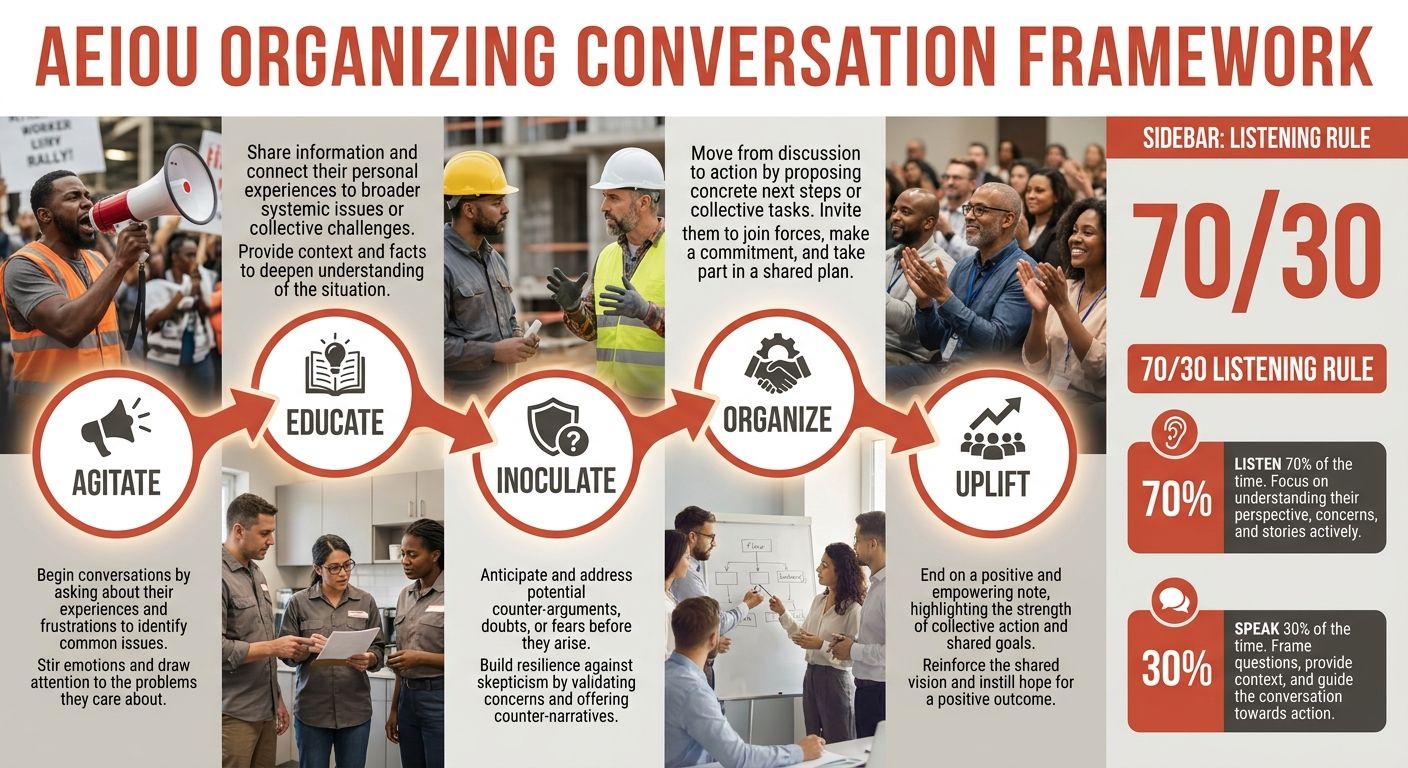
The AEIOU framework (Agitate, Educate, Inoculate, Organize, Uplift) starts with agitation for a reason. You need workers to articulate what's wrong and feel the weight of it before you propose any path forward. The 70/30 rule applies here: the worker talks 70% of the time, you talk 30%. If you're doing most of the talking, you're selling, not organizing.
Run these conversations one-on-one. Group settings let people hide behind the loudest voice in the room. In a one-on-one, you learn what a coworker actually cares about. Wages might seem like the obvious issue, but chronic understaffing or unpredictable scheduling could be what's actually keeping someone up at night. We've written before about why organizers who assume workers' needs lose campaigns, and the lesson applies here: your assumptions about what matters will be wrong at least half the time.
Use member surveys as conversation starters, not substitutes for face-to-face meetings. A survey can reveal that 60% of your coworkers think scheduling is the biggest problem. But you won't know why until you sit across from them and ask.
Build your committee to mirror your workplace
Organizing committee formation fails when the committee looks like a clique. If your committee is five friends from the same shift, you've built a social group, not a representative body. The committee needs members from every shift, every department, and every job classification. It should reflect the racial, gender, and age demographics of the workforce.
This matters for practical reasons beyond fairness. A committee that mirrors the workplace can reach corners of the shop floor that outsiders can't touch. The third-shift worker who never sees first-shift management has different concerns and different trust networks. You need someone from that shift on your committee who already has credibility there.
Research from Solidarity Tech found that unions with diverse bargaining teams see 23% higher contract satisfaction rates and 31% better grievance resolution outcomes. Those numbers reflect something organizers already know intuitively: people trust campaigns that include people who look like them and work like them.
We've covered the nuts and bolts of recruiting your first organizing committee leaders in detail elsewhere. The key principle worth repeating is that committee building is the campaign. If you skip this step or rush it, you'll pay for it when management starts pulling workers into one-on-one meetings to discourage participation.
Document everything as if it's already headed to arbitration
The United Electrical Workers' steward guide makes this point plainly: the first steps of the grievance procedure are the most important because that's where the investigative work happens and where the union frames its case. Arbitration cases have been lost because a union missed the filing deadline for a grievance. Bosses have lied about verbally agreeing to extend time limits. If it's not written down, it didn't happen.
Every complaint a worker brings to you should be recorded with a date, the names of people involved, and the specific impact on the worker. This isn't bureaucracy for its own sake. It's the raw material for grievances, unfair labor practice charges, and eventually contract negotiations. When you later sit down to negotiate a collective bargaining agreement, documented patterns of employer behavior will shape your demands and give your bargaining team evidence that holds up under pressure.
Many problems in unionized workplaces get settled informally, and because they're never put in writing, stewards don't even count them as grievances. That's a costly oversight. Informal wins are still wins, and documenting them builds your case file for the next time management tries the same thing. The grievance procedure, as Bloomberg Law outlines it, moves from informal discussion through written complaint, management review, mediation, and arbitration. Your documentation practice should assume that every complaint might travel the full distance through those steps.

Inoculate workers before management gets the chance
The Economic Policy Institute has documented how companies like Starbucks, Amazon, and Google respond to grassroots organizing tactics. NLRB decisions have ordered reinstatement for at least 73 Starbucks employees who were fired during organizing campaigns. The NLRB filed a complaint against Google alleging the company had been coercing employees' protected concerted activity. These are documented patterns of employer behavior, and your workers deserve to know about them in advance.
Inoculation means telling workers what management will do before management does it. When a supervisor later walks into the break room and announces that the company is "like a family" and unions are "outside third parties," the worker who's been inoculated recognizes the script. The worker who hasn't been inoculated might believe it.
Common employer tactics to prepare workers for:
Captive audience meetings: Mandatory sessions where management presents anti-union arguments. Workers cannot be disciplined for wearing union buttons or asking pointed questions during these sessions, though management will try to control the conversation.
Sudden improvements: Management fixes long-standing problems the week after organizing goes public. This looks generous. It's a calculated attempt to undermine the campaign's core argument that workers need collective power to win change.
One-on-one supervisor meetings: Managers pull individual workers aside to ask about their "concerns." These conversations are designed to isolate workers from the group and make organizing feel personally risky.
Delays and legal challenges: Employers file objections to election petitions, challenge bargaining unit definitions, and drag proceedings out for months hoping momentum dies.
Your inoculation conversations should be specific. Don't say "management will try to scare you." Say "your supervisor will probably pull you into a meeting within two weeks of us going public and ask if you really want to pay union dues." Specificity makes the prediction credible, and when it comes true, the organizer's credibility goes up while management's goes down.
Escalate on a calendar, not on anger
Workplace grievance escalation driven by emotion tends to peak too early and burn out. A worker gets written up unfairly, the committee fires off an angry group email to management, and suddenly the campaign is playing defense instead of building power. The Teamsters for a Democratic Union make the point directly: take action early and target the people who can settle the issue. But also don't skip stages.
The standard grievance procedure moves through defined steps: informal discussion, written grievance, higher-level management review, mediation, and arbitration. Each step exists because it increases pressure while preserving options. Jumping from "informal chat" to "public protest" skips the stages where you build your record and test management's willingness to negotiate.
Build a timeline for your campaign and stick to it. During the first four to six weeks, you should be having one-on-one conversations and mapping the workplace. By week six, you should know your top issues and have a committee in place across shifts and departments. By week eight or ten, you're ready for small group actions that test solidarity without exposing vulnerable workers to retaliation.
The connection between workplace stress and organizing motivation, which we've explored in how psychosocial hazards become organizing opportunities, is real and powerful. Workers who feel chronically ground down by understaffing, bullying, or unsafe conditions have strong reasons to organize. But that motivation needs to be channeled into a sequence of escalating actions rather than spent all at once on a single dramatic gesture that management can absorb and move past.
Set visibility thresholds and hold the line
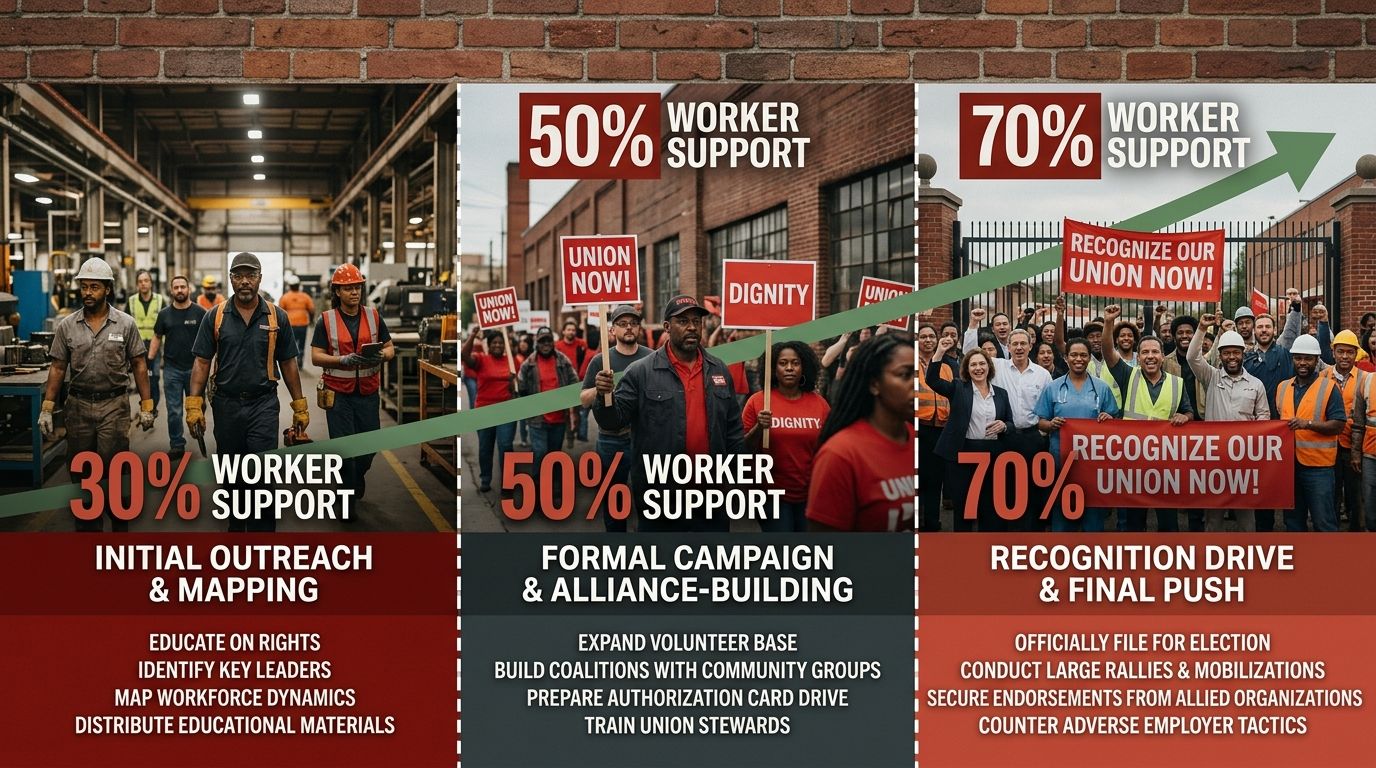
Going public too early is one of the most common ways campaigns collapse. Experienced organizers use rough thresholds to decide when to increase the campaign's visibility:
At 30% worker support: Safe, low-profile actions. Workers sign internal petitions, wear discreet solidarity symbols, and share information through trusted networks. Social media posts should come from personal accounts and avoid naming the campaign directly.
At 50% support: Group actions that management can see. Sticker days, coordinated break-time conversations, delegation visits to HR. At this level, you have enough people that management can't single out individuals without creating more grievances.
At 70% support: File for recognition or an NLRB election. Launch public communications. Hold rallies. At this stage, you have enough support to survive the inevitable employer counter-campaign.
These numbers reflect hard-won experience from campaigns across industries. Filing for an election at 51% support means you have almost no margin for error when management starts its counter-offensive. Filing at 70% gives you a twenty-point buffer that accounts for the workers who get cold feet, the ones who transfer departments, and the ones management convinces in captive audience meetings.
The threshold discipline also applies to individual workers. Some coworkers will want to go public immediately because they're angry and ready to fight. Others will stay quiet until they see enough of their colleagues standing up first. Your job as a committee is to protect the first group from overexposure while building enough visible momentum to bring the second group along. That balancing act is the core skill of grassroots organizing tactics in practice, and it's where campaigns are won or lost long before any ballot gets counted.
When these rules collide
Real campaigns are messier than any toolkit suggests. A worker gets fired for speaking up before you've reached 30% support, and suddenly you're filing an unfair labor practice charge while still building your committee. Management announces layoffs in the middle of your inoculation phase, and the workforce's attention shifts entirely to job security. Someone on your committee posts a furious social media thread that goes viral before you've even mapped every department.
The rule that holds when all others bend is documentation. Whatever happens, write it down. Date it. Name names. The employers who succeed at crushing campaigns do so by creating confusion and fear. Your written record cuts through both.
And remember that winning the election is only the midpoint of the work. As we've explored in writing about why post-recognition strategy determines real workplace change, the same skills that convert complaints into campaigns are the ones that convert election victories into strong first contracts. The organizing committee doesn't dissolve after the vote count. It becomes the backbone of your bargaining committee, your steward network, and your union's long-term power.
Ray Quinney & Nebeker, a management-side law firm, advises employers not to wait for a union campaign to address employee grievances, because by the time workers are organizing, the grievances have already hardened into demands. That admission from the other side of the table tells you something important. Employers know that unresolved complaints are the fuel for organizing. Your job as organizers is to make sure that fuel doesn't sit around until it evaporates. Collect the complaints, connect them to patterns, build a committee that reflects the whole workforce, document relentlessly, inoculate early, escalate deliberately, and go public only when you have the numbers to hold the line. The complaints are already there. The campaign is waiting to be built around them.
The Union Edge Staff
Also in the paper