
When Safety Systems Fail Workers: How Communication Breakdowns Create Hazards Unions Must Address
Sixteen days from now, on May 19, 2026, every chemical manufacturer, importer, and distributor in the United States must comply with OSHA's revised Hazard Communication Standard under 29 CFR 1910.1200.

When Safety Systems Fail Workers: How Communication Breakdowns Create Hazards Unions Must Address
Sixteen days from now, on May 19, 2026, every chemical manufacturer, importer, and distributor in the United States must comply with OSHA's revised Hazard Communication Standard under 29 CFR 1910.1200. Employers will need to update alternative workplace labels, revise their hazard communication programs, and retrain workers on new safety data sheets. The deadline caps a regulatory update years in the making. And for millions of workers exposed to hazardous substances on every shift, the real question isn't whether the paperwork gets filed on time. The real question is whether the information will actually reach the people standing next to the chemicals.
That gap between the existence of safety information and its meaningful delivery to workers is where injuries happen, illnesses accumulate, and lives get shortened. Tracing how we got here reveals a pattern: regulators write standards, employers check compliance boxes, and communication systems fail at the last mile. Unions have been fighting to close that gap for decades. The fight is getting more urgent.
The Standard's Original Promise
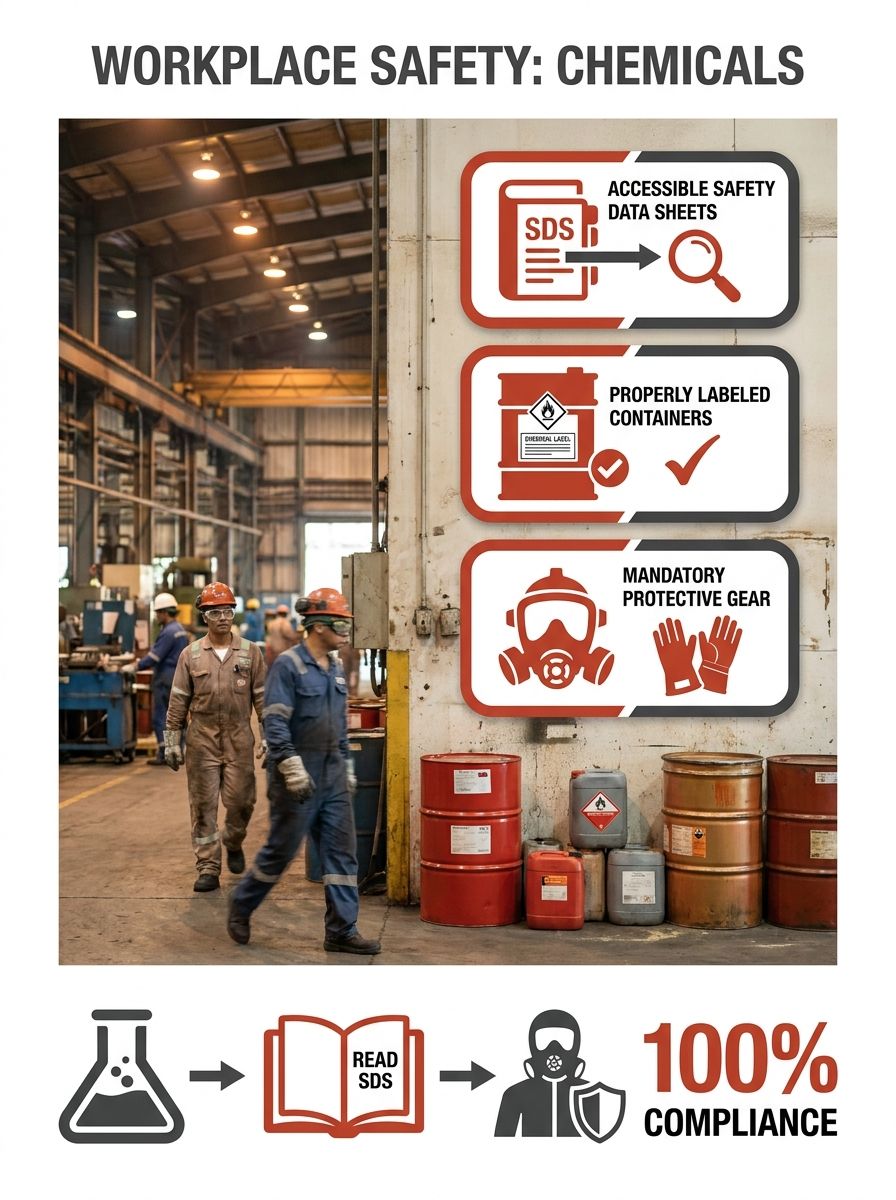
OSHA's Hazard Communication Standard was created to solve a specific problem. Chemical hazards in workplaces were killing and sickening workers who had no way of knowing what they were being exposed to. The standard required that information about the identities and hazards of chemicals be available and understandable to workers. Manufacturers had to classify chemicals, create safety data sheets, and label containers. Employers had to maintain those sheets on-site, train workers, and develop a written hazard communication program.
The logic was straightforward: if workers know what they're handling, they can protect themselves. Informed workers make safer decisions. Knowledge prevents injury.
On paper, this was a major advance. The HCS became one of OSHA's most widely applicable standards, covering an estimated 43 million workers across hundreds of thousands of workplaces. And for organized workplaces with active union safety committees, the standard gave workers a legal foothold to demand specific chemical information from employers. But the standard's effectiveness always depended on one fragile assumption: that employers would actually communicate the information in ways workers could absorb, remember, and act on.
Where the Communication Broke Down
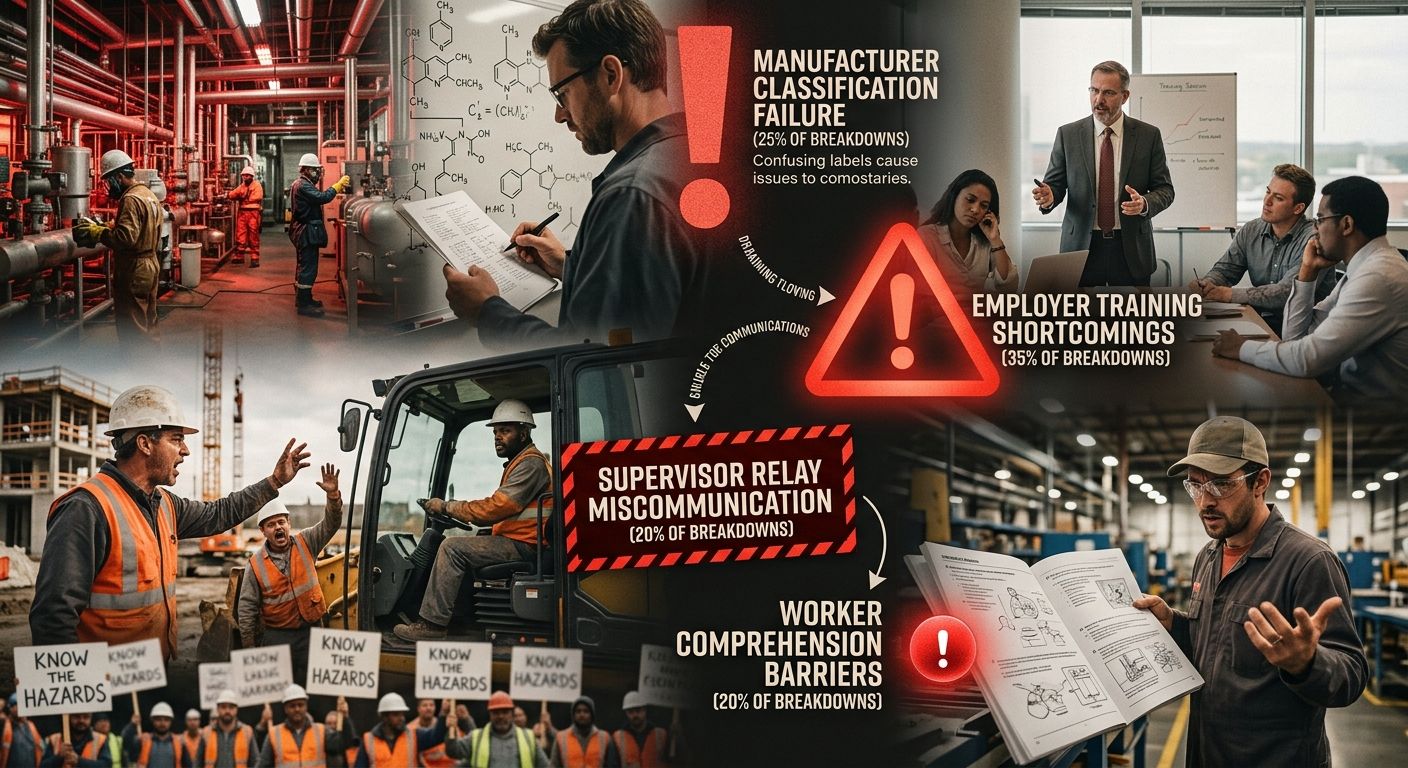
The failure mode was predictable. In non-union workplaces especially, safety culture around chemical hazards collapsed into a paperwork exercise. Safety data sheets sat in binders that nobody opened. Labels used technical jargon that excluded workers without chemistry backgrounds. Training sessions, when they happened at all, were one-time events during onboarding, never repeated or updated. Non-English-speaking workers received the same English-only materials as everyone else.
Research from the Emergency Workplace Organizing Committee documented what this looked like in practice. In non-union workplaces with overworked owner-managers, teaching and enforcing safety became the responsibility of the individual worker. Workers were told to "watch out for themselves." Training was ad-hoc and irregular. Reporting safety concerns became a matter of personal politics, not workplace protocol. These gaps in support created more opportunities for injuries and illnesses to occur.
The UE (United Electrical Workers) has documented cases that illustrate the problem at the individual level. A union steward named Tamara noticed an alarming number of workers wearing wrist braces at her hospital. When she approached the Human Resources Director about the pattern, his reply was that nothing in the contract gave her the right to investigate. Without strong contractual language and an active union health and safety program, a steward noticing a systemic injury pattern gets shut down before the investigation even starts.
The pattern repeated across industries. The information existed somewhere in the system. The safety data sheets were technically available. The labels were technically on the containers. But the communication systems connecting that information to the workers who needed it were broken, inconsistent, or deliberately neglected.
The Research That Named the Problem
Academic researchers began quantifying what union organizers had observed for years: communication is the mechanism through which safety culture either works or fails.
A study published in the journal Safety Science and indexed in PubMed Central examined the mediating role of safety communication between safety culture and employee safety performance in the petrochemical industry. The findings were direct. Safety communication methods enhanced working conditions and had a positive impact on employees' behaviors and attitudes toward safety. When communication broke down, safety performance declined regardless of what policies were written on paper.
A systematic literature review published in Frontiers in Public Health identified the specific forms of safety communication that mattered: safety meetings, alerts, training sessions, reports, audits, and feedback mechanisms. The review found that effective safety communication enabled workers to identify and report hazards and take corrective action. The key word is "effective." Posting a notice on a bulletin board doesn't count. Sending a mass email doesn't count. Communication that workers can't understand, don't trust, or never see functionally doesn't exist.
This research confirmed something unions have argued in every contract negotiation involving safety language: top-down information distribution, without bottom-up feedback channels and genuine worker participation, produces compliance theater. The binder sits on the shelf. The training video plays to an empty room. The safety data sheet gets filed and forgotten. And the worker mixing chemicals at 2 a.m. doesn't know what happens when substance A meets substance B.
The 2024 Revision and the May 2026 Deadline
OSHA's revised Hazard Communication Standard attempted to address some of these failures by aligning more closely with the latest version of the Globally Harmonized System (GHS) of Classification and Labelling of Chemicals. The revision expanded hazard categories, improved labeling clarity, and updated requirements for safety data sheets.
The Federal Register notice for the updated standard acknowledged the regulatory complexity: because the regulated community must continue to comply with the 2012 HCS, the revised standard, or a combination of both until the compliance date, extending the transition period simply maintained the status quo for a short time. OSHA found that rushing the process would be "impracticable, unnecessary, and contrary to the public interest."
The May 19, 2026 deadline for substance compliance is real. Employers are required to update labels, revise safety data sheets, and adapt their written programs. But history tells us what to expect: large companies with dedicated EHS departments will comply on schedule. Small and mid-size employers will scramble. Non-union workplaces will treat it as another paperwork requirement. And the actual communication to workers will lag behind the regulatory paperwork by months or years.
We've covered the gap between what companies promise on safety and what they deliver in practice. One of the clearest findings from the Triumvirate Environmental analysis is that hazardous workplace events pose threats to both human safety and operations, causing lost money and lost time that no organization can recover. The financial consequences of communication failures are real, but they rarely motivate employers to invest in the kind of sustained, worker-centered communication programs that prevent injuries.
How Union Safety Committees Fill the Gaps
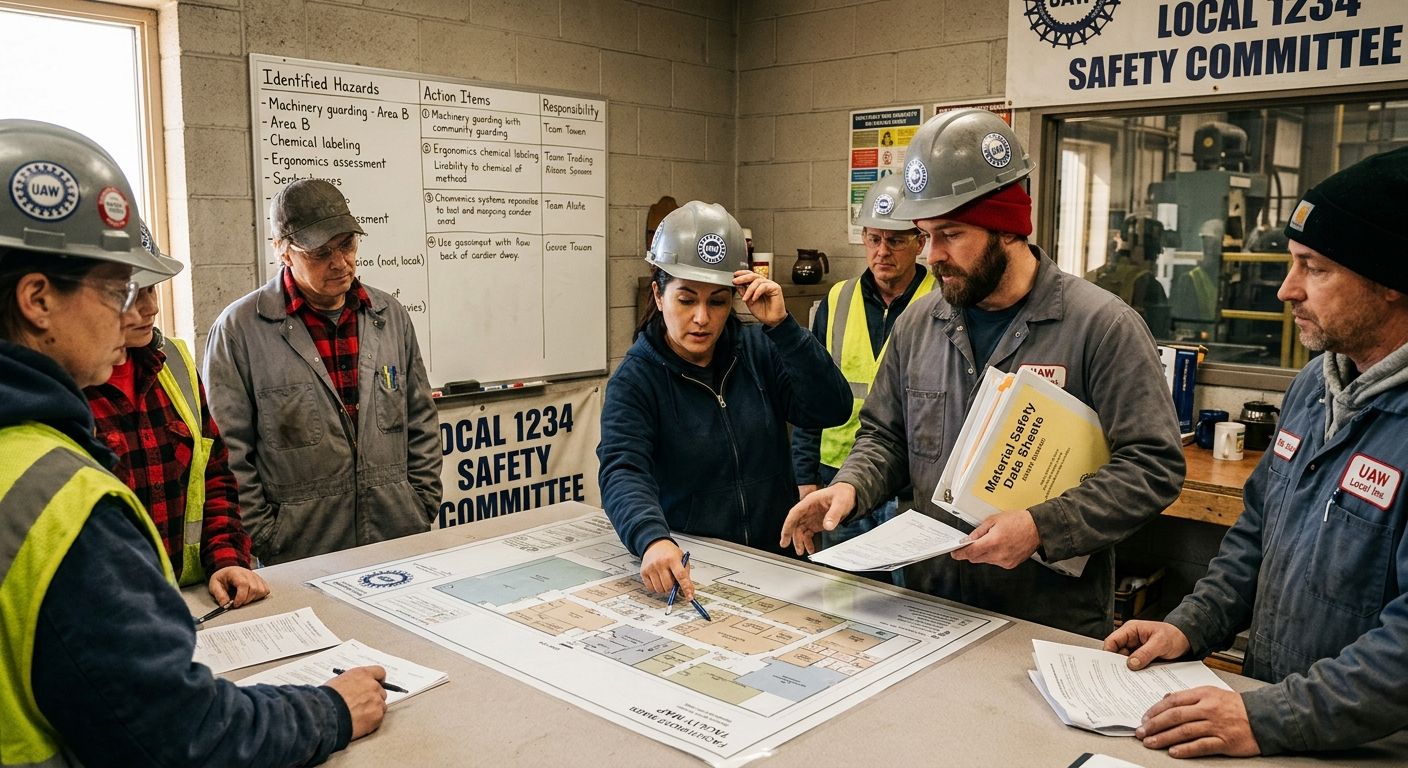
This is where organized labor changes the equation. Union safety committees operate as independent monitors of workplace hazard communication, with contractual authority that individual workers lack. As UnionTrack documented, unions routinely negotiate contract language that allows them to form health and safety committees, address hazards not covered by federal agencies, and set up worksite safety programs. These provisions put workers on firmer ground when demanding changes to working conditions.
The mechanics matter. A union safety committee doesn't just review safety data sheets. It walks the floor. It talks to workers about what they're actually experiencing. It tracks injury patterns the way Tamara tracked those wrist braces. It creates feedback loops that don't exist in non-union shops, where reporting a hazard can feel like a career risk.
Building anonymous reporting systems that workers actually trust is one piece of the puzzle. But anonymous reporting without organized follow-through is a suggestion box with no one reading the suggestions. Union safety committees provide the institutional muscle to turn reports into grievances, grievances into negotiations, and negotiations into enforceable contract language.
The contrast between union and non-union worker protection outcomes shows up in the data. Research cited in a BMJ Occupational & Environmental Medicine study found that a 1% decrease in unionization correlates with a 5% increase in occupational fatalities. That correlation holds across industries and regions. In right-to-work states, where union density is lower, deaths from falls, machinery incidents, and struck-by hazards are notably higher. The pattern linking declining enforcement to rising workplace deaths is documented and alarming.
The connection between union presence and safety outcomes isn't accidental. It reflects the fact that communication systems work differently when workers have collective power. A single worker asking a supervisor about chemical exposure risks a hostile reaction. A safety committee chair asking the same question invokes contractual rights, OSHA standards, and the collective authority of every member in the bargaining unit.
Negotiating the Language That Matters
Effective union safety programs don't stop at forming committees. The contract language itself determines whether a union can meaningfully enforce hazard communication requirements or gets stonewalled the way Tamara was.
Strong contracts include the right to conduct independent safety inspections, access to all chemical inventories and safety data sheets, paid time for safety committee activities, and protection from retaliation for committee members who raise concerns. Some contracts go further. The International Brotherhood of Electrical Workers' agreement with PG&E includes annual eye exams for workers exposed to screens and detailed ergonomic training. SEIU Local 1021's agreement with San Francisco mandates biennial computer vision exams. These are the kind of specific, enforceable provisions that emerge when unions treat safety communication as a bargaining priority rather than an afterthought.
The approach to negotiating contracts that actually stick on safety issues requires the same discipline as any other contract fight: clear proposals, documented evidence of hazards, solidarity among the rank and file, and willingness to make safety language a strike issue if necessary.
Where the fear of retaliation keeps workers from reporting hazards, unions provide both legal protection and social infrastructure. A worker who files a safety complaint through a union grievance procedure has representation, documentation, and institutional backing. A worker who files the same complaint alone in a non-union shop has a target on their back.
The State Of Play
The May 19, 2026 compliance deadline will arrive in a few weeks, and most of the media coverage will focus on whether employers have updated their labels and safety data sheets. That coverage will miss the point. The real test of the revised Hazard Communication Standard is whether the information reaches the worker who needs it, in a language they understand, through a channel they trust, with a feedback mechanism that lets them raise concerns without fear.
Right now, that test is being passed primarily in workplaces where unions have negotiated the infrastructure to make communication systems work. Where union safety committees exist, hazards get reported. Where strong contract language exists, those reports get investigated. Where collective bargaining covers safety training, workers understand what they're exposed to and how to protect themselves.
Where none of that exists, the standard is a binder on a shelf. The communication system is a memo nobody reads. And the worker mixing chemicals at 2 a.m. is watching out for themselves, the way they've always been told to do. The regulatory framework can set the floor. Only organized workers, with contractual power and institutional staying power, can make the communication reach the people who need it most.
The Union Edge Staff
Also in the paper