
Nevada Attorney General Pledges to Repeal Right-to-Work Law in First Term as Governor
Nevada Attorney General Aaron Ford has committed to repealing the state's right-to-work law if elected governor, promising union leaders he would sign legislation ending the 1953 statute during his first term, according to the Las Vegas Review-Journal.

Nevada Attorney General Pledges to Repeal Right-to-Work Law in First Term as Governor
Nevada Attorney General Aaron Ford has committed to repealing the state's right-to-work law if elected governor, promising union leaders he would sign legislation ending the 1953 statute during his first term, according to the Las Vegas Review-Journal.
"I'm getting rid of it," Ford told the GangboX Podcast, an official broadcast of the Southern Nevada Building Trades Unions, in December. "The moment you send it to me — first term — I ain't waiting." Ford, a Democrat, said the law could be repealed through legislative action or ballot initiative, adding that if lawmakers send him a bill, "I'm signing it. It's happening."
The announcement sets up a direct confrontation over labor policy in a state where right-to-work protections have stood for 73 years. Nevada's law, enacted through a 1953 ballot initiative, prohibits requiring workers to join or pay dues to a union as a condition of employment in workplaces with union contracts.
Governor Lombardo Signals Opposition
Republican Gov. Joe Lombardo, whose position Ford seeks, issued a statement supporting the existing framework. "I wholeheartedly support Nevada's right-to-work policies," Lombardo said. "My administration remains focused on protecting workers' right to choose, supporting job and wage growth, and keeping Nevada open for business."
Ford reaffirmed his position this week, framing repeal as a workers' rights priority. "I've been a longtime champion of protecting and expanding workers' union rights," he said in a statement. "As Senate Majority Leader, I fought to extend collective bargaining rights to Nevada state employees." Ford pointed to his legislative record and described his goal of becoming "the most pro-worker Governor in our state's history."
The competing positions mirror a national divide over right-to-work laws. Pennsylvania Lt. Gov. Austin Davis made similar commitments earlier this year, telling Teamsters members that right-to-work legislation would remain blocked in the commonwealth under the Shapiro administration.
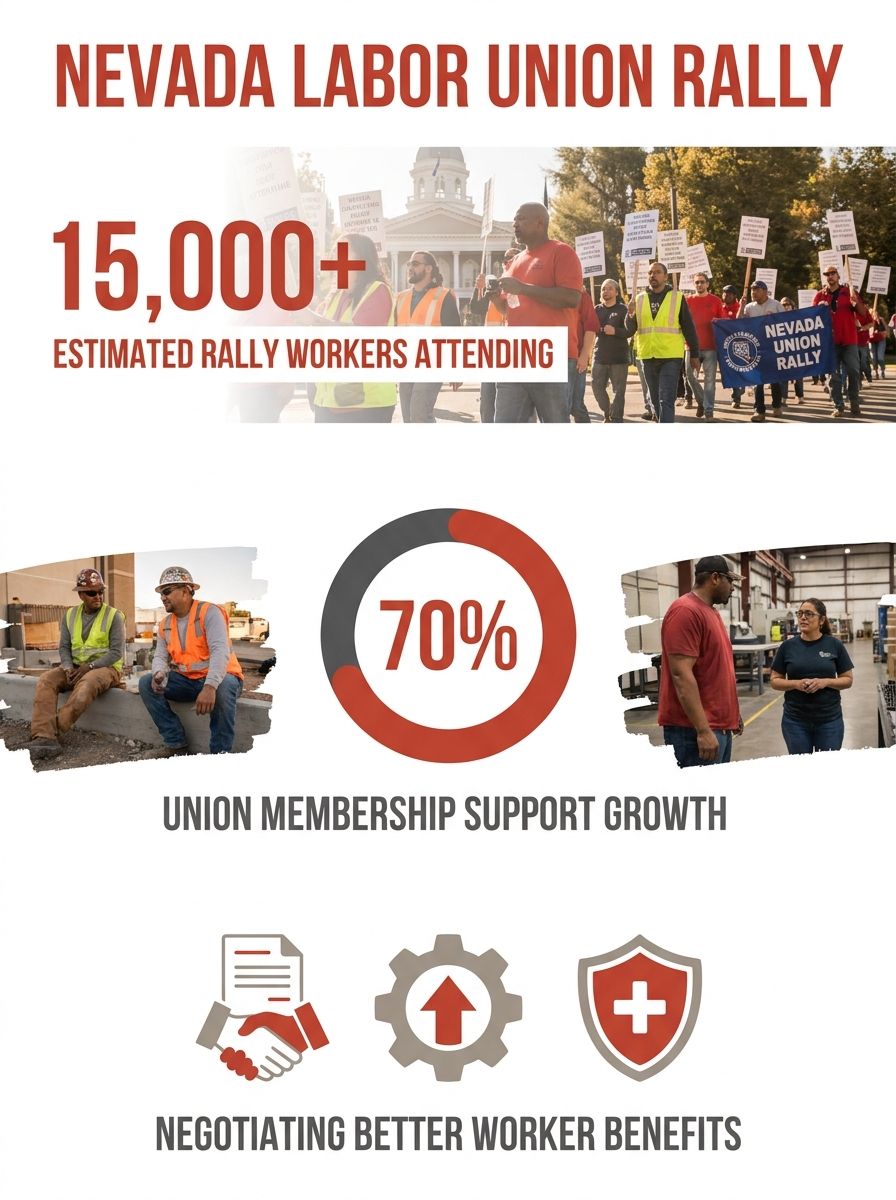
Union and Business Coalitions Draw Battle Lines
Ted Pappageorge, Secretary-Treasurer of Culinary Local 226, described Nevada's right-to-work law as "the right to freeload" in an interview with the Review-Journal. "This is about weakening unions and weakening workers' bargaining power," Pappageorge said. He noted that union representation benefits extend to non-union workers in the same sectors, and that approximately 90 percent of Culinary-represented employees currently pay dues.
U.S. Department of Labor filings from 2023 show Culinary members' monthly dues ranged from $16 to $49.50.
The Nevada Resorts Association and Vegas Chamber, representing roughly 4,000 member businesses, issued statements opposing repeal. The chamber listed preserving right-to-work as one of its top legislative priorities last year, arguing the law ensures "employees have the right to decide whether a portion of their check goes to union dues."
Virginia Valentine, president of the Nevada Resorts Association, said the law "has proven effective in preserving employee choice" over more than seven decades. The chamber characterized the policy as "fair and balanced for both employers and employees."
Research Shows Wage and Unionization Declines
A 2022 study by the National Bureau of Economic Research examined states that recently adopted right-to-work legislation. Researchers found unionization rates dropped 4 percentage points within five years of adoption, with wages declining approximately 1 percent. Construction, education, and public administration unions experienced the largest impacts.
Mark Mix, president of the National Right to Work Committee, argued that repealing Nevada's law would force union-covered private-sector workers to pay union fees even if they object to the union's political activities. "It is a fundamental individual liberty to do with your labor what you want to do or to speak to your employer the way you want to," Mix said. He added that right-to-work states lead manufacturing job growth in the private sector, claiming Ford's position puts "the economic vitality for the State of Nevada in jeopardy."
The AFL-CIO, the nation's largest union federation, states on its website that federal law already prohibits forcing workers to join unions. "The real purpose of right to work laws is to tilt the balance toward big corporations and further rig the system at the expense of working families," the organization says.
Should Nevada repeal its law, workers in unionized private-sector workplaces could be required to pay fees covering collective bargaining representation, though they would not be compelled to join unions as members.
Policy Implications
Ford's pledge transforms Nevada's gubernatorial race into a referendum on one of the labor movement's longest-standing legislative targets. Right-to-work repeal campaigns have gained momentum in recent years as union density continues declining nationwide—from 20.1 percent of wage and salary workers in 1983 to 10 percent in 2023, according to Bureau of Labor Statistics data.
The Nevada campaign will test whether organized labor can mobilize sufficient electoral support to overcome entrenched business opposition in a state whose economy depends heavily on hospitality and construction sectors with significant union presence. If Ford wins and delivers on his commitment, Nevada would become the first state to repeal right-to-work protections through legislative action rather than court intervention since Indiana briefly repealed its law in 1965.
The outcome carries implications beyond Nevada's borders. Union strategists view right-to-work repeal as essential to reversing membership declines and restoring collective bargaining power. A successful Nevada campaign could provide a template for similar efforts in other Western states where labor organizations maintain political influence but lack the legislative supermajorities needed to advance major policy changes.
The Union Edge Staff
Also in the paper