
Teamsters Sue California DMV Over Autonomous Truck Regulations, Claiming State Skipped Economic Impact Review
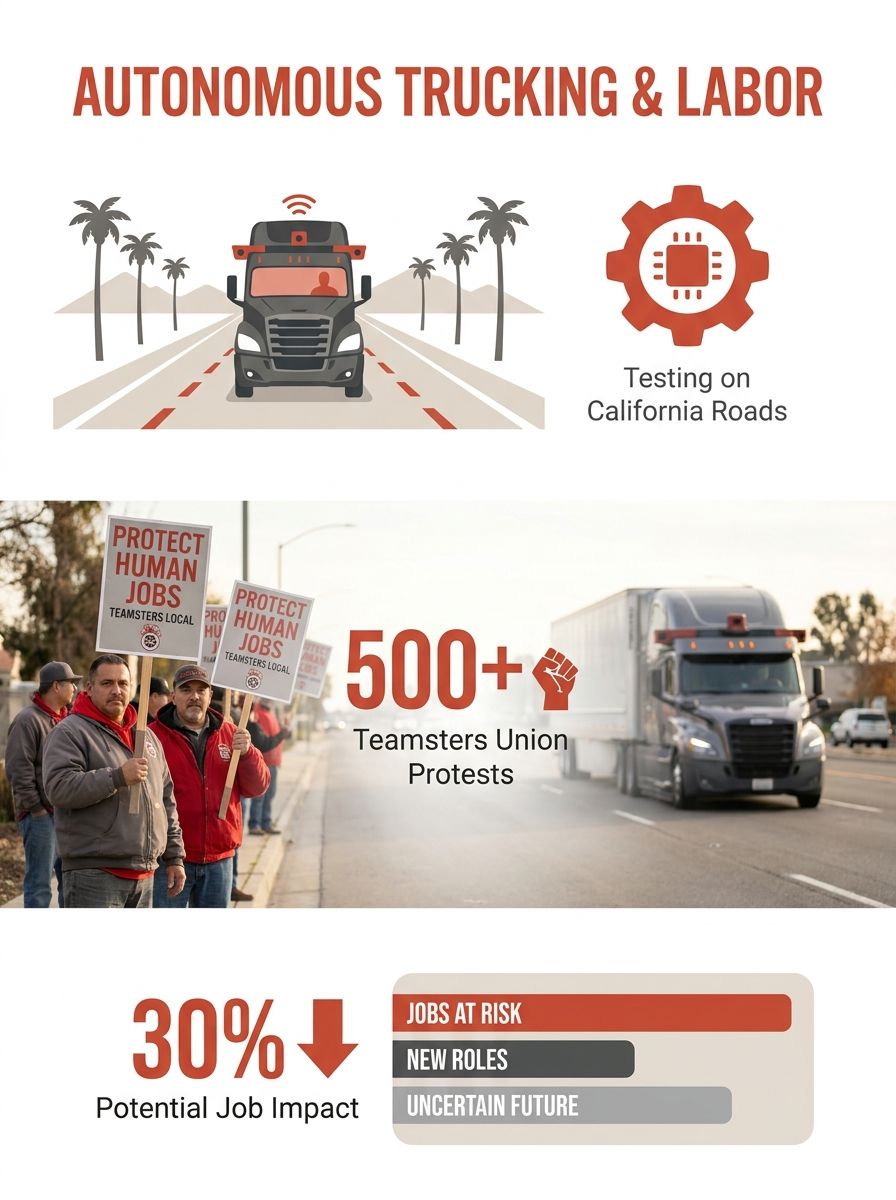
Teamsters California filed a lawsuit against the California Department of Motor Vehicles in August 2026, challenging the agency's decision to lift restrictions on heavy autonomous trucks and alleging regulators bypassed required economic impact analysis before approving rules that could affect more

Teamsters Sue California DMV Over Autonomous Truck Regulations, Claiming State Skipped Economic Impact Review
Teamsters California filed a lawsuit against the California Department of Motor Vehicles in August 2026, challenging the agency's decision to lift restrictions on heavy autonomous trucks and alleging regulators bypassed required economic impact analysis before approving rules that could affect more than 130,000 commercial drivers across the state, according to the Los Angeles Times.
Union Claims State Violated Administrative Procedure Requirements
The core of the Teamsters' legal petition targets the California Department of Motor Vehicles' compliance with the California Administrative Procedure Act, which requires state agencies to complete a standardized regulatory impact assessment before implementing policy changes with economic consequences exceeding $50 million annually, according to Julie Dickinson, a partner at Bush Gottlieb representing the union.
Dickinson said the true economic impact of the DMV's new autonomous truck regulations is predicted to exceed $280 million in the first year. "Californians had a right to know the economic impact," Dickinson stated. "The DMV acted irresponsibly, carelessly and unlawfully by keeping the public in the dark."
The lawsuit, filed earlier in August, seeks to have the court rescind the DMV's revised regulations until after an economic study is completed and public consultation occurs. The Teamsters represent 250,000 workers across dozens of industries in California, including a significant portion of the state's commercial trucking workforce.
April Rule Change Lifted Ban on Heavy Autonomous Vehicles
The California DMV announced the contested regulations in April 2026, removing a previous ban on autonomous vehicles weighing more than 10,001 pounds. The updated rules include certification requirements that mandate testing with a safety driver and 500,000 miles driven at each stage of certification before companies can deploy driverless heavy trucks.
DMV director Steve Gordon said in an April statement that the updated regulations "further demonstrate the state's commitment to public safety" and "support the growth of the AV industry by enhancing public safety and transparency while adding additional accountability for AV manufacturers." The DMV declined to comment on the pending litigation.
William Riggs, director of the Autonomous Vehicles and the City Initiative at the University of San Francisco, said the DMV spent more than a year on proposals, public hearings, and revisions before adopting the new regulations. "To say that the decision was too fast is a bit of a revisionist history," Riggs stated. "It's a long, protracted process. We're not going to see companies flood the road with thousands of autonomous trucks tomorrow."
Union Raises Safety and Job Loss Concerns
Peter Finn, Teamsters California co-chair, said the union's concerns center on both worker displacement and public safety. "We're not going to sit by idly while they put jobs and the safety of our streets and roads at risk," Finn said. "It's clear from experience with Waymo that these autonomous vehicles can't deal with unanticipated circumstances, so we are certainly cautioning about the dangers of 26,000 pounds barreling down the highways at 65 miles per hour."
Finn cited incidents involving autonomous vehicles blocking first responders and a blackout in San Francisco last year that caused Waymo taxis to stall in roadways. "Any time anything goes wrong at all, the system completely fails," he stated.
California employs more than 130,000 freight truck drivers, making it among the largest markets for commercial trucking in the United States. "Autonomous vehicles and particularly autonomous heavy trucks are an existential threat to driving jobs," Finn said. "It's very important to not just our membership, but also to the economy here in California and our local communities."
Several companies are working to deploy autonomous trucks in California and other states, including Mountain View-based Kodiak AI and San Francisco-based Humble Robotics. Humble Robotics founder and Chief Executive Eyal Cohen said he does not believe self-driving trucks will replace human drivers in the near future, though the Teamsters dispute that assessment.
What Happens Next
The Teamsters' lawsuit will test whether California regulators followed state administrative law when approving autonomous truck deployment. If the court sides with the union, the DMV could be forced to withdraw its April regulations and conduct the economic impact study that Teamsters claim should have preceded the rule change—a process that could delay heavy autonomous vehicle deployment in the state by months or years.
The case arrives as transportation workers nationwide push back against automation that threatens traditional driving jobs, from California rideshare drivers organizing unions to freight haulers confronting the prospect of driverless long-haul trucks. The outcome in California, home to both the nation's largest trucking market and its most aggressive autonomous vehicle testing programs, is likely to influence how other states approach the intersection of worker protections and automated freight technology.
Dickinson emphasized that the lawsuit's immediate goal is procedural—forcing regulators to complete the required economic analysis—but said the stakes extend beyond process. "The loss of jobs is tremendous, but the safety of millions of Californians is at stake," she stated.
The Union Edge Staff
Related Articles

Uber Aligns With Labor Unions to Oppose Autonomous Vehicle Expansion in Washington
Uber and organized labor testified in mid-July before the Washington, D.C. Council in opposition to rapid autonomous vehicle deployment, forming an unlikely alliance in a city where 35,000 gig drivers make up 9% of the workforce, according to CNBC.

California Rideshare Drivers' Union Cleared for Certification Within 30 Days
California's Public Employment Relations Board confirmed last week that the California Gig Workers Union secured support from 30% of the state's active rideshare drivers, clearing the organization for certification after a 30-day waiting period, according to the Los Angeles Times.

SEIU-Backed California Gig Workers Union Hits Organizing Milestone Amid Rival Union Competition
The California Gig Workers Union, backed by the Service Employees International Union, has reached a significant organizing milestone in its campaign to unionize Uber and Lyft drivers across the state, though the effort may face competition from a rival union seeking to represent the same workforce,
Also in the paper