
Georgia Minimum Wage: Current Rates & 2024 Updates
Only two U.S. states maintain a minimum wage below the federal floor of $7.25 per hour: Georgia and Wyoming. Georgia's rate, $5.15 an hour and frozen since 1999, ranks among the lowest statutory wage floors in the country. But that $5.

Georgia Minimum Wage: How the State's $5.15 Rate Actually Works
Only two U.S. states maintain a minimum wage below the federal floor of $7.25 per hour: Georgia and Wyoming. Georgia's rate, $5.15 an hour and frozen since 1999, ranks among the lowest statutory wage floors in the country. But that $5.15 figure misleads more than it informs, because a federal law called the Fair Labor Standards Act overrides it for the vast majority of Georgia workers.
The Official Rate and What It Means
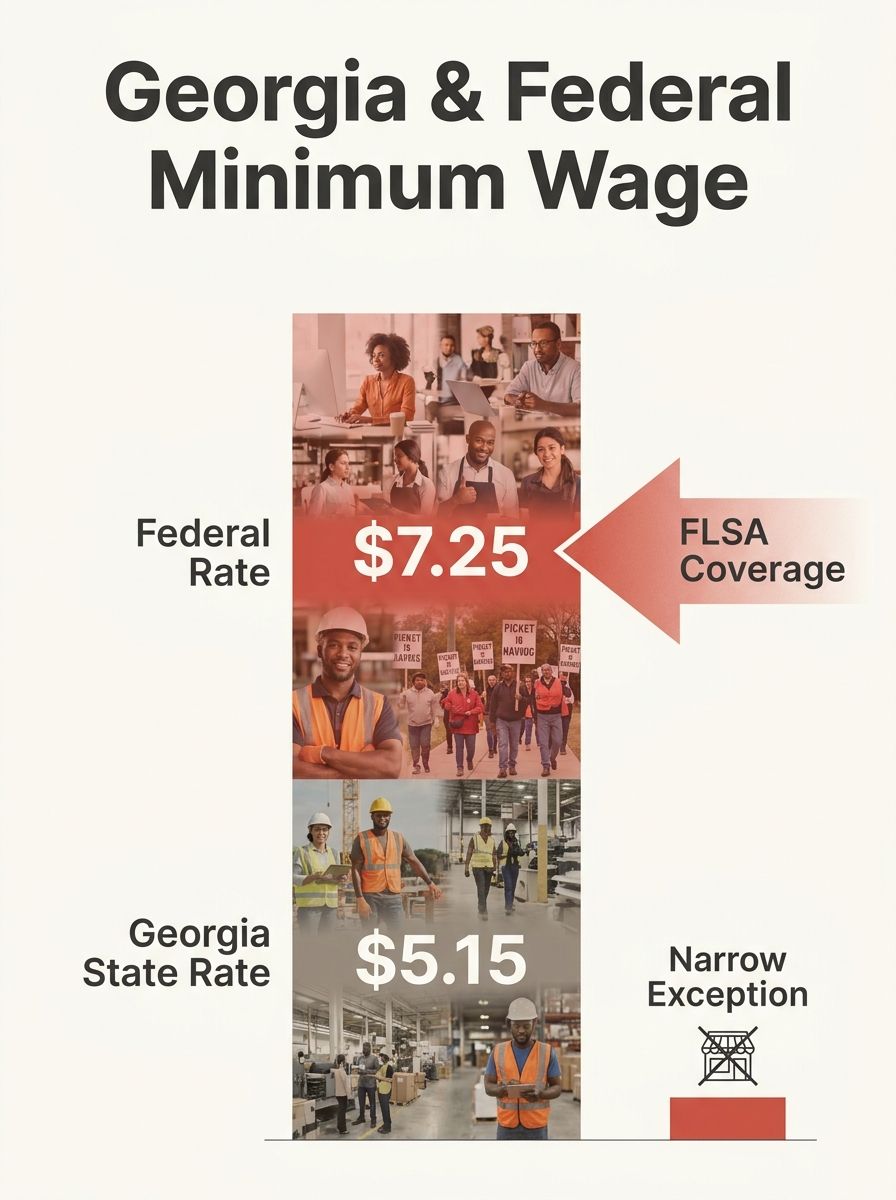
The Georgia Department of Labor defines the state minimum wage as $5.15 per hour, a figure set under Georgia's Minimum Wage Law (O.C.G.A. § 34-4-3). The department's own guidance immediately qualifies that number: "with some limited exceptions, the federal minimum wage rate applies." Those limited exceptions are so narrow that $5.15 functions as a wage floor for almost nobody.
The federal minimum wage of $7.25 per hour has held steady since July 24, 2009, when the last of three scheduled increases under the Fair Minimum Wage Act of 2007 took effect. Georgia's $5.15 rate dates back even further, to 1999. The gap between them, $2.10 per hour, creates a layered system that confuses workers and employers in equal measure.
Understanding which rate applies to your paycheck requires answering a single question: does your employer fall under federal FLSA coverage? For most Georgia workers, the answer is yes.
How Federal Preemption Determines Your Pay
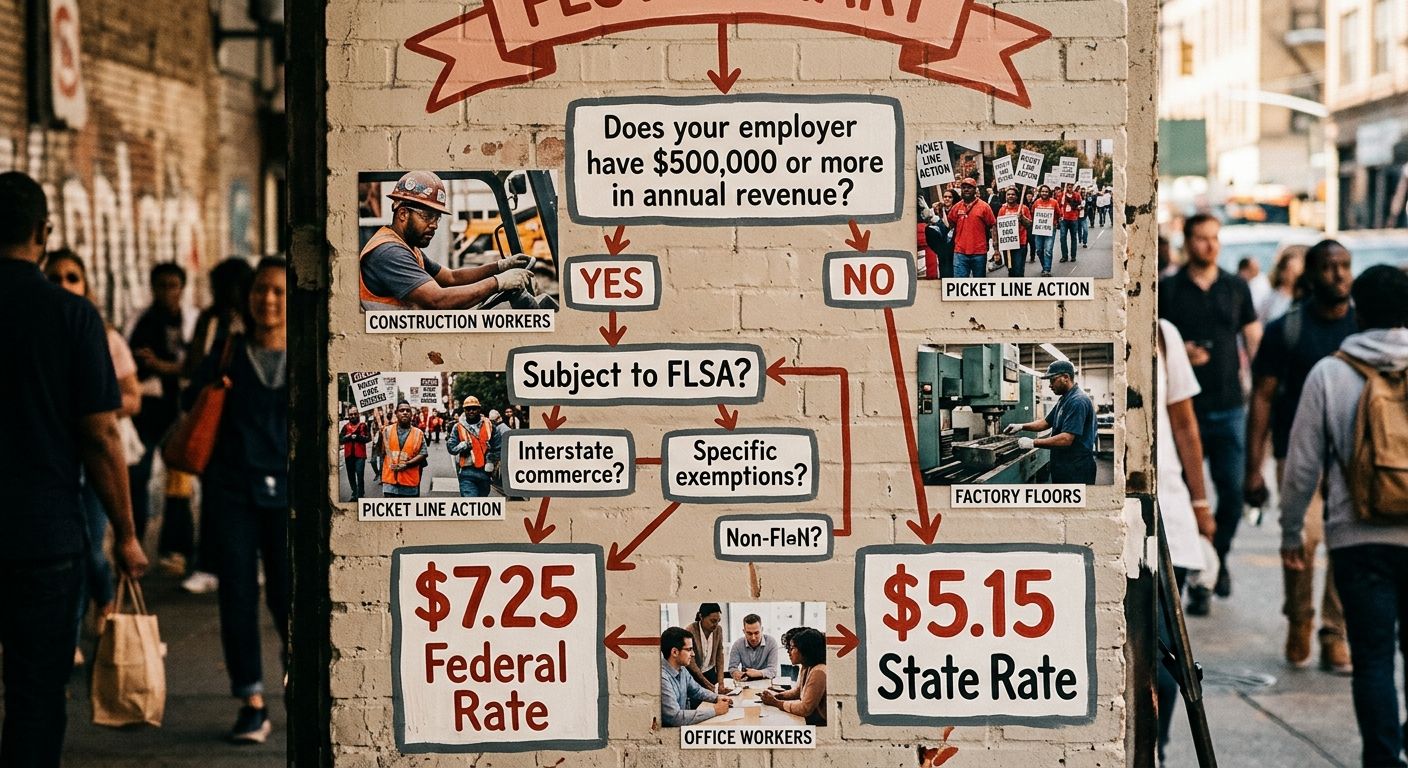
The Fair Labor Standards Act covers employers in two ways, and either one is sufficient to trigger the $7.25 floor. Enterprise coverage applies to businesses with at least $500,000 in annual gross revenue that engage in interstate commerce or produce goods for interstate commerce. Individual coverage applies to any employee who personally engages in interstate commerce or the production of goods for it, regardless of the employer's size.
That second pathway is broader than people realize. A worker who regularly uses email, phone, or the internet to communicate across state lines can qualify for individual FLSA coverage. A dishwasher handling supplies shipped from out of state can qualify. The bar is low by design, and federal courts have interpreted "interstate commerce" expansively for decades.
When both Georgia's $5.15 rate and the federal $7.25 rate apply, the higher rate wins. This principle, sometimes called the "greater benefit" rule, means the federal rate functionally erases the state rate for covered workers. The result: roughly 95% or more of Georgia's workforce operates under the $7.25 federal minimum, according to estimates based on FLSA coverage data.
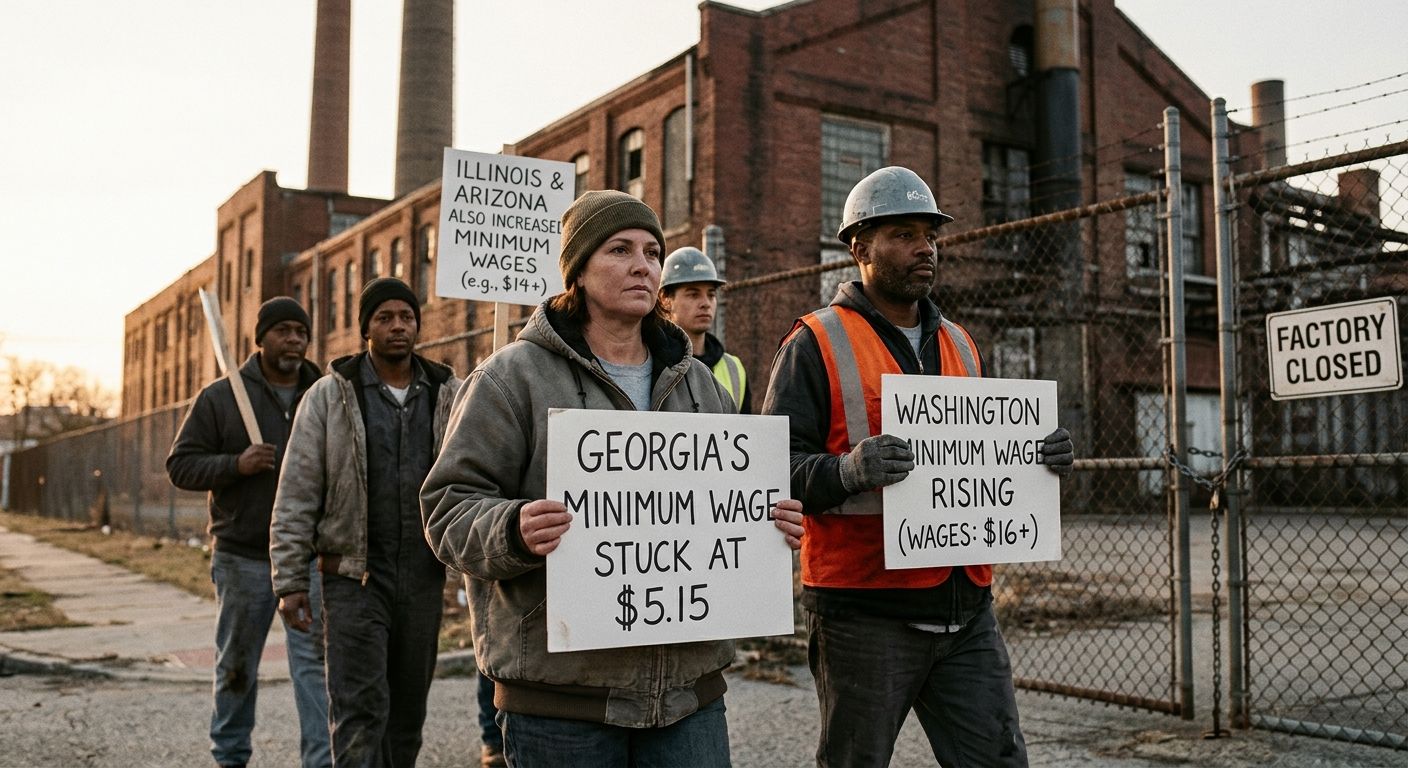
Compare this to states like Illinois, where the state minimum of $15.00 per hour exceeds the federal floor, or Washington state, where an automatic CPI adjustment pushes the rate higher each year. Georgia's structure is unusual because the state has effectively ceded minimum wage authority to the federal government without formally saying so.
Who Actually Earns $5.15
The $5.15 Georgia minimum wage applies to a very small category of workers: those employed by businesses not covered by the FLSA, in positions that don't individually qualify for federal coverage. In practice, this means employees at businesses with less than $500,000 in annual gross revenue that have no substantial connection to interstate commerce.
Think of a purely local, single-location business with a handful of employees, limited revenue, and no goods or communications crossing state lines. A small neighborhood barber shop, a local handyman service, a seasonal farm stand selling only locally grown produce. Even among these, many will still trigger individual coverage through routine activities like accepting credit card payments (processed through interstate banking networks) or ordering supplies online.
Georgia's Department of Labor does not publish data on how many workers actually earn the $5.15 state rate, making enforcement even harder to track. The opacity benefits employers who misapply the exemption, whether intentionally or through ignorance. Workers dealing with pay disputes of this kind face similar barriers to those documented in wage theft cases elsewhere in the country.
The Tipped Worker Subfloor
Georgia follows the federal tipped wage structure. Employers can pay tipped employees as little as $2.13 per hour, provided the employee's tips bring total hourly compensation to at least $7.25. This arrangement, called a "tip credit," allows employers to count up to $5.12 per hour in customer tips toward their minimum wage obligation.
The mechanism has a critical timing requirement that many Georgia employers get wrong. Tip credit compliance must be calculated on a weekly basis, not averaged over a pay period, a month, or a year. If a tipped worker earns less than $7.25 per hour in total compensation during any single workweek, the employer must make up the difference in that week's paycheck. Failure to do so constitutes a wage violation under the FLSA.
Tipped workers also have a right to notification. Before taking a tip credit, employers must inform the employee of the $2.13 cash wage, the tip credit amount claimed, that the tip credit cannot exceed the tips actually received, and that all tips belong to the employee (except in a valid tip pool). Skipping this disclosure invalidates the tip credit entirely.
Training Wages and Special Categories
Federal law allows a training wage of $4.25 per hour for employees under the age of 20 during their first 90 consecutive calendar days of employment. This "youth minimum wage" applies in Georgia through FLSA coverage, since Georgia's own minimum wage law does not separately address trainees, as noted by the Employment Law Handbook.
Full-time students employed in retail, service, agriculture, or at colleges and universities can be paid 85% of the applicable minimum wage, which works out to $6.16 per hour, for up to 20 hours per week during the school year (or 40 hours during breaks). Employers must obtain a certificate from the Department of Labor to use this rate.
Salaried employees classified as exempt from overtime must earn at least $43,888 annually, or $844 per week, under current FLSA salary thresholds. This number matters in Georgia because misclassification of hourly workers as "salaried exempt" is one of the most common wage violations the Department of Labor investigates nationwide.
Category | Hourly Rate | Conditions |
|---|---|---|
State minimum (non-FLSA) | $5.15 | Employers exempt from federal coverage |
Federal minimum (FLSA) | $7.25 | Most Georgia employers and workers |
Tipped employees | $2.13 | Tips must bring total to $7.25/week |
Youth training wage | $4.25 | Under 20, first 90 days only |
Full-time students | $6.16 | 85% of $7.25, max 20 hrs during school |
Why the Rate Hasn't Moved Since 1999
Georgia's $5.15 minimum wage has been frozen for over 27 years. The state legislature has introduced bills to raise it periodically, but none have advanced to a floor vote in either chamber in the past decade. In April 2026, State Representative Derrick Jackson proposed raising the state minimum to $20 per hour, though the bill attracted no cosponsors from the majority party and saw no committee hearing.
The political landscape in Georgia mirrors a broader regional pattern. When more than 20 states raised their minimum wages in 2024, no southern state was among them, including Georgia, according to an AARP analysis of state-by-state changes. As of 2026, Georgia has no scheduled wage increases on the books, and no automatic adjustment mechanism tied to inflation or cost of living.
The gap between Georgia's stagnant floor and the rising wages in other states grows wider each year. Workers in states with indexed minimums see annual increases without legislative action. Georgia workers relying on the minimum get nothing unless Congress raises the federal floor or the state legislature acts. The CEO-to-worker pay gap documented in recent analyses hits hardest in states like Georgia where the legal wage floor sits lowest.
Where the Dual-Rate System Breaks Down
The Georgia wage framework has three structural failure points that leave workers exposed.
Enforcement depends on workers knowing their rights. Georgia's Department of Labor has limited authority to enforce the state's own $5.15 wage floor and no independent authority over FLSA-covered workers. Federal enforcement falls to the U.S. Department of Labor's Wage and Hour Division, which handles complaints for the entire country with finite investigators. Workers who don't know they're entitled to $7.25 rather than $5.15 never file complaints. The knowledge gap is the system's largest crack.
FLSA coverage isn't always obvious. The line between a covered and non-covered employer isn't bright. Small businesses hover around the $500,000 revenue threshold, and individual coverage turns on fact-specific inquiries about whether a particular worker's tasks touch interstate commerce. Employers who want to pay $5.15 can structure job duties to argue against individual coverage, and workers without legal counsel have little practical ability to challenge that characterization.
No local override exists. Unlike states such as Colorado, which allow local jurisdictions to set their own floors, Georgia preempts local minimum wage ordinances. Cities like Atlanta, where the cost of a one-bedroom apartment exceeds $1,600 per month on average, cannot independently set a higher local wage. The preemption locks every Georgia locality into whatever the state or federal government provides, and right now that ceiling is $7.25.
The combination of these three gaps means the system works adequately for workers at large, clearly FLSA-covered employers who understand their rights. It fails for workers at smaller or ambiguous employers, workers who don't speak English fluently, and workers in industries with high turnover where institutional knowledge about wage rights is thin. The workers most likely to need minimum wage protections are the same ones least likely to receive them under Georgia's current framework.
Common Questions
Does every Georgia worker earn at least $7.25 per hour?
Nearly every one, but not technically all. Workers at employers that fall outside FLSA coverage are legally subject to Georgia's $5.15 state rate. This group is extremely small. If your employer has $500,000 or more in annual revenue, or if your individual work involves interstate commerce in any way, you're covered by the $7.25 federal minimum.
Can Georgia cities set their own minimum wage?
No. Georgia law preempts local minimum wage ordinances. Individual cities and counties cannot establish a wage floor higher than the state or federal rate. Any change must come from the state legislature or from Congress adjusting the federal rate.
Is Georgia planning to raise its minimum wage?
As of 2026, Georgia has no enacted or scheduled increase to its $5.15 state minimum wage. Legislative proposals have been introduced repeatedly but have not advanced. The state also has no automatic adjustment mechanism tied to inflation.
What should I do if my employer pays me less than $7.25?
File a complaint with the U.S. Department of Labor's Wage and Hour Division. You can do this online, by phone, or in person. Federal law protects you from retaliation for filing a wage complaint, and the process is free. You don't need a lawyer to start the complaint, and your identity can be kept confidential during the investigation.
How does Georgia compare to other states?
Georgia and Wyoming are the only two states with minimum wages set below $7.25. Five states (Alabama, Louisiana, Mississippi, South Carolina, and Tennessee) have no state minimum wage law at all, but the federal $7.25 floor still applies to FLSA-covered employers in those states. Meanwhile, 30 states and Washington, D.C., have set their minimums above $7.25, with some exceeding $15.00 per hour. The contrast shows how much wage policy varies depending on where you work.
The Union Edge Staff
Frequently Asked Questions
- What is the minimum wage in Georgia in 2024?
- Georgia's state minimum wage is $5.15 per hour, but the federal minimum of $7.25 per hour applies to nearly all workers through FLSA coverage. Approximately 95% or more of Georgia's workforce operates under the $7.25 federal minimum.
- Does Georgia minimum wage apply to all workers?
- No. Georgia's $5.15 minimum wage only applies to workers at businesses not covered by the Fair Labor Standards Act, primarily very small businesses with under $500,000 in annual revenue and no interstate commerce. Most Georgia workers fall under federal FLSA coverage and earn the $7.25 federal minimum instead.
- What is the tipped minimum wage in Georgia?
- Georgia allows employers to pay tipped employees as little as $2.13 per hour, provided the employee's tips bring total hourly compensation to at least $7.25 per week. Employers must notify employees of this arrangement and cannot use the tip credit if tips don't reach the required threshold.
- When was Georgia's minimum wage last increased?
- Georgia's $5.15 minimum wage has been frozen since 1999, over 27 years ago. As of 2026, Georgia has no scheduled wage increases and no automatic adjustment mechanism tied to inflation.
- Can cities in Georgia set their own minimum wage?
- No. Georgia law preempts local minimum wage ordinances, meaning cities and counties cannot establish a wage floor higher than the state or federal rate. Any increase must come from the state legislature or from Congress.
- What should I do if my Georgia employer pays me less than $7.25 per hour?
- File a complaint with the U.S. Department of Labor's Wage and Hour Division online, by phone, or in person. The process is free, you don't need a lawyer, and federal law protects you from retaliation while keeping your identity confidential.
- What is the federal training wage in Georgia?
- Federal law allows a training wage of $4.25 per hour for employees under age 20 during their first 90 consecutive calendar days of employment. Full-time students can be paid $6.16 per hour (85% of minimum wage) for up to 20 hours per week during the school year.
Related Articles

State of Georgia Minimum Wage: 2024 Guide
Two minimum wage rates operate in the state of Georgia simultaneously: $5.15 under state statute and $7.25 under the federal Fair Labor Standards Act.

Minimum Wage for Georgia: 2024 Rules & Requirements
Georgia's minimum wage operates through a two-tier legal structure: the state sets one rate at $5.15 per hour, the federal government enforces a higher rate at $7.25, and which number appears on your paycheck depends entirely on whether your employer falls under the Fair Labor Standards Act.

Federal Minimum Wage: What You Need to Know
The federal minimum wage is $7.25 per hour, set by the Fair Labor Standards Act (FLSA) and enforced by the U.S. Department of Labor's Wage and Hour Division. That rate has been frozen since July 24, 2009, making it the longest period without an increase since the FLSA became law in 1938.
Also in the paper