
Minimum Wage of Washington: 2024 Update
Washington's minimum wage is set by an automatic annual formula tied to the Consumer Price Index for Urban Wage Earners and Clerical Workers (CPI-W), making it one of the few state wage floors in the country that rises without requiring new legislation each cycle. The 2024 rate of $16.

Minimum Wage of Washington: The 2024 Update and How the Indexing System Works
Washington's minimum wage is set by an automatic annual formula tied to the Consumer Price Index for Urban Wage Earners and Clerical Workers (CPI-W), making it one of the few state wage floors in the country that rises without requiring new legislation each cycle. The 2024 rate of $16.28 per hour, a 3.4% increase over 2023, gave the state the highest baseline minimum wage in the nation, more than double the $7.25 federal floor.
How Initiative 688 Built an Auto-Adjusting Wage Floor
Washington voters passed Initiative 688 in November 1998, establishing a state minimum wage and tying future increases to the CPI-W. The Washington State Department of Labor & Industries (L&I) calculates the new rate each September and announces it for the following January 1 effective date.
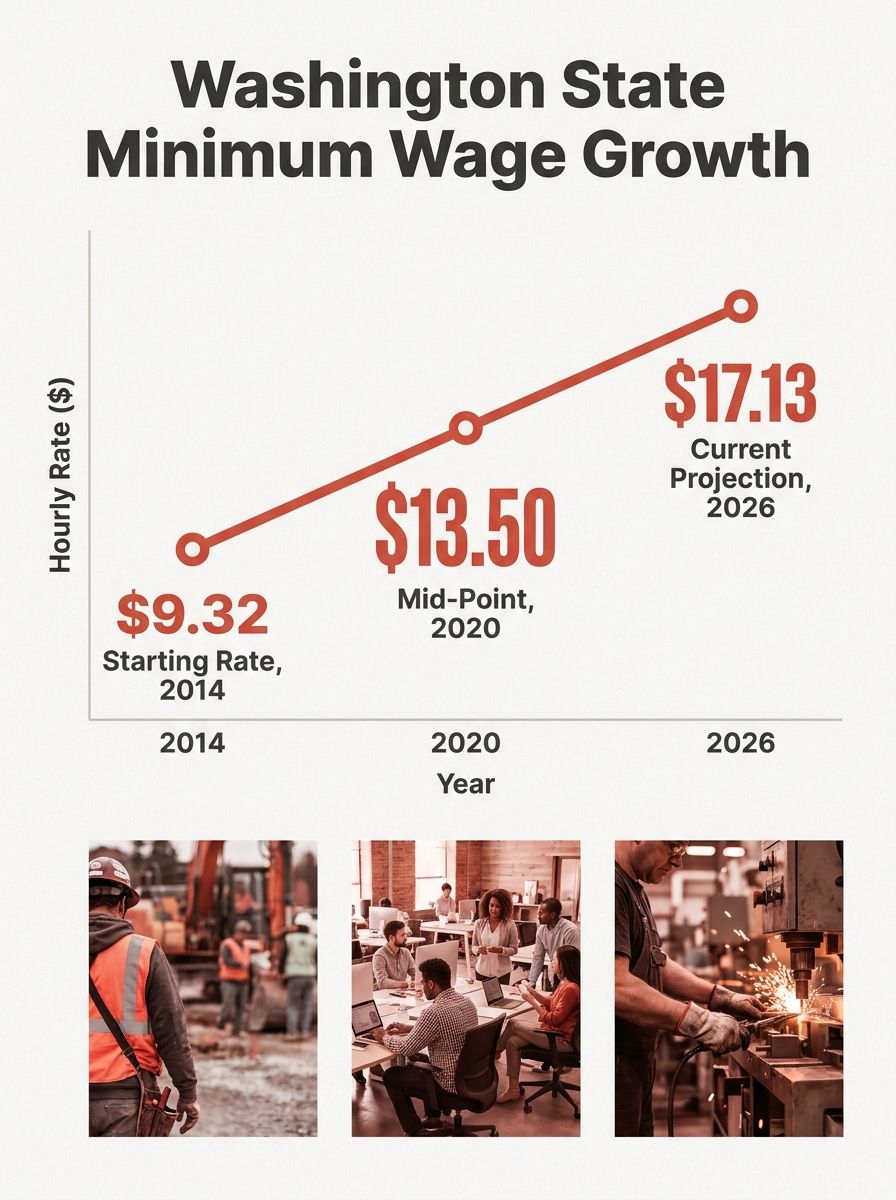
This mechanism matters because it removes the political friction that stalls wage increases in most other states. The federal minimum wage has been frozen at $7.25 since 2009. Washington's formula has produced steady annual adjustments: from $15.74 in 2023 to $16.28 in 2024, and onward to $17.13 in 2026. The CPI-W tracks price changes for goods and services that hourly and clerical workers typically purchase, including food, housing, transportation, and medical care. When those costs climb, the wage floor follows automatically.
Washington law also mandates that the minimum wage can never decrease, even if the CPI-W drops in a deflationary period. The rate stays flat or goes up. That ratchet mechanism is a deliberate design choice, one that organized labor fought hard to include in the original initiative language.
The 2024 State Rate and What It Meant for Paychecks
On January 1, 2024, the minimum wage in Washington jumped from $15.74 to $16.28 per hour, a 3.4% increase reflecting the prior year's CPI-W movement. This rate applied to all workers aged 16 and over across the state, with narrow exceptions.
The $0.54 raise translated to roughly $1,123 in additional annual gross pay for a full-time worker logging 40 hours per week, 52 weeks per year. For a household with two minimum-wage earners, that's an extra $2,246 before taxes. In a state where the median rent for a one-bedroom apartment in many counties exceeds $1,400 per month, every dollar of that increase gets absorbed fast.
Washington's approach contrasts sharply with states that rely on legislative action to raise their floors. Arizona uses a similar CPI-based formula, but most states either have no automatic adjustment or tie increases to irregular ballot measures. The result is that Washington workers have seen consistent, predictable raises every January for over two decades while workers in states like Illinois wait years for legislative packages to grind through statehouses.
Local Rates That Run Well Above the State Floor
The minimum wage of Washington gets more complicated at the city level. Several municipalities passed their own minimum wage ordinances, creating a patchwork where a worker's pay depends on which city limits they clock in within.
Here's how the major local rates stacked up in 2024:
Jurisdiction | 2024 Minimum Wage | Key Conditions |
|---|---|---|
Washington State | $16.28/hr | Statewide floor for all workers 16+ |
Seattle (501+ employees) | $19.97/hr | Set by Seattle's Minimum Wage Ordinance |
Seattle (≤500 employees, with benefits) | $17.25/hr | Tips and medical benefits count toward threshold |
SeaTac (hospitality/transportation) | $19.71/hr | Applies to specific industries near the airport |
King County (large employers) | $20.29/hr | County-level ordinance |
Tukwila | Above state rate | City-specific ordinance adopted in 2022 |
The Seattle Office of Labor Standards confirmed the city's 2024 rates, specifying that the minimum wage applies regardless of an employee's immigration status. That detail matters enormously in a metro area where immigrant workers make up a significant share of the hospitality, construction, and food-processing workforce.
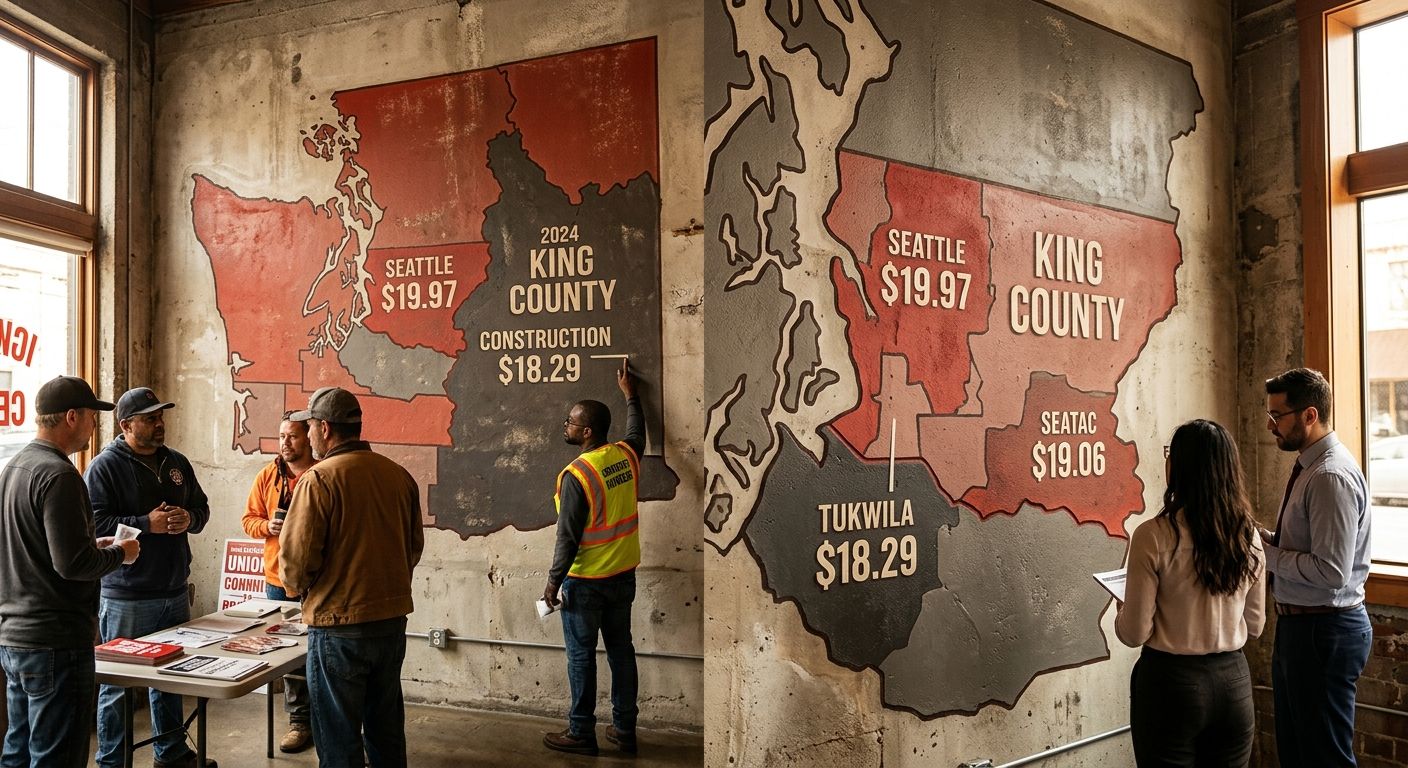
The gap between $16.28 at the state level and $20.29 in King County means a worker earning the floor rate in rural Yakima County takes home roughly $4 less per hour than someone doing identical work across the county line. Geography has become a wage determinant in Washington, and this disparity drives ongoing debate about whether the state formula rises fast enough for workers outside major metro areas.
Exempt Employee Salary Thresholds
The 2024 minimum wage increase triggered a chain reaction through Washington's overtime exemption rules. Under state law, the salary threshold for classifying an employee as exempt from overtime protections is pegged to a multiple of the minimum wage. When the floor rises, the threshold rises with it.
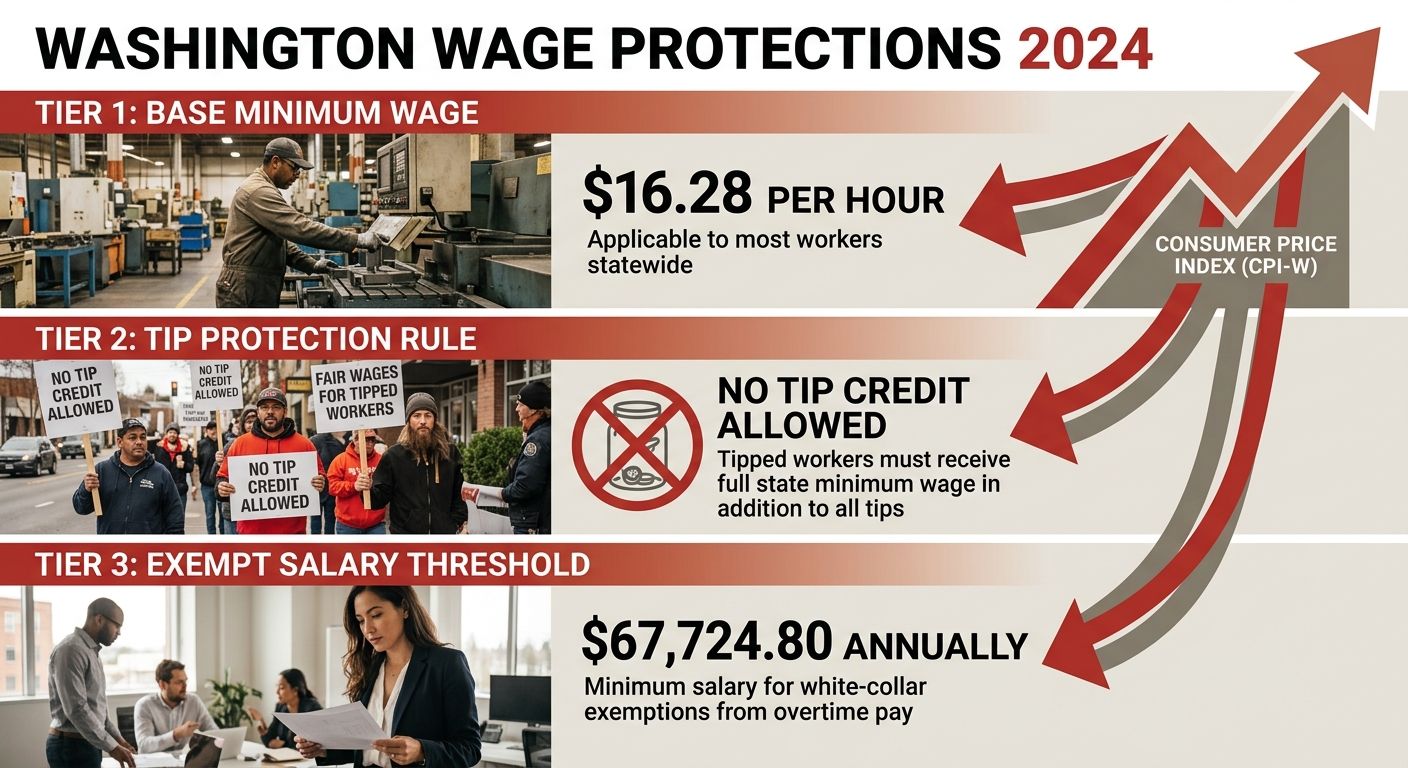
For 2024, the annual salary threshold for exempt employees reached $67,724.80 ($1,302.40 per week), applying uniformly to all employers regardless of size. This was a significant change from earlier years, which had used a tiered system based on employer headcount. Computer professionals had to earn at least $69.90 per hour to qualify as exempt.
These thresholds will continue climbing annually through 2028, when the exempt salary reaches 2.5 times the minimum wage. The practical consequence is straightforward: employers who classify salaried workers as exempt to avoid paying overtime must keep ratcheting those salaries upward or reclassify the positions as hourly and overtime-eligible.
This mechanism protects workers from a common employer tactic of handing out "manager" titles paired with modest salaries to sidestep overtime requirements. The tied threshold makes that harder to pull off with each passing year.
Tips, Youth Workers, and Non-Compete Rules
Why does Washington handle tipped workers differently than 43 other states? Because state law treats tips as entirely separate from the minimum wage. Unlike the majority of states that allow a "tip credit" (where employers pay tipped workers a sub-minimum wage on the assumption tips make up the difference), Washington requires the full minimum wage before tips. A server earning $16.28 per hour keeps 100% of their tips on top of that base. This is one of the strongest tipped-worker protections in the country, and labor organizers have defended it against repeated industry lobbying efforts.
For young workers, the law allows a reduced rate only for 14- and 15-year-olds, who can be paid 85% of the minimum wage ($13.84 per hour in 2024). Workers aged 16 and older are entitled to the full rate, period. Washington doesn't carve out sub-minimum exceptions for seasonal workers, either.
The 2024 update also raised the enforceability thresholds for non-compete agreements. Following the January 2025 decision in David v. Freedom Vans LLC, Washington employers now face heightened scrutiny on these contracts. Non-competes became void for employees earning less than $120,559.99 annually and for independent contractors earning less than $301,399.98 annually. The effect is clear: employers can't lock low- and mid-wage workers into non-compete clauses that restrict their ability to find better-paying jobs. For workers trying to negotiate through collective bargaining, non-compete restrictions are a direct obstacle to using outside offers as bargaining power.
New rules on wage claim settlements added another layer of protection. Employers settling claims without a formal citation must now include 1% monthly interest on all amounts owed. Previous practice had allowed employers to waive accrued interest during settlement, effectively penalizing workers who agreed to resolve disputes outside the formal enforcement system. That loophole closed on January 1, 2024. Workers dealing with wage theft and unpaid wages in any state should look for similar interest provisions in their local statutes.
Where the CPI-W Formula Falls Short
The automatic indexing mechanism that makes Washington's minimum wage distinctive also has blind spots that workers and organizers should understand.
The CPI-W measures national price changes, not Washington-specific ones. Housing costs in Seattle have risen far faster than the national average over the past decade, which is one reason cities like Seattle passed their own, higher minimums. The state formula captures broad inflation but misses regional cost-of-living spikes that hit workers hardest.
The formula also can't account for structural changes in the labor market. Gig workers, independent contractors, and workers misclassified as 1099 earners don't benefit from minimum wage increases at all. Washington's ongoing debates over worker classification mirror fights happening in New Jersey, California, and other states where the gig economy has eroded the reach of traditional wage-and-hour protections.
There's a timing gap, too. The CPI-W figure used to calculate each January's increase reflects data from the prior year. During periods of rapid inflation, workers experience the price shock months before the wage adjustment catches up. The formula is reactive by design. It follows inflation rather than anticipating it, which means minimum-wage workers absorb real purchasing-power losses during every inflationary spike before the system corrects.
And the ratchet mechanism that prevents decreases? It means the wage floor can stagnate during deflationary periods. Between the ratchet and the lag, the formula is better than legislative inaction. But it was never designed to deliver the kind of real wage growth that workers need to keep up with a state whose economy has been transformed by tech-sector wealth and skyrocketing housing costs. Winning stronger protections at the bargaining table, city by city and shop by shop, remains the faster path to wages that actually cover the bills.
Common Questions
Does the minimum wage in Washington apply to tipped workers?
Yes. Washington is one of seven states with no tip credit. Employers must pay the full state minimum wage ($16.28 per hour in 2024, $17.13 in 2026) before tips. Tips are the worker's property and cannot be counted toward meeting the minimum wage obligation.
Do Seattle workers earn the state minimum wage or a different rate?
Seattle has its own Minimum Wage Ordinance that sets rates above the state level. In 2024, large employers with 501 or more employees paid at least $19.97 per hour. Small employers paid $17.25 if they contributed to medical benefits or tips reached the gap, and higher if they didn't. The Seattle rate increases every January 1 alongside the state rate.
What happens if an employer pays below the Washington minimum wage?
Workers can file a wage complaint with the Washington Department of Labor & Industries. The state can investigate, issue citations, and require payment of back wages plus interest. Since 2024, settlements must include 1% monthly interest on all owed amounts, even without a formal citation.
Is there a sub-minimum wage for teenagers in Washington?
Only for workers aged 14 and 15, who can be paid 85% of the state minimum wage ($13.84 in 2024). Workers 16 and older receive the full minimum wage with no exceptions for age, experience, or seasonal employment status.
How often does the minimum wage of Washington change?
Every year on January 1. The Department of Labor & Industries announces the new rate by September 30 of the preceding year, based on the CPI-W inflation index. The wage can increase or remain flat but can never decrease under state law.
The Union Edge Staff
Frequently Asked Questions
- What is the Washington state minimum wage for 2024?
- Washington's minimum wage is $16.28 per hour as of January 1, 2024, representing a 3.4% increase from the 2023 rate of $15.74 per hour. This is the highest baseline minimum wage in the nation, more than double the federal minimum wage of $7.25.
- How does Washington's minimum wage increase automatically each year?
- Washington's minimum wage is tied to the Consumer Price Index for Urban Wage Earners and Clerical Workers (CPI-W) through Initiative 688, passed by voters in 1998. The Department of Labor & Industries calculates the new rate each September based on inflation data and announces it for the following January 1 effective date.
- What is the Seattle minimum wage in 2024?
- Seattle's 2024 minimum wage is $19.97 per hour for large employers with 501 or more employees, and $17.25 per hour for smaller employers with 500 or fewer employees that contribute to medical benefits. These rates exceed the state minimum wage of $16.28.
- Do tipped workers in Washington get the full minimum wage?
- Yes, Washington requires employers to pay tipped workers the full state minimum wage of $16.28 per hour before tips. Tips are considered the worker's property and cannot be counted toward meeting the minimum wage obligation, making Washington one of only seven states with no tip credit.
- What is the minimum wage for teenagers in Washington?
- Workers aged 14 and 15 can be paid 85% of the state minimum wage, which equals $13.84 per hour in 2024. Workers aged 16 and older must receive the full state minimum wage with no exceptions for age, experience, or seasonal employment.
- What salary must exempt employees earn in Washington for 2024?
- For 2024, the annual salary threshold for exempt employees in Washington is $67,724.80 ($1,302.40 per week), and computer professionals must earn at least $69.90 per hour to qualify as exempt. These thresholds increase annually as the minimum wage rises.
- What happens if an employer pays below the Washington minimum wage?
- Workers can file a wage complaint with the Washington Department of Labor & Industries, which can investigate, issue citations, and require payment of back wages plus interest. Since January 1, 2024, all wage claim settlements must include 1% monthly interest on owed amounts.
Related Articles

Washington State Minimum Wage: 2024 Rates & Laws
Washington state doesn't have one minimum wage. It has at least seven. The statewide floor sat at $16.28 per hour for 2024 (rising to $17.

state of washington minimum wage: 2024 Guide
Initiative 1433, which Washington voters approved in November 2016, built an automatic escalator into state law: the minimum wage rises every January 1 by the percentage change in the Consumer Price Index for Urban Wage Earners and Clerical Workers (CPI-W), producing a 2024 rate of $16.

Minimum Wage Washington: 2024 Rates & Changes
Washington's minimum wage is an inflation-indexed floor set by state law, adjusted each September based on the Consumer Price Index for Urban Wage Earners and Clerical Workers (CPI-W), and effective every January 1 without a legislative vote. The 2024 statewide rate reached $16.28 per hour, a 3.
Also in the paper