
Transit Equity: Why Public Transportation Is a Workers' Issue
A bus that doesn't show up at 5:45 AM isn't a transportation problem. It's a wage theft problem.

Transit Equity: Why Public Transportation Is a Workers' Issue
A bus that doesn't show up at 5:45 AM isn't a transportation problem. It's a wage theft problem. Every minute a worker stands at a bus stop waiting for a late or canceled route is a minute they're not getting paid for, a minute that could trigger a write-up, a minute that compounds into real economic damage over the course of a year. And yet, when politicians talk about infrastructure, they talk about highways, bridges, and airports. They talk about commuters in cars. They rarely talk about the 7.7 million Americans who depend on public transit to get to work every single day, most of whom earn less than $50,000 a year.
Transit equity isn't some abstract planning concept. It's about whether working people can reliably reach their jobs, their kids' schools, and their doctors. It determines who gets hired, who stays employed, and who falls through the cracks. If you care about wages, workplace safety, or union strength, you need to care about how workers physically get to work.
The Commute Inequality Nobody Talks About
Here's a number that should make you angry: neighborhoods with poor transit access in New York City have unemployment rates of 12.6%, compared to 8.1% in areas with strong access. That's not a coincidence. Research from the Urban Institute confirms that lower-paid workers tend to have higher unemployment rates and longer stretches of joblessness in areas with less connectivity between homes and jobs.
Think about what that means in practice. Two workers with identical skills, identical motivation, identical resumes. One lives near a functioning bus line. The other doesn't. The first gets the job. The second stays home.
Commute inequality breaks down along predictable lines. Census data shows that 85.9% of White Americans own cars, compared to 67.3% of Black Americans and 76.3% of Latino Americans. When a city designs its transit system primarily around suburban park-and-ride lots and rush-hour express routes, it's making a choice about who gets access to economic opportunity. That choice has consequences.
Women, disabled workers, and older Americans are also disproportionately transit-dependent. Flexible services like the OmniLink program in Virginia specifically serve populations without automobile access, including seniors, people with disabilities, youth, and low-income workers. These aren't edge cases. These are millions of people whose ability to earn a living depends on a bus showing up on time.
And the financial math is brutal. The American Public Transportation Association reports that riders can save over $13,000 annually by using public transit instead of driving. For a warehouse worker making $35,000 a year, that's not savings. That's survival. When transit fails, these workers face impossible choices: buy a car they can't afford, pay for rideshare services that eat their wages, or quit.
Public Transportation Workers Are Under Siege
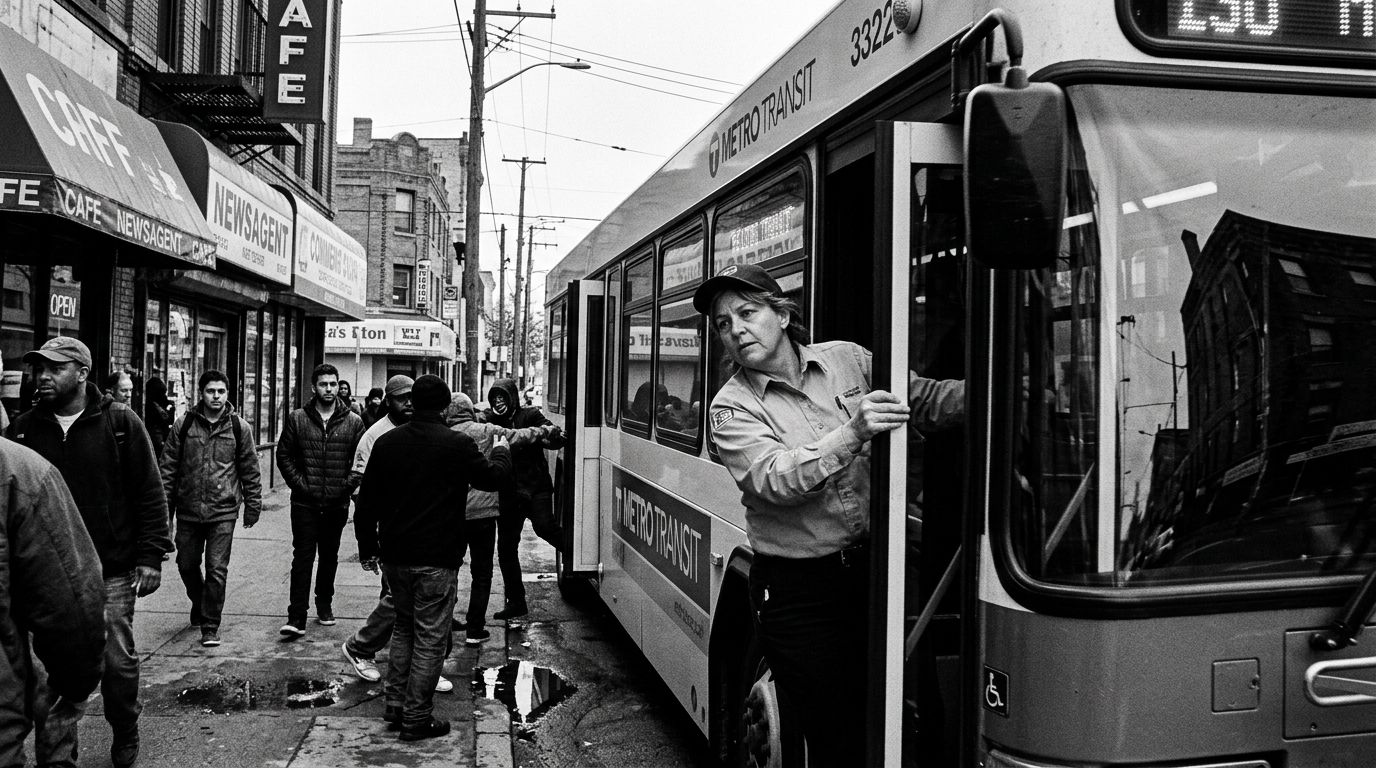
You can't talk about transit equity without talking about the people who actually drive the buses and maintain the trains. Public transportation workers are in crisis, and their crisis is every rider's crisis.
An APTA survey of 117 transit agencies found that 85% continue to face worker shortages, with bus operator positions being the hardest to fill. That's not just a hiring statistic. Every unfilled position means a route gets cut, a schedule gets thinned, and a worker somewhere misses their shift.
The reasons are structural. About 84% of agencies point to the complexity of obtaining a Commercial Driver's License as a major hiring barrier, particularly the mechanical inspection requirement that tests drivers on under-the-hood components. This requirement is increasingly absurd as agencies transition to electric buses that don't have traditional engines. We're literally testing drivers on technology that's being phased out, and it's keeping qualified candidates from filling desperately needed positions.
Pay is another factor. Transit operators face assaults, grueling split shifts, and mandatory overtime. The pandemic exposed just how essential these workers are, and how little that designation translated into actual compensation or protection. The CDC developed specific guidance for bus operators, rail operators, and transit maintenance workers during COVID-19 because these jobs couldn't go remote. These workers kept cities running while white-collar professionals worked from their couches.
This connects directly to the broader labor movement. The same dynamics playing out in supply chain organizing by the Teamsters apply to transit: essential work, difficult conditions, and employers who resist adequate staffing. When transit agencies can't retain workers, service degrades, ridership drops, and politicians use declining ridership to justify further cuts. It's a death spiral, and working people pay the price.
How Bad Transit Keeps Workers Poor
I spent a few years commuting by bus in a mid-sized city. My office was eleven miles from my apartment. By car, that's twenty minutes. By bus, it was an hour and fifteen, with one transfer. When I missed the connection, it was two hours. Multiply that by five days a week, fifty weeks a year, and you start to understand why commute inequality is really just income inequality wearing a different hat.
Research covering nine major U.S. cities found stark disparities in transit access to jobs, with the EPA's Access to Jobs and Workers via Transit data covering 88% of all transit ridership in the country. The picture these analyses paint is consistent: low-wage workers have the least access to the transit they need most.
Seattle's transit-dependent workers have relatively high job access compared to other cities, largely because the region invested in one of the country's largest public transit systems. But even in Seattle, access drops significantly during off-peak hours and overnight. That matters because the workers who most need transit don't work 9-to-5. They work retail closing shifts, hospital night shifts, warehouse early mornings. A transit system designed around the traditional commute pattern actively discriminates against shift workers.
This is where transit equity intersects with prevailing wage protections and other labor standards. You can raise the minimum wage, strengthen workplace safety rules, and expand union rights, but if workers can't physically reach the jobs that offer those benefits, the policies don't matter. Transportation is the foundation everything else sits on.
Every $1 billion invested in public transit generates roughly $5 billion in long-term economic value, supports 41,400 jobs, and produces $3.1 billion in worker income. That return on investment dwarfs most highway projects. But highway spending consistently outpaces transit spending at every level of government.
What Actually Works: Equity Strategies That Help Workers

Transit equity strategies fall into two categories, according to the Victoria Transport Policy Institute's research. Programmatic strategies provide targeted benefits to specific groups: fare discounts for seniors and people with disabilities, universal design standards, and special mobility services. Structural strategies reform the system itself to produce fairer outcomes for everyone.
Both matter. But structural changes are where the real gains live.
Here's what cities that take transit equity seriously are actually doing:
Bus priority lanes. Urban Institute research suggests that dedicated bus lanes improve job access more cost-effectively than simply increasing service frequency. A bus stuck in the same traffic as cars isn't public transit. It's a slow car with more passengers.
Off-peak and weekend service expansion. Shift workers need transit at 11 PM and 5 AM. Period. Cities like Seattle have started extending service windows specifically because research showed that transit-dependent workers needed access beyond traditional commute hours.
Transit-oriented development with affordability requirements. Building nice apartments next to train stations doesn't help if rents push out the workers who need the trains. Denver's Transit Oriented Development Fund pairs housing affordability with transit proximity. Without those protections, transit investment becomes a gentrification accelerator.
Community-driven planning. SEPTA, CapMetro, and King County Metro have developed equity statements through processes that involve staff at all levels, creating accountability tools for decision-making. This isn't just bureaucratic box-checking. When agencies actually listen to riders, they make different decisions about where routes go and when they run.
CDL modernization. Updating licensing requirements to reflect electric bus technology would expand the labor pool and get more drivers on the road faster. This is one of those rare policy fixes that helps both workers seeking transit jobs and workers depending on transit service.
This Is a Labor Fight
I keep coming back to a simple truth: transportation policy is labor policy. Every route cut is a layoff that doesn't show up in the jobs report. Every fare hike is a pay cut that doesn't trigger overtime calculations.
The labor movement has historically understood this. Union contracts in manufacturing and the trades often include transportation provisions because organizers know that getting to work is part of work. The same logic that drives the fight for financial services access for working people applies here. When essential infrastructure fails the people who need it most, that's not an accident. It's a policy choice.
And like most policy choices, it can be changed through organized pressure. Transit agencies are public entities. They have boards. They hold public comment periods. They respond to political pressure when that pressure is sustained and specific.
If you're a union member, push your local to engage with transit planning. If you're a worker who depends on a bus to get to your job, show up at the next board meeting and tell them what a missed connection costs you. These agencies need to hear from the people their decisions actually affect, not just the consultants and real estate developers who dominate planning conversations.
The connection between workers' rights on the job and workers' ability to reach the job is not abstract. It's the difference between making rent and not. Between keeping a job and losing it. Between a city that works for everyone and a city that works for people with cars.
Transit equity starts with recognizing a basic fact: a public transportation system that doesn't serve working people isn't public at all. It's just infrastructure with good branding. Demand better from your city. Show up. Bring your coworkers.
The Union Edge Staff
Also in the paper