
How the Teamsters Are Organizing the Supply Chain
Every package you order passes through roughly a dozen pairs of hands before it reaches your door. The workers behind those hands — the forklift operators, the dock loaders, the freight drivers pulling 14-hour shifts — are the invisible backbone of the American economy.

How the Teamsters Are Organizing the Supply Chain, One Terminal at a Time
Every package you order passes through roughly a dozen pairs of hands before it reaches your door. The workers behind those hands — the forklift operators, the dock loaders, the freight drivers pulling 14-hour shifts — are the invisible backbone of the American economy. And the International Brotherhood of Teamsters is betting that organizing them, link by link across the entire supply chain, is the most important labor campaign of this decade. They might be right.
The Teamsters aren't just signing up workers at individual warehouses and calling it a day. They're running an inter-divisional campaign that connects port drivers, freight haulers, and warehouse employees into a single organizing strategy. The idea is simple but ambitious: you can't fix conditions at one node in the supply chain while the companies exploit workers at the next node down the line. So you organize the whole chain.
Treating the Supply Chain as a System
Most union campaigns target a single employer at a single site. Sign cards, hold an election, negotiate a contract. It's a proven model. But the modern supply chain doesn't operate in neat, isolated boxes. A company like XPO Logistics moves goods through ports, into warehouses, and onto trucks — and the workers at each stage face different managers, different pay scales, and different pressures, all under the same corporate umbrella.
The Teamsters recognized this years ago. Their approach, as outlined in their warehouse organizing platform, explicitly connects the fight at the Port of Los Angeles to operations at facilities like Cal-Cartage, treating warehouse work as an integral part of port operations. That's not just rhetoric. It's a structural decision about how to allocate organizers, coordinate campaigns, and apply pressure at multiple points simultaneously.
Think of it this way: if you only organize the drivers but leave the warehouse workers non-union, the company can squeeze the warehouse side to offset concessions it made to drivers. The whole chain has to move together, or the gains at any single point stay fragile.
The Teamster Organizing Model: Why 65% Matters
One thing that separates Teamsters organizing from some other union efforts is their threshold for action. The Teamster Organizing Model uses a systematic, benchmarked process that requires reaching at least 65% support among workers before filing for an election. That's well above the legal minimum needed to trigger a vote.
Why set the bar so high? Because elections are brutal. The period between filing and voting is when companies pour resources into anti-union campaigns — captive audience meetings, one-on-one supervisor pressure, sometimes outright intimidation. If you walk into that fight with bare-minimum support, you're likely to watch it evaporate under the pressure. Starting at 65% gives organizers a buffer. It also means, by the time an election happens, the result is less of a coin flip and more of a confirmation of what workers already decided.
This discipline is unglamorous work. It means months of relationship-building before any public campaign. It means saying "not yet" to workers who are ready to fight but whose coworkers aren't. And it means a lot of house calls.
The House Call: Old-School Tactics That Still Work
The Teamsters' internal training materials lay out an organizing philosophy that feels almost quaint in an era of Slack channels and social media campaigns. The core unit of organizing is the house call — showing up at a worker's home, having a real conversation, and then asking for a specific commitment. As their organizer manual describes it, every visit should "build the organization in some way," starting with small tasks and gradually increasing the level of activity.
This is deliberate. Asking someone to wear a union button is a tiny act. But it's a public one. And once a worker has taken one visible step, the next step — talking to a coworker, attending a meeting, signing a card — becomes psychologically easier. It's the same escalation-of-commitment principle that good product designers use, applied to building collective power.
The pattern is strikingly similar to what's happening in tech worker organizing across Silicon Valley, where personal relationships and peer-to-peer conversations have proven far more effective than top-down campaigns. Different industries, same human dynamics.
XPO and FedEx Freight: The Terminal-by-Terminal Fight
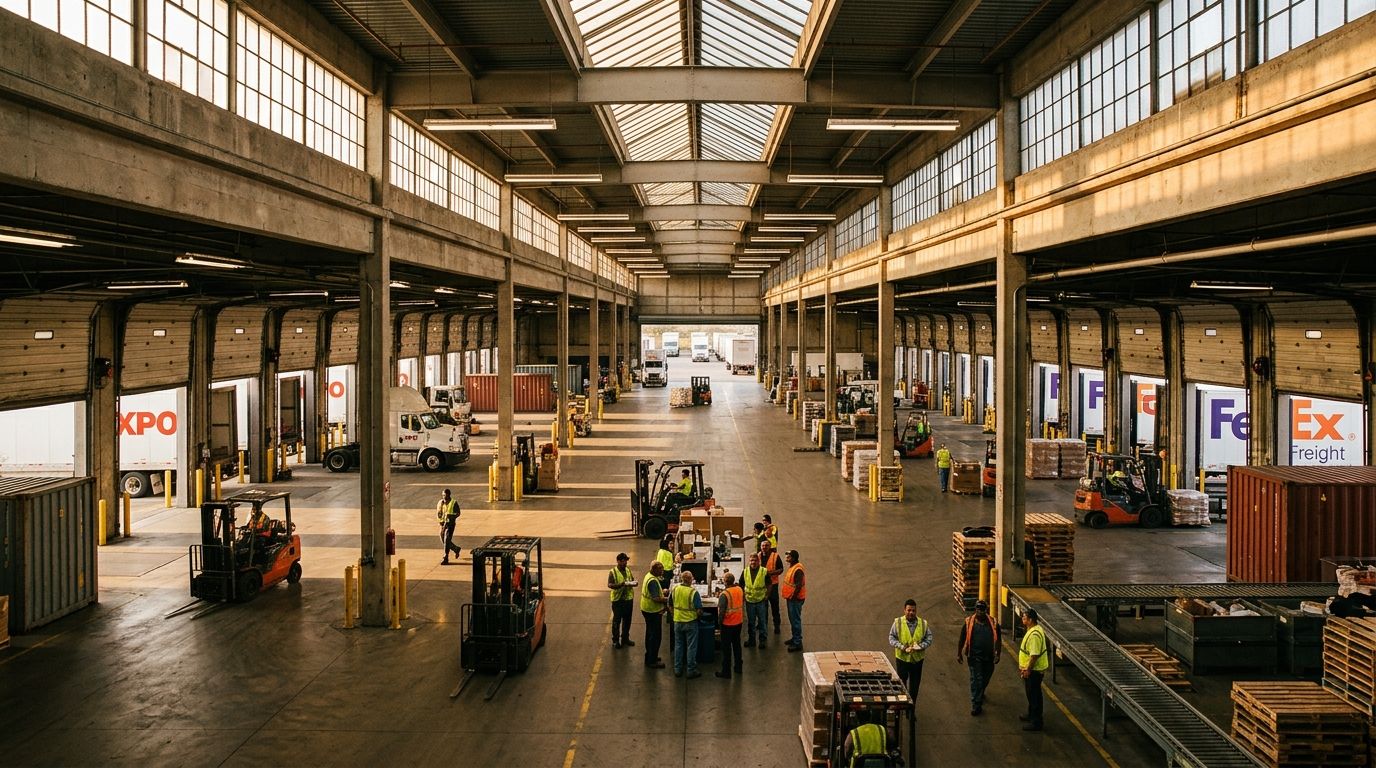
The Teamsters' two biggest freight targets tell you a lot about their strategy. Both XPO (formerly Con-way) and FedEx Freight are massive non-union carriers that compete directly with Teamster-represented companies. When those non-union carriers can undercut Teamster shops on price — often by paying drivers less and skimping on benefits — it puts downward pressure on standards across the entire freight industry.
So the Teamsters went after them. Not with a single, nationwide election (federal labor law generally doesn't allow that for freight companies), but through terminal-by-terminal organizing across the country. Each terminal election is a small campaign unto itself, with its own dynamics and its own set of worker leaders. But the cumulative effect is significant.
The union has been open about the secondary benefits of this approach: each campaign exposes the companies' bad behavior, generates public attention, raises standards for drivers at both companies, and costs the employers millions of dollars in anti-union efforts. Even terminals where the union doesn't win still force the company to spend money and make concessions to stave off future votes. It's a war of attrition, and the Teamsters are comfortable playing the long game.
E-Commerce Changed the Stakes
The explosion of online shopping didn't just create new warehouse jobs. It created new warehouse jobs that are faster, more grueling, and more precarious than what existed before. The pressure to fulfill orders in hours rather than days flows downhill to the workers doing the picking, packing, and loading.
Teamsters Union Director of Organizing Jeff Farmer has spoken directly about how e-commerce has reshaped the landscape for supply chain workers. In an economy where speed and cost-cutting dominate every corporate decision, collective bargaining matters more, not less. When companies compete on delivery times, the human cost gets absorbed by the people on the warehouse floor — unless those people have a contract that sets limits.
This is where the warehouse union push becomes especially important. Warehousing used to be a relatively stable job with decent pay in many regions. The e-commerce boom added hundreds of thousands of positions, but many of them came with temporary status, mandatory overtime, production quotas that border on punitive, and few pathways to permanent employment. Workers in these facilities are younger, more diverse, and often more transient than the traditional Teamster membership — which means organizing them requires different outreach strategies and different conversations about what a union can deliver.
The Inter-Divisional Approach: Connecting Ports, Freight, and Warehouses
Here's what makes the Teamsters' strategy different from a typical organizing campaign: they're not building separate campaigns that happen to target the same industry. They're building one campaign with multiple fronts.
The union's formal resolutions commit to an "inter-divisional approach" — meaning the Warehouse Division, the Freight Division, and the Port Division coordinate their efforts rather than working in silos. When the Teamsters organize port drivers in Los Angeles, that campaign directly informs and supports warehouse organizing at nearby distribution centers. When freight workers at an XPO terminal vote to unionize, it creates pressure for negotiations at XPO warehouses in other states.
This matters because modern supply chain companies are themselves integrated. XPO doesn't just do freight. Amazon doesn't just do e-commerce. These companies operate across multiple supply chain segments, and their labor strategies are centralized even when their operations are scattered across hundreds of facilities. A union that only fights at one level is always at a disadvantage against an employer that thinks across the whole system.
The parallel to labor disputes in the airline industry is worth noting. Airline workers have long understood that mechanics, flight attendants, pilots, and ground crews all depend on each other's bargaining strength. The Teamsters are applying that same interconnected thinking to the supply chain.
What Companies Are Doing in Response

No honest article about organizing can skip the employer side. Companies facing Teamsters campaigns have a well-funded playbook. Captive audience meetings — where attendance is mandatory and the message is anti-union — remain legal in most states. Some employers hire specialized consultants who run sophisticated counter-campaigns, complete with targeted messaging, supervisor training, and social media monitoring.
The terminal-by-terminal approach at FedEx Freight has cost the company millions in these efforts. And that spending, paradoxically, is part of the Teamsters' calculation. Every dollar a non-union carrier spends fighting organizing is a dollar it can't use to undercut Teamster-represented companies on price. The organizing campaign has strategic value even at terminals where the vote is lost.
But workers bear real risk. Retaliation, while illegal, is notoriously difficult to prove and slow to remedy through the National Labor Relations Board. Workers who lead organizing efforts can face schedule changes, disciplinary write-ups, and social isolation from managers. The 65% threshold the Teamsters set isn't just about winning elections — it's about making sure enough coworkers have each other's backs that no single person is easy to pick off.
Why This Matters Beyond the Supply Chain
The Teamsters' supply chain campaign is, in some ways, a test case for whether the American labor movement can adapt to an economy built on logistics. Manufacturing was the foundation of union power in the 20th century. Logistics is the equivalent for the 21st. The warehouses, freight terminals, and distribution centers that keep the economy running are the new factories — and the question of whether those jobs will be middle-class jobs or poverty-wage jobs is being decided right now.
The Teamsters represent over 1.3 million members across North America. Their supply chain push, if it gains enough momentum, could reshape wage standards across an industry that touches every sector of the economy. A warehouse union contract in one metro area creates a reference point that workers in the next city over can point to. A freight contract at one carrier forces competitors to match or risk losing drivers.
That cascading effect is the real prize. Not just the individual contracts, but the upward pressure on standards across the entire supply chain labor market.
What Supply Chain Workers Can Do Now
If you're a supply chain worker thinking about organizing, here's what the Teamsters' approach tells you. First, don't rush to an election. Build deep support — 65% or more — before you go public. Second, connect with workers at other points in your company's supply chain. Your power multiplies when dock workers, drivers, and warehouse staff coordinate. Third, expect the fight to be long. Terminal-by-terminal, facility-by-facility campaigns aren't fast. But they're durable.
And if you're not a supply chain worker, pay attention anyway. The conditions in the warehouses and freight terminals your packages pass through affect the entire economy. The Teamsters are making a bet that organizing these workers isn't just good for the workers themselves — it's the structural fight that determines whether logistics jobs become the next generation of stable, middle-class employment or remain a race to the bottom. The outcome of that bet will show up on your doorstep, one way or another.
The Union Edge Staff
Also in the paper