
Federal Court Voids New Jersey's Mandatory Union Labor Requirements for Cannabis Industry
A federal district court ruled on August 10, 2026, that New Jersey cannot force cannabis businesses to sign labor peace agreements with unions as a condition of licensure, striking down a state mandate that had governed the industry since legalization. United States District Judge Michael A.

Federal Court Voids New Jersey's Mandatory Union Labor Requirements for Cannabis Industry
A federal district court ruled on August 10, 2026, that New Jersey cannot force cannabis businesses to sign labor peace agreements with unions as a condition of licensure, striking down a state mandate that had governed the industry since legalization. United States District Judge Michael A. Shipp found the requirement preempted by the National Labor Relations Act, according to a Duane Morris LLP legal analysis published Monday.
The decision follows similar rulings in Oregon, California, and New York, where federal courts have blocked state efforts to tie cannabis licensing to union agreements. Judge Shipp's final judgment in Curaleaf v. New Jersey Cannabis Regulatory Commission marks the fourth state-level union mandate invalidated on federal preemption grounds in the past year.
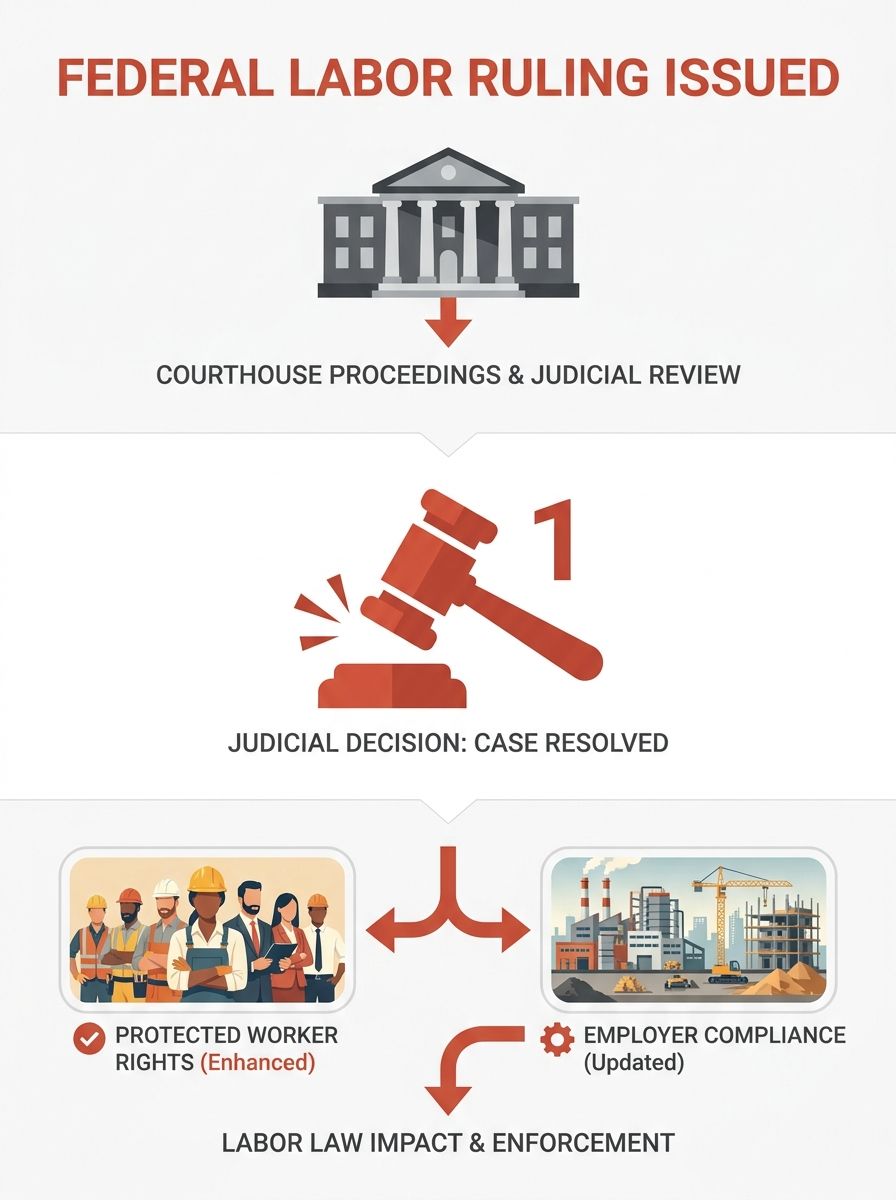
The State's Union Mandate
New Jersey's Cannabis Regulatory, Enforcement Assistance, and Marketplace Modernization Act required cannabis licensees to sign labor peace agreements with qualifying labor unions before receiving state approval to operate. The agreements granted unions broad access to organize employees and typically required employers to remain neutral during organizing campaigns. The law went further than other states by mandating that licensees enter collective bargaining agreements within 200 days of opening for business.
State regulators monitored compliance closely, reviewing whether licensees were negotiating in good faith during annual license renewals. Failure to meet the requirements exposed businesses to fines of up to $5,000 per day, license suspension, or revocation.
The Cannabis Regulatory Commission enforced the provision aggressively. When Curaleaf's labor peace agreement with UFCW Local 360 expired in April 2025 and renewal negotiations stalled, state commissioners imposed a $610,000 civil penalty and threatened to revoke the company's licenses.
Curaleaf's Federal Challenge
Curaleaf filed suit in federal court in October 2025, arguing that the state requirement violated federal labor law. The company advanced four preemption arguments: the mandate forced employers to surrender economic bargaining tools protected under federal law, it regulated union organizing in areas exclusively governed by the National Labor Relations Act, it imposed state penalties for conduct only federal agencies can regulate, and it restricted workers' freedom to choose their union representative by limiting eligible organizations to those meeting narrow state criteria.
Similar legal challenges had already gained traction in other states. In Casala, LLC v. Kotek, a federal court in Oregon granted a permanent injunction striking down that state's labor peace agreement requirement months before Curaleaf filed its complaint. Cannabis operators in California and New York filed parallel lawsuits challenging their states' union mandates on identical federal preemption grounds.
The New Jersey case became the test of whether states could condition business licenses on labor agreements even in industries operating in legal gray areas under federal law.
Court's Reasoning
Judge Shipp's May 2026 memorandum opinion addressed whether the National Labor Relations Act applies to cannabis businesses despite the federal prohibition on marijuana. The court ruled that federal labor protections extend to cannabis workers because the NLRA governs labor relations regardless of the underlying industry's federal legal status. Workers' rights to organize and bargain collectively remain protected under federal law.
The court found New Jersey's requirement preempted on two grounds. First, the mandate impermissibly regulated activity protected by the NLRA by forcing employers to recognize unions based on signed authorization cards rather than allowing them to insist on secret-ballot elections supervised by the National Labor Relations Board. Second, the requirement restricted economic tools—including the right to lock out workers during disputes—that Congress deliberately left unregulated to maintain balance between labor and management.
Judge Shipp entered final judgment on August 10, 2026, declaring the labor peace agreement requirement preempted as applied to Curaleaf. The ruling did not prevent cannabis workers from organizing voluntarily under federal labor law. It invalidated only the state's mandate that employers accept union agreements as a licensing condition.
Impact on Cannabis Industry
The decision affects cannabis operators across New Jersey immediately. Businesses that signed labor peace agreements under regulatory pressure are no longer legally bound to maintain them solely to keep their licenses. Companies facing threatened fines or license actions for failing to reach collective bargaining agreements can invoke the federal court's preemption ruling.
Operators applying for new licenses in New Jersey cannot be required to submit labor peace agreements as part of their applications. State regulators must revise licensing procedures to remove union agreement requirements from the approval process.
Similar federal court rulings blocking state labor board jurisdiction have created a pattern of judicial skepticism toward state-level mandates in areas governed by the National Labor Relations Act. The New Jersey decision reinforces that pattern in the cannabis sector specifically.
Cannabis companies in other states with similar mandates now have a growing body of federal case law supporting preemption challenges. California and New York operators facing union agreement requirements have cited the Oregon and New Jersey rulings in their own pending cases.
Policy Implications
The ruling does not prevent cannabis workers from organizing unions through the standard National Labor Relations Board process. Federal labor law remains fully available to employees seeking collective representation. The decision restricts only state governments' ability to mandate union agreements as licensing prerequisites, restoring the balance Congress established between employer and employee rights under the NLRA.
States that conditioned cannabis licenses on labor agreements must now decide whether to appeal, revise their statutes to remove union mandates, or face additional preemption challenges. New Jersey regulators have not indicated whether they will appeal Judge Shipp's ruling. Oregon chose not to appeal its similar loss, effectively ending that state's labor peace agreement requirement.
The decision may influence how states approach labor policy in newly legalized industries. Legislators seeking to support union organizing while avoiding federal preemption challenges will need to craft incentives rather than mandates—such as application scoring preferences for businesses with existing union relationships rather than absolute licensing requirements. Federal labor law permits states to encourage voluntary agreements but prohibits conditioning business licenses on surrendering rights protected by the NLRA.
The Union Edge Staff
Related Articles
Federal Court Blocks New York's Expansion of State Labor Board Jurisdiction
A federal judge issued a permanent injunction on July 20, 2026, barring New York State from enforcing a 2025 law that expanded the state labor board's authority over private-sector workplace disputes, ruling that federal law grants the National Labor Relations Board exclusive jurisdiction over such
Eleven Greenlight Dispensary Workers in Missouri Allege Firing for Union Organizing
Eleven employees at a Greenlight Dispensary in Springfield, Missouri, were terminated in late September 2026 after meeting to discuss unionization, according to statements the workers gave to local media.

Springfield Cannabis Workers Ratify First Union Contract After Four-Year Campaign
Cannabis workers at Key Cannabis Dispensary in Springfield, Missouri, ratified their first collective bargaining agreement in late July 2026, securing wage increases, bonuses, and expanded paid time off after a four-year organizing campaign that began with a 6-3 union vote in 2022, according to the
Also in the paper