
Minimum Wage Ohio: 2024 Rates & Legal Guide
Article II, Section 34a of the Ohio Constitution contains the formula that sets Ohio's minimum wage every January 1, removing the state legislature from the process entirely. The rate adjusts automatically based on the Consumer Price Index, which pushed the minimum wage in Ohio from $10.

Minimum Wage Ohio: How the Constitutional Wage Escalator Actually Works
Article II, Section 34a of the Ohio Constitution contains the formula that sets Ohio's minimum wage every January 1, removing the state legislature from the process entirely. The rate adjusts automatically based on the Consumer Price Index, which pushed the minimum wage in Ohio from $10.45 per hour in 2024 to $11.00 per hour in 2026, while Congress hasn't touched the federal floor of $7.25 since 2009. If you work in Ohio and earn close to the floor, the mechanism that determines your pay is a math formula, and understanding it is the first step toward knowing whether you're being paid correctly.
What Ohio's Minimum Wage Is, and What Made It Automatic
Ohio's minimum wage is a constitutionally mandated hourly floor that applies to most workers in the state, set by voter-approved amendment rather than legislative action. That distinction matters enormously for workers, because it means no governor and no statehouse majority can vote to freeze or lower it.
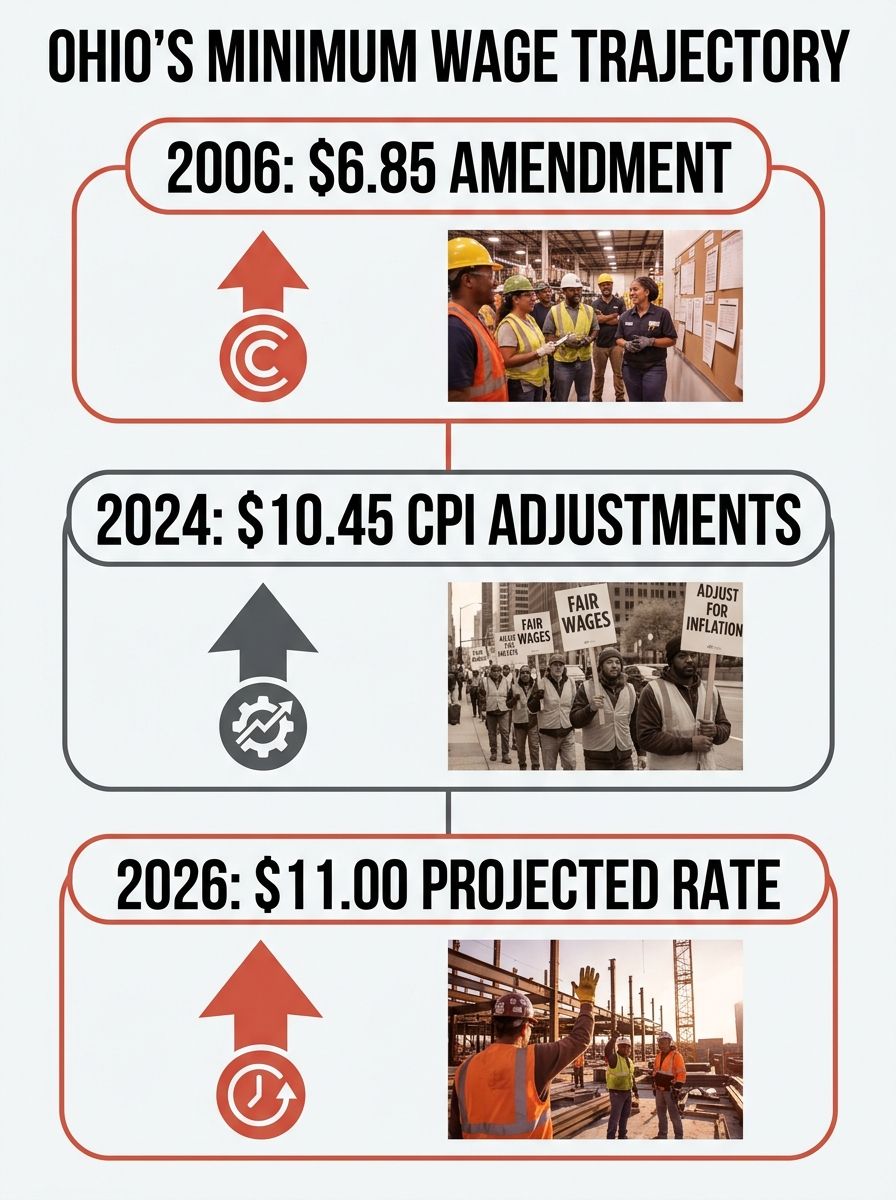
Ohio voters passed the constitutional amendment in 2006, embedding the wage floor directly into Article II, Section 34a. The amendment established two things: an initial rate (then $6.85 per hour) and a permanent mechanism for annual increases pegged to the Consumer Price Index for Urban Wage Earners and Clerical Workers (CPI-W). This made Ohio one of a handful of states where the wage floor adjusts without requiring a single legislator to cast a vote, similar in principle to how Oregon ties its wage zones to CPI.
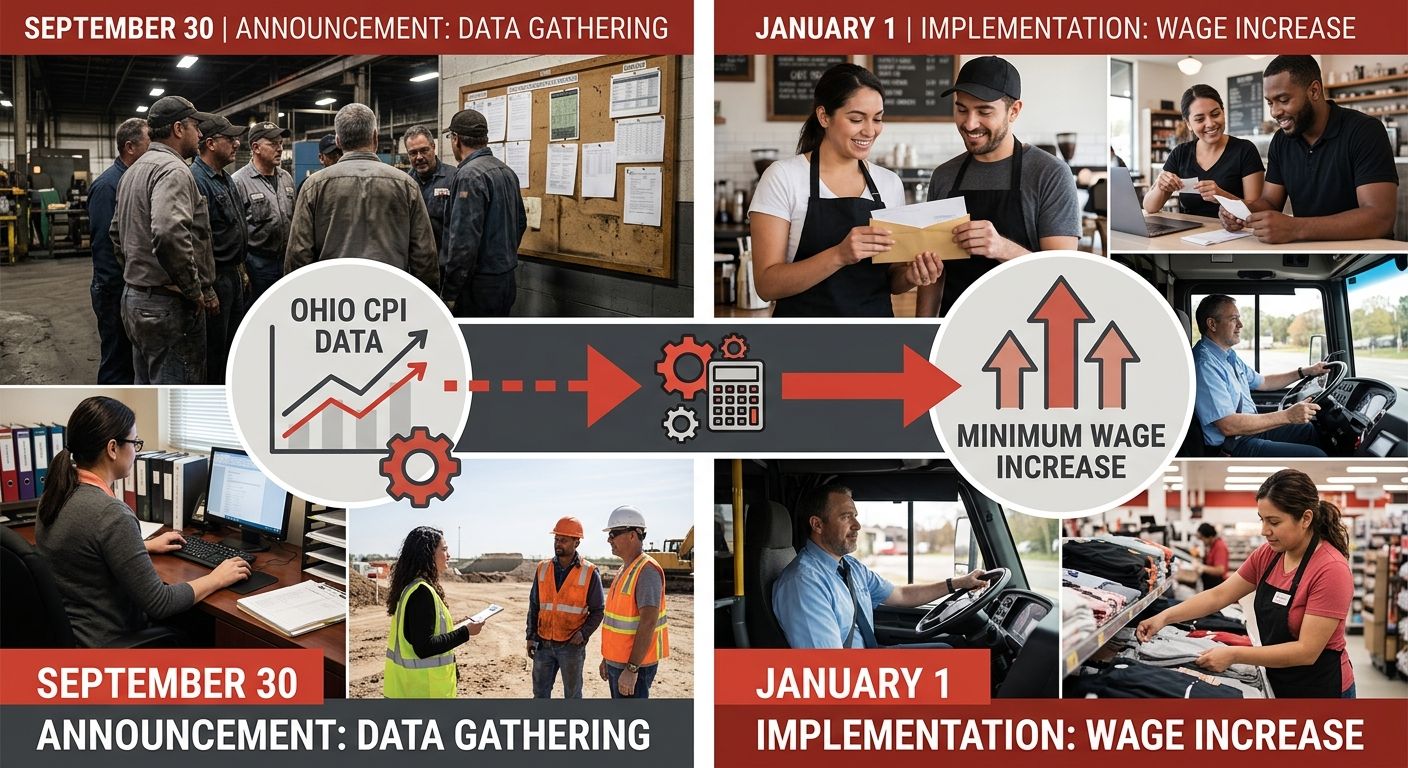
The Ohio Department of Commerce, not the legislature, administers the adjustment. Each year by September 30, the department announces the new rate for January 1. According to the 2024 minimum wage poster issued by the department, the rate structure applies to all employers meeting the gross receipts threshold, with no exemptions for industry type.
The CPI Formula That Drives Annual Increases
Every September, the Ohio Department of Commerce runs a straightforward calculation: it compares the CPI-W from the current year to the prior year's figure, then adjusts the existing minimum wage rate by that same percentage. The result is rounded to the nearest five cents, and that becomes the new floor.
The formula explains why increases feel modest in low-inflation years and more noticeable after price spikes. In 2024, the adjustment added $0.35 to the prior rate, moving Ohio's minimum wage from $10.10 to $10.45 per hour for non-tipped employees. By 2026, two more annual adjustments brought the rate to $11.00 per hour. As the St. Louis Federal Reserve tracks, the state minimum wage can change annually based on changes in the CPI and a cost-of-living formula built into the state constitution.
One critical detail: the formula only permits increases. If the CPI-W declines year over year (deflation), Ohio's minimum wage stays flat rather than dropping. This one-way ratchet is a worker protection baked into the constitutional language.
The practical effect is that Ohio's floor has climbed every year since 2006 with only brief pauses during deflationary periods. But the pace is slow. Inflation-adjusted, that original $6.85 rate and the current $11.00 rate have tracked consumer prices, meaning workers' purchasing power relative to the wage floor has barely moved in two decades. Advocacy groups estimate the rate won't reach $15.00 per hour until approximately 2034 at current CPI trends, which would leave Ohio well behind states like Florida, where voters locked in a $15.00 target through constitutional amendment.
Tipped Employees and the Half-Rate Rule
Ohio calculates its tipped minimum wage using a clean formula: exactly one-half of the standard state minimum wage. When the non-tipped floor was $10.45 in 2024, the tipped rate was $5.25 (technically $5.225, rounded up). At the current $11.00 rate, the tipped minimum is $5.50 per hour.
This half-rate structure is the tip credit in action. An employer takes a credit of up to $5.50 per hour against the minimum wage obligation, based on the assumption that tips will cover the difference. The math only works if the employee's cash wage plus tips equals or exceeds $11.00 per hour for every hour worked. If tips fall short, the employer owes the difference.
The obligation is per-pay-period, and it falls entirely on the employer. Workers don't have to ask for it; the law requires automatic correction. But enforcement depends on workers knowing the rule exists and keeping their own records. The Ohio Department of Commerce requires employers to maintain tip and hour records for at least three years, and workers should maintain parallel records.
The Two-Tier Employer System: Gross Receipts and Who Falls Through
Here's where Ohio's minimum wage structure gets complicated, and where the largest number of workers lose money without realizing it. Ohio operates a two-tier system based on employer gross receipts.
Tier 1 applies to employers with annual gross receipts exceeding $385,000 (the 2024 threshold, which has since risen to approximately $405,000 in 2026 as it also adjusts with inflation). These employers must pay the full state minimum wage: $10.45 in 2024, $11.00 in 2026.
Tier 2 applies to employers grossing below that threshold. These smaller employers are required to pay only the federal minimum wage of $7.25 per hour, a rate unchanged since July 2009. The same $7.25 floor applies to 14- and 15-year-old workers regardless of employer size.
The gap between the two tiers is significant: $3.75 per hour in 2026. For a full-time worker, that's roughly $7,800 per year in lost wages. And many workers at small businesses don't know they're in Tier 2. Employers aren't required to prominently disclose which threshold they fall under, though they must post the correct minimum wage poster for their category.
This structure creates a practical enforcement problem. A worker at a small restaurant, dry cleaner, or retail shop earning $7.25 may assume they're being paid the legal minimum, and technically they are, if the employer's gross receipts fall below the threshold. But if the business crosses the threshold mid-year (say, after a strong holiday season), the obligation shifts upward, and the employer must begin paying the full state rate. Workers rarely learn about this transition unless they ask to see the company's financials or file a complaint.
Neighboring Michigan operates a simpler single-tier system that avoids this confusion entirely.
Category | 2024 Rate | 2026 Rate | Applies To |
|---|---|---|---|
Non-tipped (large employer) | $10.45/hour | $11.00/hour | Employers with gross receipts above threshold |
Tipped (large employer) | $5.25/hour | $5.50/hour | Tipped workers at employers above threshold |
Small employer / Youth | $7.25/hour | $7.25/hour | Employers below $385K-$405K threshold; ages 14-15 |
Federal minimum | $7.25/hour | $7.25/hour | Unchanged since 2009 |
The September 30 Announcement Cycle and Payroll Compliance
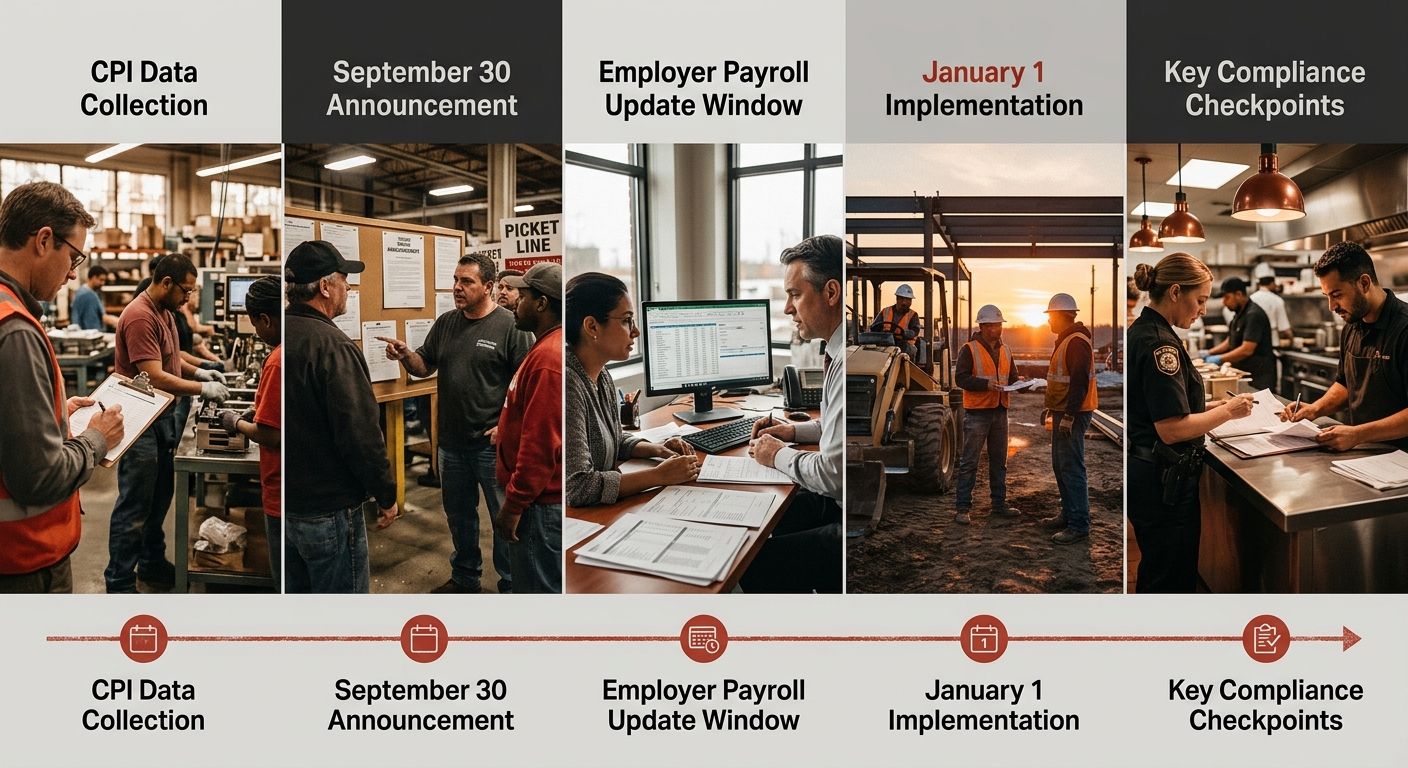
Ohio's Department of Commerce announces the new minimum wage rate on September 30 each year, giving employers a 92-day window to update payroll systems before the January 1 effective date. That window sounds generous, but the compliance failures happen in predictable places.
Employers who use automated payroll services generally absorb the change without incident. The problem concentrates among small and mid-size employers running manual payroll, particularly in food service, retail, and seasonal agriculture. A 2024 analysis by TimeTrex noted that compliance requires employers to update both standard and tipped rates simultaneously, since the tipped rate moves in lockstep with the standard rate.
The September 30 announcement also triggers an update to the gross receipts threshold, which adjusts on its own CPI track. Employers near the boundary, grossing between $370,000 and $420,000, need to verify annually whether they've crossed into the higher-obligation tier. The threshold rose from $385,000 in 2024 to approximately $394,000 in 2025 and $405,000 in 2026.
For workers, the practical takeaway is straightforward: check your first pay stub of each new year. If the hourly rate hasn't moved, either your employer falls below the gross receipts threshold, or they haven't updated. The difference between those two situations is the difference between legal compliance and wage theft.
Where the Mechanism Breaks Down
Ohio's constitutional wage escalator is well-designed in theory, but it has three clear failure points that affect real workers every pay period.
The CPI tracks prices, not productivity. Worker productivity in the United States has risen approximately 84% since 1979, but CPI-indexed wages only keep pace with consumer prices. Ohio's minimum wage workers are producing far more value per hour than they were in 2006, and the wage formula captures none of that surplus. The CPI escalator prevents erosion of purchasing power but does nothing to ensure workers share in the economic growth they generate.
The two-tier system is unverifiable by workers. Employees at small businesses have no practical way to confirm their employer's gross receipts. They must either trust the employer's posted minimum wage classification or file a formal complaint with the Department of Commerce, a step that carries obvious retaliation risks, despite legal protections against it. The burden of proof falls disproportionately on the people least equipped to bear it. This is the kind of structural problem that makes collective bargaining through union representation essential for low-wage workers.
Tipped workers absorb the risk. The half-rate rule assumes tips will reliably close the gap between $5.50 and $11.00. In practice, tip income fluctuates wildly by shift, season, and location. Workers on slow Tuesday lunches in rural Ohio experience the full weight of a $5.50 base wage, and many don't track hours and tips precisely enough to identify when their employer owes them a top-up. The enforcement mechanism exists on paper, but the detection mechanism is almost entirely dependent on individual workers monitoring their own pay, a task made harder by inconsistent tip reporting systems.
Common Questions
Does Ohio's minimum wage apply to all workers in the state?
No. Ohio's full state minimum wage ($11.00/hour in 2026) applies only to employees of businesses with annual gross receipts above the threshold ($405,000 in 2026). Workers at smaller employers and those aged 14-15 are covered by the federal minimum wage of $7.25/hour. Federal and state-exempt categories, including certain agricultural workers, live-in domestic employees, and some student workers, have separate rules.
How is the tipped minimum wage calculated in Ohio?
The tipped minimum wage is always exactly half the standard state rate. In 2024, that meant $5.25/hour (half of $10.45). In 2026, it's $5.50/hour (half of $11.00). If a tipped worker's base wage plus tips doesn't reach the full state minimum for all hours worked in a pay period, the employer must pay the difference. This isn't optional, it's a legal requirement under Ohio Revised Code Chapter 4111.
When does Ohio announce its new minimum wage rate each year?
The Ohio Department of Commerce announces the new rate on September 30 each year, based on CPI-W data. The new rate takes effect the following January 1. Employers have approximately three months to update payroll, and workers should verify their first pay stub of the new year reflects the adjustment. For current rate details, Ohio's official 2024 wage data provides a useful reference point.
Can Ohio's minimum wage ever decrease?
No. The constitutional amendment includes a one-way ratchet, if the CPI-W declines year over year, the minimum wage holds at its current level rather than dropping. This provision has been tested during deflationary periods, and the rate has never decreased since the amendment's passage in 2006.
What should I do if I think my employer is paying below the minimum wage?
Document everything: keep records of your hours, pay stubs, and (for tipped workers) daily tip totals. File a complaint with the Ohio Department of Commerce, which has enforcement authority under the constitutional amendment. Ohio law prohibits retaliation against workers who file wage complaints, though enforcement of anti-retaliation protections varies. Contacting a local workers' center or union organizer can provide additional support during the complaint process.
The Union Edge Staff
Frequently Asked Questions
- What is Ohio's minimum wage in 2024 and 2026?
- Ohio's minimum wage was $10.45 per hour in 2024 and increased to $11.00 per hour in 2026 for non-tipped workers. The tipped minimum wage is half the standard rate: $5.25 in 2024 and $5.50 in 2026.
- How does Ohio's automatic minimum wage adjustment work?
- Ohio's Constitution mandates an automatic annual wage adjustment based on the Consumer Price Index (CPI-W). The Ohio Department of Commerce announces the new rate on September 30 each year, and it takes effect January 1, with the wage adjusted by the same percentage as the CPI changed from the prior year.
- Does Ohio's minimum wage apply to all employers?
- No. Ohio uses a two-tier system: employers with annual gross receipts above $405,000 (in 2026) must pay the full state minimum wage, while smaller employers and workers aged 14-15 must only pay the federal minimum wage of $7.25 per hour.
- What is the tipped minimum wage in Ohio and how is it calculated?
- Ohio's tipped minimum wage is always exactly half the standard state minimum wage. In 2026, it's $5.50 per hour. If a tipped worker's base wage plus tips doesn't equal or exceed the full state minimum ($11.00) for a pay period, the employer is legally required to make up the difference.
- Can Ohio's minimum wage decrease if the economy experiences deflation?
- No. Ohio's constitution includes a one-way ratchet provision: if the Consumer Price Index declines year over year, the minimum wage stays at its current level rather than dropping.
- What should I do if my employer is not paying me the minimum wage?
- Document your hours, pay stubs, and daily tips (if applicable), then file a complaint with the Ohio Department of Commerce, which has enforcement authority. Ohio law prohibits retaliation against workers who file wage complaints, and you can contact a local workers' center or union for additional support.
- When does Ohio announce its new minimum wage rate each year?
- The Ohio Department of Commerce announces the new minimum wage rate on September 30 each year, based on CPI-W data. The new rate takes effect the following January 1, giving employers approximately three months to update payroll systems.
Related Articles

State of Ohio Minimum Wage: Current Rates & 2024
Constitutional Amendment II-34a, passed by Ohio voters in 2006, removed the state legislature from the annual minimum wage decision entirely.

Ohio's Minimum Wage 2024: Rates & Updates
Article II, Section 34a of the Ohio Constitution locks in an automatic minimum wage adjustment every January 1, indexed to the Consumer Price Index. The 2024 Ohio minimum wage was $10.45 per hour for non-tipped employees and $5.25 for tipped employees, and those rates have since risen to $11.

State of Colorado Minimum Wage 2024: Rates & Changes
Colorado's state minimum wage rose to $14.42 per hour on January 1, 2024, set automatically by a Consumer Price Index formula that removes the state legislature from annual rate decisions entirely.
Also in the paper