
Minimum Wage of Virginia: 2024 Guide
Governor Glenn Youngkin's 2023 veto of House Bill 1 and Senate Bill 1 broke Virginia's planned minimum wage escalator, freezing the rate at $12.00 per hour for both 2023 and 2024.

Minimum Wage of Virginia: 2024 Guide
Governor Glenn Youngkin's 2023 veto of House Bill 1 and Senate Bill 1 broke Virginia's planned minimum wage escalator, freezing the rate at $12.00 per hour for both 2023 and 2024. That single decision replaced a legislative roadmap to $15 with an inflation-indexing formula and left roughly a million Virginia workers earning less than what the original schedule promised.
The Legal Foundation: Virginia Code § 40.1-28.10
Virginia's minimum wage is governed by § 40.1-28.10 of the Virginia Code, enforced by the Virginia Department of Labor and Industry (DOLI). The statute sets both fixed-dollar floors for specific date ranges and a formula for annual inflation adjustments. Every employer in the Commonwealth must pay each employee wages at a rate no less than the greater of the state hourly minimum or the federal minimum wage, which has remained at $7.25 per hour since 2009.
The law covers the vast majority of private-sector workers, including domestic service employees who work more than 10 hours per week. Exemptions exist for certain students, nonprofit volunteers, and workers properly classified as independent contractors. Employers have historically stretched those exempt categories beyond what the statute actually allows, particularly when classifying tipped workers and part-time staff.
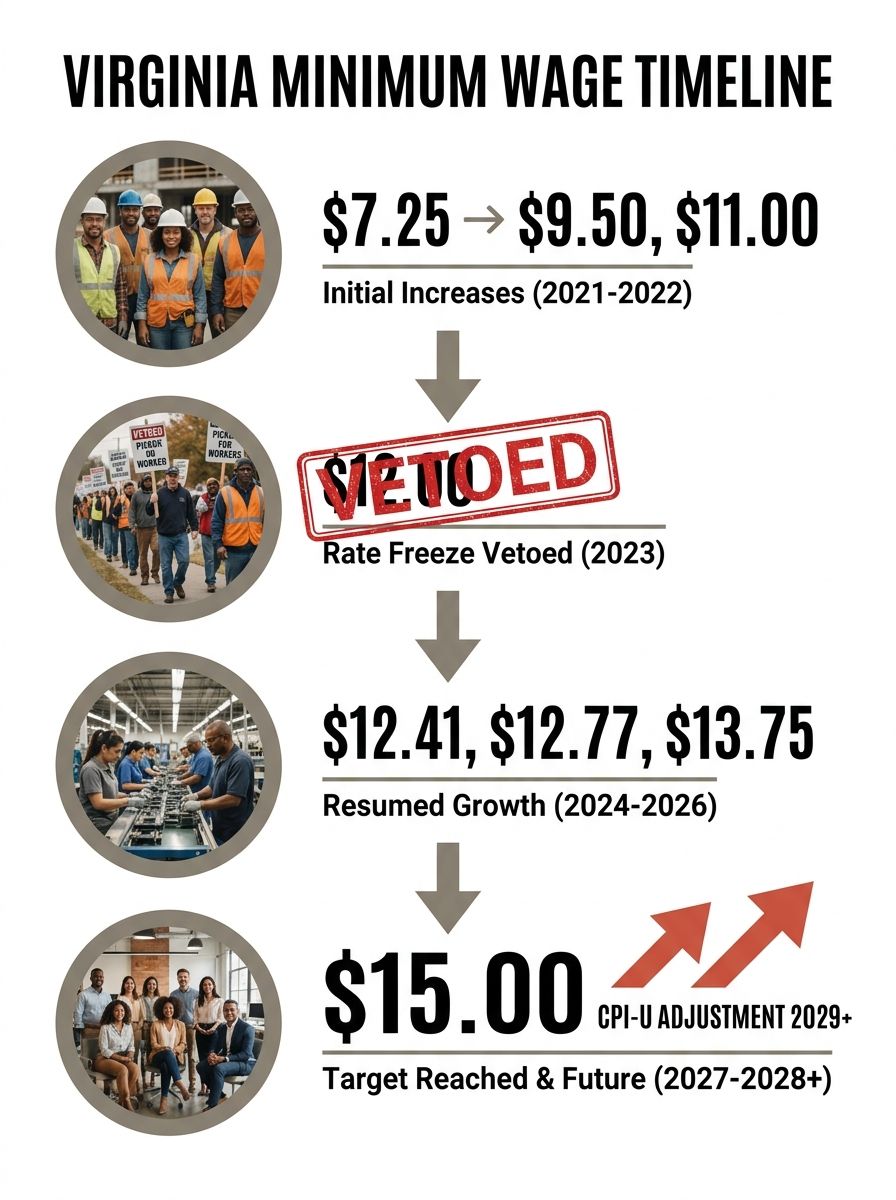
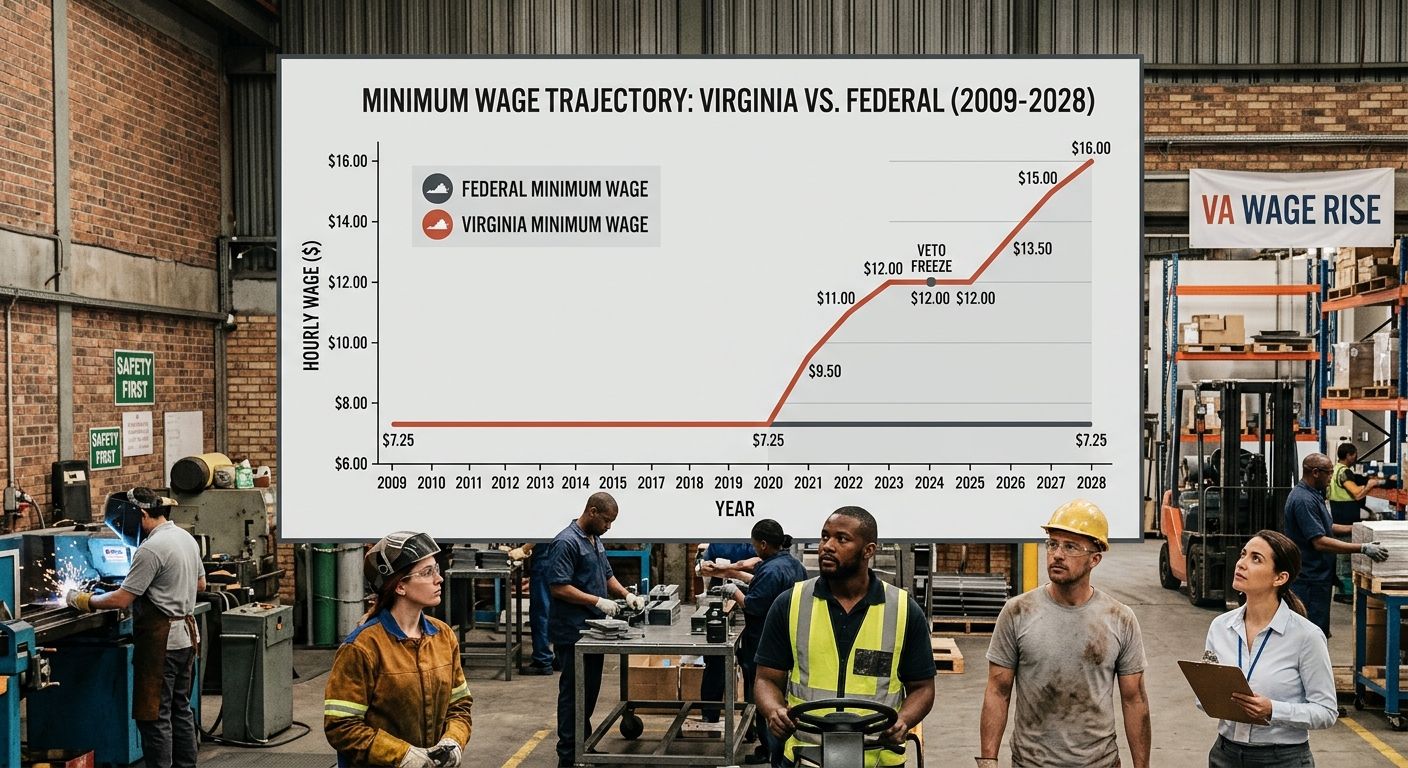
Virginia didn't always have its own minimum wage floor above the federal level. The state matched the $7.25 federal rate until 2021, when the General Assembly passed a phased increase schedule. That schedule raised the wage to $9.50 in May 2021, then to $11.00 in January 2022, and to $12.00 in January 2023. The plan called for further increases to $13.50 in 2025 and $15.00 in 2026, but those steps never took effect.
How the Veto Created a Two-Year Freeze
The original 2020 legislation included a "reenactment clause," requiring the General Assembly to pass the $13.50 and $15.00 phases a second time before they could take effect. When the legislature sent House Bill 1 and Senate Bill 1 to Governor Youngkin's desk in 2023, he vetoed both. According to Employer Pass's analysis, this veto left the minimum wage in Virginia for 2023 through 2024 at $12.00 per hour and abandoned the scheduled increases entirely.
The practical result: Virginia workers earned the same hourly minimum in January 2024 that they'd earned in January 2023. Meanwhile, the Consumer Price Index rose 3.4% over 2023. A worker earning exactly the minimum wage lost purchasing power equivalent to roughly $0.41 per hour, or about $850 per year for someone working full-time, without a single line item changing on their pay stub.
The veto didn't eliminate the adjustment mechanism entirely, though. It activated a backup provision in the statute: starting in 2025, the Commissioner of Labor and Industry would calculate annual adjustments based on the CPI-U, the Consumer Price Index for All Urban Consumers published by the Bureau of Labor Statistics. Workers who assumed their wage was permanently stuck at $12.00 were wrong, but the raises that followed were far smaller than what the original schedule had promised.
The CPI-U Adjustment Formula
The annual adjustment works through a specific calculation codified in § 40.1-28.10. The Commissioner takes the current state hourly minimum wage and multiplies it by the percentage increase in the CPI-U over the previous calendar year, then adds that product to the existing rate. The Commissioner must announce the new rate by October 1 for implementation the following January 1.
Here's how it played out for the first two post-freeze adjustments:
2025 rate: $12.00 + ($12.00 × 3.4% CPI-U increase from 2023) = $12.41 per hour
2026 rate: $12.41 + ($12.41 × 2.9% CPI-U increase from 2024) = $12.77 per hour
The DOLI announcement for the 2026 adjustment confirmed these calculations exactly. As OnPay's state wage comparison noted, the 2026 rate of $12.77 puts Virginia "about the middle of the pack compared to other states."
The CPI-U formula has a built-in floor: the state rate can never drop below the federal minimum wage of $7.25. But it has no ceiling mechanism and no rounding provision that benefits workers. The Commissioner calculates to the cent, and in a low-inflation year, the raise can be effectively invisible on a paycheck.
For workers comparing how different states handle these adjustments, Ohio's constitutional CPI-indexing mechanism offers a useful contrast: Ohio's formula is voter-approved and embedded in the state constitution, making it far harder for a single elected official to override.
Governor Spanberger's New Statutory Schedule
The CPI-U crawl would have continued indefinitely if not for new legislation. In April 2026, Governor Abigail Spanberger signed bills that overrode the indexing formula with fixed statutory increases for 2027 and 2028. According to the Virginia Mercury's reporting on the new law, the wage will rise to $13.75 per hour on January 1, 2027, and then to $15.00 per hour on January 1, 2028. Beginning in 2029, the wage will be adjusted annually to reflect changes in the Consumer Price Index.
Year | Minimum Wage | Increase Mechanism |
|---|---|---|
2024 | $12.00 | Frozen (veto) |
2025 | $12.41 | CPI-U adjustment (3.4%) |
2026 | $12.77 | CPI-U adjustment (2.9%) |
2027 | $13.75 | Statutory floor |
2028 | $15.00 | Statutory floor |
2029+ | TBD | Annual CPI-U adjustment |
The new statute uses a "greater of" structure: the minimum wage for Virginia in 2027 is the greater of $13.75 or the federal minimum wage. For 2028, it's the greater of $15.00 or the federal rate. Beginning in 2029, annual CPI-U adjustments resume from the $15.00 base rather than from the lower indexed amount.
This trajectory from $7.25 to $15.00 places Virginia among states that have fully enacted $15 floors, according to Expert Zoom's labor law analysis. The path mirrors efforts in states where legislative and grassroots campaigns pushed for $15 over multiple election cycles. Workers comparing Virginia's minimum wage to other state structures can see how Washington State's long-running CPI-indexed system operates in practice.
Tipped Workers and the $2.13 Sub-Minimum
Virginia's minimum wage for tipped employees operates on an entirely separate track that has drawn sustained criticism from labor organizations. According to Workstream's wage data, tipped employees must be paid a base cash wage of at least $2.13 per hour. Employers are then required to ensure that wages and tips combined equal at least the full state minimum: $12.00 in 2024, $12.41 in 2025, $12.77 in 2026.
The $2.13 figure hasn't changed since 1991. It's the same sub-minimum that federal law sets under the Fair Labor Standards Act, and Virginia's statute doesn't add any state-level premium on top of it. The 2026 legislation signed by Governor Spanberger did not address the tipped sub-minimum at all.
The enforcement gap here is significant. When tips don't bring a tipped worker up to the full minimum, the employer is legally obligated to make up the difference. But tracking that obligation hour by hour, shift by shift, requires precise record-keeping that many restaurants and service establishments don't maintain. Workers in these situations should understand their right to the full minimum wage regardless of tip income, a protection that parallels tipped wage structures in Florida and other states where the sub-minimum has been a flashpoint for wage theft claims.
As Virginia's minimum wage climbs to $15.00 by 2028, the gap between the $2.13 tipped base and the full minimum grows from $9.87 to $12.87 per hour. That expanding gap means a larger share of compliance depends on tip income, concentrating financial risk on the workers themselves rather than the businesses employing them.
Where the Model Breaks
Virginia's minimum wage mechanism has three notable failure points that workers and organizers should understand.
The reenactment clause gamble. The original 2020 legislation required a second legislative vote to activate its later phases. This design gave a future governor veto power over increases the General Assembly had already approved. The 2026 legislation eliminated this vulnerability for the $13.75 and $15.00 steps, but the episode demonstrated how procedural design can undermine worker protections that appear settled. Any future increases passed with similar contingency clauses carry the same risk.
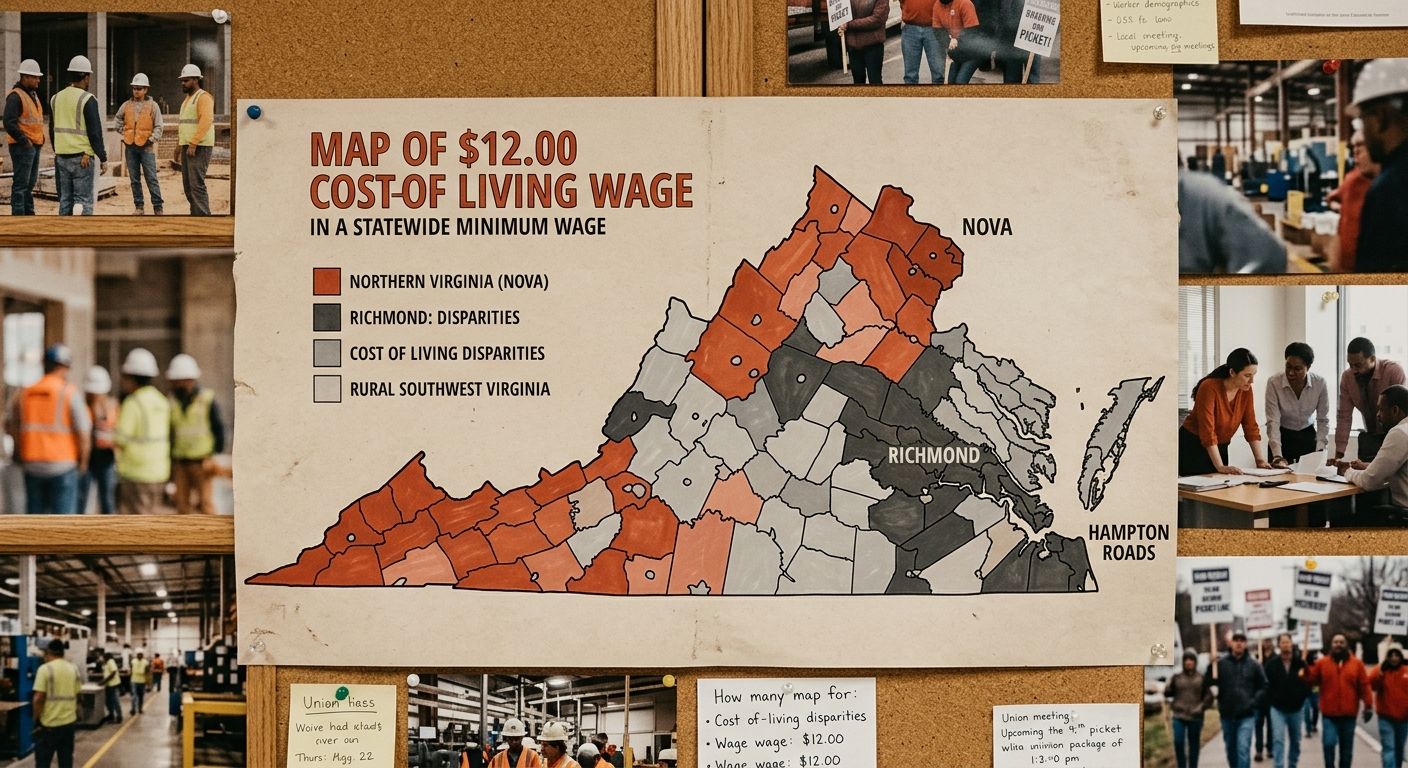
CPI-U as a blunt instrument. When the CPI-U adjustment formula operates alone, as it did from 2025 to 2026, it ties minimum wage growth to national consumer price inflation. That index measures the average cost of goods and services across all urban areas in the country. It does not capture housing costs, childcare expenses, or healthcare prices in specific Virginia metro areas. The Northern Virginia-Richmond-Hampton Roads cost corridor is among the most expensive on the East Coast. A statewide CPI-U adjustment doesn't account for those regional pressures, meaning workers in Arlington or Fairfax face a much wider gap between their minimum wage and a livable income than workers in rural Southwest Virginia, even though both earn the same rate.
No local preemption override. Virginia is a Dillon Rule state, meaning local governments have only those powers the General Assembly explicitly grants them. Unlike states where cities like Seattle or Minneapolis have set their own minimums, Virginia counties and cities cannot enact local minimum wages for private employers. Workers in high-cost areas earn the same state minimum as workers in areas where the cost of living is a fraction of theirs. This structural limitation is one that organizing efforts in states with similar preemption rules, such as Texas, have also confronted without resolution.
Common Questions
Does Virginia's minimum wage apply to all workers?
Virginia's minimum wage covers most private-sector employees, including domestic service workers who work more than 10 hours per week. Exemptions exist for certain students employed by their school, nonprofit volunteers, and bona fide independent contractors. The federal minimum wage of $7.25 per hour applies to workers not covered by Virginia's state law, though this scenario affects a shrinking number of positions. Employers cannot avoid the state minimum by misclassifying workers as exempt. If you suspect misclassification, you can file a complaint with DOLI.
Can Virginia cities or counties set their own higher minimum wage?
They cannot. Virginia operates under the Dillon Rule, which restricts local governments to powers the state legislature explicitly grants them. No Virginia locality has the authority to set a general private-sector minimum wage above the state floor. Some localities impose higher wages for their own government employees or contractors, but these requirements don't extend to private businesses. Fairfax County, for example, has adopted a living wage policy for certain contract employees, but it does not apply to general private employment.
How is the annual CPI-U adjustment calculated?
The Commissioner of Labor and Industry takes the current minimum wage rate and multiplies it by the percentage increase in the Consumer Price Index for All Urban Consumers (CPI-U) over the prior calendar year. That amount is added to the existing rate. The Commissioner announces the new rate by October 1, and it takes effect the following January 1. The 2026 adjustment, for example, used a 2.9% CPI-U increase to move the rate from $12.41 to $12.77.
What happens to the tipped minimum wage as the standard rate increases?
Virginia's tipped minimum wage has remained at $2.13 per hour, matching the federal sub-minimum, and the 2026 legislation did not change it. Employers must still ensure that tipped workers' combined wages and tips meet or exceed the full state minimum. When the standard minimum reaches $15.00 in 2028, tipped workers' total compensation (base plus tips) must hit that $15.00 threshold. The widening gap between $2.13 and the full minimum places increasing compliance burden on tip income and makes accurate record-keeping even more critical for workers protecting their earnings.
How does Virginia's minimum wage compare to neighboring states?
Virginia's 2024 rate of $12.00 placed it below Maryland ($15.00 for most employers) and the District of Columbia ($17.50) but above West Virginia ($8.75) and North Carolina ($7.25, matching the federal floor). The new legislation's path to $15.00 by 2028 will narrow the gap with Maryland and D.C., though those jurisdictions will have higher rates by then due to their own adjustment mechanisms. For a broader look at how neighboring states structure their wage laws, our guide to Florida's minimum wage breaks down a similar phased-increase model driven by a voter-approved constitutional amendment.
The Union Edge Staff
Frequently Asked Questions
- What is Virginia's minimum wage for 2024?
- Virginia's minimum wage in 2024 is $12.00 per hour, where it remained frozen after Governor Glenn Youngkin vetoed House Bill 1 and Senate Bill 1 in 2023, which would have increased the rate.
- When will Virginia's minimum wage reach $15 per hour?
- Virginia's minimum wage will reach $15.00 per hour on January 1, 2028, following new legislation signed by Governor Spanberger in April 2026 that set increases to $13.75 in 2027 and $15.00 in 2028.
- What is the tipped minimum wage in Virginia?
- Virginia's tipped minimum wage is $2.13 per hour, which has remained unchanged since 1991. Employers must ensure that tips combined with this base wage equal at least the full state minimum wage.
- How is Virginia's minimum wage adjusted for inflation?
- Starting in 2029, Virginia's minimum wage will be adjusted annually based on the Consumer Price Index for All Urban Consumers (CPI-U). The Commissioner of Labor and Industry multiplies the current rate by the percentage CPI-U increase from the prior year and adds that to the existing rate, announcing the new rate by October 1 for implementation on January 1.
- Can Virginia cities or counties set their own minimum wage?
- No, Virginia cities and counties cannot set their own minimum wages for private employers because Virginia operates under the Dillon Rule, which restricts local governments to powers the state legislature explicitly grants them.
- What are the exemptions from Virginia's minimum wage?
- Virginia's minimum wage exemptions include certain students employed by their school, nonprofit volunteers, and bona fide independent contractors. The law covers the vast majority of private-sector workers, including domestic service employees who work more than 10 hours per week.
- How much purchasing power did minimum wage workers lose during the 2023-2024 freeze?
- A worker earning exactly Virginia's minimum wage in 2024 lost purchasing power equivalent to roughly $0.41 per hour, or about $850 per year for full-time work, because the wage remained frozen at $12.00 while the Consumer Price Index rose 3.4% over 2023.
Related Articles
Virginia State Minimum Wage: 2024 Rate & Updates
$12.41 plus ($12.41 × 0.029) equals $12.77. That one-line formula, published by the Virginia Department of Labor and Industry, determines the minimum wage in the state of Virginia taking effect January 1, 2026.

Minimum Wage New Jersey 2024: Rates & Updates
New Jersey's minimum wage for most employees reached $15.13 per hour on January 1, 2024, completing a legislated climb from $8.85 in 2019 and triggering a permanent CPI-indexed adjustment formula. The rate doesn't come from annual legislative votes anymore.
Massachusetts minimum wage: 2024 rates & changes
The mass minimum wage held at $15.00 per hour throughout 2024, unchanged for the first time in five years, after the final scheduled increase under the state's 2018 "Grand Bargain" legislation took effect on January 1, 2023.
Also in the paper