
New York Home Care Workers Threaten Second Hunger Strike Over 24-Hour Shift Payment Dispute
New York home care workers announced Friday they will launch a second hunger strike to pressure the city council into voting on legislation that would end the practice of requiring 24-hour shifts while paying workers for only 13 hours, according to The Guardian.

New York Home Care Workers Threaten Second Hunger Strike Over 24-Hour Shift Payment Dispute
New York home care workers announced Friday they will launch a second hunger strike to pressure the city council into voting on legislation that would end the practice of requiring 24-hour shifts while paying workers for only 13 hours, according to The Guardian.
The announcement follows a six-day hunger strike in April 2026 outside New York's city hall, which ended only after organizers secured a promise that the council would vote on the No More 24 Act. That vote has not materialized, prompting workers to escalate their campaign.
"We are very confident that our movement is getting bigger and there will be more pressure to do the right thing," said Zishun Ning, an organizer with the Chinese Staff and Workers Association, in a statement released Friday.
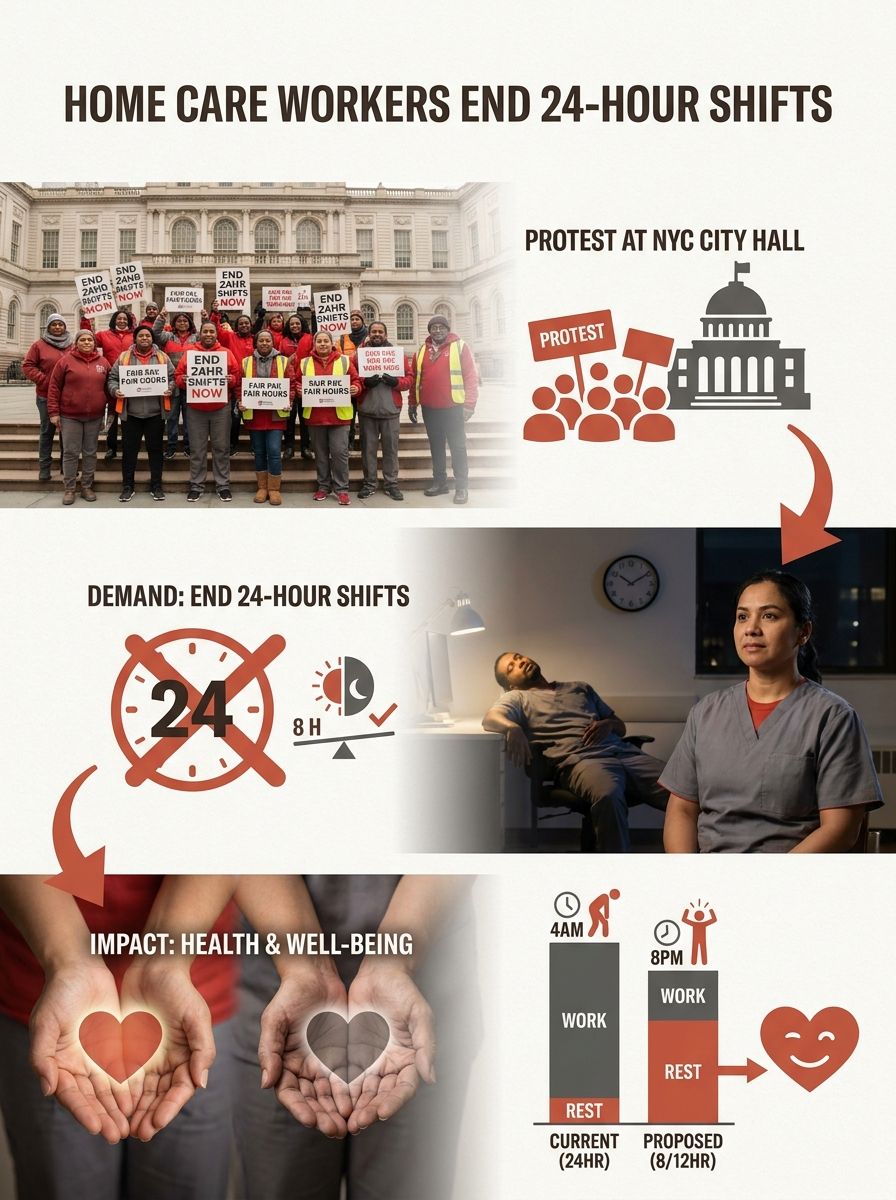
The Legislative Stalemate
The No More 24 Act, introduced by city council member Christopher Marte in 2022, would require agencies to split overnight home care assignments into two 12-hour shifts and cap a worker's total weekly hours at 56. Agencies that retaliate against workers who refuse 24-hour shifts would face steep municipal fines under the proposal.
The bill currently has 16 co-sponsors on the city council, 10 short of the 26 needed to pass. Under current New York labor law, agencies that assign workers to 24-hour live-in shifts are only required to pay them for 13 hours, with the remaining 11 hours classified as designated sleep and meal time. Workers and advocates say most home health aides care for their patients around the clock, with no opportunity for actual rest periods.
"This is the only industry that allows people to work for 24 hours and only get 13 hours of pay," Marte said in the Guardian report. "A lot of times it's 23 days in a row where people have to leave their homes and stay and sleep and eat where they work."
Patients authorized for 24-hour care require continuous monitoring—turning bed-bound patients every two hours to prevent lethal bedsores, assisting with bathroom visits, administering medications, and responding to disorientation throughout the night. Lai Yee Chan, 71, a home care worker who entered the industry after New York's garment sector collapsed following the September 11 attacks, told the Guardian through a translator, "There was just no time to sleep."
The Economics of Exploitation
Home care represents a $13 billion industry in New York alone, driven by an aging population. The Bureau of Labor Statistics projects the home health and personal care sector will add more than 70,000 jobs nationally by 2033, among the highest growth rates of any occupation in the country.
The workforce consists predominantly of immigrants and women of color. Two-thirds of home health care workers in New York state are immigrants who rely on these jobs not only for income but also for health coverage, according to the Guardian analysis. The median annual wage for home health and personal care aides was $34,900 nationally as of May 2024.
Workers say agencies pressure them to skip legally mandated breaks, and some pay flat daily rates regardless of total hours worked—practices that mirror documentation failures organizers have documented in other low-wage sectors. "Many of these workers have been threatened by their home care agencies that they will lose their jobs," Marte said.
Chan described receiving a check from her agency, the Chinese-American Planning Council (CPC), labeled "overtime" for $200, covering what the agency's accounting office claimed amounted to roughly 6,000 hours worked between 2007 and 2013. "They thought that because we can't read English, they can fool us," Chan said. The CPC did not respond to the Guardian's request for comment.
A Decade of Organizing
The Ain't I a Woman?! coalition of home care aides, youth groups, and feminist organizations has been organizing against working conditions since 2015 through hunger strikes, lawsuits, and legislation. Workers began filing wage-theft lawsuits as early as 2011, claiming they have the right to be paid for 24-hour shifts.
A 2015 Department of Labor rule extended minimum wage and overtime protections to home care workers, but agencies found workarounds, workers say. The practices continued largely undetected inside the private homes where care is delivered. The coalition now accuses the CPC of withholding $90 million in wages.
Every Wednesday morning for the past two years, coalition members—many in their 60s and 70s, some leaning on walkers, others holding signs reading "Stop killing us"—gather outside the CPC's offices. The organizing campaign reflects tactics increasingly common among vulnerable workforces who face retaliation risks.
The No More 24 Act faces opposition from the Legal Aid Society and the Center for Independence of the Disabled New York, which argue that splitting 24-hour shifts into two 12-hour periods could disrupt continuity of care for patients with severe disabilities and terminal conditions. The organizations did not provide detailed rationale in public statements.
The Takeaway
The renewed hunger strike threat demonstrates how migrant-heavy workforces continue to deploy high-visibility direct action when legislative channels stall. For labor organizers, the case illustrates the challenge of mobilizing around regulatory loopholes—New York's exemption for "sleep time" in 24-hour shifts creates a wage-theft structure that's technically legal but economically devastating for workers who cannot actually rest during those 11 unpaid hours.
The bill's 10-vote shortfall on the city council suggests that either disability advocacy groups' concerns about care continuity are persuasive to legislators, or that the home care industry's lobbying power exceeds the coalition's current reach. The hunger strike escalation aims to test which of those forces will prevail before the council's summer recess.
The Union Edge Staff
Related Articles

Hospital Workers Strike Over Workplace Violence as Injury Rates Hit Seven Times National Average
Hundreds of hospital workers at Henry Ford Genesys Hospital in Michigan have been on strike since September 1, 2025, with workplace violence and chronic understaffing at the center of their demands, according to NPR.

Night Shift Work Linked to Cancer Risk and Early Death as California Nursing Veteran Calls for Policy Overhaul
Long-term night and rotating shift work causes reduced brain volume, increases cancer risk, and raises mortality rates among workers with cardiometabolic disease, according to an analysis published July 1 in the Los Angeles Times examining 26 years of occupational health evidence and frontline testi

Chicago Daycare Workers Demand $24,000 in Unpaid Wages After Months of Alleged Wage Theft
Current and former employees of Little Angels Day Care Center rallied outside the Far North Side facility on August 27, 2026, demanding more than $24,000 in unpaid wages they say the business has withheld from seven workers over multiple pay periods, according to the Chicago Tribune.
Also in the paper