
Hospital Workers Strike Over Workplace Violence as Injury Rates Hit Seven Times National Average
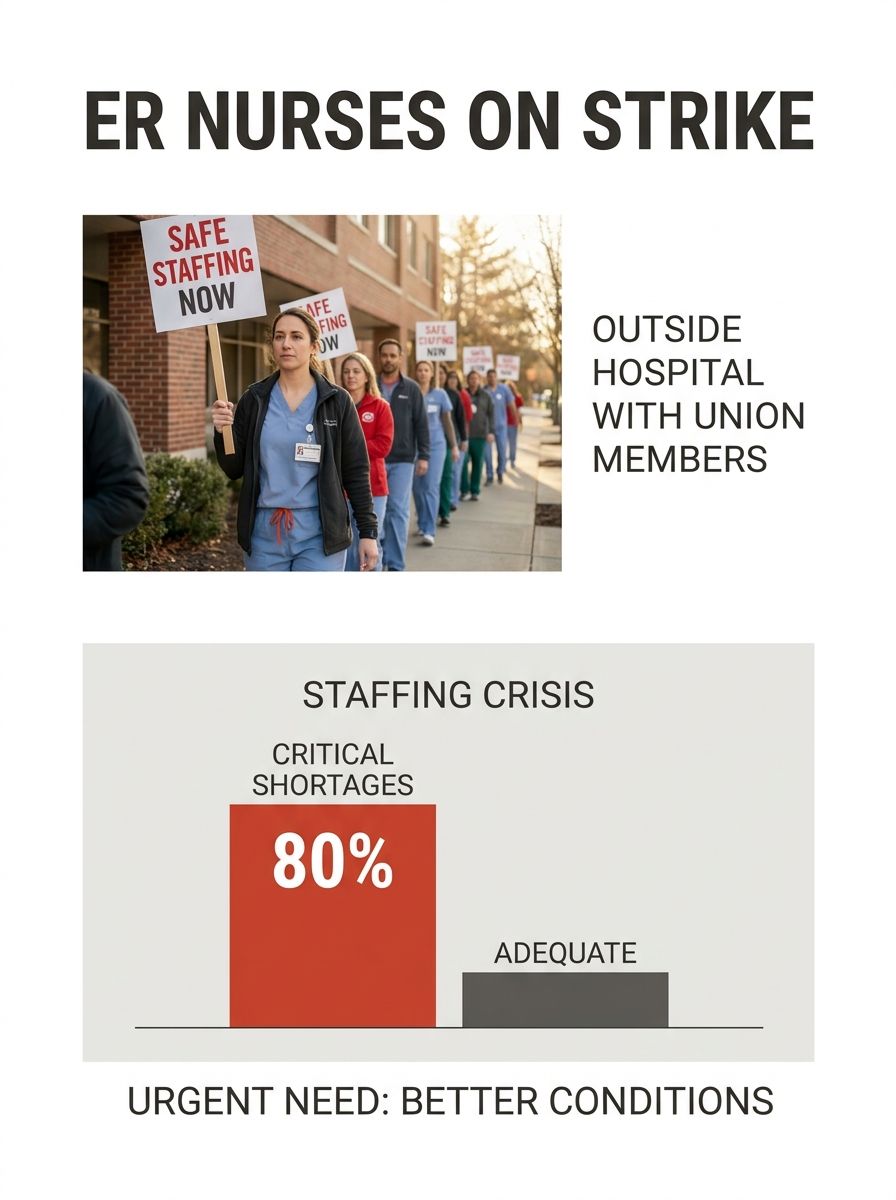
Hundreds of hospital workers at Henry Ford Genesys Hospital in Michigan have been on strike since September 1, 2025, with workplace violence and chronic understaffing at the center of their demands, according to NPR.

Hospital Workers Strike Over Workplace Violence as Injury Rates Hit Seven Times National Average
Hundreds of hospital workers at Henry Ford Genesys Hospital in Michigan have been on strike since September 1, 2025, with workplace violence and chronic understaffing at the center of their demands, according to NPR. The work stoppage is among several healthcare strikes nationwide driven by Bureau of Labor Statistics data showing hospital workers face injury rates from violent acts seven times higher than the general working population.
The Henry Ford Genesys strike, now approaching its first anniversary, reflects broader labor unrest in healthcare facilities across Louisiana, New York, Pennsylvania, and Rhode Island. Workers are demanding enhanced safety protocols, increased staffing levels, and financial protections for employees injured by patient assaults—issues that hospital operators say conflict with pressure to control costs.
Violence Drives Multi-State Strike Wave
Emergency room nurse Crystal Dhooghe, a striker at Henry Ford Genesys Hospital in Grand Blanc, Michigan, described witnessing repeated physical assaults on colleagues. "I've seen nurses get shoved, pushed, scratched. The biggest one is bitten," Dhooghe said in the NPR report. She continues working by relying on strike benefits and picking up extra shifts at another facility.
Henry Ford Health System spokesperson Dana Jay acknowledged that violence against healthcare workers constitutes a "national epidemic" but characterized the strike as "simply an economic strike" rather than a safety action. The health system has installed metal detectors, deployed armed security officers authorized to make misdemeanor arrests, and implemented de-escalation training, Jay said.
The nationwide injury rate for hospital workers stands at seven times that of the general working population, according to the most recent Bureau of Labor Statistics data. Rachel Odes, an assistant professor at the University of Wisconsin-Madison School of Nursing, told NPR that "emergency rooms right now are like a powder keg."
The Staffing Connection to Patient Violence
Research shows the risk of violence increases when hospitals operate with insufficient staff or when employees lack adequate training and experience, according to the NPR report. Healthcare facilities use the term "code gray" to designate a combative or violent patient incident.
Mental health worker Andrew Kimball-Mirzaie, who participated in a three-month strike at Butler Hospital in Providence, Rhode Island, said he was assaulted by a patient in February 2024, approximately six weeks into his employment. The patient punched him in the face while the two were alone watching a basketball game, an incident documented in the hospital's records. Kimball-Mirzaie sustained a concussion and broken nose.
"I understand that there is an inherent danger with the job," Kimball-Mirzaie said. "We should have had at least another staff member with us, and I should have been adequately trained on the unit." He does not blame the patient, who he said was severely ill at the time.
The Butler Hospital strike, which involved roughly 700 unionized workers represented by Service Employees International Union 1199 New England, forced the facility to close nearly half of its beds during the spring and summer of 2026.
Butler Strike Secures Injury Protections
The Butler Hospital work stoppage concluded with wage increases that union leaders said would help the hospital recruit and retain more staff. Workers also won financial support for employees injured by workplace violence and a jointly funded "time bank" to supplement workers' compensation for injured staff requiring extended recovery periods, according to SEIU 1199 New England.
Mary Marran, Butler's president and chief operating officer, said in a statement that the hospital "recognizes the importance of being proactive in protecting those who provide care" and that leadership meets regularly with staff to review safety measures.
Five months after the strike ended, a nurse supervisor at Butler had to call 911 when an unarmed patient in the emergency room assaulted staff, according to a police report. By the time police arrested the patient, he had injured two nurses, a security guard, and a police officer. The patient was charged with four counts of felony assault, including two counts for assaulting the nurses.
The incident underscores the persistence of violence even in facilities that have negotiated enhanced safety provisions. Similar workplace safety demands have driven labor actions at HCA Healthcare facilities, where workers staged pickets at a dozen hospitals during contract negotiations over pay and staffing earlier this year.
Legislative Push for Criminal Penalties
The American Hospital Association has been lobbying Congress to make assaulting healthcare workers a federal crime carrying up to 10 years in prison. At least 45 states, including Michigan and Rhode Island, have enacted similar laws at the state level.
Workplace safety advocates argue that criminal penalties alone do not address the root causes of violence—understaffing, inadequate training, and systemic failures to screen and monitor high-risk patients. Union representatives contend that hospitals prioritize cost-cutting measures that leave staff vulnerable to preventable attacks.
Hospital industry representatives counter that they face mounting financial pressures from rising labor costs, declining reimbursement rates, and regulatory burdens. They argue that enhanced safety measures, including security personnel and facility modifications, require significant capital investment at a time when many facilities operate on thin margins.
The Takeaway
The ongoing Henry Ford Genesys Hospital strike—now nearing 12 months—signals that healthcare workers are willing to endure prolonged financial hardship to force systemic changes in workplace safety protocols. The seven-fold injury rate gap between healthcare workers and the general workforce represents a measurable crisis that unions are using in contract negotiations. Butler Hospital's post-strike assault incident demonstrates that even facilities that negotiate enhanced protections remain vulnerable to violence, suggesting that legislative fixes and contractual language may not be sufficient without addressing the staffing and training deficits that research identifies as contributing factors. Healthcare labor organizing increasingly frames workplace violence not as an unavoidable occupational hazard but as a management failure—a rhetorical shift that strengthens strike mandates and puts hospital systems on the defensive in communities where public sympathy for frontline workers runs high.
The Union Edge Staff
Related Articles

More Than Two-Thirds of Ohio Nurses Experienced Workplace Violence in Past Year, New Report Finds
Nearly 69 percent of direct care nurses in Ohio experienced workplace violence, including verbal abuse, threats, or physical assault, in the past 12 months, according to the Registered Nurses Association of Ohio's 2026 Workplace Safety Report released today.

UMass University Campus Nurses Vote 99 Percent to Authorize 14-Day Strike Over Staffing and Safety Concerns
Registered nurses at UMass Memorial Medical Center's University Campus voted 99 percent in favor of authorizing a 14-day strike on July 1, escalating a contract dispute over staffing ratios, workplace safety, and retention issues at Massachusetts' only academic Level 1 Trauma Center, according to th

Massachusetts Nurses Launch Largest Health Care Strike in State History Over Stalled Wage Talks
More than 4,000 nurses at Brigham and Women's Hospital will walk off the job on July 8 in what the Massachusetts Nurses Association calls the largest health care worker strike in state history, according to NBC Boston. The strike follows months of stalled contract negotiations over cost-of-living in
Also in the paper