
LIRR Workers Strike After Midnight Deadline, Halting Service for 300,000 Daily Commuters
Long Island Rail Road service stopped at midnight Saturday after contract negotiations between the Metropolitan Transportation Authority and five unions representing more than 3,500 rail workers collapsed over wage increases and health care cost disputes, according to ABC News. Nearly 300,000 daily

LIRR Workers Strike After Midnight Deadline, Halting Service for 300,000 Daily Commuters
Long Island Rail Road service stopped at midnight Saturday after contract negotiations between the Metropolitan Transportation Authority and five unions representing more than 3,500 rail workers collapsed over wage increases and health care cost disputes, according to ABC News. Nearly 300,000 daily commuters face the first LIRR strike since 1994.
Negotiations Collapse Hours Before Deadline
Kevin Sexton, national vice president of the Brotherhood of Locomotive Engineers and Trainmen, told reporters that union leaders and MTA management remained "far apart" when the negotiation deadline expired. The five unions include BLET and four other labor organizations representing the LIRR workforce.
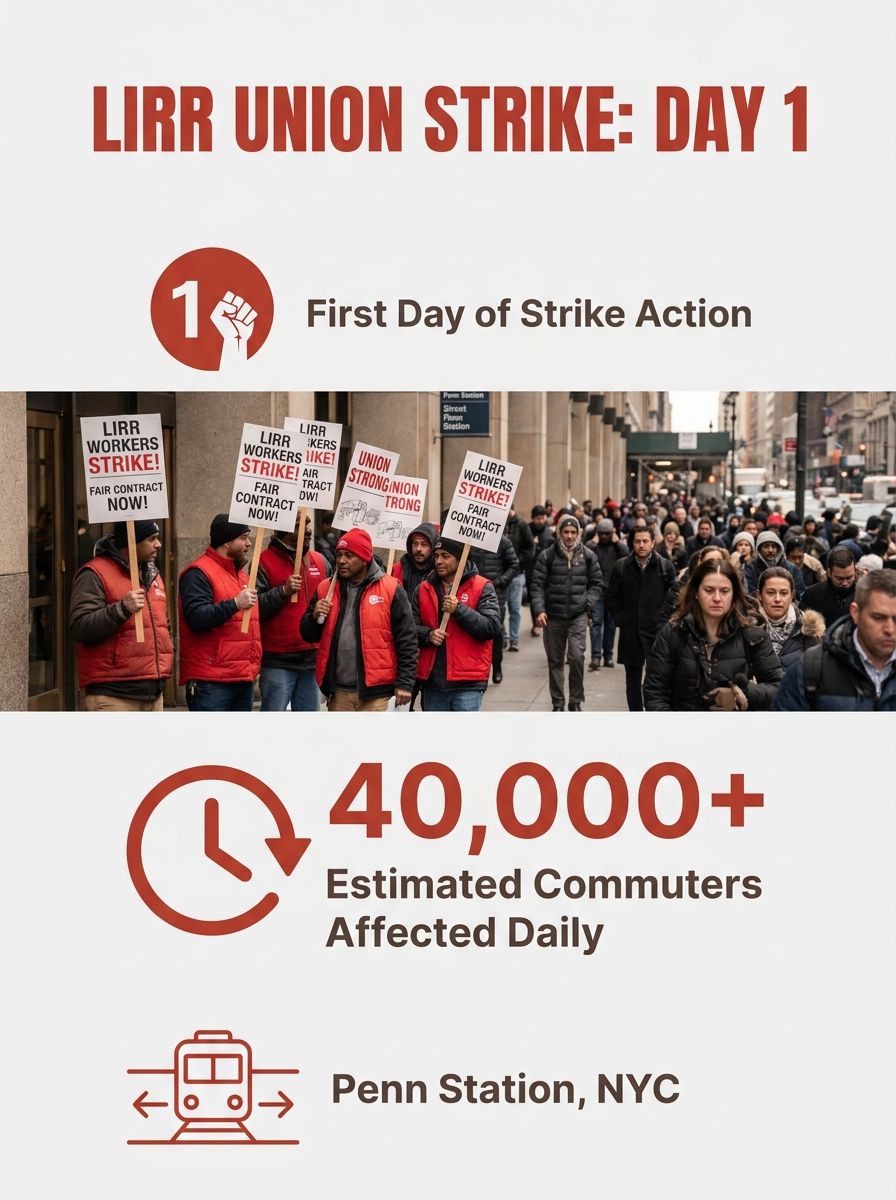
"We went through the process," Sexton said at a picket line outside Penn Station Saturday morning. The union official added that no additional negotiation sessions had been scheduled and that the duration of the work stoppage remained unknown.
The breakdown represents the first LIRR strike in 32 years. The 1994 work stoppage lasted two days before workers ratified a new contract.
MTA Cites Wage Premium, Rejects Union Demands
MTA Chairman Janno Lieber told reporters Saturday that the authority would not accept a contract requiring riders and taxpayers to fund wage increases for workers he characterized as already the highest-paid railroad employees in the nation. Lieber stated that shifting additional costs to riders or taxpayers was unacceptable.
Governor Kathy Hochul called the union demands "unacceptable" in a Saturday statement, asserting that the contracts being sought could raise fares as much as 8 percent. "These unions represent the highest-paid workers of any railroad in the nation," Hochul said, adding that the proposals would "pit workers against one another, and risk tax hikes for Long Islanders."
The U.S. Department of Transportation issued a statement Saturday blaming Hochul and Lieber for the service disruption. "MTA and Kathy Hochul's failure to ensure LIRR's continuous service exposes the MTA's dysfunction and Janno Lieber's failed leadership," a DOT spokesperson said.
Unions Report No Contact Despite Governor's Claim
In an evening update Saturday, the LIRR unions described the work stoppage as "open-ended" and confirmed that no negotiation sessions had been scheduled. Union representatives told ABC News that, contrary to claims in a Saturday afternoon statement from Hochul encouraging both sides to "work around the clock," MTA officials had not contacted the unions about resuming talks.
Sexton addressed stranded commuters directly. "These riders are our friends, our neighbors. They live in our communities. We understand the service that the LIRR provides," he said. "We are truly sorry that we are in this position."
The disconnect between public statements and actual communication points to the coordination breakdowns that often plague high-stakes labor negotiations when political pressure mounts.
Impact and Contingency Planning
The MTA announced contingency plans including free shuttle buses to select Queens subway stations beginning Monday if the strike continues. Queens Borough President Donovan Richards told WABC Saturday that he predicted "chaos" at those stations. "That's not enough when our buses are overcrowded," Richards said of the shuttle bus plan.
New York City Mayor Zohran Mamdani said in a statement that he was monitoring the situation and coordinating with city agencies to mitigate impacts. "New Yorkers should prepare for heavier-than-usual traffic, crowded transit options and additional travel time," Mamdani said.
The 300,000 daily commuters affected by the service halt face limited alternatives. The LIRR operates the nation's busiest commuter rail system, connecting Long Island to New York City through Penn Station and other terminals.
Reading Between the Lines
The LIRR strike exposes the structural contradictions facing public-sector transit labor in 2026. Management's claim that LIRR workers are the highest-paid railroad employees in the nation becomes the justification for rejecting wage increases, yet that same wage premium reflects decades of successful organizing in a high-cost region where the alternative, private-sector rail operations with lower labor standards, doesn't exist. The 8 percent fare-increase figure cited by Governor Hochul functions as a political ceiling rather than an actuarial calculation, a rhetorical move designed to position union demands as unreasonable to a commuter base already strained by cost-of-living pressures.
The absence of scheduled negotiations 18 hours into the strike, combined with the governor's public call for around-the-clock talks that unions say never materialized, suggests both sides are calculating whether public pressure will break first on labor or management. The DOT's unusually direct criticism of state leadership signals federal impatience with what Washington views as a preventable disruption to interstate commerce. For organizers watching this unfold, the LIRR case reinforces a tactical lesson: in high-visibility public-sector strikes, the battle for narrative control in the first 48 hours often determines bargaining leverage more than the underlying economics of the dispute.
The 32-year gap since the last LIRR strike means most current workers have never participated in a work stoppage, a factor that could either strengthen resolve through novelty or create pressure to settle quickly as the financial and social costs mount. Unions representing essential transportation workers must navigate the reality that every day of a strike imposes hardship on the working-class riders their members serve, a dynamic management will exploit relentlessly.
The Union Edge Staff
Related Articles

Long Island Rail Road Workers Strike Over Wage Dispute, Halting Service for 250,000 Daily Riders
Long Island Rail Road workers represented by five unions walked off the job early Saturday morning after contract negotiations with the Metropolitan Transportation Authority collapsed, halting service for approximately 250,000 daily commuters on North America's busiest commuter rail system, accordin

LIRR Strike Deadline Three Days Away as Wage Talks Resume
Five labor unions representing 3,500 Long Island Rail Road workers are three days from a strike deadline over wage demands that remain unresolved despite ongoing negotiations with the Metropolitan Transportation Authority, according to ABC7 New York. The unions are demanding a 5% wage increase for 2

DART Paratransit Workers Authorize Strike With 160-1 Vote Over Pay and Working Conditions
Paratransit workers serving Dallas Area Rapid Transit voted 160-1 on Tuesday to authorize a strike against Transdev, the contractor providing door-to-door transportation for roughly 11,000 disabled riders, according to Amalgamated Transit Union Local 1338. The 210 unionized employees set a strike de
Also in the paper