
The Collective Bargaining Agreement Blueprint: How to Negotiate Workplace-Specific Contracts That Actually Stick
Section 8(d) of the National Labor Relations Act requires both employers and unions to bargain in good faith over wages, hours, and working conditions. That three-word legal phrase, "in good faith," is the engine behind every collective bargaining agreement in the country.

The Collective Bargaining Agreement Blueprint: How to Negotiate Workplace-Specific Contracts That Actually Stick
Section 8(d) of the National Labor Relations Act requires both employers and unions to bargain in good faith over wages, hours, and working conditions. That three-word legal phrase, "in good faith," is the engine behind every collective bargaining agreement in the country. It's also the part that bargaining committees most often misunderstand. Good faith doesn't mean both sides have to agree. It doesn't mean management has to accept your proposals. It means both parties must meet at reasonable times, exchange relevant information, and genuinely attempt to reach an agreement. The mechanism that produces a contract worth enforcing depends on understanding each moving part inside this framework, because a collective bargaining agreement that ignores any one of them tends to collapse within its first year of implementation.
We've watched dozens of first contracts fall apart after ratification. The language was too vague, the grievance procedure was toothless, or the side letters got buried in a filing cabinet. Union contract drafting requires the same precision as any binding legal document, but it also requires something law school doesn't teach: knowledge of what happens on the shop floor at 2 a.m. when nobody from HR is watching. Here's how the mechanism actually works, piece by piece.
The Recognition Clause Defines Who's Protected
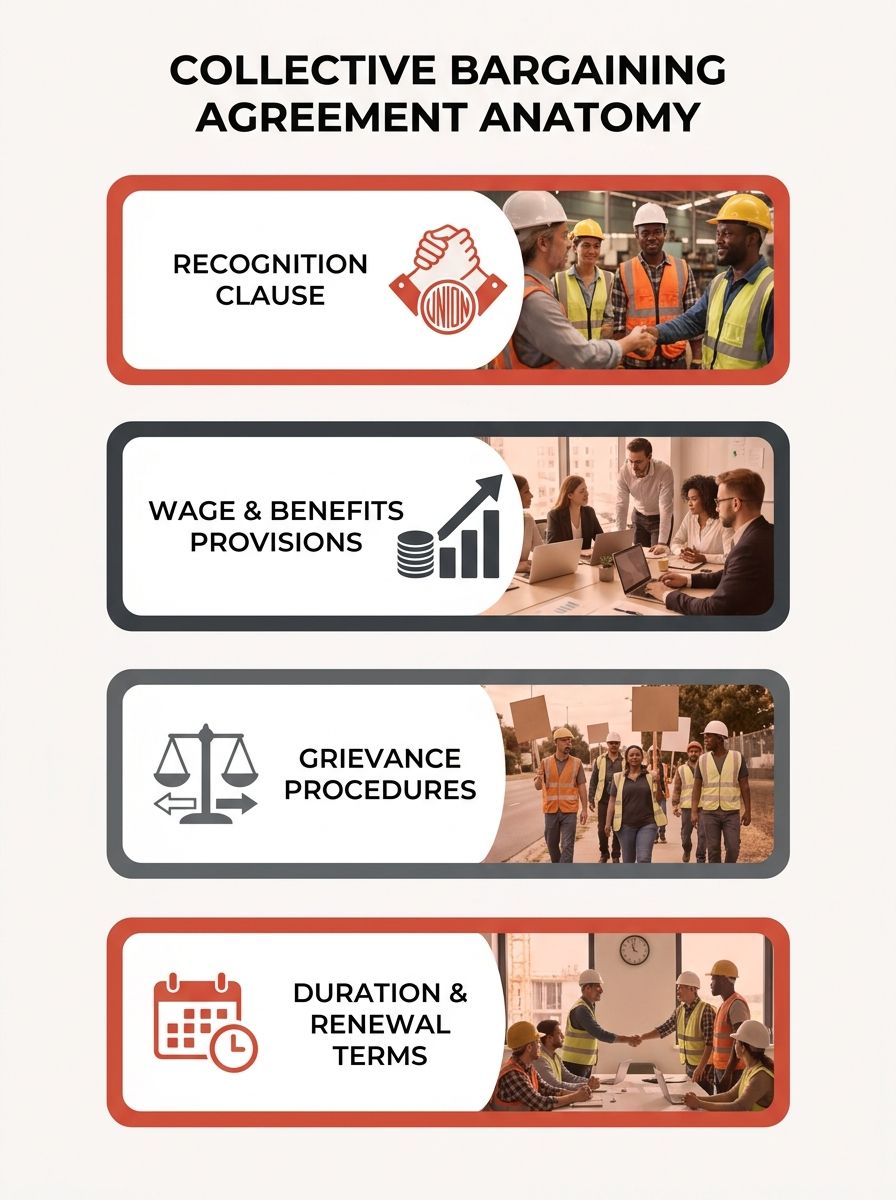
Every CBA begins with a recognition clause, and getting this wrong poisons everything that follows. The recognition clause identifies the bargaining unit: which employees are covered, which are excluded, and what the employer formally acknowledges about the union's representational authority.
A typical recognition clause reads something like this: "The Company agrees to recognize [Union Name] as the exclusive representative of all hourly-paid Production, Shipping, Receiving, and Maintenance employees for the purposes of collective bargaining in respect to rates of pay, wages, hours of employment, or other conditions of employment." The key word is "exclusive." Under the NLRA's good faith bargaining provisions, once a union is certified or voluntarily recognized, the employer cannot negotiate side deals with individual workers or rival groups on mandatory subjects of bargaining.
The workplace-specific dimension matters here. A recognition clause for a warehouse operation will look different from one covering game developers or healthcare workers. If your unit includes part-time workers, seasonal hires, or employees split across multiple locations, the recognition clause needs to say so explicitly. Ambiguity here is management's friend, not yours. We've seen employers argue that newly created job titles fall outside the bargaining unit, effectively carving workers out of the contract's protections one reclassification at a time.
Mandatory vs. Permissive Subjects of Bargaining
U.S. labor law divides bargaining topics into two categories, and the distinction determines what you can force to the table and what you can't.
Mandatory subjects include wages, hours, overtime rules, health benefits, seniority provisions, disciplinary procedures, safety conditions, and layoff protocols. The employer must bargain over these topics. Refusing to do so constitutes a violation of Section 8(a)(5) of the NLRA.
Permissive subjects include things like union involvement in corporate governance, changes to the pension plan's investment strategy, or decisions about whether to close a facility. Either side can raise permissive subjects, but neither side can insist on them to the point of impasse. If your bargaining committee pushes a permissive subject to impasse and the employer files a charge, you've handed management a legal weapon.
Understanding this distinction is where contract negotiation gets tactical. You can sometimes smuggle the practical effect of a permissive subject into a mandatory one. You can't force the employer to give you a seat on the board, but you can negotiate information-sharing provisions that require management to disclose financial data relevant to staffing decisions. You can't bargain over whether a facility closes, but you can bargain over severance packages, transfer rights, and notification timelines.
The workers who've recently organized in the tech sector, including game developers pushing for union recognition, are running into this exact issue with AI governance. Algorithmic scheduling and AI-driven performance evaluations sit at the boundary between mandatory and permissive. Unions are increasingly writing clauses that mandate human oversight of algorithmic decisions as a condition-of-employment issue, which reframes AI governance as a mandatory subject.
Wage Clauses Need Arithmetic, Not Aspirations
The wage clause is usually what the membership cares about most, and it's the place where vague language does the most damage. A well-drafted wage clause specifies exact percentage increases tied to specific dates. For example: "Employees shall receive an annual increase of 3% per year for the duration of this contract." That sentence creates a predictable, enforceable obligation. Compare it to "wages shall be competitive with industry standards," which means absolutely nothing in an arbitration hearing.
Workplace-specific labor standards demand workplace-specific wage structures. If your unit includes multiple classifications, the contract should list each one with its corresponding pay rate, step increases, and any premiums for shift differentials, hazardous duty, or bilingual work. Don't leave the math to a future interpretation. Spell it out in tables.
Experienced negotiators also build in reopener clauses for wages in multi-year contracts. A three-year deal with 3% annual raises sounds reasonable until inflation runs at 5% for two consecutive years. A reopener clause allows the union to return to the table on wages at specified intervals without blowing up the entire agreement.
Side Letters: The Hidden Architecture of Any Good Contract
One of the most overlooked components of union contract drafting is the side letter. Side letters are supplemental agreements attached to the main CBA that address specific situations too narrow or too politically sensitive for the body of the contract.
The International Brotherhood of Teamsters' bargaining manual emphasizes this directly: include side letters when the contract is printed, and brief the membership on their purpose. If members don't understand what a side letter does and why it exists, they can't enforce it. And an unenforceable provision is worse than no provision at all, because it creates a false sense of security.
Side letters are useful for handling issues like:
A specific safety protocol for one department that doesn't apply to the rest of the unit
A temporary scheduling arrangement negotiated during a facility renovation
An agreement about how a new technology will be piloted before broader deployment
Protections for a small group of workers with unique immigration-related needs
The danger is that side letters can also be used by management to quietly weaken the main contract. If the side letter contradicts a CBA provision, you've got a legal mess. Every side letter should reference the section of the main agreement it supplements, and the bargaining committee should maintain a master index.

The Grievance Procedure Is the Contract's Immune System
A CBA without an enforceable grievance procedure is a wish list. The grievance process is the mechanism through which the contract polices itself. When management violates a provision, the grievance procedure gives the union a structured path from informal complaint to binding arbitration.
The standard structure moves through escalating steps: the worker and their steward raise the issue with the immediate supervisor, then it moves to a formal written grievance reviewed by middle management, then to upper management or a labor relations officer, and finally to arbitration by a neutral third party. Each step has time limits for both sides.
Many unions also write in a provision requiring the employer to comply with "all applicable laws, standards, and regulations." According to research from the UC Berkeley Labor Occupational Health Program, this allows the union to use the grievance procedure and other labor-management mechanisms to enforce government requirements. It turns OSHA violations, wage-and-hour infractions, and anti-discrimination law breaches into grievable offenses, which means faster resolution than waiting for a federal agency to investigate.
The grievance procedure is also where the "just cause" standard lives. If your contract requires just cause for discipline and termination, the employer can't fire someone for a vague performance complaint. They need documented, progressive discipline. The union grieves every case on its own merits, forcing management to follow the contractual standard. As the United Electrical Workers note, this framework has become more complicated as the NLRB and courts have shifted on certain work-rule questions, but the core mechanism remains the strongest protection workers have against arbitrary discipline.
Understanding how this process works after you've won recognition is critical, and we've written at length about why post-recognition organizing strategy shapes real workplace change.
Mid-Contract Changes and the Duty to Bargain
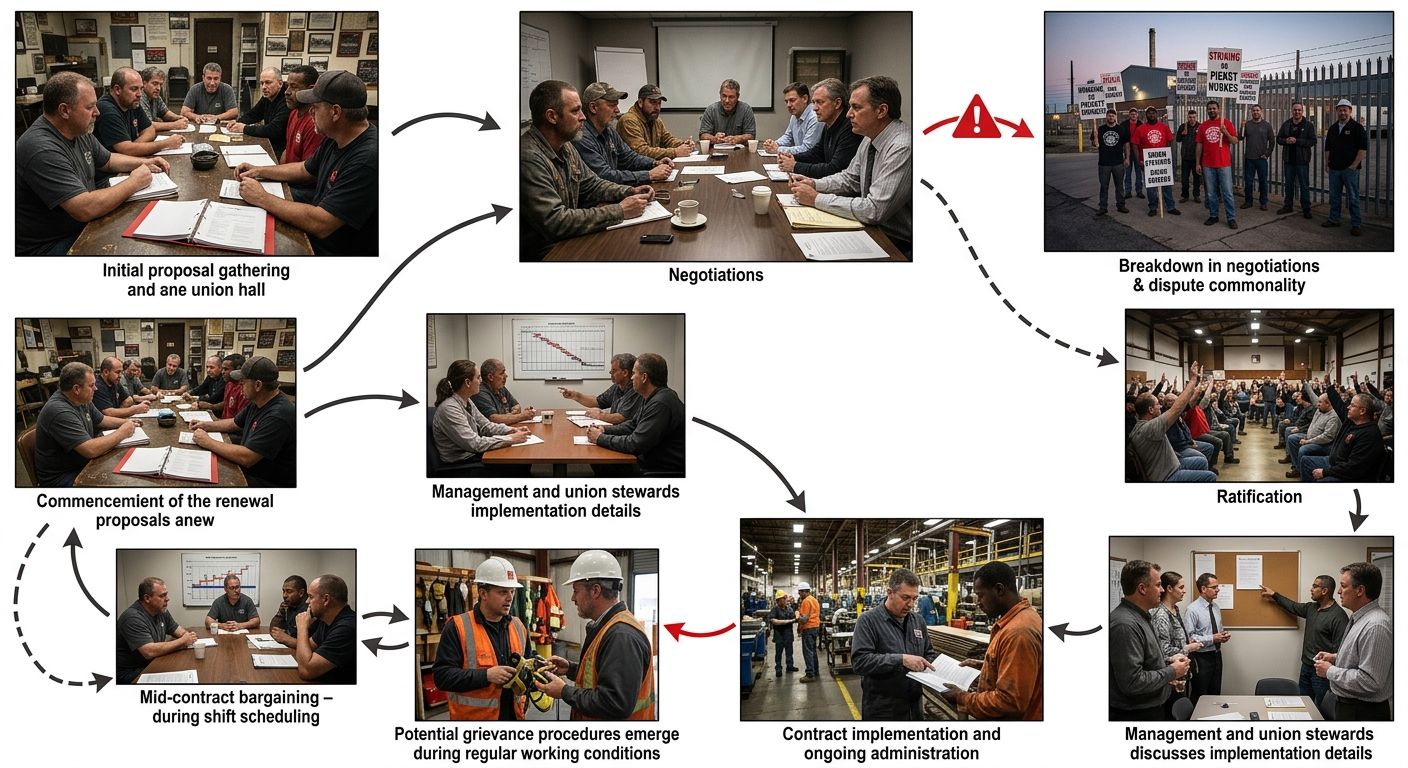
Here's something that trips up even experienced bargaining committees: the contract doesn't freeze everything in place until expiration. Employers sometimes need to make changes during the life of the agreement, and the legal rules governing those changes are more nuanced than "they can't touch anything."
Under basic collective bargaining obligations, changes to wages, hours, or working conditions cannot be made without providing the union notice and an opportunity to bargain. This includes changes to past practice as well as changes to the written CBA. If management has always allowed workers to take their lunch break at a specific time and suddenly imposes a new schedule without notifying the union, that's a unilateral change and a potential unfair labor practice charge.
But here's the tension: some CBAs include "management rights" clauses that give the employer latitude to make operational decisions. If the management rights clause is broadly written and the union agreed to it, the employer may argue that a particular change falls within its reserved authority. This is why the language of the management rights clause matters enormously during contract negotiation. Every word the union concedes in that clause is a potential weapon aimed back at the membership.
The practical guidance: narrow the management rights clause as much as possible, and pair it with a "past practices" provision that prevents the employer from changing established workplace norms without bargaining. Get specific about what past practices you're protecting.
Building Density Into the Contract Itself
The strongest CBAs don't exist in isolation. They're connected to broader organizing strategies that build union density across an industry or region. The Economic Policy Institute has documented extensively how unions that maintain strong membership and density can bargain more broadly than a single worksite, setting standards that lift conditions for entire sectors.
You can build density-supporting provisions directly into the contract. Union security clauses, new-hire orientation access, bulletin board rights, and paid time for stewards to handle grievances all strengthen the union's presence inside the workplace. In states where these provisions are legally permissible, they ensure that the union doesn't wither between contract cycles.
This connects to the broader dynamics of how pattern bargaining reshapes entire industries. When your contract sets a high standard and the union organizes the competitor down the road, that first contract becomes the floor for the second negotiation. Workplace-specific labor standards built into one CBA become the template for the next.
Where the Model Breaks
This entire mechanism assumes two things: that the union has enough organized power to enforce what it negotiates, and that federal labor law provides meaningful consequences when employers violate the process. Both assumptions have weakened over the past four decades.
The NLRA's penalty structure for unfair labor practices remains anemic. An employer who bargains in bad faith, makes unilateral changes, or retaliates against union activists faces, at worst, a cease-and-desist order and back pay. There are no punitive damages. There are no criminal penalties for first-time violations. The process of filing a charge, getting it investigated, and reaching a Board decision can take years, during which the employer's illegal behavior continues to have its intended chilling effect.
And the single-worksite bargaining structure of U.S. labor law makes it difficult to build the kind of sectoral agreements common in Europe and parts of Latin America. Even when unions win strong contracts at individual employers, the lack of a legal framework for industry-wide bargaining means those gains remain isolated unless the union has the resources and strategic capacity to organize every competitor in the market.
The model also breaks when the bargaining committee fails to do the internal work of educating the membership. A contract is only as strong as the workers who understand and are willing to defend it. If members don't know what their rights are, grievances go unfiled, past practices erode quietly, and management learns that it can violate the agreement without consequence. Understanding what strategy actually wins contracts for workers is as important as understanding the legal framework.
None of this means the CBA mechanism is useless. It means the mechanism works best when it's supported by an engaged membership, competent stewards, and a bargaining committee that understands every clause well enough to explain it to a coworker on a break. The contract is a tool. Like any tool, it performs according to the skill and determination of the people holding it.
The Union Edge Staff
Also in the paper