
The Architecture Industry's Unionization Crisis: Why White-Collar Professional Workers Face Unique Organizing Barriers
BA Union, formed in 2022 at Bernheimer Architecture in New York, remains one of fewer than five unionized private-sector architecture firms in the United States.

The Architecture Industry's Unionization Crisis: Why White-Collar Professional Workers Face Unique Organizing Barriers
BA Union, formed in 2022 at Bernheimer Architecture in New York, remains one of fewer than five unionized private-sector architecture firms in the United States. The profession's small firm sizes, credential-based hierarchies, and legal exclusions under the Taft-Hartley Act create organizing barriers that conventional union strategies struggle to address.
Architecture by the Numbers
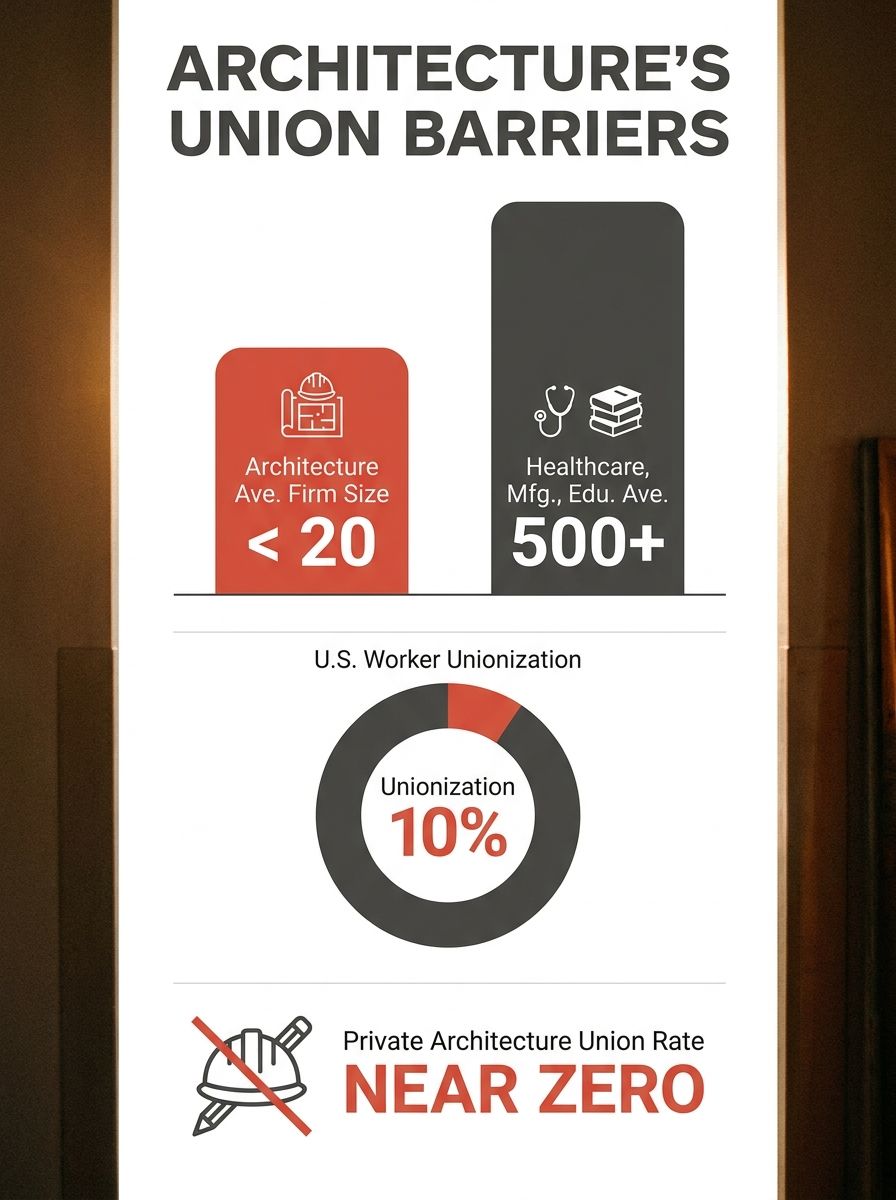
The U.S. architecture industry employs workers across roughly 22,000 firms, according to industry data compiled by ArchLaunch, with a steady employment outlook driven by residential, commercial, and institutional projects. But that employment picture disguises a structural reality that makes organizing nearly impossible under traditional models: the overwhelming majority of these firms are small, many with fewer than 20 employees, and a significant number operate with fewer than 10.
Why does firm size matter so much? Because the NLRB election process, including the 30% authorization card threshold required to trigger a vote, assumes a workforce large enough to sustain an organizing committee, absorb employer retaliation, and maintain momentum through what can be months of legal proceedings. In a 7-person architecture studio, losing even one sympathetic worker to turnover or intimidation can kill a campaign.
Meanwhile, architect salaries in the United States vary significantly by geography, experience, and licensure status. Entry-level architectural workers often earn between $45,000 and $55,000 annually, while principals and partners at the same firms pull six figures. This wage spread within small teams creates a dynamic where the people with the most to gain from collective bargaining work alongside the people most likely to resist it.
How Taft-Hartley Split Professional Workers From the Labor Movement
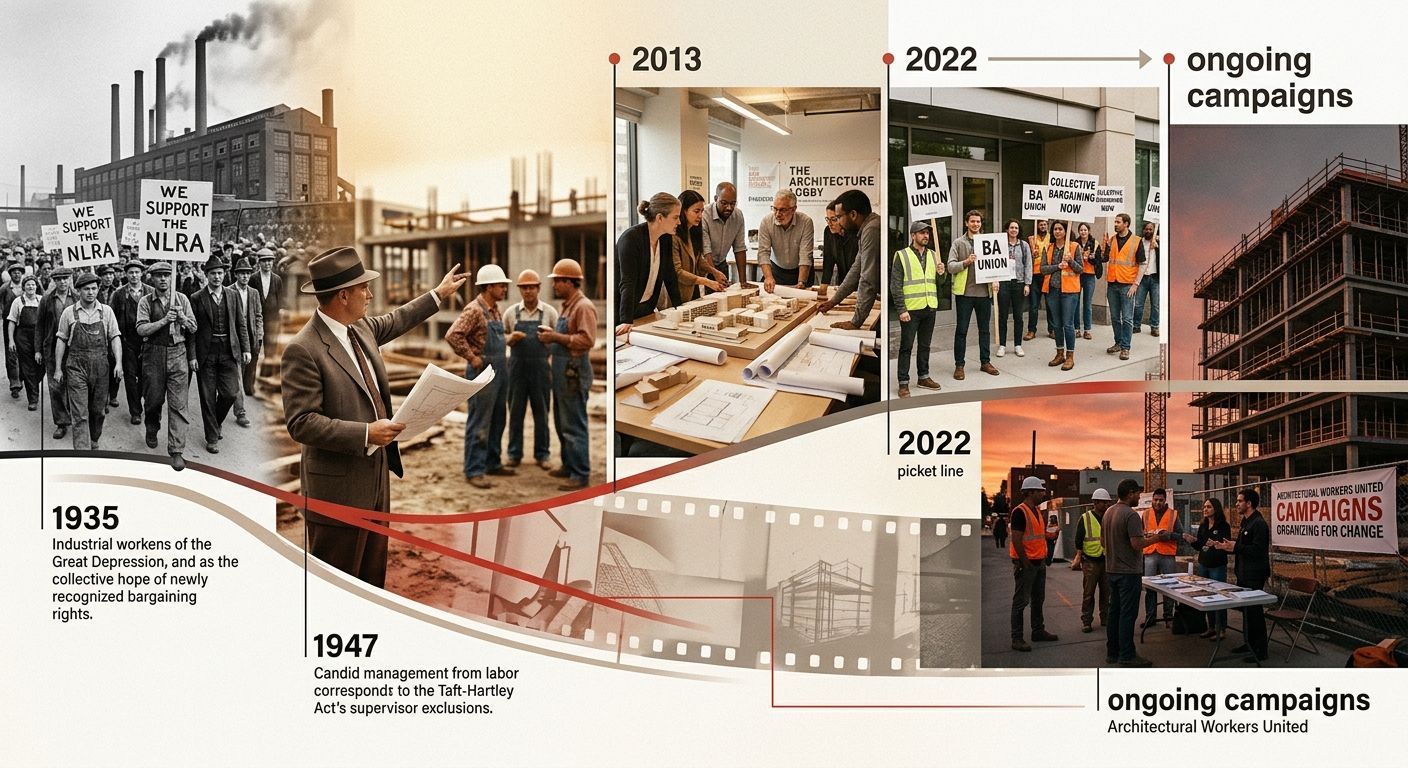
The legal architecture of white-collar unionization was set in 1947, when the Taft-Hartley Act reshaped the rules governing who could and couldn't organize. The Act granted that professional workers could have separate bargaining units, but it simultaneously excluded supervisors and foremen from NLRA coverage entirely. For architecture, this exclusion has proven devastating.
In a typical architecture firm, the hierarchy runs from unlicensed designers and drafters through licensed architects to project managers, associates, and principals. The supervisor exclusion means that project architects who manage teams of two or three people may be classified as supervisors under NLRA definitions, even when they share the same economic vulnerabilities as the junior staff below them. The result: potential bargaining units in already-small firms get even smaller once supervisory staff are carved out.
The Taft-Hartley Act also excluded employees of non-profit hospitals and certain other institutions, which had a cascading effect on architecture labor. Many architects working on institutional projects are employed by or contracted through entities whose workers fell outside NLRA protections for decades. The professional worker provisions created a legal framework where credential-based industries could fragment their workforces into categories too small, too hierarchical, or too legally complex to organize efficiently.
This legal history explains why the craft union revival that's taken root in industries like gaming and tech hasn't reached architecture with the same force. When game developers at major studios began organizing, they had one advantage architecture workers don't: they worked at companies with hundreds or thousands of employees, making the math of authorization cards, committee building, and election survival fundamentally different.
Professional Identity Becomes an Organizing Barrier
Architecture cultivates a professional identity that actively works against collective action. Architects are trained to see themselves as creative professionals, individual practitioners of a licensed discipline, and members of a credentialed class. The word "worker" sits uneasily next to "architect" in a profession where aesthetic ambition and public-interest rhetoric often mask extractive labor practices like unpaid overtime, spec work, and poverty-level intern wages.
As Slate documented in its coverage of white-collar professional unions, unions are historically born to fight for social justice, emerging from conditions of oppression "the likes of which professionals, frankly, haven't felt." Black Americans are more likely than whites to be union members, a disparity rooted in the economic violence that drove workers like the Memphis sanitation strikers to organize in 1968. Architecture, a profession that remains disproportionately white and affluent in its upper ranks, lacks this historical pressure.
This identity gap creates a real organizing problem. Workers in credential-based industries often believe that professional associations like the AIA (American Institute of Architects) already represent their interests. They don't. Professional associations serve the profession's brand and regulatory framework. They don't negotiate wages, challenge overtime policies, or file unfair labor practice charges when a firm retaliates against a worker who raises safety concerns. The distinction between a professional association and a union is the distinction between an industry lobby and a collective bargaining agreement.
The credential hierarchy also fractures solidarity along licensure lines. An unlicensed designer with a master's degree doing the same production work as a licensed architect earns less, has less job security, and carries less internal authority. These workers share economic interests but are divided by a credentialing system that positions licensure as the reward for individual merit rather than a regulatory gatekeeping mechanism.
Firing the Organizer
Employer resistance in architecture follows patterns documented across industries, but the small-firm structure amplifies every tactic. As the Architizer Journal noted in its analysis of union prospects for architects, "the firing of union activists has been a notable challenge in the museum industry, which shares with architecture" a similar professional culture and firm structure.
Research by the Economic Policy Institute found that unfair labor practice charges per election petition increased dramatically across sectors starting in the 1970s, as union-busting tactics moved into industries where unions had traditionally been strongest. Architecture firms don't need to hire expensive anti-union consultants the way a hospital system or manufacturing company might. In a firm of 12 people, the principal can simply invite a pro-union employee to lunch and make clear that their future at the firm depends on dropping the effort. That conversation never gets recorded. No ULP charge gets filed. And the organizing attempt dies quietly.
Karen J. Bentham's study of employer resistance to union certification across eight Canadian jurisdictions documented how delay tactics, selective discipline, and strategic terminations suppressed organizing campaigns even where legal protections were stronger than in the United States. In American architecture firms, where at-will employment is the default and project-based work creates natural endpoints for getting rid of troublesome employees, the barriers are compounded.
The PRO Act, which has stalled repeatedly in Congress, would address one of the sharpest tools in the employer resistance toolkit. Under current law, workers can be fired for organizing activity, and the penalties for doing so are weak enough that many employers treat them as a cost of doing business. The PRO Act would prohibit firing workers who seek to form a union, removing what the Architizer Journal identified as one of the most significant deterrents to architecture labor organizing.
Organizing Barrier | Architecture | Tech (Gaming) | Healthcare | Manufacturing |
|---|---|---|---|---|
Average Firm/Workplace Size | Under 20 employees | 200-10,000+ | 50-5,000+ | 100-10,000+ |
Credential Hierarchy | Licensed vs. unlicensed | Moderate (degree-based) | Strong (MD/RN/CNA tiers) | Low (skill-based) |
Supervisor Exclusion Risk | High (project leads) | Moderate | Moderate | Moderate |
Professional Association Substitution | Strong (AIA) | Weak | Moderate (ANA) | Weak |
At-Will Employment Vulnerability | Very high | High | Moderate (shortage protection) | Moderate |
Existing Union Density | Near zero | Under 5% | 15-20% | 8-10% |
What the Architecture Lobby and Architectural Workers United Have Built
The Architecture Lobby, described by Monograph's industry analysis as "a collective of architectural workers advocating for the value of the labor required to design, construct, and occupy architecture," has been the most visible force pushing architecture workers toward collective consciousness since its founding in 2013. The organization has campaigned against unpaid internships, wage theft, and the culture of overwork that pervades the profession.
Architectural Workers United, operating as an organizing resource, has published detailed guidance for workers considering unionization, including documentation protocols for employer retaliation and step-by-step explanations of NLRB election procedures. Their FAQ acknowledges directly that "forming a union may be one of the most challenging things we have ever tried to take on."
BA Union's formation at Bernheimer Architecture in 2022 provided the first proof of concept that private-sector architecture unionization was possible. As one organizer wrote for Progressive.org, "designers need to continue to take advantage of the current climate and organize more workplaces," noting that despite impressive gains across the broader labor movement, only 10% of U.S. workers are unionized.
The challenge now is scaling from proof of concept to movement. The organizing model rather than the service model is the approach most likely to work in architecture, because it emphasizes worker-to-worker communication and distributed leadership rather than top-down union staff campaigns. In firms of 8 or 15 people, there's no room for a traditional organizing committee structure. The entire staff IS the committee.

The parallel to other white-collar organizing efforts is instructive. Inc. magazine reported that the weakening value of college degrees started some professionals reconsidering union membership, and that management flattening combined with AI adoption is accelerating the trend. Architecture workers face both pressures: AI-driven design tools are changing the production work that junior architects depend on for employment, and the credential that was supposed to guarantee professional-class wages increasingly doesn't.
The workers who wrote to us after the DeepMind unionization vote in London asked variations of the same question: if AI researchers at Google can organize, why can't architects? The answer isn't that they can't. The answer is that the structural barriers in architecture require strategies built specifically for small, hierarchical, credential-stratified workplaces, and those strategies are still being invented.
Questions The Numbers Still Can't Answer
The data on architecture labor organizing is thin because the phenomenon barely exists yet. We know that 10% of U.S. workers are unionized. We know architecture firms skew small. We know the Taft-Hartley Act's supervisor exclusions reduce already-tiny potential bargaining units. We know employer retaliation is widespread and underdocumented across all industries, and architecture's at-will employment norms make it worse.
What we don't know is whether the micro-unit organizing models being tested in coffee shops and retail stores can translate to professional offices. We don't know whether the PRO Act, if it ever passes, would meaningfully change the calculus for a profession where most retaliation happens through informal channels rather than formal termination. And we don't know whether the Architecture Lobby and Architectural Workers United can build the kind of sustained infrastructure that converts professional discontent into durable collective bargaining relationships.
The data also can't tell us how many organizing attempts in architecture have failed quietly. In firms where the entire staff is fewer than 10 people, a failed campaign doesn't generate NLRB filings, media coverage, or academic study. It generates a few uncomfortable weeks and then someone leaves. The denominator of the architecture organizing success rate is unknown, which means the numerator of a handful of wins is impossible to evaluate.
What we can say is that the conditions driving white-collar unionization across credential-based industries are intensifying. Wages haven't kept pace with the cost of the education required to enter the profession. AI is reshaping production workflows. And a generation of architecture workers who watched baristas, warehouse workers, and game developers organize is asking why the professional class can't do the same. The barriers we've documented here are real and specific. They're also the kind of problems that organizers have solved before, in industries that looked equally impossible to unionize a decade before they weren't.
The Union Edge Staff
Related Articles

Building Union Power in Design Professions: The Architecture Workers' Organizing Blueprint
Architectural Workers United announced its affiliation with the International Association of Machinists and Aerospace Workers in 2021, then set a goal no design-profession campaign had attempted: organizing enough private-sector architecture offices to form a self-sustaining local lodge with shared

Leadership Density Over Card Counts: Why Union Authorization Metrics Fail and What Actually Predicts Organizing Success
Authorization cards measure interest, not resilience.

When Employers Fight Back: Recognizing and Countering Union-Busting Tactics During Your Organizing Campaign
U.S. employers are charged with violating federal law in 41.5% of all union election campaigns, according to a study from the Economic Policy Institute. The violations follow a predictable script.
Also in the paper