
The Organizer's Listening Playbook: How to Move Beyond Solutions and Into Workers' Real Problems
"I told the organizer about the rats in the supply closet, and she immediately started talking about filing an OSHA complaint," said Maria, a certified nursing assistant at a long-term care facility outside Cleveland. "But that wasn't what I needed.

The Organizer's Listening Playbook: How to Move Beyond Solutions and Into Workers' Real Problems
"I told the organizer about the rats in the supply closet, and she immediately started talking about filing an OSHA complaint," said Maria, a certified nursing assistant at a long-term care facility outside Cleveland. "But that wasn't what I needed. I needed someone to understand that I've been asking management about those rats for two years, that they laugh at me, that I feel invisible. The rats were the symptom. Being treated like I don't matter was the disease."
Maria's story captures something we see constantly in healthcare labor campaign development: organizers who jump to fixes before they've heard the full picture. The instinct makes sense. You're trained to identify problems and propose solutions. Someone tells you about unsafe staffing ratios, and your brain immediately fires up with grievance procedures, NLRA Section 7 protections, and petition strategies. But that instinct, left unchecked, can kill a campaign before it starts.
Listening isn't a soft skill. It's the hardest, most strategic thing an organizer does. And in healthcare settings, where burnout runs deep and trust runs thin, getting it wrong means losing workers who desperately need collective power.
Healthcare Organizing Demands a Different Kind of Listening
Healthcare workers carry a unique burden. They watch people suffer and die. They work mandatory overtime during staffing crises. They absorb verbal abuse from patients, families, and administrators. And they do all of this while being told they should feel grateful because their work is "a calling."
That emotional weight means the problems healthcare workers bring to organizers are rarely straightforward. A nurse who complains about scheduling isn't just talking about scheduling. She might be talking about missing her kid's school play for the third time, about the guilt of leaving a patient mid-crisis because her shift ended, about a charge nurse who retaliates against anyone who pushes back.
If you respond to "scheduling is terrible" with "let's draft a scheduling proposal," you've solved the wrong problem. You've also told that nurse, without meaning to, that you're just like management: focused on checking boxes instead of seeing her as a whole person.
Research consistently backs this up. According to Salesforce Research data, employees who feel heard are 4.6 times more likely to feel capable of performing their best work. In a hospital, "best work" isn't an abstraction. It's whether a patient gets the right medication on time. The stakes of worker engagement strategies in healthcare are literally life and death.
Borrowed from Therapy, Built for Organizing
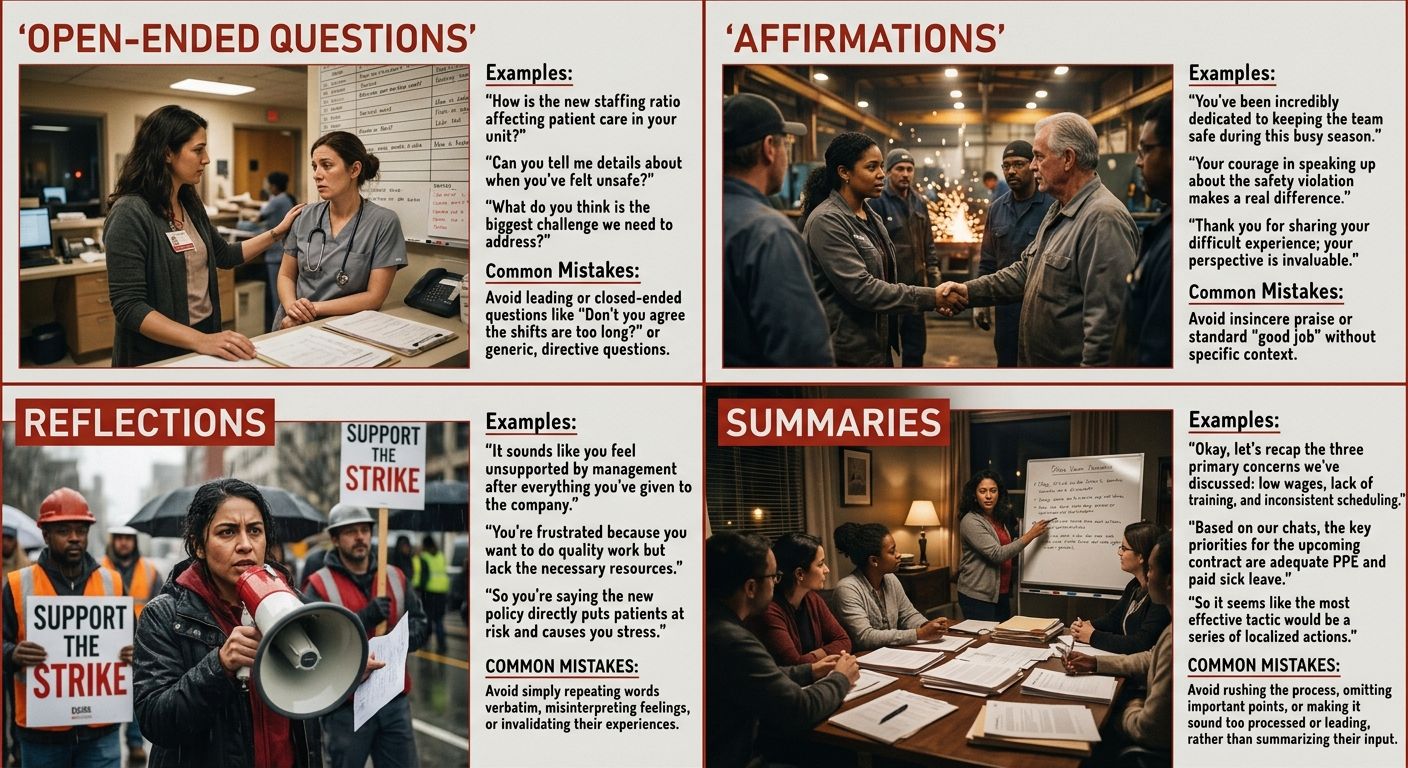
The most effective union organizing tactics we've seen in healthcare campaigns borrow from an unlikely source: motivational interviewing, a counseling technique designed to help people work through ambivalence. An organizer and writer at Fire with Fire adapted these principles into what's called the OARS framework for organizing conversations: Open-ended questions, Affirmations, Reflections, and Summaries.
Here's how each piece works in practice, specifically in healthcare settings:
Open-Ended Questions
Closed questions get you data. Open questions get you stories. And stories are what build campaigns.
Bad question: "Are you unhappy with the staffing levels on your floor?" Good question: "What's it like on your floor during a typical night shift?"
The second question doesn't assume the answer. It invites the worker to paint a picture. Maybe staffing is fine but the equipment is broken. Maybe the staffing numbers look adequate on paper but three of the eight nurses are brand-new travelers who don't know the unit's protocols. You won't know until you ask in a way that creates space.
As one guide to 1-on-1 organizing conversations puts it, once an issue surfaces, the organizer should go deeper with questions like: "How does that make you feel?" and "Is this what you thought the job would be like?" and "How does this impact your ability to do your work?"
These questions don't have quick answers. That's the point.
Affirmations
This isn't flattery. It's recognition. When a respiratory therapist tells you she's been documenting unsafe patient loads on her own for six months, you don't just nod. You say: "That took real courage, especially knowing management could retaliate. You've been building a record that matters."
Affirmation tells the worker that their instincts were right, that what they've already been doing counts. The NEA's organizing toolkit puts it simply: let workers know you're listening, you understand, and their feelings are valid.
In healthcare, where workers are conditioned to minimize their own suffering because "the patients have it worse," affirmation is radical. It gives people permission to name their own pain.
Reflections
Reflection means paraphrasing what someone said back to them, not parroting it. Marshall Rosenberg's work on nonviolent communication stresses that this technique helps both parties confirm shared understanding and moves conversations toward resolution faster.
A CNA says: "Every time I report a fall risk, nothing happens. Then when a patient falls, suddenly it's my fault."
Your reflection: "So you're doing exactly what you're supposed to do, flagging dangers ahead of time, but the system ignores your warnings and then punishes you for the outcome. That sounds like they want you responsible without giving you any actual power."
Watch what happens. The CNA's eyes widen. She nods. "Yeah. That's exactly it." You've just articulated something she felt but hadn't put into words. That moment of being truly understood is where trust gets built.
Summaries
At the end of a conversation, pull the threads together. "So what I'm hearing is that the staffing is dangerously thin, the reporting system gets ignored, and you feel like management treats frontline workers as disposable. And this isn't new. It's been getting worse since the facility was acquired two years ago. Did I get that right?"
Summaries do two things. They prove you were actually listening, not waiting for your turn to talk. And they create a shared narrative that the worker can claim as their own.
The Five Most Common Listening Mistakes in Healthcare Campaigns
We've trained dozens of organizers and watched plenty of promising grassroots organizing efforts stall because of preventable mistakes. Here are the ones that show up most in healthcare:
1. Jumping to the grievance. A worker describes a problem, and the organizer immediately pivots to formal remedies. This signals that you see the worker as a case file, not a person. Hear the full story first. The formal strategy comes later.
2. Projecting your own experience. "Oh, I know exactly how that feels" is well-intentioned but dangerous. You don't know exactly how it feels to be a home health aide making twelve dollars an hour driving between patients in your own car. Let them tell you how it feels.
3. Filling the silence. Deep listening requires comfort with quiet. When a worker pauses, they're often processing something important. If you rush to fill that gap, you steal the moment where the real truth would have surfaced. Silence, as communication researchers note, can be more powerful than words in building genuine understanding.
4. Listening only to "leaders." It's natural to gravitate toward the most vocal workers. But in healthcare, the quietest people often carry the most critical information. The overnight phlebotomist, the dietary aide, the environmental services worker: these are the folks who see everything and get asked about nothing. Your organizer training should specifically address reaching them.
5. Treating listening as a one-time event. The first conversation isn't the real conversation. It's the audition. Workers are testing whether you're safe. The second, third, and fourth conversations are where the deeper problems emerge, the ones about discrimination, wage theft, sexual harassment by a supervisor, immigration-related threats. You have to earn those stories.
Building the Bridge from Listening to Organizing
Listening without action is just therapy. The whole point of deep listening in a labor context is to translate what you hear into collective power. Here's how that bridge gets built in healthcare campaigns specifically:
Step 1: Map the Issues to Patterns
After ten conversations on a hospital unit, you might hear ten different complaints. But if you're listening well, you'll notice the patterns. Seven of those ten complaints trace back to a single root cause: chronic understaffing driven by corporate cost-cutting after a private equity acquisition.
When you surface that pattern back to workers collectively, it transforms individual frustration into shared analysis. "It's not just you. It's all of you. And it's by design." That's the moment grassroots organizing catches fire.
This kind of pattern recognition is exactly what separates effective campaigns from scattered complaints. Understanding how to build from first conversations to first contracts requires this translation step.
Step 2: Let Workers Name the Priority
Don't decide for them. Once you've reflected patterns back, ask: "If you could change one thing first, what would it be?" The answer might surprise you. Organizers often assume wages will top the list. In healthcare, it's frequently staffing, safety, or respect. Jaz Brisack, writing in Forbes, puts it clearly: before advocating for change, invest time in understanding your coworkers' concerns, aspirations, and fears.
Workers who choose their own fight are workers who show up.
Step 3: Build the Committee from Listeners
Your organizing committee should be 10 to 15 percent of the workforce, and the people you recruit first should be the best listeners in the building, not necessarily the loudest voices. As the IAFF notes, this committee is the nucleus of your organizing effort. In healthcare, where departments are siloed and shifts rarely overlap, you need listener-leaders embedded across every unit and every shift.
Step 4: Create Structured Listening Rounds
Don't leave listening to chance. Build it into your campaign timeline. Set goals: every committee member has three deep conversations per week. Track who's been reached and who hasn't. Pay special attention to the gaps, because the departments you haven't reached are exactly where management will focus their anti-union efforts.
When those gaps include workers from different cultural or linguistic backgrounds, standard approaches may not be enough. Adapting your methods to reach everyone, as we've explored in writing about why standard union tactics sometimes fail without cultural adaptation, is essential to building genuine majority support.
Step 5: Feed What You Hear Back Into Strategy
Every listening conversation generates intelligence. What are workers scared of? What do they want most? Who do they trust? Who do they distrust? This information shapes your strategy at every stage, from petition language to bargaining priorities to strike authorization votes.
The 34,000 NYC building workers who authorized a strike didn't reach near-unanimous solidarity by accident. It came from months of listening that surfaced what mattered most and built a campaign around those specific concerns.
Your Right to Have These Conversations
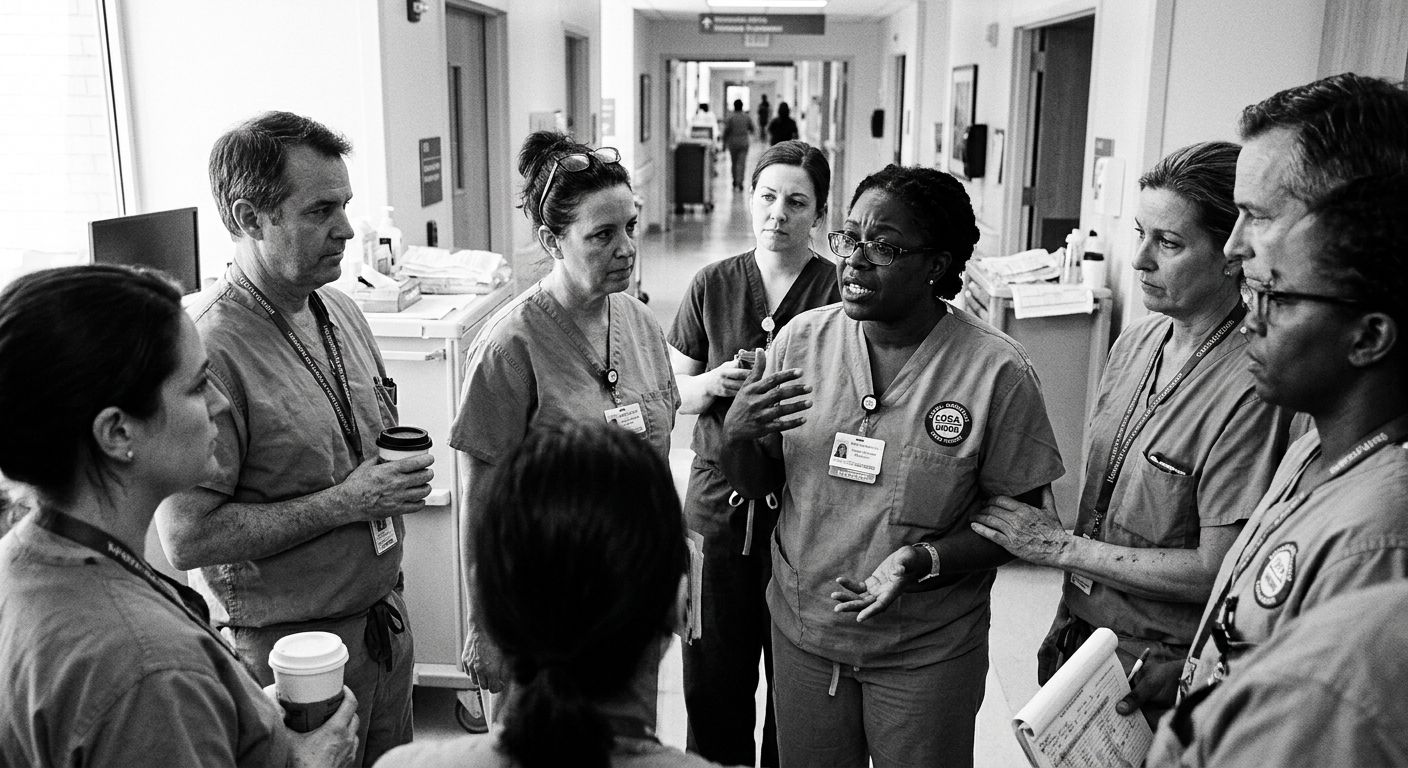
Some healthcare workers worry that one-on-one organizing conversations could get them fired. Let's be direct about the law.
Section 7 of the National Labor Relations Act protects workers' rights to engage in "concerted activities for the purpose of collective bargaining or other mutual aid or protection." That includes talking to coworkers and organizers about workplace conditions.
Section 8(a)(1) makes it an unfair labor practice for an employer to "interfere with, restrain, or coerce employees" exercising those Section 7 rights. If your hospital fires or disciplines you for having a conversation about working conditions, they've broken federal law.
There are practical limits. You can have these conversations during breaks, before and after shifts, and in non-work areas. Employers can enforce legitimate, non-discriminatory rules about solicitation during work time. But they cannot single out union-related conversations while allowing workers to chat about everything else.
Know your rights. Enforce your rights. And when management crosses the line, as they often do in healthcare organizing, document everything and file charges with the NLRB. The gap between what companies promise about worker safety and what they actually deliver often extends to how they handle organizing rights too.
Where to Start Tomorrow
If you're an organizer working a healthcare campaign, or a healthcare worker thinking about organizing your shop, here's your immediate checklist:
Practice OARS in your next three conversations. Write the framework on an index card and carry it. Open-ended questions, Affirmations, Reflections, Summaries. It will feel awkward at first. Keep going.
Stop offering solutions in the first conversation. Your only job in conversation one is to understand. Solutions come from the collective, not from you.
Reach the invisible workers. Environmental services, dietary, transport, overnight shifts. These workers are often the most exploited and the least consulted. Find them. Listen to them. They'll transform your campaign.
Build a listening log. Paper or digital, it doesn't matter. Track every conversation. Look for patterns weekly.
Study your legal protections. Read NLRA Sections 7 and 8. Know what your employer can and cannot do. Share that knowledge with every worker you talk to.
Connect with organizer training resources. Organizations like Training for Change have been building grassroots capacity since 1992, running everything from campaign strategy retreats to facilitation training for union leaders. Seek out these programs. The skills they teach are learnable, but they require practice.
The workers in your hospital, your nursing home, your clinic are already telling you what's wrong. The question isn't whether they'll speak. The question is whether we're ready to truly hear them, sit with the discomfort of what they describe, and let their reality shape our strategy instead of the other way around.
That's not just better organizing. That's solidarity.
The Union Edge Staff
Also in the paper