
The Migrant Worker Organizing Gap: Why Standard Union Tactics Fail Without Cultural and Legal Adaptation
"After they fired me, my employer withheld my last pay. They said I owed them for sponsorship costs." That's Kathleen, a care worker whose story was documented by Citizens Advice in the UK.

The Migrant Worker Organizing Gap: Why Standard Union Tactics Fail Without Cultural and Legal Adaptation
"After they fired me, my employer withheld my last pay. They said I owed them for sponsorship costs." That's Kathleen, a care worker whose story was documented by Citizens Advice in the UK. She was left broke, scrambling for a new job, and racing against a visa clock that could make her undocumented at any moment. Kathleen isn't an edge case. She represents millions of visa-dependent workers worldwide who exist in a legal gray zone where the boss doesn't just control your paycheck, they control whether you get to stay in the country.
We've spent years talking to organizers, labor lawyers, and workers across sectors where migrant labor is dominant. The pattern is always the same: well-meaning unions show up with their standard playbook, run the same campaigns they'd run in any shop, and then wonder why turnout is low, why workers won't sign cards, why entire communities seem unreachable. The answer isn't that migrant workers don't want unions. The answer is that our movement has been building organizing campaigns for a workforce that no longer exists in large swaths of the economy.
This is the migrant worker organizing gap. And closing it requires us to fundamentally rethink how we approach campaigns, legal strategy, and community trust.
How Employer Sponsorship Becomes a Weapon
Standard union organizing assumes a basic premise: workers can assert their rights without losing the legal ability to exist in their community. For visa-dependent workers, that premise is shattered from day one.
Here's how it works in practice. An employer sponsors a worker's visa. That worker is now legally tied to that employer. If conditions are dangerous, if wages are stolen, if hours are illegal, the worker faces an impossible choice: speak up and risk losing your sponsorship, or stay quiet and survive.
As the Work Rights Centre has documented, the system is rigged by the absence of a sponsor registry broken down by industry, steep visa renewal fees, and the fact that workers can't work full-time or access public benefits while transitioning between sponsors. The Right to Remain toolkit puts it bluntly: the visa system "creates dependency on sponsors. Some employers might threaten to cancel your sponsorship or your colleagues' sponsorship if you complain about working conditions."
This isn't a side issue for organizers. It's the central obstacle. When we talk about organizing barriers, nothing compares to a system that gives your boss the power to make you deportable.
Consider the numbers that reveal the enforcement imbalance in the United States. Congress has appropriated roughly $25 billion for immigration enforcement, employing nearly 79,000 personnel. Labor standards enforcement, by contrast, gets about $2.1 billion and fewer than 9,400 staff across ten federal agencies. That's a 12-to-1 ratio favoring deportation over workplace protection. Workers can do the math. Calling for help is more likely to bring an immigration agent than a labor inspector.
Why the Standard Playbook Breaks Down
The traditional union organizing model assumes several things that simply don't hold true for large portions of the migrant workforce:
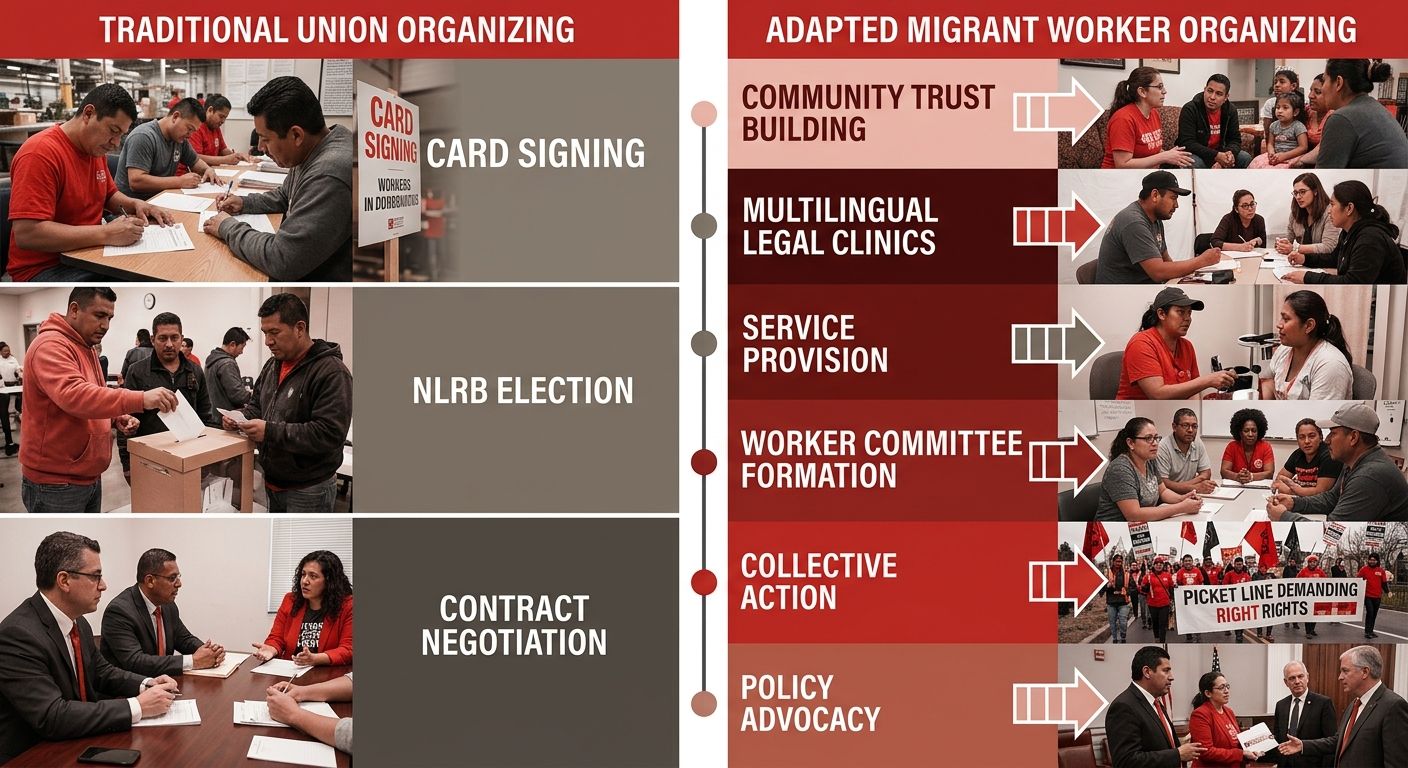
Workers have a stable, identifiable workplace. Many migrant workers cycle through informal labor arrangements — day labor, subcontracted agricultural work, domestic care, gig-style temp staffing. There's no break room to post a flyer, no single employer to file an NLRB petition against.
Workers can attend meetings and sign cards without existential risk. For undocumented workers or those on precarious visas, putting their name on a union authorization card feels like signing their own deportation order.
English-language materials and meetings are sufficient. This one should be obvious, but we still see campaigns that produce a single Spanish-language flier and call it "outreach."
Workers trust institutions. Many migrant workers come from countries where unions are corrupt, government-controlled, or actively dangerous. The word "union" itself can trigger suspicion rather than solidarity.
Legal protections function as advertised. Section 7 of the National Labor Relations Act protects the right to organize regardless of immigration status. That's the law. The reality is that employers routinely use immigration threats as retaliation, and research on labor trafficking confirms that "fears of deportation and being misidentified as undocumented migrants often prevents trafficked workers from accessing support services or legal resources."
We've written before about how organizers must get into the community to build trust and power. For migrant worker campaigns, that principle isn't optional. It's the whole ballgame. You cannot organize workers who are afraid of you. And if your organizing committee doesn't include people who share the language, culture, and immigration experience of the workforce, you're not organizing. You're performing.
The Informal Economy Problem
Beyond visa dependency, a massive segment of migrant labor exists in the informal economy — work that happens off the books, without contracts, outside the reach of standard labor law enforcement. Day laborers picked up at corners. Domestic workers in private homes. Agricultural workers paid in cash through labor contractors.
The ILO's Bureau for Workers' Activities has argued that training local leadership and organizers in the informal economy is essential to extending democratic culture and union power into these spaces. But that requires models very different from the card-check-and-election process most U.S. unions rely on.
The most instructive example comes from SEWA (the Self-Employed Women's Association) in India. SEWA, the world's largest organization of informal workers, pursues what researchers call a "twin strategy" — union organizing and collective bargaining paired with service delivery like cooperative banking, healthcare, and legal aid. Workers join not because someone handed them a card, but because the organization became indispensable to their survival.
This service-plus-struggle model has direct relevance to migrant worker organizing in the U.S. When we've covered how the organizing model compares to the service model, the debate usually frames them as opposing strategies. For migrant communities, the evidence says you need both simultaneously.
Lessons from Successful Campaigns
The good news is that migrant workers are highly organizable when unions adapt. Research on immigrant union drives in major U.S. cities has consistently shown that unions with a firm stance on trans-ethnic solidarity and inclusion produce successful campaigns among populations that other organizers write off as "impossible to reach."
Here are the models that are working:
Worker Centers as Union On-Ramps
Across Europe, unions have built hybrid institutions that combine legal aid with organizing. In Spain and Italy, unions created dedicated centers for migrant workers that handle work permits, residence renewals, and mediation — all while building the relationships needed for collective action. Milan's Camera del Lavoro initiated over 27,200 legal cases in a single year, with 37% related to work permits and 22% to residence renewals. These aren't charity operations. They're organizing infrastructure.
In the U.S., worker centers like the National Day Laborer Organizing Network and the National Domestic Workers Alliance have pioneered similar approaches. They meet workers where they are, address immediate survival needs, and build toward collective power.
Supply Chain Pressure Campaigns
When the direct employer is a subcontractor or staffing agency with little public profile, organizers have found success targeting the companies at the top of the supply chain. Unite the Union's campaign in UK meat-processing plants targeted supermarkets as the real power behind cost-driven precarity, even purchasing Tesco shares to force shareholder resolutions. This contributed to a government inquiry that exposed systemic abuse and led to new regulations on agency worker protections.
This approach works because it bypasses the organizing barriers at the worksite level. You don't need every meatpacking worker to sign a card if you can get Tesco's board to sweat over its supply chain practices.
Bilingual Organizing Committees
The Malaysian Trades Union Congress adapted by waiving membership fees for migrant workers and producing all organizing materials in multiple languages. Simple? Yes. But how many U.S. locals still run campaigns where every meeting is in English, every document is in English, and the one bilingual steward is expected to handle translation on top of their regular duties?
Building genuine bilingual or multilingual organizing committees isn't a nice-to-have. It's a structural requirement. The union needs the kind of inside-out organizing approach that builds worker leaders, and those leaders must reflect the actual workforce.
Labor Trafficking and the Enforcement Continuum
The labor trafficking prevention conversation often gets siloed away from union organizing, treated as a criminal justice issue rather than a labor issue. That's a mistake. Trafficking exists on a continuum with wage theft, visa manipulation, and coercive working conditions. The same systems that allow an employer to withhold pay from a care worker like Kathleen also enable forced labor.
Anti-Slavery International has pointed out a bitter irony: when governments tighten immigration laws, they increase the profitability of smuggling and trafficking. Ordinary people pay the price. The tighter the border, the more desperate workers become, and the more power unscrupulous employers accumulate.
Unions have a direct role in breaking this cycle. Workers with collective power, legal representation, and community support are far harder to traffick or exploit. Every organizing campaign that reaches into migrant communities is, whether it frames itself this way or not, a labor trafficking prevention program.
Research on the intersection of migration and trafficking stresses the importance of understanding how immigration executive orders affect working families. Policy shifts can overnight transform a legally present worker into an undocumented one, creating exactly the vulnerability that traffickers exploit.
An Actionable Framework for Migrant Worker Campaigns
So what does an adapted campaign look like? Here are concrete steps organizers can take:
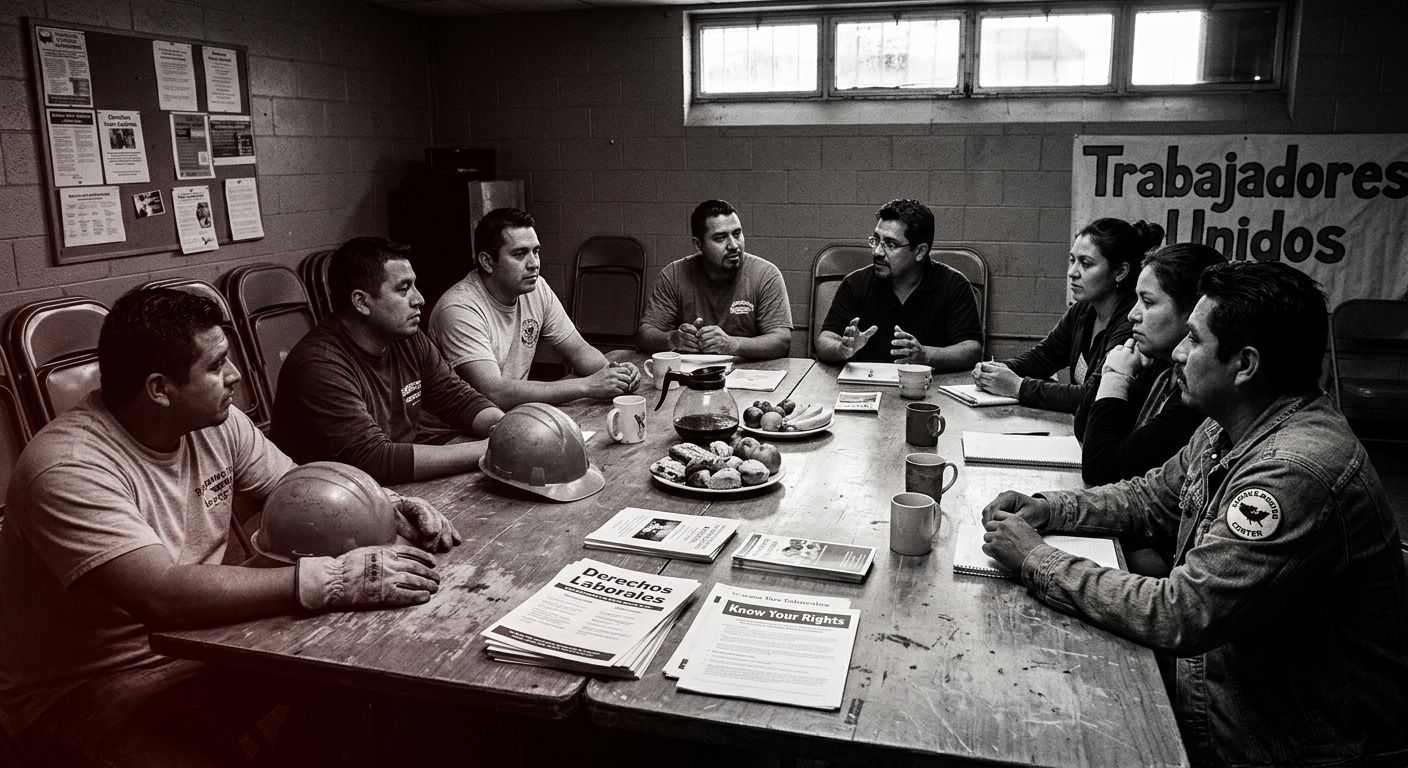
Start with legal clinics, not card drives. Partner with immigration attorneys and legal aid organizations to offer free Know Your Rights workshops. Build trust through service before asking for commitment.
Map the real power structure. In industries with subcontracting and informal labor arrangements, identify who actually controls wages and conditions. It's often not the direct employer.
Build multilingual leadership from the start. Don't translate materials as an afterthought. Recruit and train organizing committee members who speak the languages of the workforce. SEWA's model of training local leadership in the informal economy applies directly here.
Create immigration firewalls. Establish clear protocols that no immigration-related information is collected or stored during organizing. Work with legal partners to ensure that union activity cannot be used as a pretext for immigration enforcement.
Address the visa dependency directly. Advocate for portable work visas that aren't tied to a single employer. Support legislative efforts like proposed worker protection acts that would shield migrant workers from retaliation during labor disputes.
Use digital tools carefully. Many migrant communities organize through WhatsApp, Signal, and other encrypted platforms. But as we've documented when covering critical mistakes unions make with digital organizing tools, technology is only as good as the trust behind it. Encrypted chats mean nothing if workers don't trust who's in the group.
Build coalition power. Connect with faith organizations, ethnic community associations, immigrant advocacy groups, and legal clinics. The union is one node in a larger support network, not the only institution that matters.
The Solidarity We Owe
The American labor movement's greatest victories have always come when it expanded its definition of "worker" to include people the establishment wanted to exclude. That was true during the CIO's industrial organizing drives. It was true when farmworkers organized under Cesar Chavez and Dolores Huerta. It remains true now.
Migrant workers aren't a special interest within the labor movement. They're a test of whether the labor movement means what it says. When we repeat the phrase "an injury to one is an injury to all," do we mean it for the H-2A worker in the strawberry field? The domestic worker in a private home? The visa-dependent care worker who just got her paycheck stolen?
Research consistently shows that unionization reduces the wage gap between immigrant and native-born workers, with the strongest effects for first-generation immigrants. Organizing migrant workers doesn't just help migrant workers. It raises standards for everyone in the industry. It prevents the race to the bottom that undercuts every union contract.
But none of that happens if we keep showing up with the same playbook that assumes every worker has a Social Security card, speaks English, and can file a complaint without fearing deportation.
Adapt or fail. Those are the options. And for the millions of workers trapped between a broken immigration system and exploitative employers, failure isn't an abstraction. It's another stolen paycheck, another unsafe shift, another day wondering if the boss will make that phone call.
Your local can start this week. Find the immigrant advocacy organization in your area. Show up to their next meeting. Listen before you talk. Build the relationship before you build the campaign. That's how solidarity actually works.
The Union Edge Staff
Also in the paper