
From First Conversation to First Contract: A Field Guide to Union Organizing Campaigns
The election isn't the hard part. I know that sounds wrong. Everybody treats the NLRB vote like the finish line, the climax of the whole union organizing campaign. But here's what nobody tells new organizers: roughly 80% of campaigns that win an election still fail to secure a first contract.

From First Conversation to First Contract: A Field Guide to Union Organizing Campaigns
The election isn't the hard part. I know that sounds wrong. Everybody treats the NLRB vote like the finish line, the climax of the whole union organizing campaign. But here's what nobody tells new organizers: roughly 80% of campaigns that win an election still fail to secure a first contract. That number comes from research by sociologist John-Paul Ferguson, and it should fundamentally change how you think about building power at work. The real fight starts after the ballots are counted. So if you're planning a campaign, you need a strategy that doesn't just win a vote. You need one that builds an organization strong enough to drag an employer to the bargaining table and keep them there.
This is what I've learned from watching campaigns succeed and fail, from talking to organizers who've done the work, and from studying the patterns that separate drives that fizzle from drives that deliver a signed agreement.
The Conversation That Starts Everything
Every campaign begins the same way. Not with a petition, not with a rally, not with a lawyer. It begins with two coworkers talking honestly about what's broken.
The one-on-one conversation is the atomic unit of organizing. Get this wrong and nothing else matters. Get it right and you've planted something that grows faster than management can contain it.
The best framework I've seen for structuring these conversations is called AEIOU, which stands for Agitate, Educate, Inoculate, Organize, Uplift. It's outlined in detail in resources like Fire with Fire's guide to organizing conversations, and organizers across industries have adopted it because it works.
Here's how it breaks down:
Agitate — Ask questions about the person's work life. What frustrates them? What feels unfair? You're not inventing problems. You're drawing out the ones they already carry.
Educate — Share what you know about how collective action has solved similar problems elsewhere. Be specific. Name workplaces, name wins.
Inoculate — This is the step most beginners skip, and it's the most important. Tell them exactly what the boss is going to do. Mandatory meetings. Scare tactics. Promises of sudden improvements. When it happens, the worker thinks "they told me this would happen" instead of "maybe the boss has a point."
Organize — Ask for a commitment. Sign this card. Come to this meeting. Talk to these three coworkers.
Uplift — Remind them they're not alone. Celebrate what you've already built together, even if it's small.
The critical ratio here is 70/30. You listen 70% of the time. You talk 30%. Most people get this backwards. They show up ready to deliver a speech about labor rights when what they should be doing is asking questions and shutting up.
Building Your Organizing Committee
A single angry worker is a complaint. Twenty angry workers with a plan are a union. The bridge between those two things is the organizing committee.
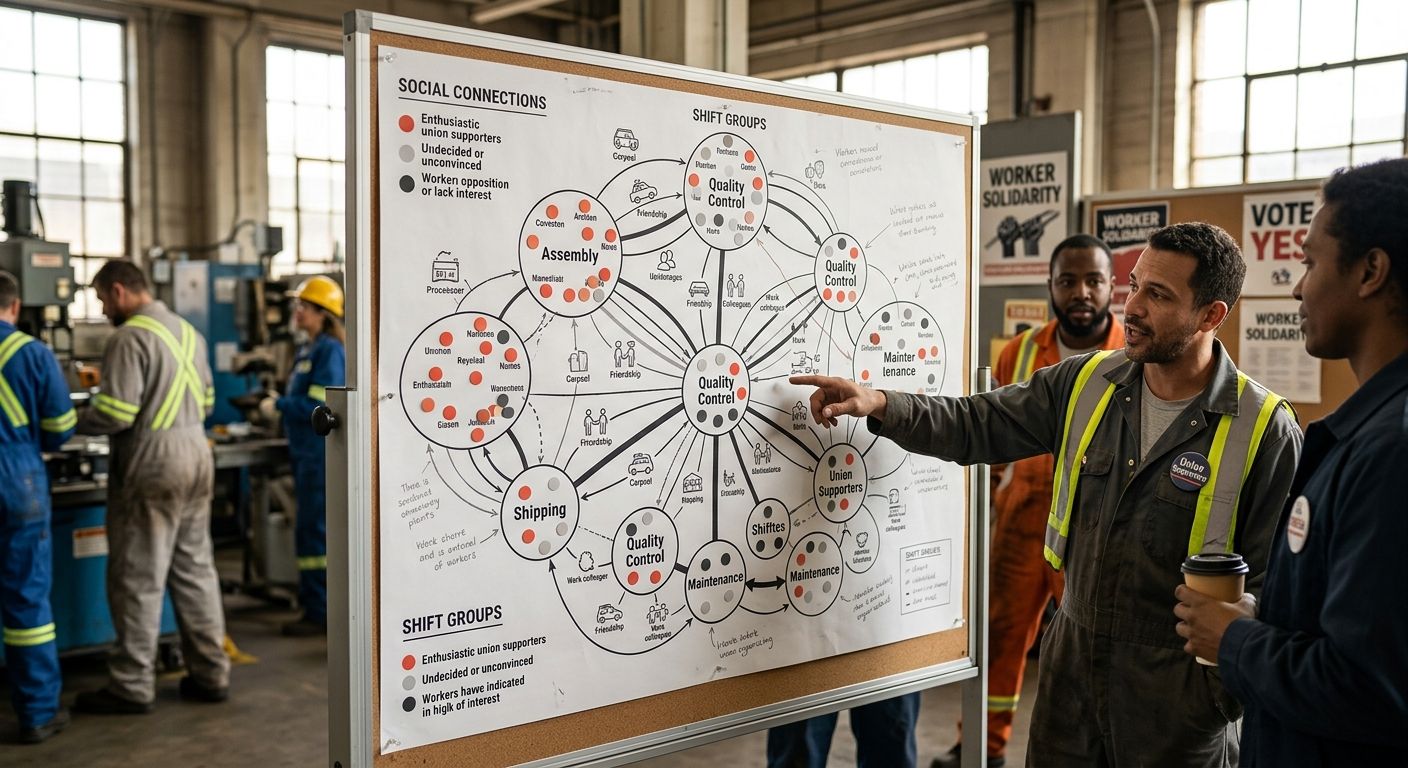
Your committee should look like your workplace. Every shift, every department, every demographic group needs representation. This is where workplace mapping becomes essential. Draw out the social architecture of your job. Who do people eat lunch with? Who do they trust? Who's the person everyone goes to when they have a problem? Those informal leaders are your first recruitment targets.
The research backs this up. Unions with deep rank-and-file organizing tactics built into their committee structure report 23% higher contract satisfaction and 31% better grievance resolution rates, according to data compiled by labor analytics groups. That's because a campaign run by workers themselves creates ownership that no outside organizer can manufacture.
And this connects to a broader truth: unions don't just win better contracts. They close persistent wage gaps for women and workers of color, which means your committee's diversity isn't just good optics. It's the foundation of a campaign that speaks to everyone's interests.
How Many People Do You Need?
The numbers matter. A general rule for your workplace organizing strategy:
At 30% support (signed authorization cards), you can safely go public with your campaign without fear of it collapsing under management pressure
At 50% support, you're ready for visible collective actions like petition deliveries, group grievances, or coordinated shirt days
At 65-70% support, you should be filing for an election, because you need a cushion against the votes you'll lose during the employer's anti-union push
That cushion isn't paranoia. Employers hold mandatory anti-union meetings (called "captive audience" meetings) in 89% of union election campaigns. Research shows that when employers hold 20 or more of these meetings, the union win rate drops to just 18%. When they hold none, unions win more than 40% of the time. Your inoculation work in those one-on-one conversations is the vaccine against this.
The Card Campaign and the Election
Once your committee is solid, you start collecting signed authorization cards. The UE's organizing guide describes this clearly: your coworkers are asked to join and support the union program by signing membership cards, with the goal of building majority support.
This phase is where many campaigns stall. People confuse quantity with quality. Getting 200 signatures is meaningless if 150 of those people won't actually show up when things get hard. Every card should come with a conversation, not a clipboard shoved across a break room table.
The election itself is a straightforward process through the NLRB, and you should understand your rights under the Board's rules before you file. But I want to be blunt about something: the election is a referendum on your organizing, not a replacement for it. If you've done the one-on-one work, if your committee reflects the shop, if you've inoculated against management's playbook, the vote takes care of itself.
The Real Fight: First Contract Negotiation
Here's where campaigns go to die. You've won the election. Everybody celebrates. And then nothing happens for months. The employer stalls. Workers lose interest. Committee members burn out. The union decertifies before a contract is ever signed.
Your first contract negotiation has to be treated as a continuation of your organizing campaign, not a separate legal process. Bill Barry's From First Contact to First Contract emphasizes this point: the book covers every step from targeting through contract, because experienced organizers know these aren't distinct phases. They're one continuous effort.
Build a Contract Action Team
Your organizing committee should evolve into a Contract Action Team (CAT). These are the workers who keep the shop engaged while negotiations drag on. Their job is communication: relaying updates from the bargaining table, collecting feedback on proposals, and organizing actions that remind management there's an organized workforce behind the negotiators.
The CAT should be running:
Regular updates through group chats, flyers, or shift-change meetings
Escalating actions timed to bargaining sessions (informational pickets, work-to-rule campaigns, public petitions)
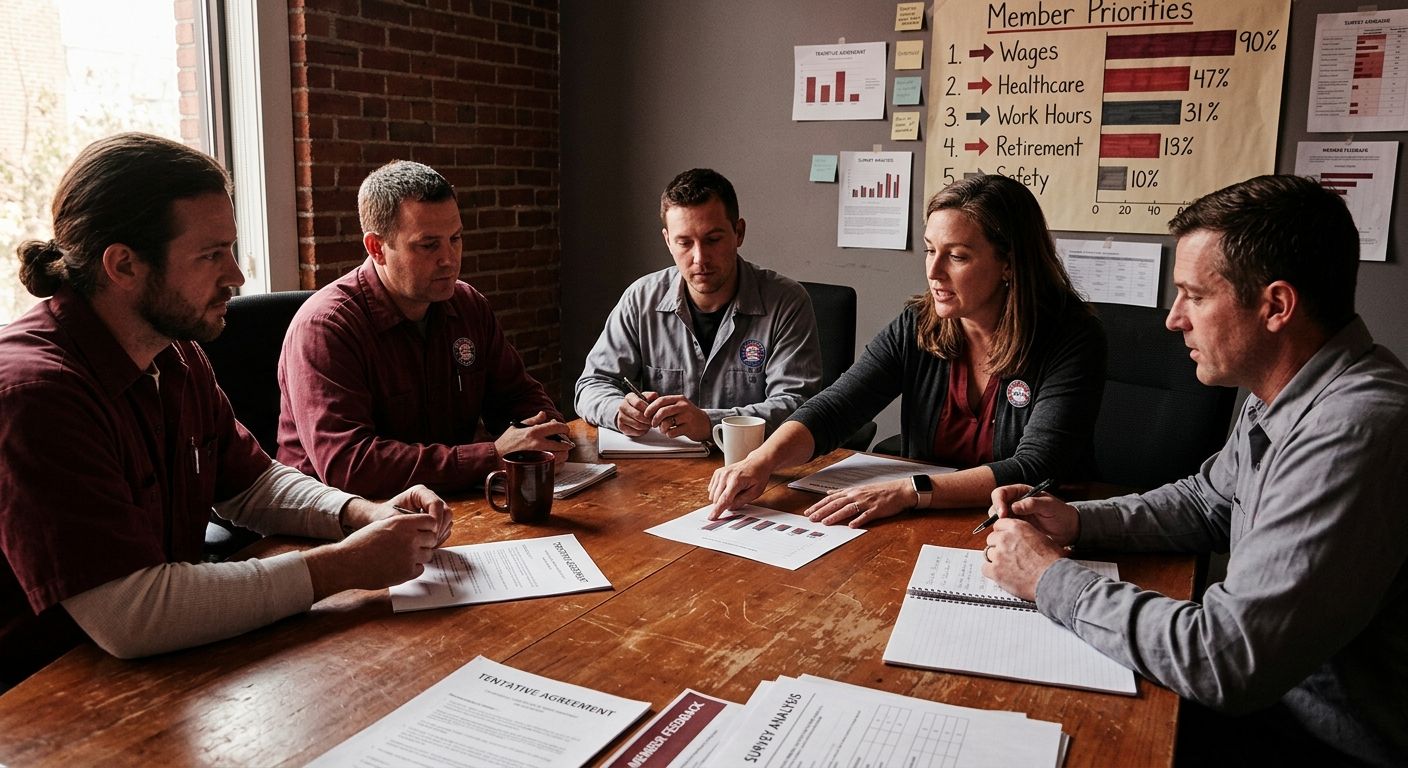
Member surveys on priorities, so negotiators always speak with the authority of the workforce behind them
Know Your Priorities and Your Power
Before you sit down at the table, survey your members. What do they actually want? Don't assume. The answers will surprise you. In one AFL-CIO poll, 98% of workers rated a safe workplace as "essential" or "very important," ranking it above wages and health insurance. If your shop has safety issues, that's your lead demand, and the data on how unions reduce workplace injuries gives you powerful evidence to bring to the table.
One of the most effective negotiation techniques is demonstrating why your position makes sense from a reasoned basis. That means doing your homework. Pull comparable contracts from similar employers. Get wage data for your region and industry. Quantify turnover costs. When you can show management that your proposals aren't just fair but financially logical, you change the dynamic from adversarial to problem-solving.
Maintain Pressure Without Losing People
The employer's primary strategy during first contract negotiation is delay. Every month that passes without a contract is a month where members wonder if the union was worth it. Your job is to make delay more expensive for the employer than settling.
This means escalation. Start with low-risk, high-visibility actions. Matching shirts on Wednesdays. A group letter to management about a specific issue. Gradually increase the intensity. An informational picket during a board meeting. A petition signed by community allies. Media outreach about stalled negotiations. The stress that workplace conditions cause doesn't just stay at the job. It follows workers home, and the toll on families is a story the public cares about.
Each escalation should be tied to a specific demand or a specific instance of employer bad faith. Random actions confuse people. Targeted actions build narrative.
What Separates Campaigns That Win From Campaigns That Don't
After watching dozens of these drives play out, I've identified the patterns. Successful campaigns share a few traits that failing ones lack.
They organize around issues, not abstractions. "We deserve respect" is a bumper sticker. "We need a grievance procedure because Maria got fired for calling in sick to take her kid to the ER" is a campaign.
They build leadership, not followership. The best organizers work themselves out of a job. If the campaign depends on one charismatic person, it dies when that person burns out, gets promoted, or gets pushed out. Rank-and-file organizing tactics that distribute leadership across dozens of workers create resilience that no single firing can break.
They plan past the election. Every decision during the organizing phase should be made with the contract campaign in mind. The committee you build, the issues you center, the communication habits you establish. All of it either sets you up for contract negotiations or leaves you scrambling.
They connect workplace fights to bigger ones. Workers who understand that their campaign is part of a larger movement, who see themselves in the struggles of immigrant workers organizing for their rights or nurses fighting for safe staffing, sustain motivation through the long months of bargaining. Isolation kills campaigns. Solidarity sustains them.
The Practical Takeaway
If you're starting a union organizing campaign today, don't think of it as a three-step process of talk, vote, negotiate. Think of it as building an organization. The conversations create the committee. The committee runs the card campaign. The card campaign wins the election. The election becomes the contract campaign. The contract campaign produces the first contract. And the first contract builds the foundation for the second, the third, and every fight after that.
The single most important thing you can do right now is have one honest conversation with one coworker about one specific problem at work. Don't pitch the union. Don't hand them a card. Just ask them what's wrong, and listen. Everything else follows from that.
The Union Edge Staff
Also in the paper