
Anonymous Hazard Reporting Systems: Building a Safety Culture Workers Actually Trust
Three systems dominate anonymous hazard reporting in American workplaces: company-run hotlines, third-party digital platforms, and union-administered safety programs. Each promises workers a way to flag dangers without exposing themselves to management retaliation.

Anonymous Hazard Reporting Systems: Building a Safety Culture Workers Actually Trust
Three systems dominate anonymous hazard reporting in American workplaces: company-run hotlines, third-party digital platforms, and union-administered safety programs. Each promises workers a way to flag dangers without exposing themselves to management retaliation. The differences between them determine whether reports actually lead to fixes or vanish into someone's inbox, unread and unresolved.
The stakes are real. Roughly 75% of workplace errors are self-detected by the worker involved, according to research still cited across safety literature. That means three out of four hazards will only surface if the person who spotted them feels safe enough to speak up. When the Veterans Administration switched to a nonpunitive reporting approach, it saw a 30-fold increase in reported safety events and a 900-fold increase in near-miss reports. The hazards were always there. Workers just weren't talking about them.
So which system actually earns worker trust? The answer depends on who controls the data, who investigates the reports, and who has the power to retaliate.
Company-Run Hotlines and the Trust Problem
The most common approach is the one management already owns. Internal anonymous reporting systems typically include suggestion boxes (physical or digital), dedicated phone lines staffed by HR, and web portals hosted on company servers. They're cheap to set up, easy to administer, and give employers direct access to incoming reports.
The problem is structural. When the same organization that creates hazards also controls the reporting channel, workers have every reason to doubt the system's independence. And they do doubt it. As we've explored in our reporting on why workers fear retaliation more than the hazards themselves, workplace retaliation fears are the single largest barrier to hazard identification in industries from construction to healthcare.
Where Internal Systems Break Down
Internal hotlines suffer from three specific weaknesses:
Anonymity is fragile. If your report describes a hazard on a specific shift, in a specific department, involving a specific piece of equipment, management can often narrow down who filed it. True anonymity requires more than hiding a name. It requires separating identifying context from the safety concern, and most company-run systems don't do this.
Investigations stay in-house. The people reviewing reports are often the same supervisors responsible for the conditions being reported. Even when an HR department handles intake, the investigation loops back to management. Workers know this.
There's no external accountability. If management decides a report doesn't warrant action, nobody outside the company ever sees it. There's no audit trail accessible to workers, no independent review, and no mechanism for escalation.
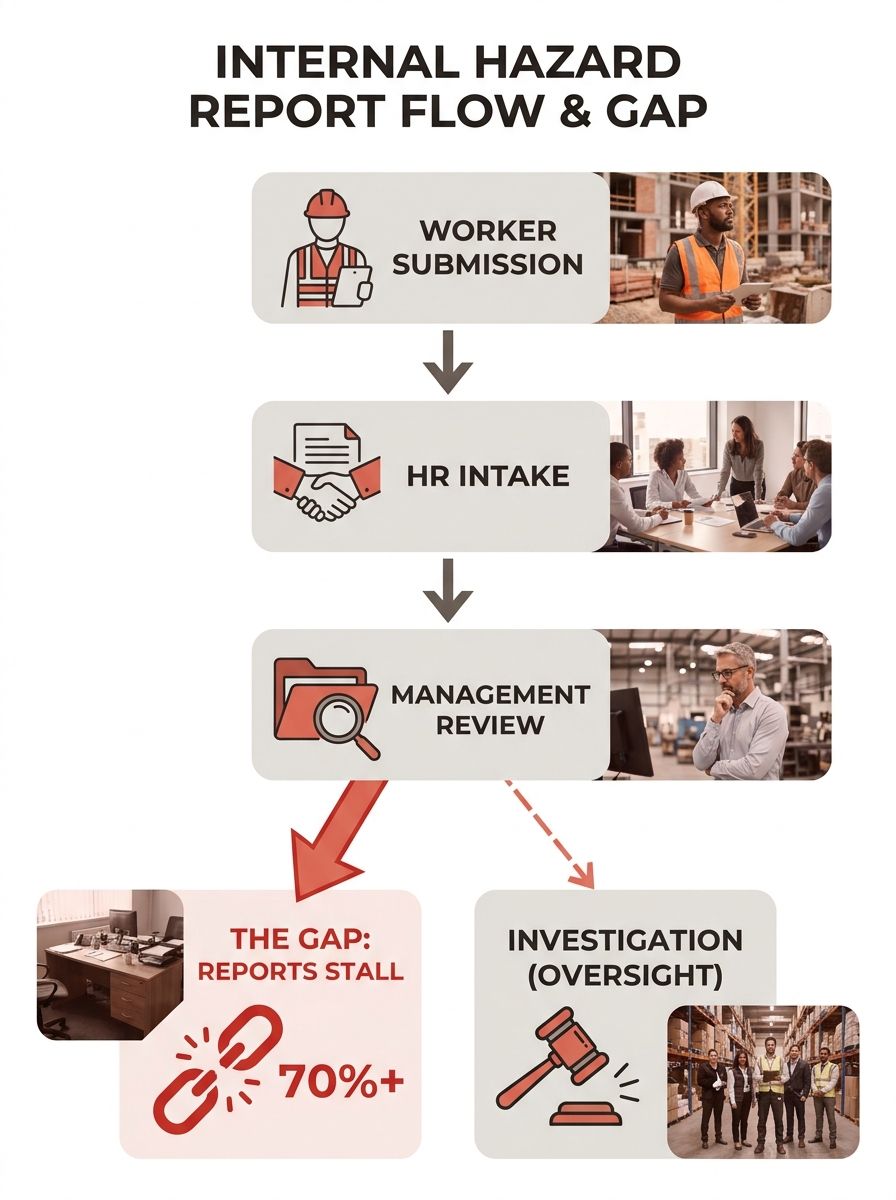
Some companies do run internal systems well. Large unionized manufacturers sometimes negotiate reporting protocols into their contracts, building in protections that don't exist at non-union shops. But the fundamental tension remains: the entity receiving the complaint is the entity being complained about. For workers already worried about losing shifts or being written up on pretextual grounds, that's often enough to keep their mouths shut.
OSHA's recommended practices for anti-retaliation programs specifically warn employers to create processes for staying current on anti-retaliation law. The agency understands that legal compliance and genuine trust are two different things.
Third-Party Platforms Promise Independence
A growing category of anonymous reporting systems runs through independent vendors. Platforms like Elker, FaceUp, and EthicsPoint offer digital channels where workers submit reports to a third-party server. The employer receives the report's content but, in theory, can't trace it back to the individual who filed it. Some platforms allow two-way anonymous communication, so investigators can ask follow-up questions without unmasking the reporter.
These tools address the biggest weakness of internal systems: they put a firewall between the worker and the boss. Elker specifically provides employees with anonymous space to raise concerns about psychosocial hazards, converting reports into cases sorted by issue type and severity. FaceUp and similar platforms allow workers to report hazards without revealing their identity, which matters most in environments where the hazard involves senior staff or sensitive operational decisions.
What Third-Party Platforms Get Right
The best of these platforms offer mobile-friendly interfaces, multilingual support, and offline capability for workers in remote locations or on job sites without reliable internet. Organizations can provide online portals, dedicated hotlines, suggestion boxes, or third-party reporting services designed to protect the reporter's identity while keeping the information actionable. The separation between the reporter and the employer's IT infrastructure makes anonymity more credible.
And credibility matters enormously. The concept of psychological safety culture rests on workers' genuine belief that speaking up won't cost them their livelihood. As research from the CIPD has documented, people are afraid of delivering bad news because they think it will make them unpopular. When a system can demonstrate, through consistent visible follow-through, that reports lead to action without consequences for the reporter, more people use it.
What Third-Party Platforms Still Get Wrong
Third-party platforms have real limitations that their marketing materials tend to gloss over:
Management still controls the response. The platform handles intake, but the employer decides whether and how to act. If a report about a malfunctioning press gets filed through a third-party portal and management ignores it, the third-party vendor has no enforcement authority. The worker is back to square one.
Cost creates access gaps. Subscription pricing means smaller employers and non-union workplaces are least likely to adopt these tools. The workers who need anonymous channels the most often have the least access to them.
Data governance is murky. Who owns the reports? Can management request metadata from the vendor? What happens if the company switches platforms and demands historical data? These questions have different answers depending on the vendor, and most workers never see the contract terms.
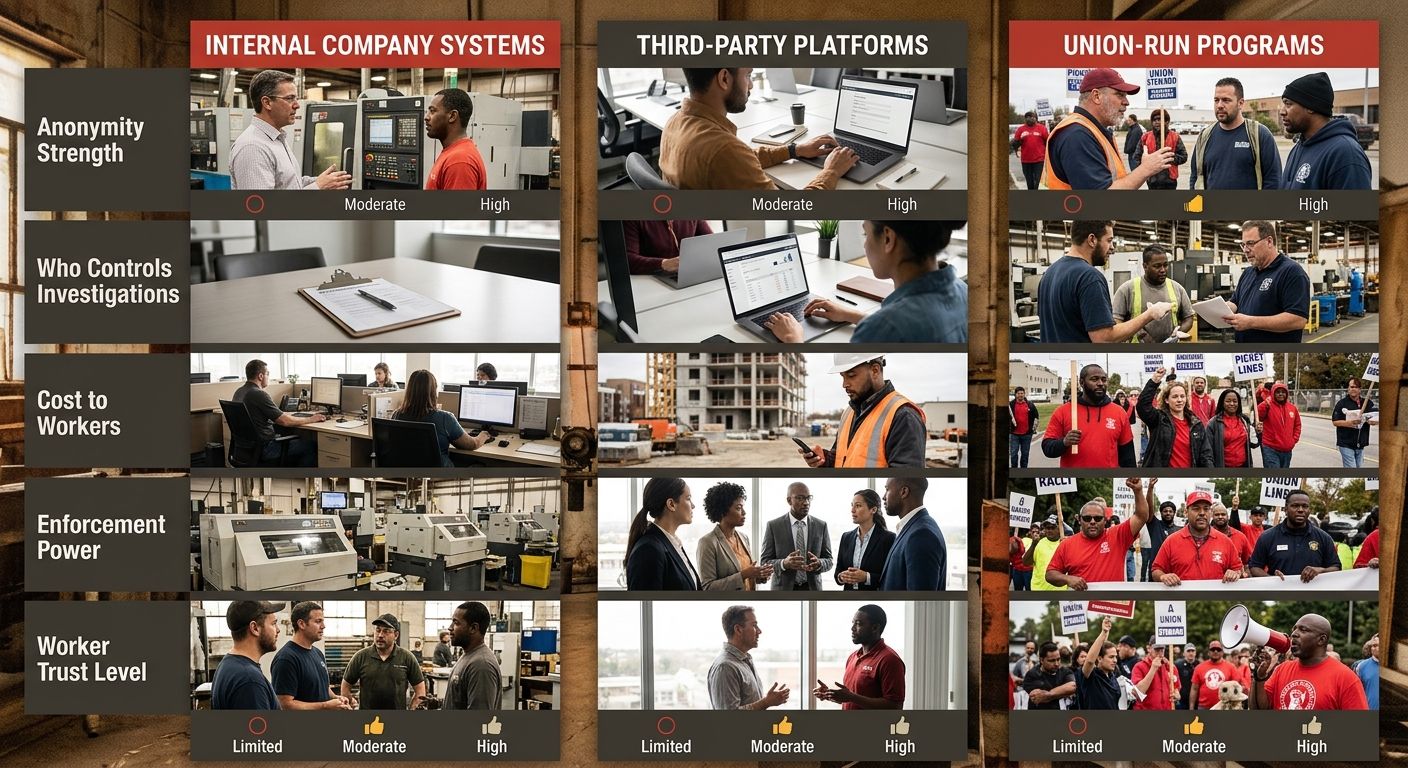
The gap between what companies promise and what their safety policies actually deliver is well-documented. Third-party platforms can narrow that gap, but they can't close it without structural accountability that extends beyond the software itself.
How Union Safety Programs Change the Power Dynamic
Union-run hazard reporting operates on a fundamentally different model. Instead of routing reports through management or a management-selected vendor, unions collect and investigate safety concerns through their own structures: joint labor-management safety committees, steward networks, and membership-wide hazard mapping campaigns.
The United Electrical Workers (UE) outlines this approach in their health and safety programs, which include surveying membership about illnesses and stresses, conducting symptom reviews, hazard mapping, and other activities for identifying and tracking hazards. The union doesn't just receive reports. It investigates them independently, compiles patterns across worksites, and uses the findings in bargaining and regulatory complaints.
This model addresses the enforcement gap that weakens both internal and third-party systems. When a union files a complaint with OSHA, the agency is legally obligated to respond. The Department of Labor's whistleblower protections shield workers from retaliation for identifying hazards, asking for inspections, or refusing unsafe work. But exercising those rights is far more practical when a union is backing you up than when you're a single worker hoping HR treats your anonymous tip seriously.
The Structural Advantages
Union workplace safety programs bring several things that neither internal systems nor third-party vendors can replicate:
Independent investigation capacity. Union safety committees can inspect worksites, interview witnesses, and document conditions without management controlling the process. OSHA encourages involving labor unions and worker advocacy groups in hazard identification precisely because independent eyes catch what management-directed inspections miss.
Collective bargaining as enforcement. When hazard patterns emerge from reporting data, unions can bring them to the bargaining table and negotiate enforceable fixes. As we've covered in our piece on negotiating contracts that stick, the strongest workplace protections come from language written into collective bargaining agreements, where violations have contractual consequences.
Retaliation protection through solidarity. A worker who reports a hazard through a union channel has the weight of the entire membership behind them. Retaliation against one reporter becomes a grievance that affects everyone. This shifts the calculus for employers in ways that no app or hotline can.
The Limitations Are Real Too
Union-run systems aren't available everywhere. Only about 10% of the U.S. workforce belongs to a union, which means 90% of workers don't have access to this model at all. Building a union safety committee requires an existing collective bargaining relationship, steward training, and management cooperation (or at least contractual obligation). For workers in non-union shops, especially in right-to-work states, this approach isn't immediately available without an organizing campaign first.
There's also a learning curve. Effective hazard mapping and symptom surveys require training and coordination. Small locals without dedicated safety staff sometimes struggle to maintain consistent reporting infrastructure, particularly when stewards are already stretched thin handling grievances.
And anonymity within a union structure can be complicated. In a tight-knit local, reporting a hazard to your steward may feel less anonymous than submitting a form through a faceless digital platform. The tradeoff is that the steward has both the obligation and the power to act on your report, which the faceless platform does not.
Who Should Pick Which
The honest assessment: all three approaches have a place, and the right choice depends on the power workers already hold.
If you're in a non-union workplace with a cooperative employer, a third-party anonymous reporting platform is your strongest realistic option. Push for a vendor that offers two-way anonymous communication, clear data governance policies, and regular reporting back to the workforce on actions taken. Insist that the employer commit to response timelines in writing. Without that commitment, the platform is a suggestion box with better branding.
If you're in a non-union workplace with an uncooperative employer, internal systems and even third-party platforms will likely fail you. Your best immediate protection comes from OSHA's direct complaint process, which allows anonymous reports to the agency. But the deeper answer is organizing. Worker-led safety campaigns have historically been among the strongest catalysts for union formation, and the connection between psychosocial hazards and organizing momentum runs deep.
If you're in a unionized workplace, demand that your collective bargaining agreement includes specific language on joint safety committees with independent investigation authority, hazard reporting protocols with anonymity protections, and enforceable timelines for management response. A third-party platform can complement this structure, but it shouldn't replace the union's own reporting channels. The platform collects data. The union acts on it.
Across all three models, one principle holds: anonymous reporting systems only work when workers see evidence that reports produce change. The Veterans Administration's dramatic increase in reporting didn't come from better software. It came from a policy decision to treat reports as learning opportunities rather than grounds for discipline. That's a cultural shift, and culture follows power. Workers who control their own reporting infrastructure, who can investigate independently, and who can bargain over the findings don't need to hope management takes their concerns seriously. They can require it.
The Union Edge Staff
Also in the paper