
Worker Democracy: What It Means and Why It Matters
Most people accept a strange contradiction without thinking twice. You live in a democracy. You vote for your representatives, debate public policy, and expect a say in how your community runs. Then you walk into work and surrender all of that.

Worker Democracy: What It Means and Why It Matters
Most people accept a strange contradiction without thinking twice. You live in a democracy. You vote for your representatives, debate public policy, and expect a say in how your community runs. Then you walk into work and surrender all of that. Your boss sets your schedule, dictates your tasks, monitors your keystrokes, and can fire you for reasons you'll never fully understand. We call this normal. Worker democracy asks a simple question: why?
I've spent years covering labor movements, from tech workers pushing for collective bargaining to supply chain fights that reshape entire industries. And the pattern I keep seeing is this: the workplaces where people thrive aren't the ones with the best perks or the highest pay. They're the ones where workers actually have power. Real, structural, decision-making power. That's what worker democracy is about, and the evidence backing it up is stronger than most people realize.
What Worker Democracy Actually Looks Like
Worker democracy is the application of democratic practices to the workplace. Voting. Debate. Participatory decision-making. It sounds abstract until you see it in practice.
At its simplest, a democratic workplace might hold regular forums where employees weigh in on scheduling, safety policies, or how new technology gets rolled out. At its most developed, workers sit on corporate boards, vote on company strategy, and share in ownership through stock plans or cooperatives. The Center for Learning in Action at Williams College defines it as the application of democratic practices like voting, debate, and participatory decision-making systems to the workplace. That's a clean definition. But the reality is messier and more interesting than any academic framing.
Think of it as a spectrum. On one end, you've got suggestion boxes and town halls where management listens politely and then does whatever it was going to do anyway. On the other end, you've got fully worker-owned cooperatives where every employee gets one vote on major decisions, regardless of title or tenure. Most real-world examples fall somewhere in between.
A few models dominate the conversation:
Employee Stock Ownership Plans (ESOPs), where workers accumulate voting shares over time
Works councils, common across Europe, where elected employee representatives consult on layoffs, reorganizations, and workplace policies
Worker cooperatives, where ownership and governance are fully in workers' hands
Sectoral bargaining boards, where workers help set wages and conditions across an entire industry
Union democracy, the internal democratic processes that give rank-and-file members control over their own unions, from electing leadership to ratifying contracts
That last one matters more than people think. Union democracy isn't just an internal governance question. It determines whether unions actually represent their members or become another top-down institution. When the Teamsters reformed their internal elections and saw a surge in member engagement, it didn't just change the union. It changed how effectively they organized across the supply chain.
The Numbers That Should Change Your Mind
Here's where skeptics tend to check out. "Sounds nice in theory," they say, "but does it actually work?" The data says yes, and it's not close.
Democratic workplaces in the United States are associated with 70 to 80 percent higher worker incomes, 9 to 19 percent higher productivity, 45 percent lower turnover, and are 30 percent less likely to fail in their early years. In Canada, firms with democratic structures were nearly half as likely to fail within ten years compared to conventionally managed ones. A meta-analysis of 43 studies on workplace democracy found no negative impact on efficiency, with many studies reporting clear gains.
Read those numbers again. We're not talking about marginal improvements. We're talking about dramatically better outcomes on nearly every metric that matters to both workers and business owners.
A 1995 study in the U.S. timber industry found productivity increases of 6 to 14 percent under democratic models. A 2006 meta-study concluded that combining employee involvement with ownership can equal or exceed the productivity of conventional firms. And a 2022 study using French data found that workplace democracy boosts economic performance, especially in knowledge-intensive sectors.
So why aren't more companies doing this? Partly because the people who benefit most from the current arrangement are the ones making the decisions. And partly because there's a persistent myth that democracy slows things down, that you can't run a business by committee. But that's a straw man. Nobody's proposing that warehouse workers vote on every purchase order. The question is whether workers get meaningful input on the decisions that directly affect their lives: wages, scheduling, safety, technology deployment, and the distribution of profits they helped create.
Why This Matters Beyond the Workplace
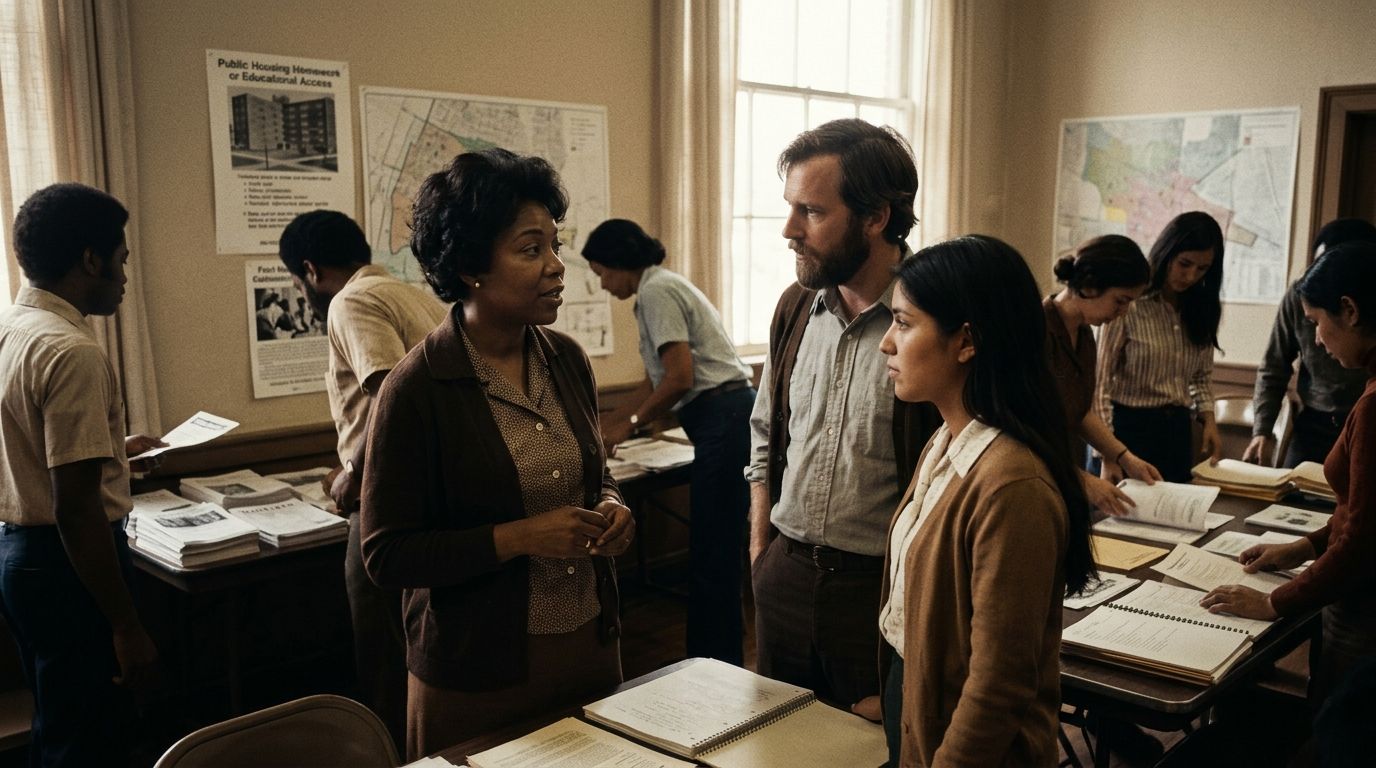
Worker democracy doesn't stay inside the factory gates or the office walls. It spills over into civic life in ways that researchers are just beginning to measure.
Field experiments cited in the American Political Science Review have linked participation in democratic workplaces to higher voter turnout and reduced authoritarian attitudes. The Roosevelt Institute has argued that unions and democratic workplaces serve as training grounds for democracy itself, building skills in communication, compromise, and collective action.
This makes intuitive sense. If you spend 40 hours a week in an environment where your opinion matters, where you practice deliberation and negotiation, you carry those habits into your community. If you spend 40 hours a week being told to shut up and do your job, you carry that too.
The connection between workplace authoritarianism and political disengagement is one of the most underexplored dynamics in American life. We worry about declining civic participation, eroding trust in institutions, and rising extremism. We spend billions on voter outreach campaigns. But we rarely ask whether the place where adults spend most of their waking hours might be shaping their relationship to democracy.
I think it is. And I think any serious conversation about democratic renewal has to include the workplace.
The Equity Model: Ownership Plus Voice
Not all employee ownership counts as democracy. Giving workers stock options without giving them a vote is just profit-sharing with extra steps. The most effective model, according to researchers, combines ownership with participatory management.
Experts call this the equity model. Workers own voting shares of their company, typically through an ESOP, and participatory management practices give them real influence over day-to-day operations. The Center for Learning in Action notes that the best examples distill into this equity model, where the relationship between participatory management and employee stock ownership creates a reinforcing cycle.
Senator Bernie Sanders proposed in 2020 a plan requiring large firms to gradually transfer 20 percent of shares into Democratic Employee Ownership Funds controlled by workers. Analysis by Roosevelt Institute Senior Fellow Lenore Palladino estimated such a policy could yield average annual dividends of over $2,600 per worker. And a 2019 survey found that 55 percent of Americans support giving employees up to half ownership in companies with more than 250 employees.
That's a majority. On a question most politicians won't touch.
What's Already Happening on the Ground
The policy landscape has shifted meaningfully. Since 2018, six U.S. states and three cities have established industry standards boards. California's Fast Food Council can set minimum wages and working conditions for the entire sector. Minnesota's Nursing Home Workforce Standards Board has already raised wages and guaranteed paid holidays. These bodies give workers a formal seat at the table, not just within a single company but across entire industries.
Internationally, the precedents run deeper. Germany's codetermination system puts worker representatives on corporate boards. Sweden's Social Democrats built democratic workplace reforms from the 1950s through the 1970s. In China, a form of workplace democracy is mandated by law for state-owned enterprises.
And the academic support is broad. A 2020 open letter calling for democratizing work was signed by over 6,000 researchers from more than 700 universities worldwide.
The trend is clear in organized labor too. Workers in industries from aviation to tech are demanding not just better pay but genuine voice in how their workplaces operate. The fights over algorithmic management in gig work, over surveillance tools in warehouses, over AI deployment in white-collar jobs are all fundamentally fights about democracy. Who decides how technology shapes work? Right now, the answer is almost never the people doing the work.
How to Build a More Democratic Workplace

If you're a worker, organizer, or even a manager who sees the value in this, here's what actually works:
Start with real decision-making power, not surveys. Suggestion boxes and engagement surveys are not democracy. Workers need binding input on at least some decisions. Start with scheduling, safety protocols, or hiring criteria.
Push for structural representation. Works councils, joint labor-management committees, and union steward systems create durable channels for worker voice. Individual charismatic managers come and go. Structures endure.
Connect ownership to governance. If your company offers stock options or an ESOP, push for those shares to carry voting rights on meaningful questions. Ownership without voice is just a financial instrument.
Invest in democratic skill-building. Workers need training in financial literacy, strategic thinking, and governance to participate effectively. Researchers call these "skills in economic democracy," and they don't develop automatically.
Build union democracy from within. If you're in a union, the internal democratic health of your organization determines its external power. Fight for transparent elections, accessible meetings, and real debate over contract priorities.
Advocate for sectoral standards boards. These bodies raise floors for wages and conditions across entire industries, reducing the race-to-the-bottom dynamic that punishes democratic firms competing against exploitative ones.
The Objection You'll Hear (and Why It's Wrong)
The most common pushback is that democracy is inefficient. Decisions take longer when more people are involved. Companies need decisive leadership, not endless meetings.
This is partly true and mostly misleading. Yes, some decisions need to happen fast. Nobody's suggesting a companywide vote on which cloud provider to use. But the decisions that most affect workers, compensation structures, layoff policies, surveillance practices, safety standards, benefit from more input, not less. The research consistently shows that democratic firms don't lose productivity as they scale. A common critique, and one the data simply doesn't support.
The deeper objection, usually unspoken, is about power. Worker democracy redistributes it. People who currently hold disproportionate control over workplace decisions, executives, shareholders, senior managers, would have to share that control. That's not an efficiency argument. It's an interest argument. And it's worth being honest about.
Where This Goes From Here
Worker democracy is not a fringe idea. It's a growing movement with policy traction, academic backing, and real-world results. The question isn't whether it works. The evidence on that is settled. The question is whether enough workers, organizers, and policymakers will push hard enough to make it the norm rather than the exception.
If you take one thing from this piece, make it this: the way most workplaces are governed is a choice, not a law of nature. We chose hierarchy. We can choose differently. And when workers do get genuine democratic power, the results are better for everyone, including the business.
The practical next step is unglamorous but effective. Talk to your coworkers. Find out what decisions affect your daily life that you currently have zero input on. Then figure out, together, how to change that. Whether that means forming a union, pushing for a works council, advocating for employee ownership, or simply demanding a real seat at the table when your company rolls out its next round of "efficiency improvements."
Democracy shouldn't clock out when you clock in.
The Union Edge Staff
Also in the paper