
When Tech Workers Unionize: Why Game Developers Are Leading the AI-Era Organizing Wave
On April 27, a supermajority of game developers at Wizards of the Coast filed for voluntary union recognition under the banner United Wizards of the Coast, affiliating with the Communications Workers of America.

When Tech Workers Unionize: Why Game Developers Are Leading the AI-Era Organizing Wave
On April 27, a supermajority of game developers at Wizards of the Coast filed for voluntary union recognition under the banner United Wizards of the Coast, affiliating with the Communications Workers of America. The workers build Magic: The Gathering Arena, the digital version of a trading card game that generates hundreds of millions of dollars annually for parent company Hasbro. Their demands center on three issues that have become the defining concerns of tech worker unionization in 2026: mass layoffs, mandatory return-to-office policies, and the forced adoption of generative AI tools in creative workflows. The filing didn't come out of nowhere. It landed after months of quiet organizing inside a studio that had already watched colleagues disappear in successive rounds of cuts. And it landed at a moment when the game industry's broader labor movement has built enough infrastructure to make drives like this one viable.
The Filing on Hasbro's Doorstep
The group asking for recognition includes developers, engineers, and quality assurance workers on the MTG Arena team at Wizards of the Coast's Renton, Washington offices. They petitioned Hasbro directly, asking the company to voluntarily recognize their union without forcing a formal NLRB election. According to reporting from The Guardian, the workers secured support from a supermajority of eligible employees before going public — a threshold well above the 30% showing of interest the NLRB requires to schedule an election, and one that signals deep workplace consensus rather than a narrow factional push.
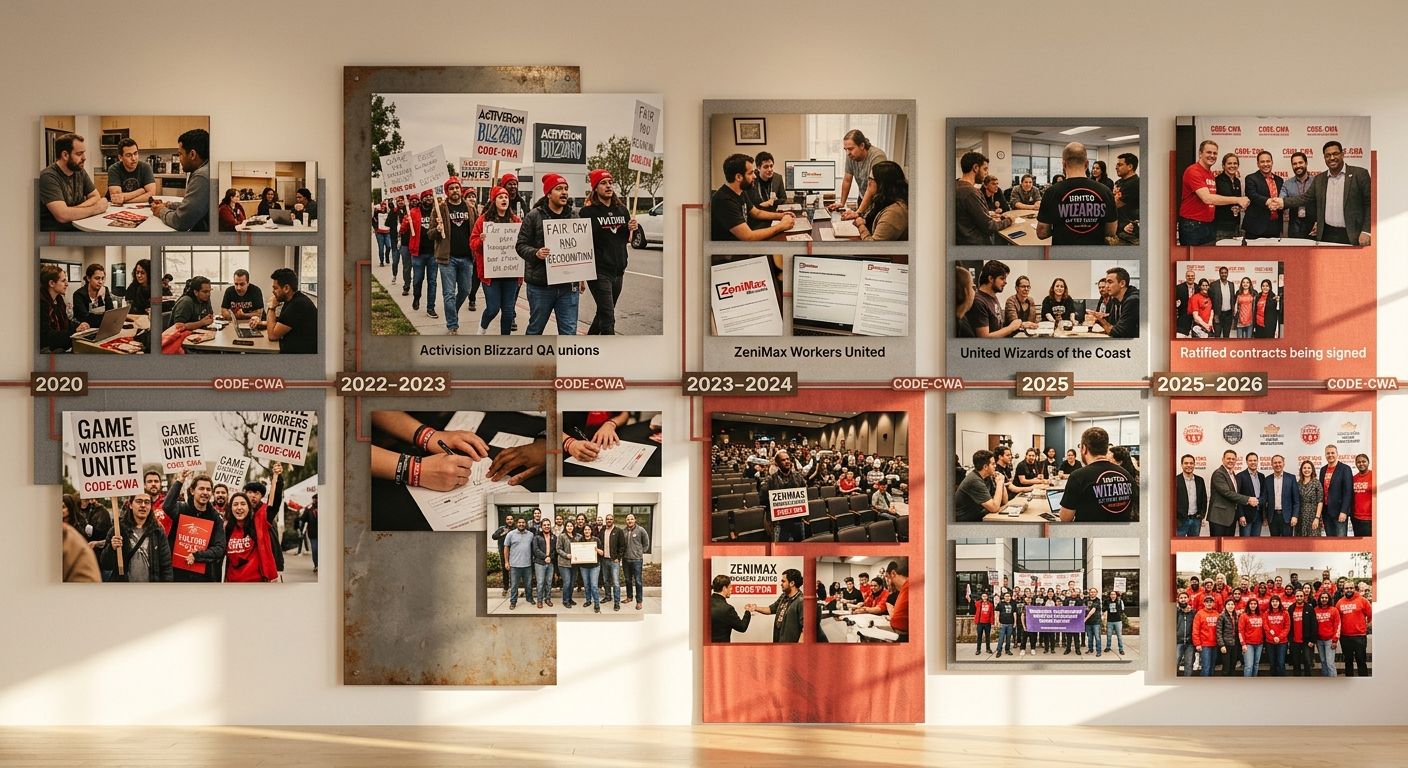
The union is organizing through CODE-CWA, the Campaign to Organize Digital Employees, which has become the primary vehicle for game developer labor drives since its founding. CODE-CWA's first year alone saw successful unionization at Glitch, Blue State Digital, the Alphabet Workers Union at Alphabet, and game studio Voltage Entertainment. The Wizards of the Coast drive would add another high-profile studio to a growing list — and one owned by a Fortune 500 toy and entertainment conglomerate, which raises the stakes for both sides.
The workers haven't been shy about naming their motivations. "We know the workers that make the game can and should be treated better," the group stated publicly. The phrasing is deliberate: it stakes a claim about the value of skilled creative labor at a moment when management across the industry has treated developers as interchangeable and disposable.
Crunch, Cuts, and a Return-to-Office Order
The conditions driving the Wizards of the Coast campaign are familiar to anyone who's followed the game industry's labor crisis. Crunch — the practice of requiring or pressuring employees to work extreme overtime during production deadlines — remains endemic. The International Game Developers Association's 2019 survey found that at least 40% of game developers had experienced crunch, and industry observers believe the number has only grown as studios push for faster release cycles with leaner teams.
But the immediate trigger at Wizards of the Coast wasn't crunch alone. The studio has gone through multiple rounds of layoffs in the past two years, part of broader cuts across Hasbro as the company restructured its entertainment divisions. Workers who survived the layoffs described a climate of anxiety — not knowing whether their jobs would exist in six months, watching experienced colleagues get terminated, and receiving no meaningful guarantees about future headcount. As NPR documented across the game industry, some developers have seen former coworkers cycle through unemployment repeatedly, with each layoff eroding the illusion that high skill levels provide AI-era job security.
On top of the layoffs came a return-to-office mandate. Wizards of the Coast, like many tech employers, had shifted to remote or hybrid work during and after the pandemic. The reversal forced workers to restructure their lives — commutes, childcare, housing — with little apparent input from the people affected. For a workforce already feeling disposable, the mandate signaled that management viewed workplace policy as something done to employees, not with them.
Researcher Ergin Bulut has written about how the game industry sustains a sharp divide between workers "above the line" — designers, creative directors, producers — and those "below the line," including testers and junior developers who perform essential work under precarious conditions. Game testers, Bulut found, often feel their creative contributions are undervalued, with one stating they were made to feel "less valuable," revealing a hierarchy of perceived creativity that maps directly onto a hierarchy of job security. Precarity in creative industries isn't distributed evenly. The people most vulnerable to layoffs are often the ones whose daily labor makes shipping the product possible.
Generative AI as the Accelerant
The layoffs and return-to-office policies are serious, but the issue that distinguishes this organizing drive from earlier ones — and that connects it to a much larger fight across the tech sector — is generative AI.
Workers at Wizards of the Coast cited the forced use of AI tools in creative workflows as a central concern. The complaint isn't abstract. These are developers who produce art, code, game mechanics, and narrative content for a beloved franchise. When management introduces generative AI into those workflows without negotiation, without clear policies about how AI-generated content will be attributed or credited, and without transparency about whether the tools are being used to reduce headcount, workers face an immediate threat to their professional identity, their compensation, and their continued employment.
This dynamic is accelerating across the economy. Research from the Dallas Federal Reserve demonstrates that patents for AI-augmenting technologies increase labor demand, while patents for AI-automating technologies reduce it. The distinction matters enormously: a tool that helps a developer work faster is different from a tool designed to replace that developer. But from the shop floor, the difference is invisible unless workers have a contractual voice in how new technologies get deployed.
The Brookings Institution's analysis of workers' capacity to adapt to AI-driven displacement found that AI exposure is positively correlated with adaptive capacity — meaning that many of the workers most affected by AI also have transferable skills. But the report cautions that dozens of confounding factors shape whether a given worker can actually navigate a transition, and that individual capability doesn't help much when the firm decides to cut an entire team. A union contract that requires bargaining over the introduction of AI tools provides a structural buffer that individual adaptability can't.
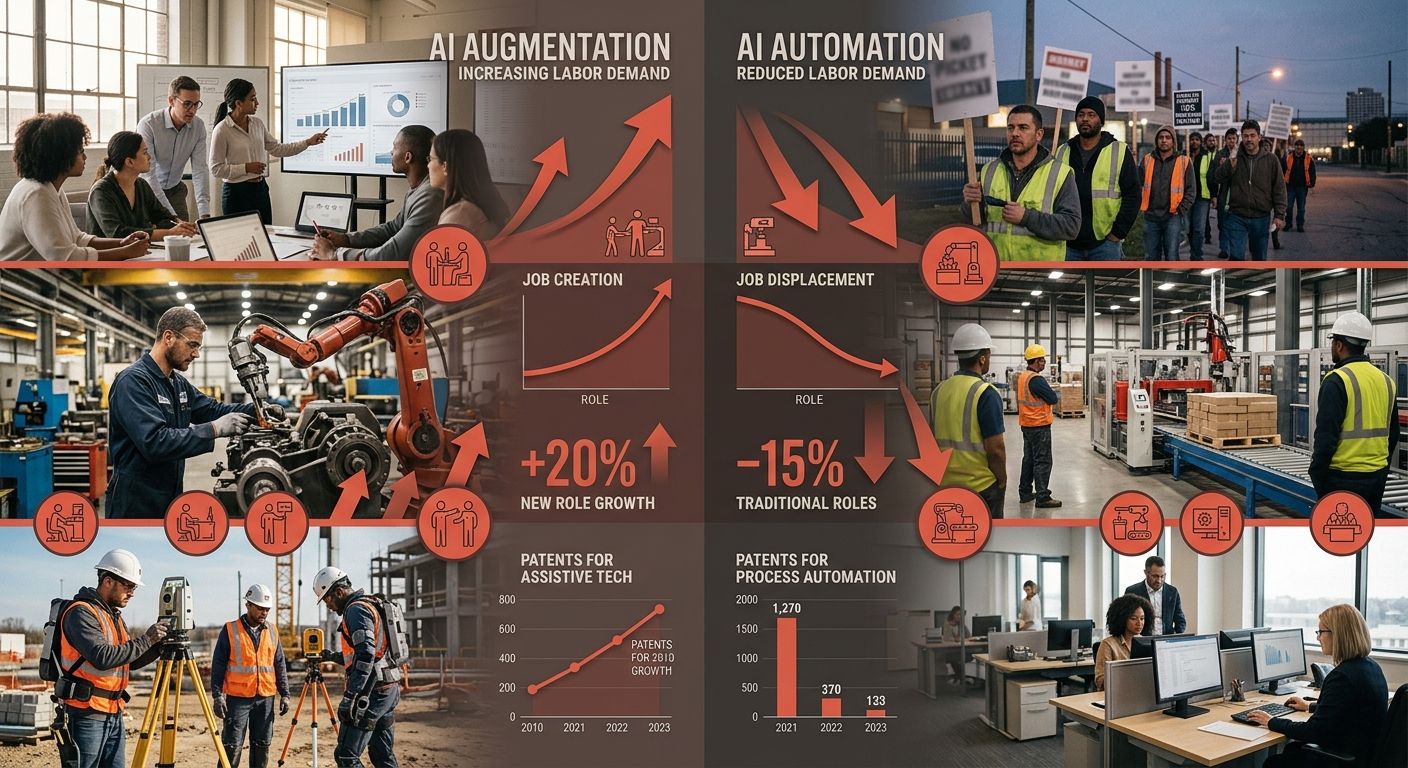
This is where the game developer labor movement feeds directly into the broader question of skilled worker organizing in the AI era. Game developers are canaries, not outliers. They're highly educated, digitally fluent, and employed in an industry that generates billions. If they can't negotiate the terms of AI adoption without a union, what chance do workers with less bargaining power have? As we've covered in examining how union wins can reshape entire industries, the contracts these early tech unions secure will set precedents for creative and technical workers across sectors.
From ZeniMax to MTG Arena: A Pattern Building Through Game Studios
The Wizards of the Coast filing didn't happen in isolation. It's the latest in a series of successful and attempted organizing drives that have made game development one of the most active fronts in tech worker unionization.
ZeniMax Workers United, formed at Microsoft-owned ZeniMax Studios, became one of the most prominent game developer unions in the U.S. and has been fighting for protections against layoffs and extended benefits after cuts occur. At GDC 2024, a panel on unionization reported that more and more studios were actively considering organizing, and that what had been whispered conversations about labor unions had become open, organized campaigns. CODE-CWA's infrastructure has been central to this shift, providing legal guidance, organizing training, and institutional backing that individual studios would struggle to assemble on their own.
The pattern is significant because it challenges a long-standing assumption about the tech sector: that highly compensated knowledge workers don't need unions. That assumption was always questionable — compensation doesn't protect you from arbitrary termination, and stock options don't help when your entire division gets eliminated. But the wave of game industry layoffs since 2023, combined with the AI disruption, has shattered the myth for good. Workers who build the products generating the revenue are watching management capture the gains while distributing the risks downward.
What's happening in game development echoes dynamics we've tracked in calls for aggressive union organizing to counter AI-driven inequality. The economic logic is straightforward: when productivity gains from AI accrue entirely to shareholders while workers absorb the displacement costs, collective bargaining becomes the primary mechanism for redistribution. Game developers who watched colleagues lose their jobs while their studio posted record revenues understand this in a visceral way that no policy paper can convey.
And there's a lesson here about how surveillance technology intersects with workplace AI. When your employer introduces AI tools that monitor your output, generate content in your style, and track your productivity metrics, the line between augmentation and replacement becomes a question of power. Who controls the data? Who decides when the AI's output is "good enough" to replace a human? Without collective bargaining, the answer is always management.
The Supermajority Card and What Hasbro Decides Next
The immediate question is whether Hasbro will voluntarily recognize United Wizards of the Coast. The workers filed a petition for an NLRB election but have asked the company to skip that step and grant recognition based on their demonstrated supermajority support. Voluntary recognition is faster, cheaper, and less adversarial — but it also requires the employer to accept that collective bargaining is coming without the delay and attrition that an election campaign enables.
Hasbro's response will be telling. The company has options: it can recognize the union quickly, signaling acceptance; it can refuse and force a formal election, buying time to run the kind of anti-union campaign that's standard in corporate playbooks; or it can challenge the composition of the bargaining unit, arguing about who should and shouldn't be included. Each path sends a signal to the thousands of workers at other Hasbro subsidiaries and across the game industry who are watching.
The broader significance of this drive extends well beyond one studio. Every successful game developer union changes the calculus for workers at the next studio considering organizing. The techniques for building an organizing committee from scratch that CODE-CWA has refined through years of campaigns get sharper with each drive. The legal strategies get tested. The employer counter-tactics become more predictable and easier to prepare for.
Under the National Labor Relations Act, Section 7 guarantees workers the right to organize and bargain collectively. Section 8(a)(1) prohibits employers from interfering with those rights. If Hasbro or Wizards of the Coast management takes any retaliatory action against workers involved in the organizing drive — discipline, reassignment, termination, or even pointed changes to work conditions — the company exposes itself to unfair labor practice charges. Workers at the studio should document every interaction with management about the union in writing, and anyone who experiences retaliation should contact CODE-CWA and file a charge with the NLRB immediately.
What's unfolding at Wizards of the Coast is a test case for whether the game industry's labor movement can extend from QA departments and junior roles into the core development teams that build flagship products. If a supermajority of the MTG Arena team wins recognition and bargains a contract covering AI deployment, layoff protections, and remote work rights, the template will travel. Other studios, other tech companies, other creative industries where AI is being introduced without worker input will look at the Wizards contract and ask: why don't we have that?
The workers filing this week in Renton already know the answer. They're building it themselves.
The Union Edge Staff
Also in the paper