
AI Safety Monitoring in the Workplace: What Workers Need to Know About Surveillance Technology
Computer vision systems mounted in warehouses and factory floors can now identify which workers are wearing hard hats, track how long someone stands in a restricted zone, and flag the exact moment an employee lifts a box at an angle the algorithm considers risky.

AI Safety Monitoring in the Workplace: What Workers Need to Know About Surveillance Technology
Computer vision systems mounted in warehouses and factory floors can now identify which workers are wearing hard hats, track how long someone stands in a restricted zone, and flag the exact moment an employee lifts a box at an angle the algorithm considers risky. The employer sees a safety dashboard. The worker sees a camera that never turns off. The gap between those two experiences defines one of the most urgent workplace fights happening right now.
Ninety-four percent of firms surveyed in a March 2026 Cority report said they're prioritizing AI implementation for environmental, health, and safety automation within the next two years. That's industry moving at scale, and workers in construction, manufacturing, logistics, and petrochemicals are already living inside these systems every shift.
The case we're dissecting here isn't a single company scandal. It's the documented collision between AI workplace monitoring tools spreading across workplaces globally and a regulatory framework that, in the United States, hasn't caught up. The clearest test case for what happens when workers fight back came from Italy, where a food delivery company called Foodinho ran into labor law that actually had teeth.
The Cameras and Wearables Pitched as Protection
Vendor pitch decks are straightforward: AI-powered safety monitoring saves lives. And the technology is genuinely impressive on a mechanical level. Computer vision platforms analyze live camera feeds, detecting PPE non-compliance, unauthorized entry into danger zones, and unsafe behaviors like smoking near flammable materials. Wearable devices with inertial measurement units and heart rate sensors track fatigue, posture, and fall events. Smart helmets send location data to digital twin systems and activate internal alarms on impact.
As documented in a Springer Nature ethics review, computer vision workplace surveillance offers benefits including enhanced security, improved worker safety, and misconduct prevention. But that same review flags the other side: privacy erosion, a stressful work environment, employee micromanagement, and the reinforcement of power imbalances between management and labor.
Here's where the safety argument starts to thin out. Many of these systems generate continuous "risk scores" for individual workers. They don't just detect a hazard and alert a supervisor. They build behavioral profiles over time, tracking patterns of movement, speed, breaks, and compliance across weeks and months. The data collected for "safety" purposes becomes indistinguishable from the data used for performance evaluation, discipline, and termination decisions.
When your employer tells you the cameras are there to keep you safe, ask what happens to the data after the shift ends. Ask who can access your individual risk score. Ask whether that score has ever been referenced in a disciplinary proceeding. If management can't answer those questions clearly, the system has already drifted past safety into worker surveillance territory. We've written before about the gap between what companies promise on safety and what they actually deliver, and AI monitoring follows the same pattern with more sophisticated technology underneath.
Foodinho's Algorithm on Trial in Italy
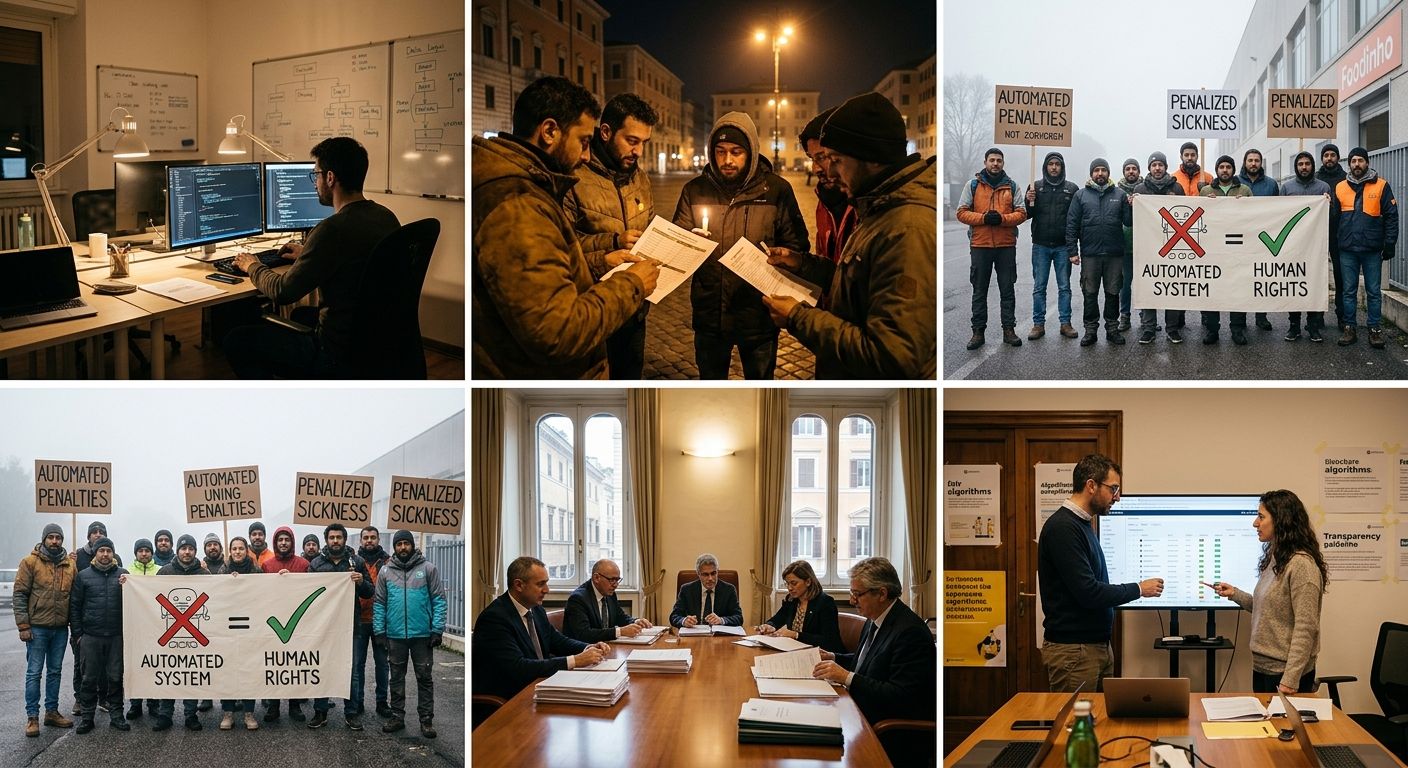
The most instructive legal confrontation over algorithmic management in the workplace happened in Italy, where Glovo's subsidiary Foodinho operated an app-based delivery system that assigned shifts, rated workers, and penalized riders through automated decision-making. The algorithm scored rider "reliability" and used those scores to determine who got access to the most lucrative delivery slots. Workers who canceled shifts for illness or emergencies saw their scores drop, which reduced future earning opportunities.
Italy's data protection authority, the Garante, investigated Foodinho's practices. What they found confirmed what workers had been saying: the algorithm made consequential decisions about employment without meaningful human oversight, collected more data than necessary, and provided no transparent mechanism for workers to challenge automated outcomes.
The European Trade Union Institute published a detailed report on this case, documenting how Italy's legal framework gave workers tools that most other countries don't provide. Italian labor law, combined with GDPR provisions on automated decision-making, created grounds for regulators to intervene. The report noted that the ability of workers to co-define rules concerning workplace technology is a right that's rarely exercised in practice, and the Foodinho case showed what happens when that right is actually activated.
The Foodinho outcome matters for every worker dealing with AI workplace monitoring because it showed the mechanics of resistance. Workers and their representatives identified the specific data flows that harmed them, linked those harms to existing legal protections, and used regulatory channels to force transparency. That playbook translates across borders, even when the specific laws differ.
The American Regulatory Vacuum
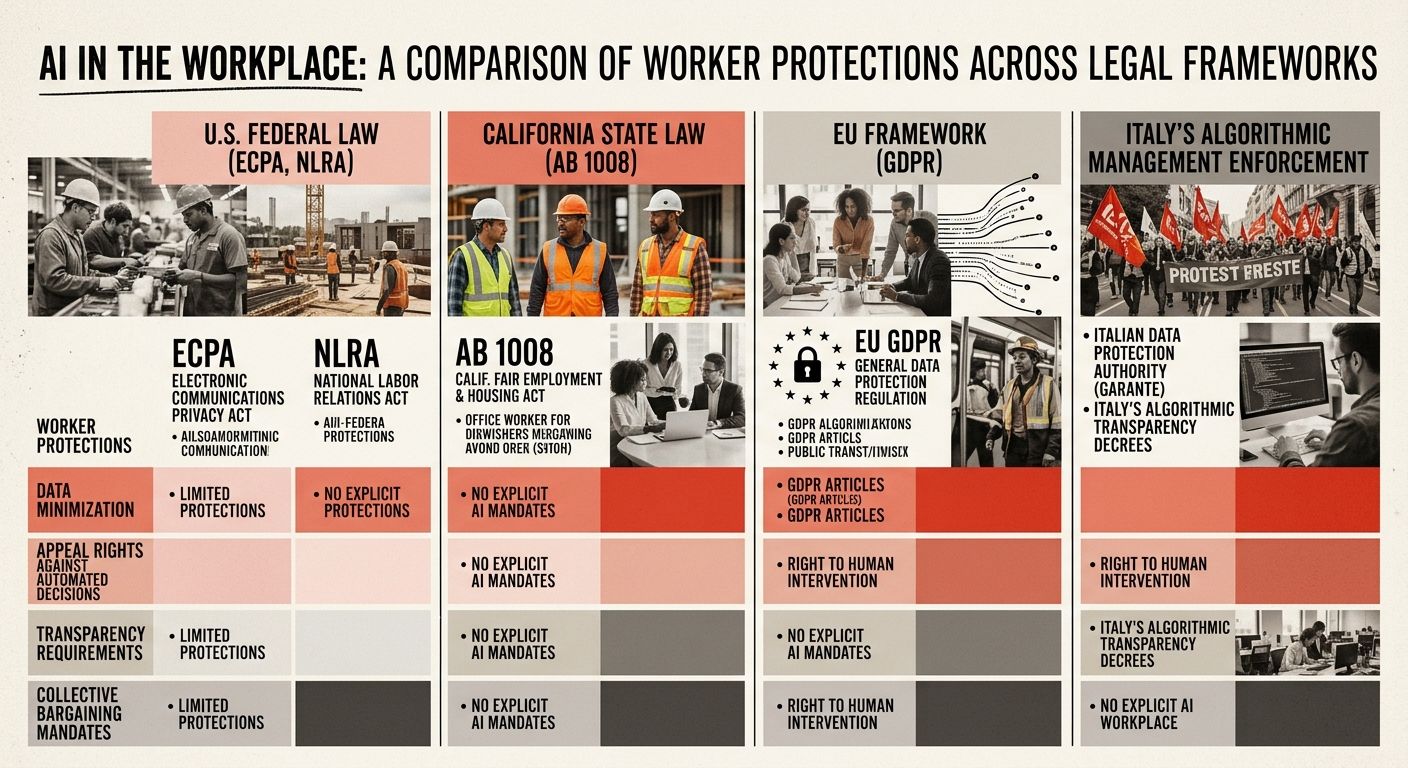
If you're working in the United States, the legal landscape for challenging AI safety monitoring is far less developed. As Harvard's Center for Labor and a Just Economy has documented, there is currently no legislation at the federal level explicitly regulating the use of AI in workplaces. The laws that do apply were written decades before anyone imagined an algorithm scoring your lifting posture in real time.
The Electronic Communications Privacy Act governs phone and electronic monitoring but was enacted in 1986. The National Labor Relations Act protects concerted activity, which means your employer can't legally use surveillance to retaliate against union organizing, but proving that a camera-equipped AI system targeted organizers requires a level of technical evidence that most workers and their representatives aren't equipped to produce. There are no explicit federal laws prohibiting employers from monitoring workers via video surveillance, and state-level protections remain uneven at best.
California's AB 1008 extended existing privacy protections to AI-generated content and broadened the definition of "personal information" to include abstract digital formats. A handful of other states have passed or proposed data-minimization requirements, stating that employers may collect only the data necessary for a defined purpose and must delete data when no longer needed. But patchwork state coverage means that a warehouse worker in California has meaningfully different workplace data privacy protections from a warehouse worker doing identical work across the state line in Nevada.
An OECD working paper on AI in the workplace warned that AI systems can "extend and systematize ethical failings and fundamentally change the relationship between workers and their managers". Without federal standards, that change is happening on management's terms. The conversation around AI-driven inequality and its impact on workers keeps circling back to this same structural gap: the technology moves fast, the law moves slow, and workers absorb the consequences in between.
The ILO's ongoing debate over algorithmic management has pushed the principle that workers must have the right to challenge automated decisions, access human review, and seek remedy through labor law channels. That principle sounds obvious. In practice, most U.S. workers have no formal mechanism to appeal a decision made by an AI system about their safety compliance, risk score, or fitness for a shift.
What the NLRA Still Protects—and Where It Falls Short
Union organizers need to understand both the power and the limits of current law when confronting safety technology ethics questions. Section 7 of the NLRA guarantees workers the right to engage in concerted activity for mutual aid and protection. When an AI monitoring system captures conversations between coworkers discussing working conditions or union interest, and that footage influences management decisions, there's a plausible unfair labor practice charge. The Board has historically taken a dim view of surveillance that chills organizing rights.
But the NLRA's protections are reactive, not preventive. A worker has to be harmed first, then file a charge, then wait for investigation, then hope the Board acts before the damage becomes permanent. The timeline of an NLRB case can stretch past a year. An algorithmic scoring system can reduce your hours, reassign your shifts, or flag you for "safety coaching" within a single pay period.
This mismatch between the speed of AI decision-making and the speed of labor law enforcement is the core structural problem. It's why workers need contract language that addresses technology before it's deployed, not grievance procedures that kick in after the harm has occurred.
Cambridge researchers analyzing algorithmic human resource management have identified three fundamental rights at stake: the right to equality, equity, and non-discrimination; the right to privacy; and the right to work. All three are threatened when an employer can deploy an AI system that scores, ranks, and sorts workers without negotiation or consent.
If your workplace is unionized, algorithmic management is a mandatory subject of bargaining. An employer can't unilaterally implement a surveillance system that changes working conditions without negotiating with the union. If your workplace isn't unionized, your strongest tool is collective action under Section 7, and knowing what data the system collects is the first step toward organizing around it. We've covered how post-recognition strategy determines real workplace change, and technology bargaining is rapidly becoming one of the most consequential items on that agenda.
The Bargaining Table Where Code Gets Negotiated
The Foodinho case didn't end with a fine. It established a principle that's migrating into collective bargaining agreements across Europe and into early-stage contract fights in the United States: technology that makes decisions about workers is a working condition, and working conditions are subject to negotiation.
For workers facing AI safety monitoring, the practical demands at the bargaining table look like this:
Data scope limitations: The contract should specify exactly what data the system collects, who accesses it, how long it's retained, and when it must be deleted. Data-minimization language prevents the gradual expansion of monitoring from safety alerts to behavioral profiling.
Separation of safety and discipline: Any data generated by safety monitoring systems should be contractually barred from use in performance evaluations, disciplinary proceedings, or termination decisions. If the employer says the cameras are about safety, hold them to it in writing.
Algorithmic transparency: Workers and their representatives should have the right to understand how risk scores are calculated, what thresholds trigger alerts, and what training data the models use. Bias audits should be conducted regularly and shared with the union.
Human review of automated decisions: No worker should be disciplined, reassigned, or have hours reduced based solely on an algorithmic output. A human supervisor with authority to override the system must review every consequential decision.
Right to challenge with matched timelines: Workers must have a clear, fast process for contesting AI-generated findings. The timeline for appeals should match the timeline of the system's decisions, not the glacial pace of traditional grievance arbitration.
These demands are adapted from the principles that emerged from the Foodinho enforcement, the ILO's working framework on algorithmic management, and early contract language being negotiated in U.S. public-sector unions. If your local is building digital infrastructure for tracking compliance and grievances, incorporating AI monitoring data into that system should be a priority now, not after the next contract cycle.
The companies deploying these systems understand that the window for establishing norms is closing. Every month that passes without contract language or regulatory guardrails is a month where management sets the defaults. As organizers with decades of collective experience, we've seen this pattern before with drug testing, electronic badge tracking, and GPS monitoring of vehicles. The technology arrives under a safety rationale, expands without resistance, and becomes a permanent fixture of workplace control. AI monitoring is following the same trajectory, with more granular data than anything that came before it.
Workers who are paying attention to what their employers' cameras and wearables actually capture, who are asking the right questions about data retention and algorithmic scoring, and who are bringing those questions to their union representatives or their coworkers are the ones who will shape what safety technology ethics look like for the next generation of labor agreements. The Foodinho workers proved that fighting algorithmic management is possible when you have the legal tools and the solidarity to use them. Building that same capacity in American workplaces, shop by shop and contract by contract, is the work ahead.
The Union Edge Staff
Frequently Asked Questions
- What types of AI safety monitoring systems are used in warehouses and factories?
- Computer vision systems can identify workers not wearing hard hats, track time in restricted zones, and flag unsafe lifting techniques. Wearable devices with inertial measurement units and heart rate sensors track fatigue, posture, and fall events, while smart helmets send location data and activate alarms on impact.
- How can AI safety monitoring data be misused beyond its stated purpose?
- Data collected for safety purposes often becomes indistinguishable from data used for performance evaluation, discipline, and termination decisions. Many systems generate continuous individual risk scores that track behavioral patterns over weeks and months, enabling micromanagement and power imbalances between management and workers.
- What legal protections do US workers have against workplace AI monitoring?
- Currently, there is no federal legislation explicitly regulating AI use in workplaces. The Electronic Communications Privacy Act (1986) and National Labor Relations Act provide some protections, but they weren't designed for AI systems and are difficult to enforce; protections vary by state with only a handful addressing data minimization.
- What happened in the Foodinho case in Italy?
- Italy's data protection authority found that Foodinho's algorithm made consequential employment decisions without meaningful human oversight, collected excessive data, and provided no transparent way for workers to challenge automated outcomes. The case demonstrated how combining Italian labor law with GDPR provisions enabled workers to force regulatory intervention and transparency.
- What should workers ask their employer about AI safety monitoring systems?
- Workers should ask what data is collected, who can access individual risk scores, how long data is retained, whether risk scores are used in disciplinary proceedings, and whether the data is kept separate from performance evaluations. These questions reveal whether the system is truly about safety or has expanded into worker surveillance.
- What contract language should unions negotiate regarding AI monitoring?
- Union contracts should specify exactly what data is collected and how long it's retained, prohibit using safety data in disciplinary decisions, require algorithmic transparency and bias audits, mandate human review of automated decisions before discipline or reassignment, and establish fast appeal timelines matching the speed of AI decisions.
- What rights do unionized workers have regarding workplace monitoring technology?
- Algorithmic management is a mandatory subject of bargaining in unionized workplaces, meaning employers cannot unilaterally implement surveillance systems that change working conditions. Under the NLRA, workers have the right to discuss monitoring practices with coworkers and cannot be retaliated against for union organizing activities.
Also in the paper