
Pattern Bargaining Beyond the Table: How Union Wins Reshape Entire Industries
Every contract the United Auto Workers won at General Motors in the postwar decades had a second audience: Ford and Chrysler.

Pattern Bargaining Beyond the Table: How Union Wins Reshape Entire Industries
Every contract the United Auto Workers won at General Motors in the postwar decades had a second audience: Ford and Chrysler. The UAW's approach, as the Federal Reserve Bank of Chicago has detailed, was to choose one target company, negotiate the strongest possible deal, and then bring that settlement to every remaining competitor as the baseline. This is pattern bargaining in its classic form, and its effects have always extended well past the union members who ratified the original agreement. When one contract sets new terms for wages, benefits, or working conditions, those terms ripple outward through an entire industry, raising standards for workers who may never have attended a union meeting in their lives.
How One Contract Becomes an Industry Standard
Pattern bargaining works because it removes labor costs as a competitive variable among firms in the same sector. If the UAW negotiates identical or near-identical wage packages at GM, Ford, and Chrysler, no single automaker can undercut the others by squeezing its workers harder. The playing field tilts toward competing on product quality, efficiency, and management skill instead of on who can pay the least. Walter Reuther understood this when he told the UAW convention that the union's objective was to take wages out of competition entirely. The strategy required discipline: the union chose which firm to bargain with first, typically selecting the company most likely to agree to strong terms, and then used that agreement as the template for every subsequent negotiation.
The 1948–1950 negotiations between the UAW and General Motors, often called the "Treaty of Detroit," illustrate the concept at its most effective. The contract tied wage increases to productivity growth and cost-of-living adjustments, and the UAW then extended those terms across the domestic auto industry. For roughly three decades, this pattern held. Auto workers at every major manufacturer received comparable pay, comparable benefits, and comparable job protections, and the model spread beyond autos into steel, meatpacking, and aerospace. The result was an industrial middle class that became the backbone of postwar American prosperity.
But pattern bargaining was never limited to the companies at the table. Its effects on the broader labor market operated through two mechanisms that researchers have studied extensively: direct wage spillovers and what economists call threat effects. Understanding these mechanisms matters because they explain why you don't need to be a union member to benefit from high union density in your industry, and why the erosion of that density has cost millions of workers money they'll never see.
The Invisible Raise
When union density is high in a given sector, nonunion employers face a practical problem. If the union shop down the road is paying $28 an hour with health insurance and a pension, and you're paying $22 with no pension, your best workers will leave or organize. So nonunion firms raise wages, improve benefits, and offer better working conditions preemptively. Economists call these threat effects, and they are among the most consequential and least understood dynamics in the American labor market. The U.S. Department of the Treasury has acknowledged this mechanism directly, noting that nonunionized firms in competition with unionized workplaces may choose to raise wages, change hiring practices, or improve their workplace environment to attract workers. This isn't charity on the part of nonunion employers. It's competitive pressure, and it only exists when unions are strong enough to set a credible standard.
Research from the Economic Policy Institute quantifies what this means in practice. On average, a worker covered by a union contract earns 10.2% more in wages than a peer with similar education, occupation, and experience in a nonunionized workplace in the same industry. That's the union wage premium. The wage spillovers extend further: when union density is high, nonunion workers in the same labor market see their pay rise too, because employers must compete for labor against the union standard. EPI's research on these spillover effects finds that threat effects are one of the primary ways union strength benefits employees who do not belong to unions.
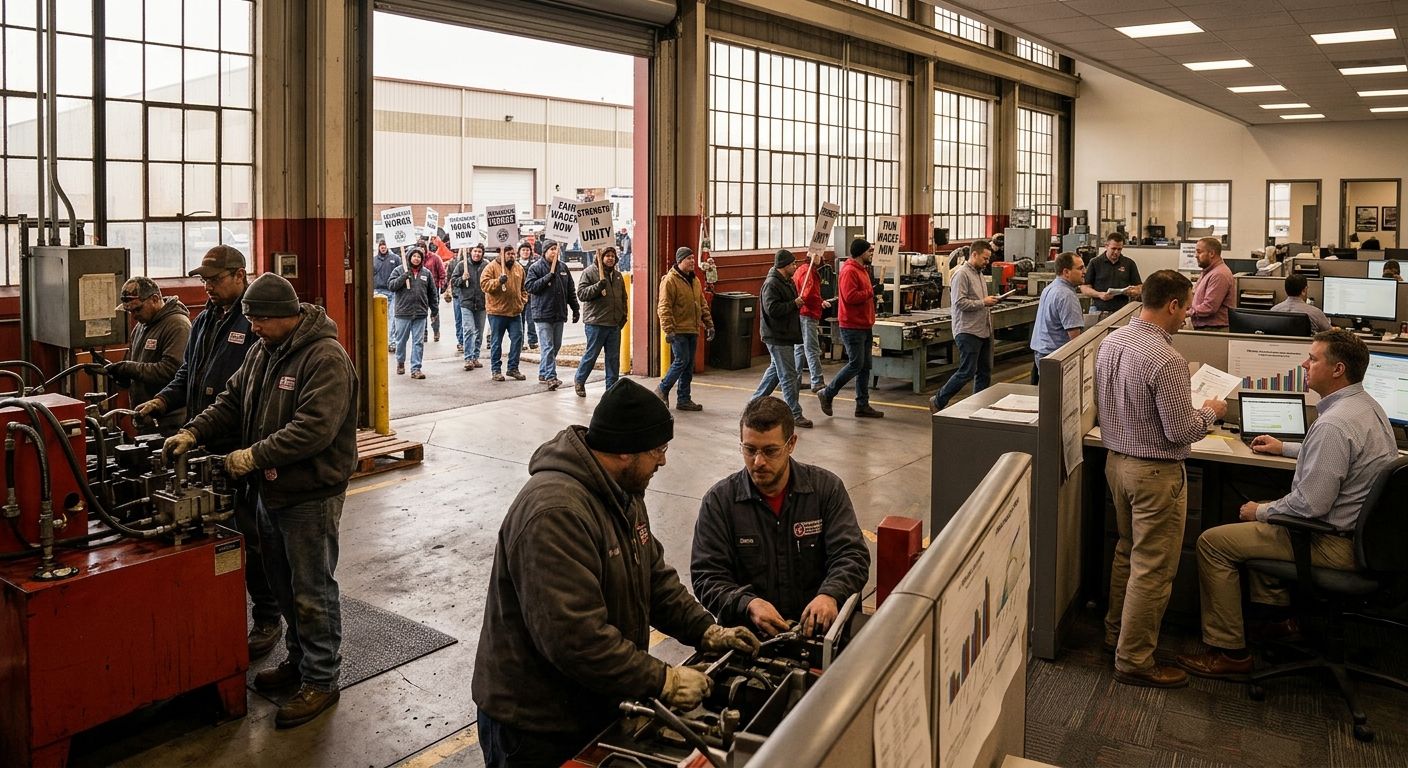
This dynamic operated powerfully in sectors where pattern bargaining was strongest. In auto manufacturing during the 1960s and 1970s, even nonunion parts suppliers in Michigan and Ohio paid wages well above what the same work would command in a low-density region. The union contract at the Big Three set a gravitational center that pulled wages upward across the entire supply chain. Workers who built brake pads at a nonunion shop benefited from the contract the UAW had won at the assembly plant, whether they realized it or not. Public health researchers have confirmed the broader implications, finding that labor union contracts create higher wage and benefit standards, working hours limits, and workplace hazards protections that establish norms well beyond the bargaining unit itself.
What Falling Density Costs Workers Who Never Held a Union Card
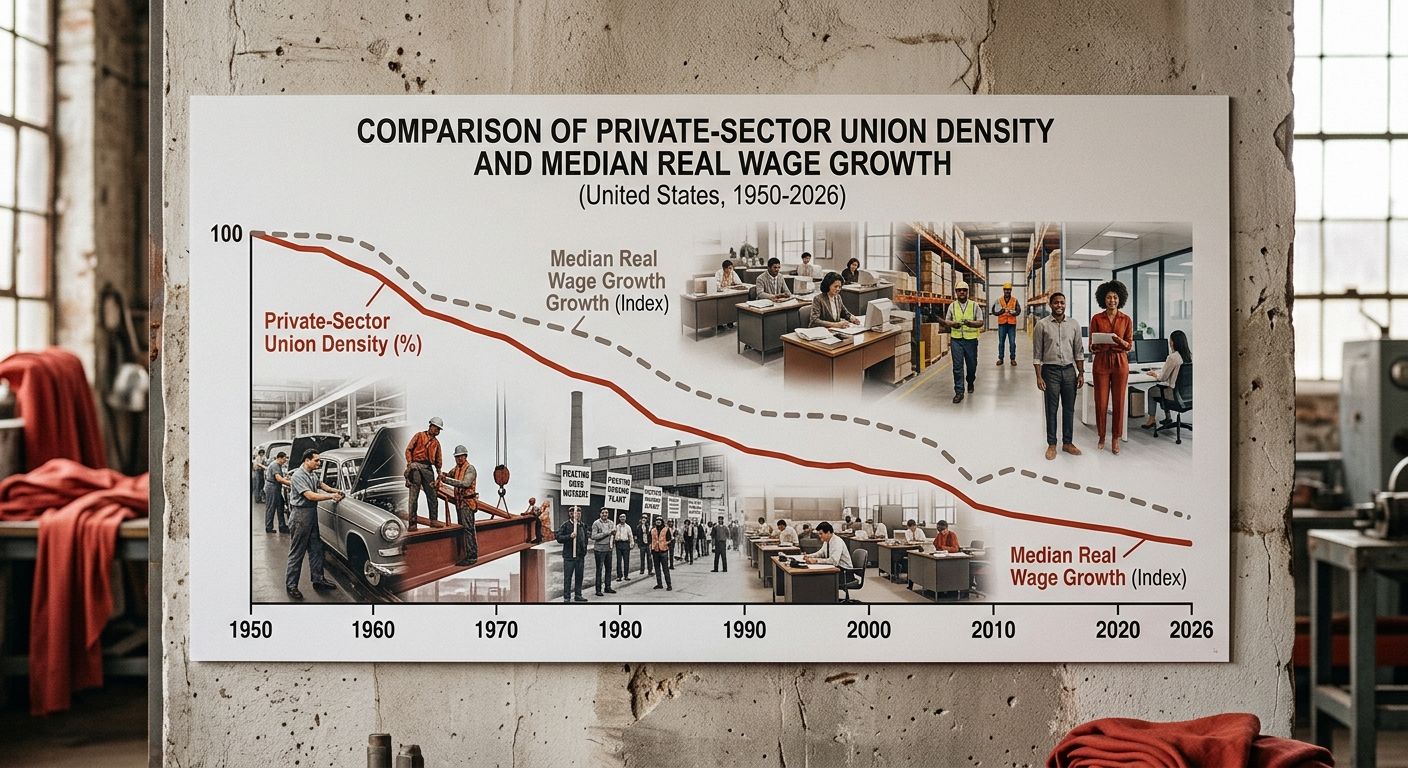
The flip side of this equation is the reality we're living in. Private-sector union density has dropped from over 30% in the 1950s to roughly 6% today. That collapse has eliminated the threat effects that once lifted wages across entire sectors. Research from the early 1990s established that declining collective bargaining was responsible for around a fifth of the rise in wage inequality among men in the 1980s, and more recent work has only confirmed and extended that finding. The erosion of collective bargaining has had an enormous impact on wages for workers across the economy, union and nonunion alike.
The mechanism is straightforward. When there's no credible union standard in an industry, nonunion employers face no upward pressure on compensation. They can pay whatever the individual worker is willing to accept, which in a labor market shaped by concentrated employer power and information asymmetry is almost always less than what collective action would secure. The loss is concentrated among workers who are already vulnerable. Research has consistently shown that unions reduce the wage gap between white workers and workers of color, and between men and women, a subject we've explored in the context of how collective bargaining narrows pay disparities across demographic groups. When union density falls, those gaps widen.
The scale of this loss is staggering. EPI's research estimates that nonunion men's wages would be 5% higher today if union density had remained at 1979 levels, translating to roughly $2,704 in lost annual wages per worker. For nonunion women, the effects are somewhat smaller but still significant. Multiply those figures across the tens of millions of nonunion workers in formerly high-density industries, and you begin to grasp the cumulative cost of pattern bargaining's decline. These aren't abstract losses. They show up as the gap between what a warehouse worker in 2026 earns and what a warehouse worker in 1976 earned in inflation-adjusted terms, despite producing far more output per hour.
The legal framework makes this worse. The National Labor Relations Act, as currently interpreted, confines bargaining to individual worksites or employers. There is no mechanism under U.S. law for the kind of sectoral bargaining that still sets industry-wide labor standards in Germany, France, or Scandinavia. The NLRA's framework assumes that bargaining happens firm by firm, which means unions must organize shop by shop, contract by contract, in an economic environment where capital can relocate across state lines or national borders in response to a single organizing drive. This structural disadvantage is one reason why smaller, independent unions often pay a steep price for going it alone instead of building the kind of coordinated, multi-employer power that pattern bargaining demands. And when federal enforcement of labor protections is simultaneously declining, the gap between what workers need and what the law provides grows even wider.
The result is a labor market where industry-wide labor standards are set not by collective bargaining but by whatever the lowest-cost employer can get away with. In logistics, in food service, in retail, the absence of a union pattern means there's no floor beneath which compensation cannot fall.
What Pattern Bargaining's Disappearance Leaves Unsettled
The conventional story about pattern bargaining treats it as a relic of the industrial era, something that worked when a few large firms dominated each sector and the workforce was concentrated in large plants. There's truth in that framing. You can't run the Reuther playbook in a gig economy or a sector where the lead firm contracts out 80% of its labor to staffing agencies. The conditions that made classic pattern bargaining possible in auto, steel, and meatpacking no longer exist in most of the American economy.
But the economic logic behind it hasn't changed at all. The threat effects that lifted nonunion wages in the 1960s would work the same way today if union density were high enough to generate them. The problem is one of power, not of theory. And recent events suggest that pattern bargaining can still reshape expectations even in its diminished form. The UAW's 2023 stand-up strikes against all three legacy automakers, followed by its public campaign to extend those gains to nonunion manufacturers, was an explicit attempt to revive the pattern-bargaining model in an industry that had largely abandoned it. Whether Toyota, Honda, and Tesla will feel enough pressure to match those terms depends on whether the UAW can actually organize their plants, a question that turns on whether organizers can build genuine worker-led committees rather than relying on top-down campaigns.
The deeper question is whether the United States will ever adopt the legal infrastructure that would make industry-wide labor standards enforceable rather than dependent on the organizing efforts of individual unions fighting firm by firm. Sectoral bargaining, where wages and conditions are negotiated for entire industries through tripartite bodies representing labor, management, and government, remains the norm in most wealthy democracies. It has never existed here, and the political obstacles to creating it are formidable. Without it, every union victory remains local, and the wage spillovers that once benefited tens of millions of nonunion workers continue to weaken as density declines.
We don't pretend to know when or whether that political shift will arrive. What we do know, from decades of research and organizing experience, is that the workers who lose most from the absence of pattern bargaining are the ones who never appear in any bargaining story. They work at the nonunion competitor. They stock shelves at the company that would have raised wages if there were a credible threat that its workforce might organize. They take home less, save less, and retire later because the gravitational pull of a strong union contract no longer reaches their paycheck. The research is unambiguous on this point, and it should inform every conversation about whether unions matter to workers who aren't in one. The answer, measured in dollars and in dignity, is that they matter enormously.
The Union Edge Staff
Also in the paper