
Building an Organizing Committee From Scratch: A Practical Guide to Identifying and Recruiting Your First Leaders
Rank-and-file organizing in healthcare facilities lives or dies on one structural question: whether the organizing committee reaches every shift, every department, and every building where workers show up.

Building an Organizing Committee From Scratch: A Practical Guide to Identifying and Recruiting Your First Leaders
Rank-and-file organizing in healthcare facilities lives or dies on one structural question: whether the organizing committee reaches every shift, every department, and every building where workers show up.
That reach determines everything else. A committee made up entirely of day-shift nurses will never persuade the overnight CNAs, the dietary workers, or the housekeeping staff that the union effort belongs to them too. The Emergency Workplace Organizing Committee calls the organizing committee "the backbone of any organizing effort", and in healthcare settings where 24/7 operations create natural silos between workers, that backbone needs to stretch further than in almost any other industry.
The standard benchmark is 10 to 15 percent of the bargaining unit. In a 200-person hospital, that means recruiting 20 to 30 committee members. But the number alone isn't enough. Those members need to reflect the actual composition of the workforce across department, shift, race, gender, age, and job title. Miss a group, and that group becomes the employer's primary target during an anti-union campaign.
Why Healthcare Organizing Committees Face Unique Pressure
Healthcare workers don't share a single break room. They don't all work the same hours. A respiratory therapist on the night shift may never cross paths with a medical records clerk who works 9-to-5. This fragmentation is the central obstacle to organizing committee formation in hospitals, nursing homes, clinics, and home care agencies.
The employer knows this. Anti-union consultants in healthcare routinely exploit departmental divisions, telling nurses that their interests conflict with those of support staff, or telling techs that the union is "really" a nurses' union. An organizing committee that fails to represent every segment of the workforce hands the employer that argument for free.
Beyond representation, healthcare workers face specific legal and scheduling constraints. Twelve-hour shifts, mandatory overtime, and rotating schedules make it difficult to find times when committee members can meet. Workers who interact with patients face additional employer scrutiny, because management often frames union activity as a threat to patient care, even though research consistently links better working conditions to improved psychosocial health and stronger organizing capacity.
Mapping the Workplace Before You Recruit Anyone
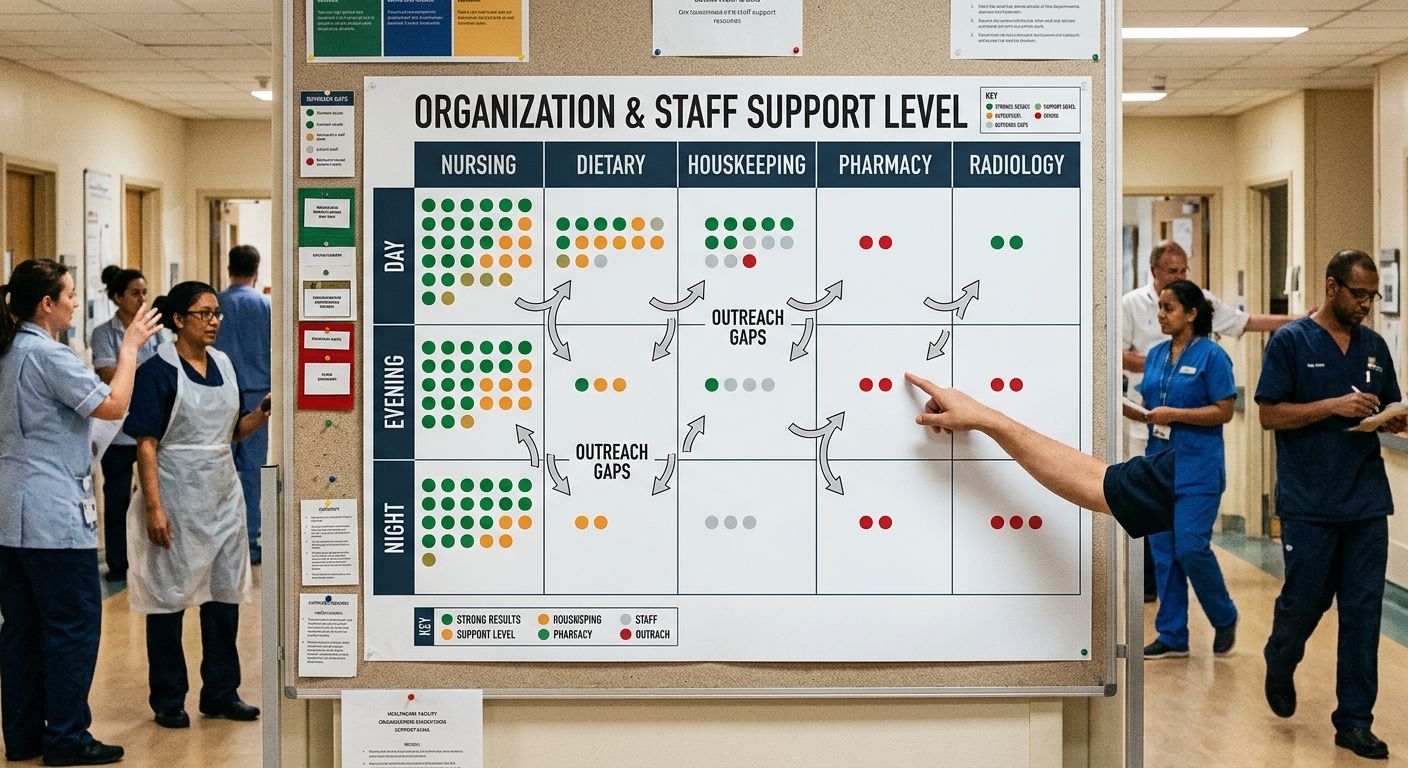
Before identifying a single potential committee member, you need a complete picture of who works in the facility. Organizers call this tool a "workplace chart," and it's the foundation of any serious worker recruitment strategy.
The chart is a spreadsheet or document listing every worker in the bargaining unit by name, organized by department and shift. For each person, you track their job title, their attitude toward the union on a scale of 1 to 5 (ranging from strong supporter to strong opponent), who they're close to at work, and any known concerns about workplace conditions.
You won't fill this chart in a day. It builds over weeks of quiet conversations. As the United Electrical Workers (UE) advise, the starting point is to "quietly talk to a few of your co-workers who you think may be interested in organizing" before expanding outward. Those early conversations reveal who the natural leaders are in each department.
In a healthcare setting, pay particular attention to the informal networks that already exist. Who do people go to when they have a question about scheduling? Who speaks up when patient ratios are unsafe? Who organizes the potluck or the birthday card? These workers carry social influence that has nothing to do with formal titles, and they're your primary recruitment targets for grassroots union leadership.
What the Chart Reveals
A well-maintained chart does three things simultaneously. It shows you where your support is concentrated, where the gaps are, and who the persuadable workers in the middle might be. If your chart shows strong support among RNs on the day shift but zero contacts in environmental services or the night shift pharmacy, you know exactly where to focus your outreach before forming the committee.
The chart also helps you avoid a common trap: building a committee out of the people you already know. Grassroots union leadership grows from intentional recruitment across the full workforce, and the chart is what keeps you honest about whether you're actually doing that.
Identifying Leaders Who Can Actually Do the Work
Not every supporter is a good committee member. The difference between a worker who signs a card and a worker who can recruit others, withstand employer pressure, and show up consistently to meetings matters enormously for the campaign's survival.
UnionTrack identifies four qualities to assess: willingness to serve, ability to meet regularly, comfort level with being the public face of the drive, and likeability among coworkers. In healthcare, we'd add two more. First, does this person have credibility across departmental lines? A CNA who is respected by nurses and dietary staff alike can bridge gaps that a worker known only within their own unit cannot. Second, can this person handle the emotional weight of the campaign? Healthcare workers already carry enormous emotional loads from patient care. Committee work adds to that burden, and honest conversations about capacity matter from the very beginning.
When assessing potential leaders, ask other workers directly: "Who do you trust?" and "If something went wrong on your unit, who would you want speaking for you?" Names that come up repeatedly across different conversations are your strongest candidates. This approach surfaces organic leaders rather than self-selected volunteers, which produces a committee with genuine credibility on the floor.
The Museum of Protest's grassroots organizing guide reinforces this point, urging organizers to start with those most directly affected by workplace conditions when building their initial leadership team. In a hospital, that often means the workers carrying the heaviest patient loads with the least institutional support.
The One-on-One Conversation That Builds the Committee
Recruiting a committee member is a structured conversation, not a pitch. The goal is to understand what a potential leader cares about, connect that concern to collective action, and ask them to take a specific next step.
A good one-on-one follows a pattern. You listen first, asking open-ended questions about what's working and what isn't in their daily experience. You reflect back what you hear, making sure the worker feels understood. You connect their individual frustration to a broader pattern affecting other workers. And then you make the ask: "Would you be willing to be part of the group of workers leading this effort?"
This approach aligns with research on why organizers who assume workers' needs tend to lose campaigns. Workers join committees when they feel heard, not when they feel recruited by someone who showed up with a predetermined agenda.
In healthcare, these conversations often happen in hallways, parking lots, and break rooms during shift changes. Home visits remain one of the most effective settings for deeper conversations, because workers feel safer discussing workplace conditions away from the facility. The organizing model has traditionally depended on organizers putting in significant time visiting workers at home, building the kind of personal trust that's difficult to establish in a five-minute break room chat.
Expect to have the conversation more than once. Committee membership is a serious commitment, and workers who are thoughtful about it often need time. Follow up without pressuring, and always respect a "not right now" as different from a "never."
Training the Committee Before Going Public
A committee that goes public before its members are trained is a committee that will get picked apart by management. Healthcare employers spend millions on anti-union consultants, and those consultants are skilled at identifying weaker links on an organizing committee and targeting them with one-on-one pressure, misleading information about union dues, and scare tactics about strikes affecting patients.
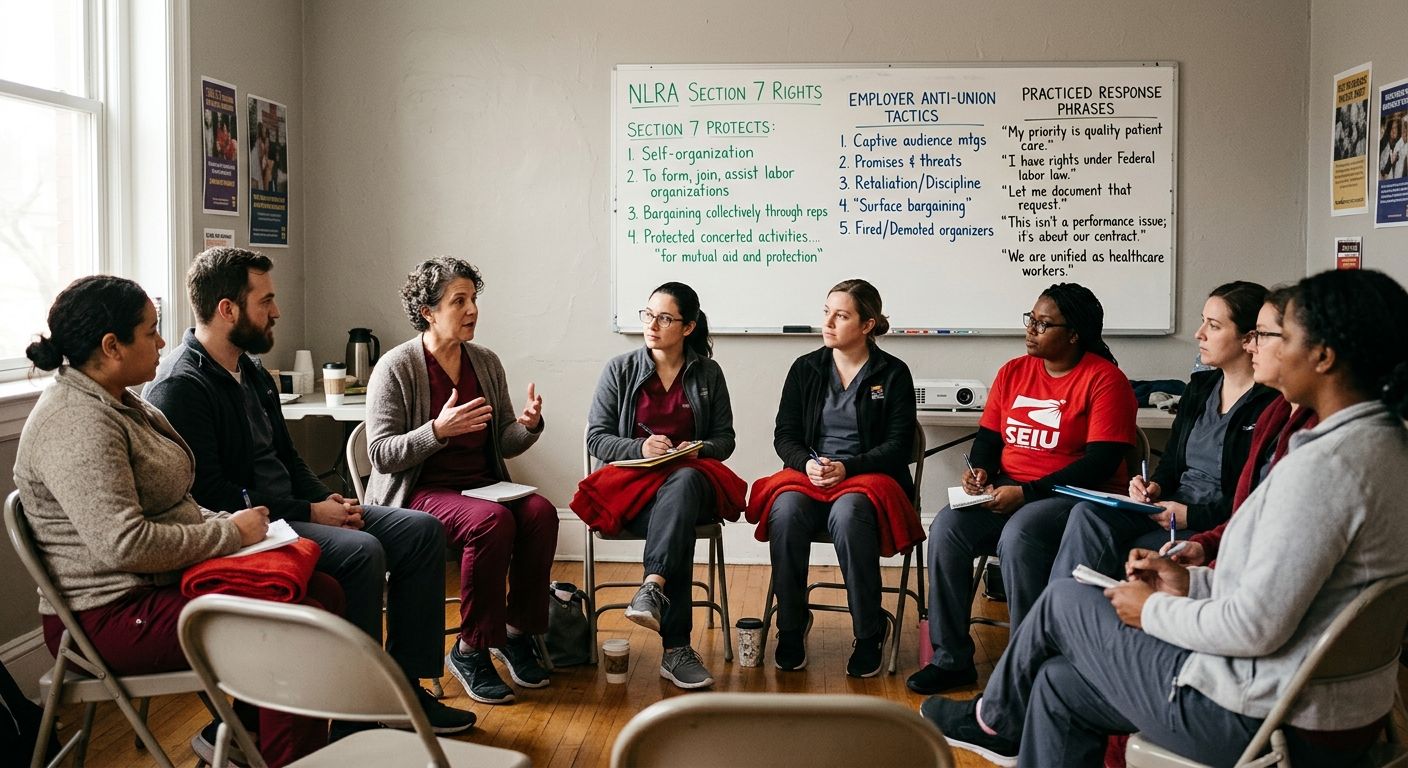
Every committee member should understand the basics of the National Labor Relations Act, including Section 7 rights that protect concerted activity and Section 8(a)(1) provisions that prohibit employer interference with organizing. They should know what management can and cannot legally say or do during a campaign. And they should practice responding to common anti-union arguments through role-playing exercises until the responses feel natural.
The UE places particular emphasis on training rank-and-file members in the skills needed to run their own organizations and to collectively confront employer resistance. This philosophy matters in healthcare, where the employer's strongest weapon is the claim that unionization will harm patients. Committee members need to articulate clearly, calmly, and with specific examples how unsafe staffing ratios, mandatory overtime, and inadequate equipment are the actual threats to patient care.
Training should also cover the campaign mechanics themselves: how to track conversations on the workplace chart, how to identify and respond to employer surveillance, how to maintain confidentiality during the early stages, and what threshold of support signals the committee is ready to go public. That threshold is generally 60 to 65 percent of the bargaining unit showing confirmed support. Anything less gives the employer too much room to erode your numbers before an election.
Keeping the Committee Together Through a Long Campaign
Healthcare organizing campaigns rarely move quickly. Between the initial quiet conversations and a potential NLRB election, months can pass. During that stretch, management will increase pressure, offer selective concessions designed to split the workforce, and attempt to identify and isolate committee leaders.
The committee's durability depends on three things: regular meetings, shared decision-making, and honest communication about setbacks. Weekly meetings keep momentum alive. Rotating responsibilities ensures that if one member faces retaliation or burns out, the campaign doesn't collapse around a single point of failure. And acknowledging when a conversation went badly or a department remains unpersuaded builds the kind of trust that sustains people through difficult stretches.
Independent union organizing efforts face additional challenges here, because they lack the institutional support structure that established unions provide. We've written about the tradeoffs that small independent unions face when they choose to go it alone, and organizing committees considering the independent route should weigh those costs honestly during the committee-building phase. Access to experienced organizers and dedicated legal counsel can make the difference between a committee that holds together under pressure and one that fractures.
Workload distribution within the committee deserves direct attention as well. Too often, the logistical work of an organizing campaign falls disproportionately on women and workers of color within the group. Meeting facilitation, note-taking, and outreach coordination should rotate deliberately so that every committee member develops leadership skills and no one person carries the administrative weight of the entire effort.
Where the Hard Questions Remain
The mechanics of organizing committee formation are well understood. The harder questions are contextual, and healthcare raises some of the most difficult ones.
How do you build a committee in a facility where annual turnover exceeds 40 percent, as it does in many nursing homes and home care agencies? High turnover means your committee membership is constantly eroding. Some organizers address this by recruiting faster than attrition, but that approach is a treadmill, and exhaustion catches up. Others argue for a longer base-building phase focused on the workplace conditions most likely to reduce turnover, creating a cycle where organizing itself improves retention and retention strengthens the committee.
How do you handle professional hierarchies within the bargaining unit? Registered nurses, licensed practical nurses, CNAs, and support staff occupy different rungs of the healthcare hierarchy, and those status differences don't disappear inside a committee meeting. Effective committees address this head-on by establishing ground rules that give equal voice to every member regardless of credential or pay grade.
And how do you protect committee members from retaliation in an industry where employers routinely claim that union activity threatens patient safety? The NLRA provides legal protections, but enforcement through the NLRB is slow, and healthcare employers have learned to disguise retaliation as performance management. Committee members need to document everything, communicate through secure channels outside employer-controlled systems, and understand that the legal framework offers protection in theory that often arrives late in practice. This gap between written policy and on-the-ground reality for workers facing retaliation is one of the persistent structural problems in American labor law.
These aren't problems with clean solutions. They're tensions that every healthcare organizing committee navigates in real time, and the committees that survive are the ones willing to talk about them openly rather than pretending the path forward is simple.
The Union Edge Staff
Also in the paper