
Beyond the Office: Why Union Organizers Must Get Into the Community to Win
The most effective union organizer I ever watched work spent less than a third of her time talking to people at their workplace. The rest? She was at school board meetings, church potlucks, community health fairs, and neighborhood association gatherings.

Beyond the Office: Why Union Organizers Must Get Into the Community to Win
The most effective union organizer I ever watched work spent less than a third of her time talking to people at their workplace. The rest? She was at school board meetings, church potlucks, community health fairs, and neighborhood association gatherings. Her campaign won authorization cards from 74% of the bargaining unit in under six weeks. The organizer down the hall, who focused exclusively on workplace conversations, had been grinding on his campaign for four months and couldn't crack 40%. Same union, same city, same resources. The difference was where the work happened.
Too many organizers treat the workplace as the entire battlefield. It's not. The workplace is where grievances live, but the community is where power gets built. If your union organizing strategy stops at the breakroom door, you're leaving your strongest cards on the table.
The Workplace-Only Trap
Here's the pattern I keep seeing. An organizing committee forms. Volunteers start having one-on-one conversations on lunch breaks and in parking lots. Management catches wind. Suddenly there are captive audience meetings, anti-union consultants, and supervisors hovering near every conversation. The campaign stalls because the only space organizers have claimed is a space the employer controls.
This shouldn't surprise anyone. Employers own the building, set the schedule, and control who goes where during work hours. When your entire campaign exists inside those walls, you're fighting on hostile terrain every single day.
The AFSCME Organizer Handbook puts it plainly: the union's number one priority is organizing, and that priority demands building a movement that extends well beyond any single employer. A campaign confined to the workplace is a campaign that management can suffocate.
But when you move organizing conversations into homes, community spaces, and public venues, you take away management's biggest advantage. Workers who only hear from you during a rushed ten-minute break get a fundamentally different experience than workers who sit across from you at a kitchen table for an hour, with their family present, talking about what a union could mean for their lives.
What Field Organizing Actually Looks Like
Field organizing borrows directly from political campaign infrastructure. Door-to-door canvassing, phone banking, text banking, and community events are core tactics of any serious field program. Political campaigns figured out decades ago that you don't win elections by only talking to voters at their polling place. You win by meeting people where they already are.
For union campaigns, this translates into specific activities:
House visits to workers on the organizing committee's contact list, ideally with a coworker they trust making the introduction
Community canvassing in neighborhoods where workers live, building name recognition and public support for the campaign
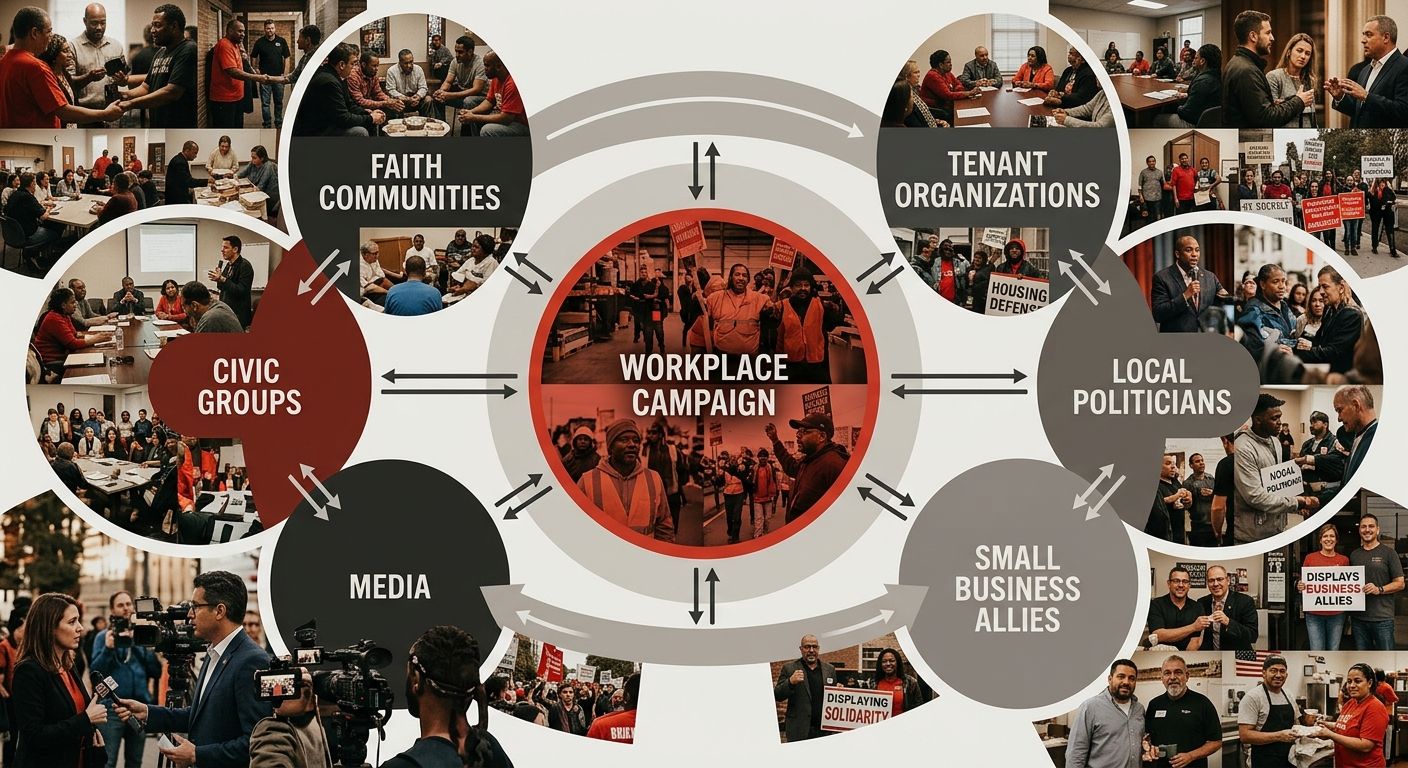
Coalition events with allied organizations like faith groups, tenant associations, and civic clubs
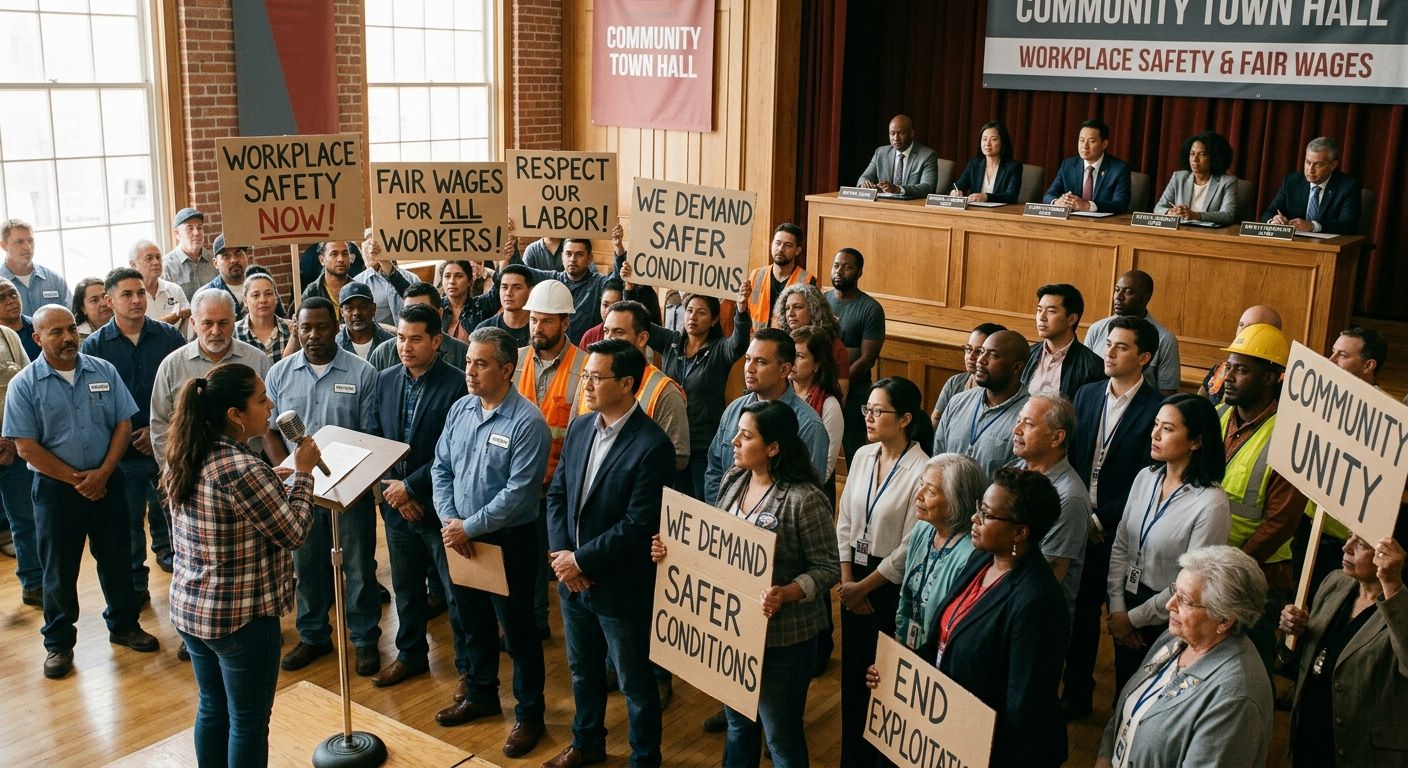
Public forums where workers can speak about conditions without a supervisor three feet away
The United Electrical Workers union's five basic steps to organizing emphasize that an organizing committee needs to gather detailed information about every worker: name, address, phone, shift, job title, department. That data isn't just for filing paperwork. It's for building a field program that can reach every single worker outside the employer's controlled environment.
When I talk to organizers who've run successful campaigns, the ones who win consistently all describe the same thing: a moment when the campaign stopped feeling like a workplace project and started feeling like a community movement. That shift doesn't happen by accident. It happens because someone made the deliberate choice to get out of the breakroom.
Building Real Community Coalitions
The AFL-CIO's resolution on building worker power states it clearly: state and local labor organizations succeed by "establishing strong and lasting alliances with community allies" and serving as key spokespersons for working families in the broader community. This isn't aspirational language. It's a description of what actually works.
Think about what a community coalition gives you that a workplace-only campaign can't provide:
Credibility with undecided workers. When a respected pastor or neighborhood leader supports the campaign, that carries weight with workers who don't yet trust the union.
Public pressure on the employer. A company can ignore its own workers behind closed doors. It's much harder to ignore a coalition of community organizations, local politicians, and media attention.
Infrastructure for grassroots mobilization. Community organizations have their own volunteer networks, meeting spaces, and communication channels. Plugging into those multiplies your capacity overnight.
Protection against retaliation. Workers who face threats from management are far more likely to stand firm when they know an entire community is watching and ready to respond.
The Fight for $15 movement is probably the clearest example. Backed by SEIU and a web of community organizations, it raised wages for nearly 26 million workers and delivered over $150 billion in additional income since 2012. Most of those workers weren't in traditional bargaining units. The wins came through political action, public pressure, and grassroots mobilization that treated entire cities as the organizing terrain, not individual workplaces.
Unions that care about closing the wage gap for women and workers of color understand this instinctively. Those fights can't be won shop by shop. They require the kind of broad political and social coalition that only community organizing can generate.
Pre-Majority Organizing: A Community-First Model
One of the most promising developments in labor strategy is pre-majority organizing, where workers take collective action without waiting for a formal NLRB election. The Emergency Workplace Organizing Committee points out that pre-majority unionism gives workers more control over defining who gets to be part of the union, rather than letting the NLRB or the employer dictate bargaining unit boundaries.
This approach is inherently community-oriented. Without the structure of an election timeline, organizers need to build sustained relationships with workers and their networks. You're not racing to 50%+1 on a specific date. You're building ongoing power that can push for improvements through direct action, public campaigns, and political pressure.
Pre-majority campaigns thrive when they're embedded in community infrastructure. A worker center connected to local immigrant rights organizations, for example, can organize across multiple employers simultaneously. Groups like the Domestic Workers Alliance have used this model to win real protections for workers who fall entirely outside the NLRA's coverage. If you're involved in efforts like organizing immigrant workers for their rights, pre-majority strategies paired with community coalitions are often the only viable path.
The Political Dimension You Can't Ignore
Here's something that doesn't get said enough in organizer training programs: workplace organizing and political organizing are the same skill set applied to different targets.
Door knocking is door knocking. Persuasion conversations follow similar structures whether you're asking someone to sign an authorization card or to support a ballot initiative. Data management, volunteer coordination, event logistics: it's all the same muscle.
Smart unions train their organizers in both. And the payoff goes in both directions. Political wins create organizing opportunities. The gaming rights initiative in Broward County, Florida, opened the door for thousands of workers to join unions. Prevailing wage laws have generated union jobs in construction for decades. Pro-worker state governments have enabled organizing among home care workers, child care providers, and graduate teaching assistants at public universities.
Research shows the connection runs deep. Twelve of the seventeen states with the highest union density have enacted paid sick leave laws, compared to only four of thirty-four states with medium or low union density. County-level union density has even been linked to greater access to ballot drop boxes. When you build worker power in the community, the community builds worker power right back.
This is why civic engagement beyond the picket line matters so much for labor. Every organizer who helps a coworker register to vote, shows up at a city council meeting, or testifies at a public hearing is doing organizing work, even if it doesn't show up on a union campaign timeline.
Practical Workplace Organizing Tactics That Bridge the Gap
So how do you actually move a campaign from workplace-only to community-embedded? Here's what I've seen work.
Map the community, not just the workplace
Your organizing committee should identify every community institution that touches workers' lives. Where do they worship? Where do their kids go to school? What neighborhood associations exist? Which local politicians represent them? Build a power map that includes all of these, not just the org chart at work.
Train your committee in field skills
Most workplace organizing tactics focus on conversations inside the shop. That's necessary but insufficient. Committee members need practice with house visits, community canvassing, and public speaking at coalition events. The skills overlap, but the setting changes everything. Someone who's confident in a breakroom conversation might freeze up knocking on a stranger's door. Practice matters.
Create community-facing events early
Don't wait until you're in a defensive posture to seek community support. From the first weeks of the campaign, host events that are open to supporters beyond the workplace. A community forum on healthcare costs, a neighborhood cookout, a panel discussion at a local library. These events serve double duty: they build public support and they give undecided workers a way to engage with the campaign in a low-pressure setting.
Connect the campaign to broader issues
Workers don't just care about their contract. They care about healthcare, housing, schools, transit, and safety. When your campaign speaks to those broader concerns, you naturally draw in community partners who share those priorities. If you're working with people affected by workplace stress and its impact on families, frame the campaign around what a union contract means for family stability, not just shop-floor conditions.
Understanding your rights under the NLRB is essential for the formal campaign. But winning the informal campaign for hearts and minds requires speaking a language that resonates far beyond labor law.
Build a year-round presence
The NEA's guidance on year-round field strategies emphasizes reaching potential members through multiple channels to create what they call a "surround sound" effect. This applies directly to union campaigns. If workers only hear from the union during a concentrated organizing drive, the message feels transactional. If they see union organizers and committee members active in the community all year, showing up at school board meetings and volunteering at food banks, the union becomes a trusted institution, not an outside force.
The Takeaway for Every Organizer
If your campaign strategy fits entirely inside the four walls of the workplace, you're playing defense on your employer's home turf. The organizers who win consistently are the ones who build power in the community first and bring that power to bear on the workplace fight.
This means investing time in relationships that don't have an obvious, immediate payoff. It means showing up for community partners on their issues, not just yours. It means training your organizing committee in field skills that feel more like political campaigning than traditional labor organizing. And it means redefining what "organizing" looks like, from a project with a start date and an election date to an ongoing practice of building worker power everywhere workers live.
The workplace is where the grievance starts. The community is where you build the power to fix it. Every organizer who internalizes that distinction gives their campaign a massive structural advantage. Stop organizing campaigns. Start organizing communities. The contracts will follow.
The Union Edge Staff
Also in the paper