
From Election Win to Contract Victory: Why Post-Recognition Organizing Strategy Determines Real Workplace Change
Fifty-two percent of newly certified unions don't reach a first contract within a year of winning their election. Nearly a third still don't have one after three years.

From Election Win to Contract Victory: Why Post-Recognition Organizing Strategy Determines Real Workplace Change
Fifty-two percent of newly certified unions don't reach a first contract within a year of winning their election. Nearly a third still don't have one after three years. The mechanism that separates election victories from actual workplace improvements isn't luck, legal maneuvering, or even the strength of workers' initial demands. It's post-recognition organizing strategy, the deliberate, sustained campaign to build and exercise power between the day the NLRB certifies your union and the day your employer signs a binding agreement. Most workers assume the hard part is over once the votes are counted. That assumption is the single most dangerous misunderstanding in labor organizing today. The election is the starting gun. The real race begins after.
What the Law Actually Requires (and What It Doesn't)
Under the National Labor Relations Act, once the NLRB certifies an election result, your employer is legally compelled to recognize the union and begin bargaining in good faith. That phrase sounds reassuring. It isn't.
"Good faith" is one of the slipperiest concepts in labor law. Section 8(d) of the NLRA requires both parties to meet at reasonable times, confer in good faith about wages, hours, and conditions of employment, and execute a written contract if agreement is reached. But the law does not require either side to agree to any specific proposal. It does not require the employer to make concessions. And it certainly doesn't put a hard deadline on when bargaining must conclude.
This is the gap that employers exploit. As UnionTrack has documented, companies routinely drag out the process through surface bargaining, where they show up to sessions, nod politely, and refuse to move. They challenge the certification. They reorganize departments. They hire law firms whose entire business model is delay. The National Labor Relations Board can issue unfair labor practice charges for bad-faith bargaining, but enforcement is slow and penalties are weak. A company willing to spend $500,000 on anti-union lawyers can easily stall negotiations for two or three years, counting on worker fatigue to do the rest.
So the legal framework gives you a right to bargain. It doesn't give you a contract. Only organized, sustained worker power does that.
Building a Bargaining Committee That Actually Represents the Shop
The first structural decision after certification is forming your bargaining committee. This isn't a formality. Who sits at the table shapes what ends up in the contract.
A strong committee includes workers from every shift, every department, and every job classification in the unit. If your night shift warehouse crew isn't represented, their concerns about scheduling and overtime won't carry weight. If your maintenance workers don't have a voice, safety language will be drafted by people who've never operated the equipment.
The Teamsters' bargaining manual puts it bluntly: as team members work together to develop contract language and bargaining strategy, they develop trust and confidence in each other. But if certain members don't get along, those conflicts need to surface early and get resolved before you're across the table from management. Internal division at the bargaining table is a gift to the employer.
A few principles we've seen work repeatedly in first contract strategy:
Size matters, but not the way you think. A committee of 3-5 works for a 50-person shop. A 500-person unit might need 12-15 members. The key ratio is one committee member for roughly every 30-50 workers, enough that every worker personally knows someone at the table.
Don't pick only the loudest voices. You need organizers who can relay information back to their coworkers credibly. The quiet worker respected by their department is sometimes more valuable than the passionate activist who alienates half the break room.
Rotate observers. Even workers who aren't on the committee should attend sessions as observers when possible. Transparency kills rumors, and rumors kill solidarity.
If you've followed a strong organizing campaign from the start, many of these committee members will already be your shop-floor leaders. If you haven't, building this committee is your chance to correct that.
The Survey Phase: Turning Grievances Into Demands
Before your first bargaining session, you need to know exactly what your members want. Not what the organizers think they want. Not what the international union's template contract says they should want. What they actually want.
This means surveying every member of the unit, ideally through face-to-face conversations supplemented by written questionnaires. The goal is twofold: gather priorities and deepen relationships.
The most common mistake here is rushing. Unions that skip thorough surveying end up proposing contract language that doesn't resonate with the rank and file. When management rejects those proposals, workers shrug instead of mobilizing. The connection between the demand and the lived experience was never made.
Effective surveys ask specific questions: What's the biggest problem on your shift? What would make you stay at this job for five more years? If you could change one policy tomorrow, what would it be? These questions mirror the deep listening approach that drives successful conversations about workers' real problems, and they produce demands that workers will actually fight for.
Once you have priorities, translate them into specific contract language. "Better pay" becomes "a 12% wage increase over three years with annual step increases." "Fairer scheduling" becomes "schedules posted 14 days in advance with premium pay for changes made within 72 hours." Specificity is power.

Keeping the Organizing Alive Between Sessions
Here's where most first contract campaigns die. Not at the bargaining table. In the weeks and months between sessions, when nothing visible is happening and management is whispering that the union can't deliver.
Post-recognition organizing means treating every day between bargaining sessions as an organizing day. The solidarity you built during the election campaign becomes the muscle behind your contract demands, but muscle atrophies without use.
Unions with active engagement programs report 23% higher contract satisfaction and 31% better grievance resolution outcomes. Those numbers aren't abstract. They reflect the difference between a union where members show up to ratification votes informed and fired up, versus one where half the unit doesn't bother to vote because they've been in the dark for nine months.
Concrete tactics that sustain momentum during union contract negotiation:
Bargaining updates after every session. Within 24 hours. Not a sanitized press release. An honest account of what happened, what management proposed, and what the committee pushed back on.
Department-level meetings. Monthly at minimum. These are where workers flag new issues, where stewards are identified and trained, and where the committee gauges whether its priorities still match the floor's.
Visible collective actions. Wear union buttons on the same day. Deliver a petition to HR about a specific safety concern. These small actions remind management that the workforce is organized and paying attention.
Digital communication infrastructure. Group texts, secure messaging apps, email lists. If you haven't already built a reliable digital system, do it now. Workers who don't hear from their union will hear from management instead.
The difference between the organizing model and the service model becomes starkly visible during this phase. A service-model union handles bargaining as a transaction between paid staff and management. An organizing-model union treats bargaining as a campaign, with members as active participants rather than passive clients.
Employer Stall Tactics and How to Break Them
Employers don't need to win at the bargaining table. They just need to wait.
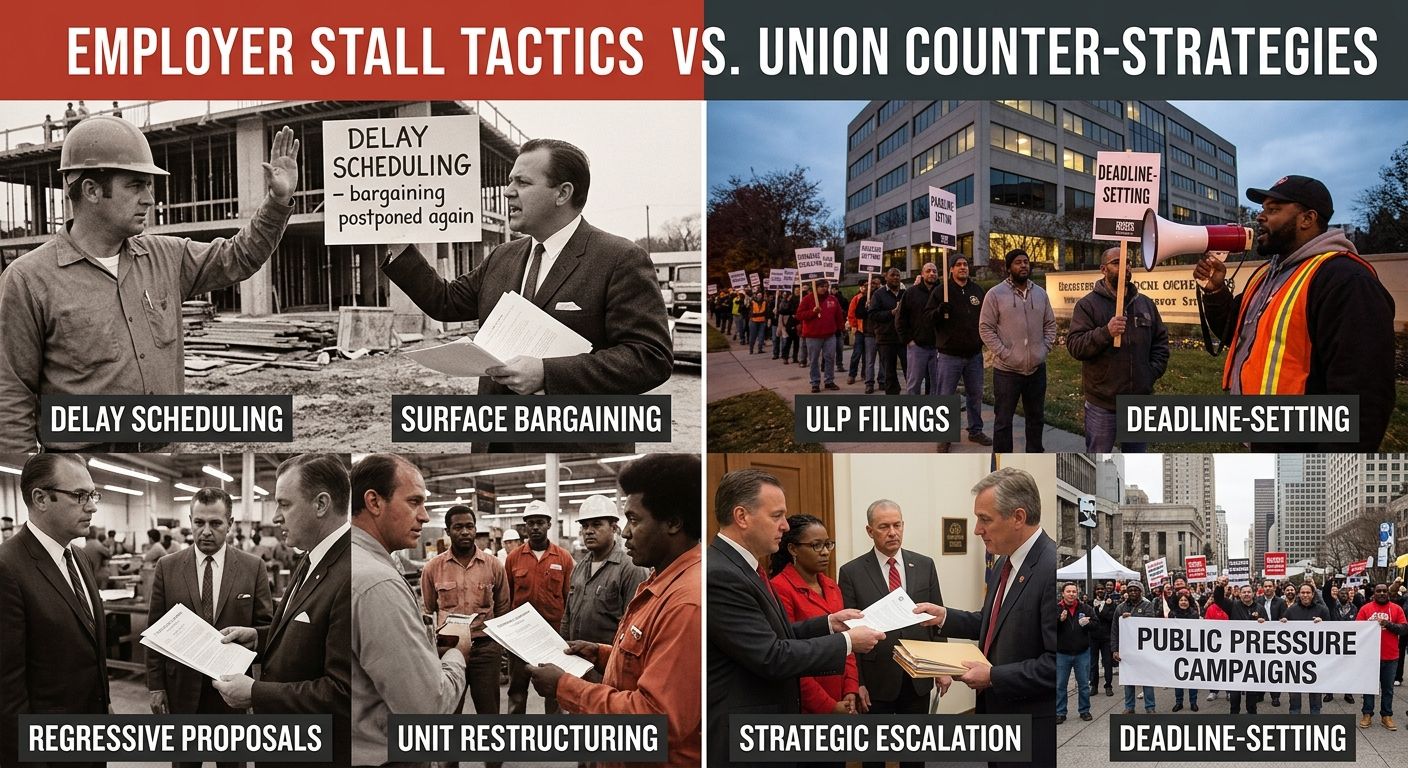
The playbook is well documented. Delay scheduling sessions. Send negotiators without authority to make decisions. Propose regressive offers that walk back even existing conditions. Restructure the company mid-negotiation to argue the unit is no longer appropriate. Every week of delay costs the union credibility and costs workers money they should already be earning under a contract.
According to the Economic Policy Institute's research, workers at more than 300 Starbucks stores won union elections, yet securing first contracts has taken years in many locations. Amazon workers in Staten Island faced similar delays. These aren't obscure cases. They're the most visible organizing victories of recent years, and they illustrate exactly how collective bargaining tactics from the employer side are designed to exhaust rather than negotiate.
Your counter-strategy has several layers:
Document everything. Every cancelled session, every proposal withdrawn, every time management's negotiator says "I'll have to check with my boss." This documentation becomes your unfair labor practice case.
File ULP charges early. Don't wait until you've accumulated a year of bad faith. File when you see the pattern forming. Even if the NLRB process is slow, the filing itself puts the employer on notice and creates a public record.
Escalate strategically. If management stalls for three months, don't just complain. Organize a march on the boss. Contact local media. Reach out to community allies. Announce that workers are considering a strike authorization vote. Each escalation should be proportional and planned, not reactive.
Set public deadlines. "We expect a response to our wage proposal by March 15" forces the employer to either engage or publicly refuse. As we've seen with NYC building workers who authorized a strike under contract deadline pressure, deadlines concentrate minds.
The legal framework under the NLRA provides some tools, but those tools are blunt. The real pressure comes from organized workers willing to escalate.
Contract Enforcement Is Just Organizing by Another Name
You've ratified your first contract. Congratulations. Now the real test begins.
A contract is only as strong as the workers willing to enforce it. Every supervisor who violates the scheduling provision, every manager who skips a safety protocol, every HR rep who denies a grievance on a technicality is testing whether your union has the capacity to respond.
Training stewards is non-negotiable. Every shift needs at least one steward who knows the contract cold, knows how to file a grievance correctly, and has the trust of their coworkers. Steward training should cover Weingarten rights, the grievance procedure, and basic labor law. But it should also cover organizing skills, because enforcing a contract is organizing. You're asking a worker to take a risk by standing up to their boss. You need to make that worker feel supported, informed, and confident.
Unions that treat contract enforcement as an administrative function, where grievances are paperwork that gets shuffled to a staff rep, are unions that lose members. Unions that treat enforcement as an extension of the organizing fight, where every grievance is an opportunity to demonstrate the union's value and build solidarity, are unions that grow.
The AFL-CIO has documented cases where workers who successfully organized and bargained new contracts won wage increases of 10% or more, along with increased time off and stronger protections. Those wins didn't happen because the contract language was elegant. They happened because workers stayed organized enough to demand compliance.
Workplace Power Consolidation Starts the Day After Certification
If you're a worker who just won a union election, or a steward preparing for first contract negotiations, or an organizer advising a newly certified unit, here's what you can do with everything above.
Start bargaining prep before the certification ink is dry. Survey your coworkers this week. Identify your bargaining committee candidates within two weeks. Have your top five priorities ranked within a month. Don't wait for the employer to schedule the first session. Demand it.
Build your communication infrastructure now. If you don't have a system for reaching every member of your unit within 24 hours, you're not ready to bargain. And keep your organizing committee active. The people who knocked on doors and had one-on-one conversations before the election are the same people who need to be mobilizing during bargaining.
Most critically, understand that workplace power consolidation is not a phase that ends. It's a permanent practice. Your first contract is the floor, not the ceiling. The strength of your second contract, your third, and every one after depends on whether you maintained and grew the organizing muscle that got you here.
The 52% of unions that don't reach a first contract within a year aren't failing because the law is stacked against them, though it often is. They're failing because the organizing stopped on election night. Don't let that happen to your shop.
The Union Edge Staff
Frequently Asked Questions
- Why do many unions fail to get a first contract after winning an election?
- 52% of newly certified unions don't reach a first contract within a year because they stop organizing after the election. The real race begins after certification, and employers exploit the gap in labor law by using surface bargaining, delays, and other stall tactics while workers become fatigued.
- What does good faith bargaining actually require under the NLRA?
- The NLRA requires both parties to meet at reasonable times and confer in good faith about wages, hours, and conditions of employment, but it does not require either side to agree to specific proposals, make concessions, or set a hard deadline for concluding negotiations. Employers can legally stall negotiations for years without penalty.
- How large should a union bargaining committee be?
- The committee should maintain a ratio of roughly one member per 30-50 workers, so a 50-person shop needs 3-5 members while a 500-person unit might need 12-15. The committee should include workers from every shift, department, and job classification, with representation from both vocal organizers and respected quiet workers.
- What should unions do to survey members before first contract negotiations?
- Unions should conduct face-to-face conversations supplemented by written questionnaires asking specific questions about problems on shifts, what would make workers stay longer, and what policies they'd change. Results should be ranked to identify the top 3-5 core demands that matter to at least 60% of the unit.
- What tactics keep union momentum alive between bargaining sessions?
- Unions should provide bargaining updates within 24 hours of sessions, hold monthly department-level meetings, organize visible collective actions like union button days, and maintain digital communication infrastructure. Unions with active engagement programs report 23% higher contract satisfaction and 31% better grievance resolution outcomes.
- How should unions respond to employer stall tactics during negotiations?
- Document every cancelled session and withdrawn proposal, file unfair labor practice charges early when bad faith patterns emerge, escalate strategically through public actions and media outreach, and set public deadlines for management responses. These tactics create pressure beyond what the slow NLRB enforcement process can provide.
- Why is steward training critical after a contract is ratified?
- Every shift needs trained stewards who know the contract, understand grievance procedures, and can mobilize coworkers to enforce contract violations. Unions that treat contract enforcement as an organizing activity rather than administrative paperwork maintain member engagement and grow stronger.
Also in the paper