
Why Architecture Remains Union-Resistant: Lessons From a Century of Failed Organizing Attempts
Bernheimer Architecture in New York employs fewer than a dozen people. In 2024, this tiny firm became the site of the first ratified collective bargaining agreement at a privately owned U.S. architecture practice in roughly half a century.

Why Architecture Remains Union-Resistant: Lessons From a Century of Failed Organizing Attempts
Bernheimer Architecture in New York employs fewer than a dozen people. In 2024, this tiny firm became the site of the first ratified collective bargaining agreement at a privately owned U.S. architecture practice in roughly half a century. The contract included just-cause protections, remote work rights, enhanced family leave, and safeguards for workers on visas. Every one of those provisions was unheard of in architectural employment. And the fact that one small firm's contract qualifies as historic tells you everything about architecture unionization in this country: the profession has spent a century resisting collective bargaining, and every campaign that attempted to break through has had to fight a specific, repeatable set of obstacles.
We've studied these failures. We've talked to architectural workers who organized and those who tried and couldn't. What follows are the rules that govern why architecture remains one of the most union-resistant white-collar professions, what each failed attempt teaches, and when the pattern might finally crack.
Recognize that "vocation" talk is a wage suppression tool
Architecture has a mythology problem. The profession tells itself a story about creative calling, artistic devotion, and the nobility of design work. That story is powerful. It's also a mechanism for keeping wages low and hours absurdly long.
The Guardian reported in 2019 that architects form unions amid fury over exploitation, and the article laid bare the core tension: "There is still a deeply ingrained culture of architects thinking of their work as a 'vocation,' and an artistic labour of love, so the long hours and poor remuneration have become an inevitable part of the package." Survey data from the UK's Architects' Journal found that 40% of respondents were working more than 10 hours of unpaid overtime per week. Nearly a quarter had signed away their legal right to a 48-hour workweek cap, with many reporting they felt they wouldn't have gotten the job otherwise.
This isn't unique to architecture, but the profession weaponizes it with unusual efficiency. When workers internalize the belief that their labor is a calling, asking for overtime pay or predictable schedules starts to feel like admitting you aren't devoted enough. Organizers in architecture have to confront this cultural script before they can even get to the question of union cards. In sectors where the stress-to-strike pipeline runs from psychosocial hazards to organizing momentum, architecture has an extra filter: the hazard itself is rebranded as a badge of honor.
The rule for organizers is blunt: when a boss or a professional association describes your work as a "vocation," treat that language as what it is. It is an argument against paying you fairly for your time.
Treat professional credentialism as an organizing obstacle, not a personality trait
Architecture requires years of graduate education, a grueling multi-part licensing exam, and supervised internship hours that can stretch five years or longer. This credentialing pipeline shapes how architectural workers see themselves. They graduate believing they're professionals with individual market value, not workers with collective interests.
This is the professional credentialism barrier that has stalled white-collar organizing across multiple fields. But architecture stacks additional layers on top. The profession's self-image is bound up with the myth of the singular genius architect, a cultural archetype stretching from Ayn Rand's Howard Roark to the starchitect celebrity system that dominates media coverage of the built environment. When you've been trained to see yourself as an individual creative mind competing for recognition, solidarity feels foreign.
The Architectural Paper's 2019 investigation into why architects don't have unions found that this question "has as much to do with general labor consciousness under capitalism in the United States as it does with the idiosyncratic structure of the profession." Workers in architecture don't think of themselves as workers. They think of themselves as professionals who happen to work for someone else, temporarily, on their way to running their own practice someday.
Organizers working in architecture need to understand that this is a structural feature of credentialed professions, and that overcoming it requires organizing model adaptation. The workers most likely to respond to union messaging aren't the ones who've fully bought into the starchitect pipeline. They're the ones who've watched that pipeline fail to deliver for them personally, the ones carrying student debt they can't service on architectural salaries, the younger generation saddled with more debt than any cohort before them.
Organize the whole office, not the drafting room
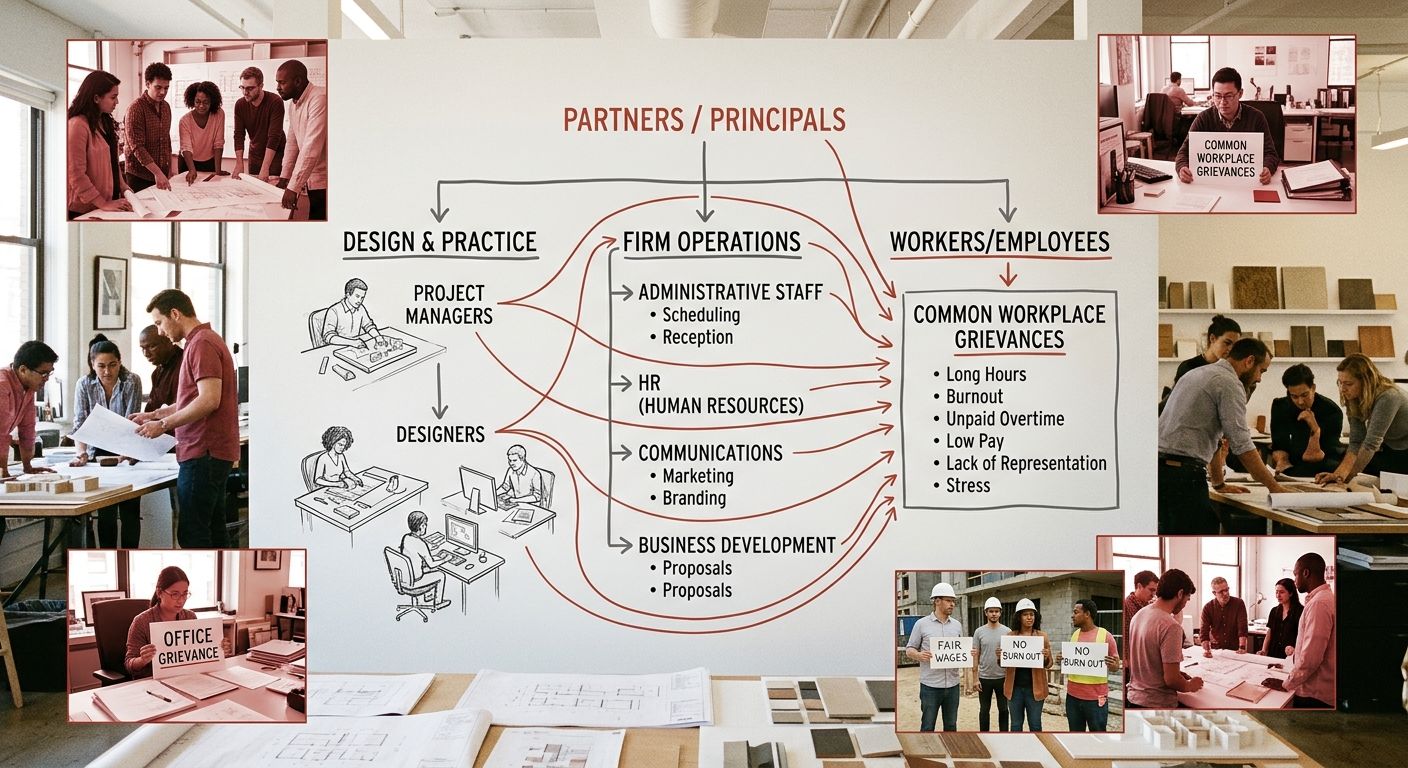
One of the most persistent mistakes in architecture unionization campaigns is treating the profession as if it only includes designers. Architectural offices employ project managers, administrative staff, communications workers, human resources professionals, and business development teams. Many of these workers face the same conditions of long hours, uncertain employment, and low pay relative to their qualifications.
The SHoP Architects campaign in 2022, which Dezeen reported as the first architecture union attempt since the 1940s, was driven by workers across roles who shared grievances about "endless overtime and deadlines." The campaign ultimately did not result in union recognition. Among the lessons: organizing efforts that center only on designers leave large parts of the workforce feeling excluded from the conversation.
This mirrors a pattern we've seen in other sectors. When you're building an organizing committee from scratch, the committee needs to reflect the actual workforce, not just the most visible or credentialed segment of it. Architecture offices often have rigid internal hierarchies where designers see themselves as the core of the firm and support staff are treated as peripheral. An organizing campaign that reproduces that hierarchy will fail to build the supermajority needed to withstand management pressure.
Expect the professional body to side with management
In the United Kingdom, the Royal Institute of British Architects (RIBA) functions as the profession's primary institutional body. It does not function as a union. It has never taken disciplinary action against firms that normalize unpaid overtime, wage theft, or discriminatory pay practices. When unionization efforts gained visibility in 2019, RIBA's then-Head of Professional Communities, Lucy Carmichael, called the idea of a union "an indictment on the professionalism of architectural practices."
The American Institute of Architects (AIA) occupies a similar structural position in the United States. These organizations represent the profession's brand and its firms' interests. They do not represent workers. This distinction matters because many architectural workers assume their professional association is looking out for them. It isn't.
The practical implication is that organizers in architecture cannot rely on professional bodies as neutral institutions. They must be prepared for those institutions to actively oppose or undermine organizing campaigns, either through direct statements or through the subtler work of maintaining professional norms that equate unionization with a failure of individual merit. Understanding the gap between what institutions promise and what they deliver is essential preparation for any architectural organizing effort.
Adapt to the project-based, fragmented nature of the work
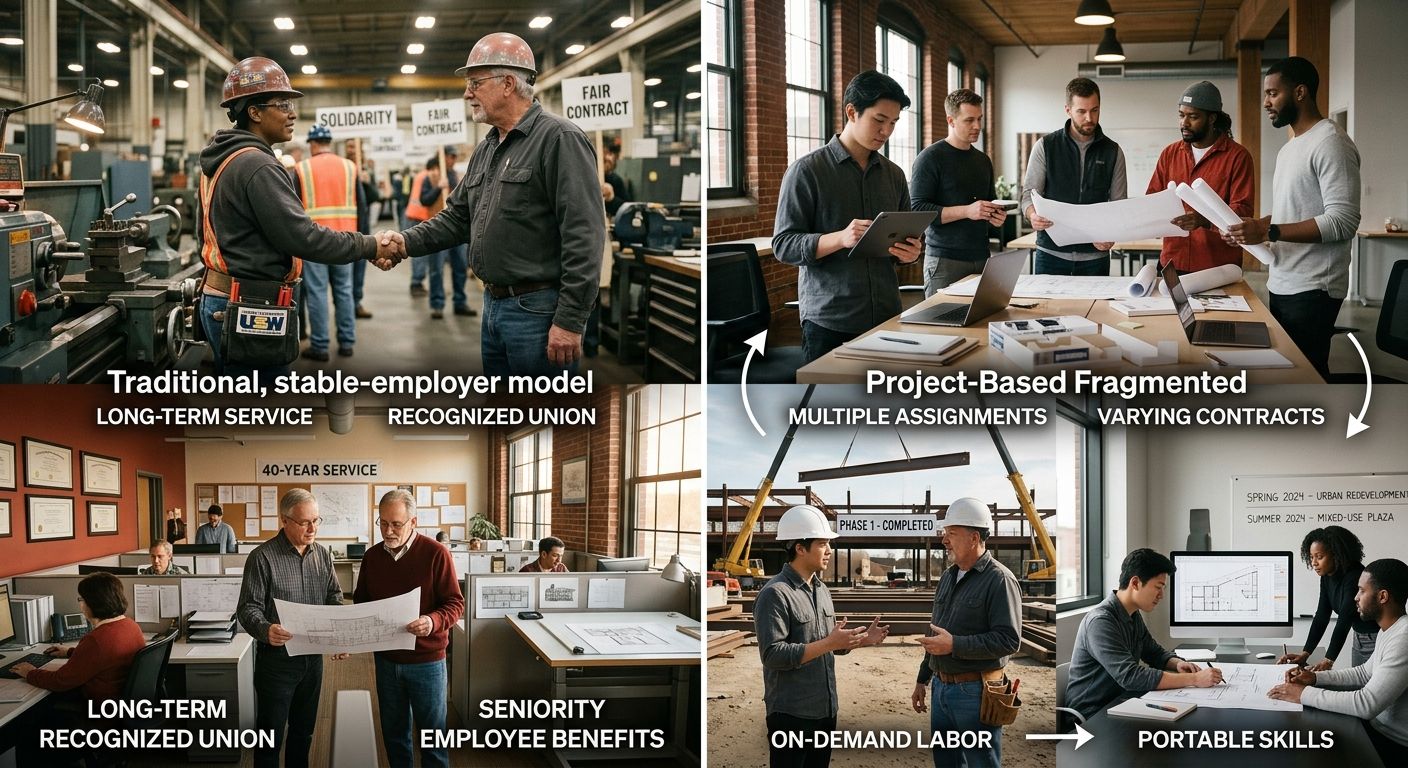
Architecture firms operate on a project-by-project basis. Staff levels fluctuate. Workers move between firms frequently, following projects rather than building long-term employment relationships at a single shop. This fragmentation is one of the most serious skilled trade organizing challenges the profession presents.
A Reddit discussion among architects about why no successful architecture union has formed surfaced this structural problem repeatedly. As one practitioner described it, the work involves "the knowledge of coordinating trades, processes, codes and design thinking to execute a project all the while training staff to do so on a project type they have most likely never worked for." Every project is different. The teams assembled for each one are different. The firms themselves range from sole practitioners to global operations with thousands of employees.
Traditional organizing models assume a stable workforce at a fixed location. Architecture doesn't offer that. Workers cycle through firms, projects end, and the team disperses. Building durable worker power in this environment requires approaches more common in the building trades than in white-collar organizing: portable union membership, sectoral bargaining frameworks, or regional organizing that follows workers rather than targeting individual firms.
This is also where the question of whether small independent unions can sustain themselves becomes directly relevant. Bernheimer Architecture's successful contract covered fewer than a dozen workers. Scaling that model across a profession of more than 100,000 licensed architects in the U.S. would require either a massive proliferation of independent shop-level unions or a sectoral approach that no existing labor organization has yet built for architecture.
Bridge the gap between design workers and building trades
The Architecture Lobby, a worker advocacy organization, has published research on the divide between architects at the drafting table and tradespeople at the construction site. Their analysis found that "at the job site, there is limited funding for training unless green building work is 'in the pipeline.' At the drafting table, designers face resistance specifying high-performance details when there are not enough skilled trades workers to implement them." Both groups suffer from the same race-to-the-bottom dynamics driven by developers and clients who want buildings delivered faster and cheaper.
Architecture workers and building trades workers share more economic interests than either group typically recognizes. Both are squeezed by the same clients. Both face pressure to absorb costs through unpaid time or reduced quality. And both would benefit from coordinated action that connects the people who design buildings with the people who construct them. The Architecture Lobby argues that when these efforts are coordinated, workers on both sides can organize against the downward pressure on wages and conditions.
This cross-sector solidarity is rare. Architects are trained to see themselves as distinct from construction workers, and professional credentialism barriers reinforce that separation. But the most promising path to durable architecture unionization probably runs through building trades alliances rather than through the profession's existing institutional structures. The building trades have a century of organizing infrastructure. Architecture has almost none. One of these sectors has something to teach the other.
When These Rules Finally Crack
Every one of these rules describes a barrier that has held for decades. The vocation myth, the credentialism trap, the narrow definition of who counts as an architectural worker, the hostile professional bodies, the project-based fragmentation, the artificial wall between design and construction. Together, they form a system that has kept architecture nearly union-free since the New Deal era.
But the conditions are shifting. White-collar organizing is accelerating across professions, driven by workers facing layoffs and extended unemployment for the first time in their careers. A new generation of architectural workers, carrying unprecedented student debt loads and watching firms cycle through layoffs with every market downturn, is less willing to accept the vocation narrative. As one organizer at Bernheimer wrote in Jacobin, the first attempt to unionize a privately owned architecture firm since the 1970s started at SHoP Architects, and when that campaign didn't succeed, the energy moved to Bernheimer and produced an actual contract.
The SHoP campaign failed. Bernheimer's succeeded. The difference was scale, approach, and the willingness to adapt organizing methods to the specific dysfunction of architectural employment. The rules above describe why organizing architecture is hard. They also describe exactly where the vulnerabilities lie. Each barrier has a corresponding weakness: the vocation myth crumbles when workers can't pay rent; credentialism loses its grip when the credential doesn't deliver economic security; professional bodies lose authority when workers see them defending the firms that exploit them.
Architecture won't unionize through a single dramatic campaign. It will unionize firm by firm, contract by contract, with each successful agreement proving to the next group of workers that collective bargaining works in their profession too. The century of failed organizing attempts isn't evidence that architecture can't be organized. It's a detailed map of every trap the next campaign needs to avoid.
The Union Edge Staff
Also in the paper