
The Decentralization Dilemma: Why Small Independent Unions Are Choosing to Go Alone—and Paying the Price
Across U.S. hospitals, nursing homes, and home care agencies, newly organized worker groups are declining affiliation with established national unions at a growing rate, opting instead to form independent unions with full local union autonomy over dues, governance, and contract negotiations.

The Decentralization Dilemma: Why Small Independent Unions Are Choosing to Go Alone—and Paying the Price
Across U.S. hospitals, nursing homes, and home care agencies, newly organized worker groups are declining affiliation with established national unions at a growing rate, opting instead to form independent unions with full local union autonomy over dues, governance, and contract negotiations. The pattern has accelerated since 2023, particularly among registered nurses, certified nursing assistants, and behavioral health technicians. And it's costing them at the bargaining table.
The appeal is obvious. Independent unions charge lower dues because they don't send money up to a national body. Workers keep total control over their priorities. Nobody in a distant headquarters tells them what to put on the table or which political candidates to endorse. As the Emergency Workplace Organizing Committee explains, independent unions avoid the friction that comes when a local joins a national with different political views or organizing philosophies, where smaller locals can find themselves outvoted on decisions that directly affect their workplace.
But the empirical evidence tells a different story about what happens next. Research published in ScienceDirect has found that full centralization performs better in terms of employment outcomes compared with decentralized bargaining structures. Workers who go it alone tend to secure weaker wage gains, slower contract timelines, and less durable protections against management retaliation. In healthcare, where staffing ratios and patient safety language carry life-or-death stakes, these gaps matter in measurable ways.
The Pull Toward Independence in Healthcare Workplaces
Healthcare workers have specific, practical reasons for distrusting larger union structures. A home health aide in rural Appalachia has almost nothing in common with a stagehand in Manhattan, even if both technically fall under the same international union's jurisdiction. When national unions set bargaining priorities, they tend to weight their resources toward large, high-profile campaigns. Small healthcare units with 40 or 60 members can feel invisible.
There's also the question of speed. National unions have internal bureaucracies: research departments, legal teams, regional directors, approval chains. An independent union at a single nursing home can call a meeting, take a vote, and file a grievance the same week. That responsiveness is attractive to workers who are watching unsafe staffing levels erode patient care in real time.
And the dues savings are real. A healthcare worker earning $18 an hour notices the difference between 1.5% of gross pay going to a national versus a flat $15 per month staying within the local. For workers in states where Medicaid reimbursement rates effectively cap wages, every dollar counts.
Where the Resource Gap Hits Hardest
The trouble begins the day after the election win. Forming a union is a campaign. Negotiating a first contract is a war of attrition, and small independents enter that war badly outgunned.
Consider what a newly certified independent healthcare union typically lacks:
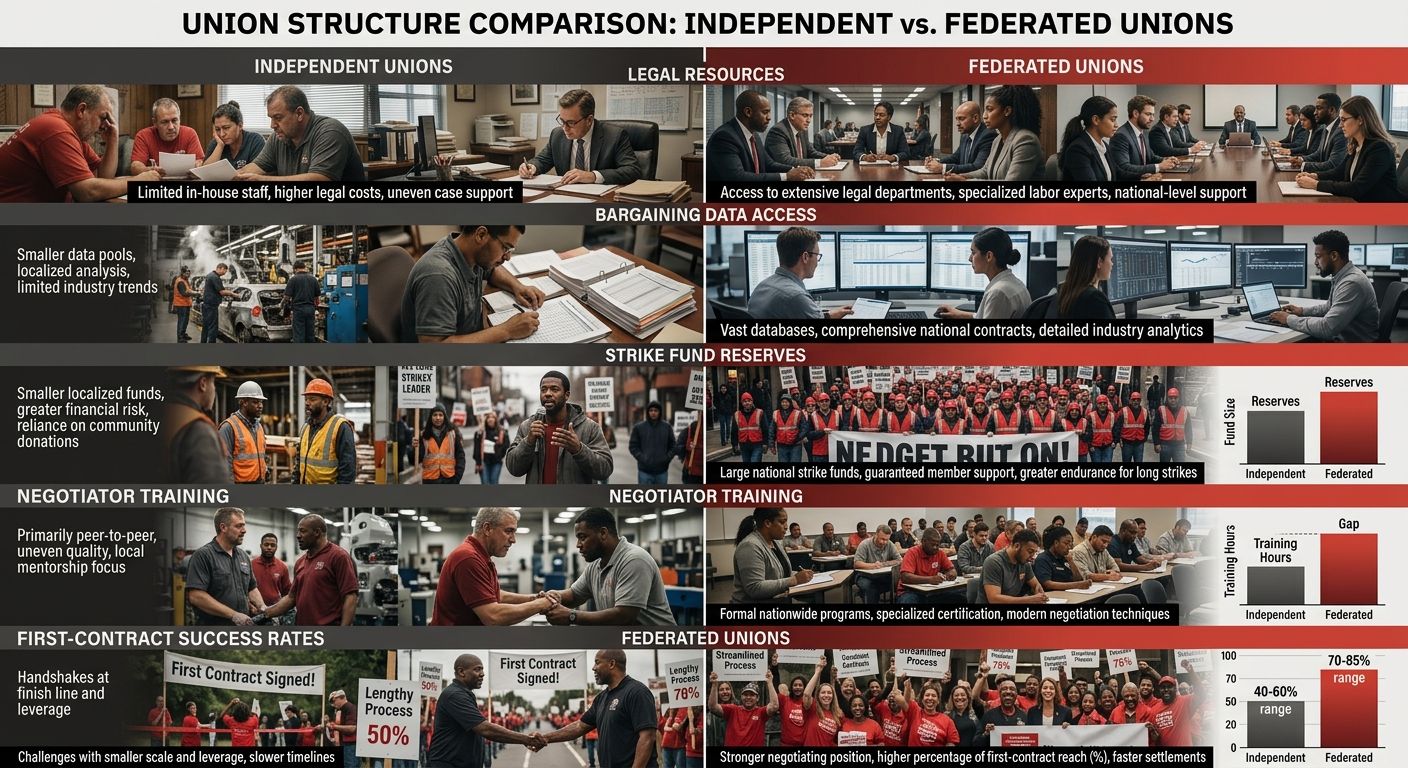
Legal counsel experienced in NLRA proceedings. National unions retain labor attorneys on staff or on retainer. An independent union has to find and pay for its own, often at $300–$500 per hour in regions where labor lawyers are scarce.
Bargaining data from comparable contracts. National unions maintain databases of thousands of contracts across similar facilities. An independent union at a single hospital has no baseline for what's achievable on wages, shift differentials, or mandatory overtime protections.
Strike funds. If negotiations stall and workers need to walk out, a national union can draw on millions in strike reserves. An independent with 50 members and $750 in monthly dues has nothing to sustain a work stoppage.
Trained negotiators. Bargaining is a skill. National unions have staff who've sat across the table from management hundreds of times. Independent unions often send elected officers who've never negotiated anything beyond a car loan.
This resource deficit explains a painful statistic: a large proportion of newly certified unions fail to reach a first contract within a year. The problem is even worse for independents. As we've covered in our discussion of why post-recognition strategy determines real workplace change, the election is only the starting line. What happens in the months that follow depends almost entirely on the organizing resources available to the bargaining unit.
Management knows this. According to the UFCW's analysis of employer tactics, management may hire highly paid union-busting consultants whose explicit job is to prevent workers from securing a contract. These consultants often cost employers as much as or more than the workplace improvements the union is requesting. Against a well-funded national union, these consultants face experienced opposition. Against a 45-member independent union at a behavioral health clinic, they face workers who may not even know what an unfair labor practice charge looks like.
Healthcare's Staffing Crisis Makes Isolation More Dangerous
The stakes of weak contracts in healthcare are different from those in other industries. When a warehouse union negotiates a bad first contract, workers get lower pay. When a healthcare union negotiates a bad first contract, patients can die.
Safe staffing ratios, mandatory rest between shifts, protections for whistleblowers who report safety violations: these provisions require sophisticated contract language that anticipates how management will try to work around them. National unions like National Nurses United or AFSCME have decades of institutional memory about which staffing clauses hold up under arbitration and which ones contain loopholes that management exploits within months.
An independent union writing its first contract doesn't have that memory. Workers may win election day and then discover that the contract language they negotiated on "adequate staffing" gives management full discretion to define "adequate." By the time the first grievance is filed, the damage to working conditions and patient care is already done.
This dynamic is especially acute in nursing homes and home health agencies, where profit margins are thin and corporate ownership structures are designed to obscure who actually controls the facility. Workers trying to negotiate with a single nursing home may discover mid-bargaining that the real decision-maker is a private equity firm three states away. National unions have research departments that can pierce corporate veils. Independent unions usually cannot.
Right-to-Work States Compound the Problem
In the 27 states with right-to-work laws, independent healthcare unions face an additional structural disadvantage. These laws prohibit unions from collecting fair share fees from non-members who benefit from the contract. As the AAUP's analysis of organizing in hostile legal environments makes clear, maintaining a union under right-to-work requires continuous internal organizing to keep membership rates high enough to fund basic operations.
National unions can absorb the revenue losses from free riders across thousands of locals. An independent union at a 60-bed nursing home in Texas cannot. When membership drops from 80% to 55% because workers realize they can get the contract benefits without paying dues, the independent's budget collapses. The union can no longer afford a lawyer to handle grievances. It can't send a negotiator to the next contract cycle. Within a few years, the independent either folds or exists on paper only, a shell that management ignores.
The Economic Policy Institute's research on private-sector union erosion documents how corporate practices and legal changes have systematically undercut workers' ability to organize and bargain effectively. Independent unions in right-to-work states sit at the intersection of every one of those pressures, with none of the institutional buffers that federation membership provides.
The European Cautionary Tale
The U.S. experience mirrors a well-documented pattern in Europe. In Italy, labor reforms created fiscal incentives for company-level agreements outside traditional multi-employer frameworks. The result was the rise of so-called "pirate agreements," where minor or unaffiliated worker organizations negotiated deals that undercut sector-wide contracts. According to research by FEMCA-CGIL, a textile worker under one of these independent agreements earns €4.68 per hour, less than half the €9.13 guaranteed under the national collective agreement.
France followed a similar trajectory. Reforms under President Macron allowed small and medium enterprises with fewer than 50 employees to negotiate working conditions directly with workers, bypassing union representation entirely. The fragmentation has disproportionately hurt women, who make up 60% of the lowest-paid workers in Europe and are concentrated in sectors like healthcare, hospitality, and textiles.
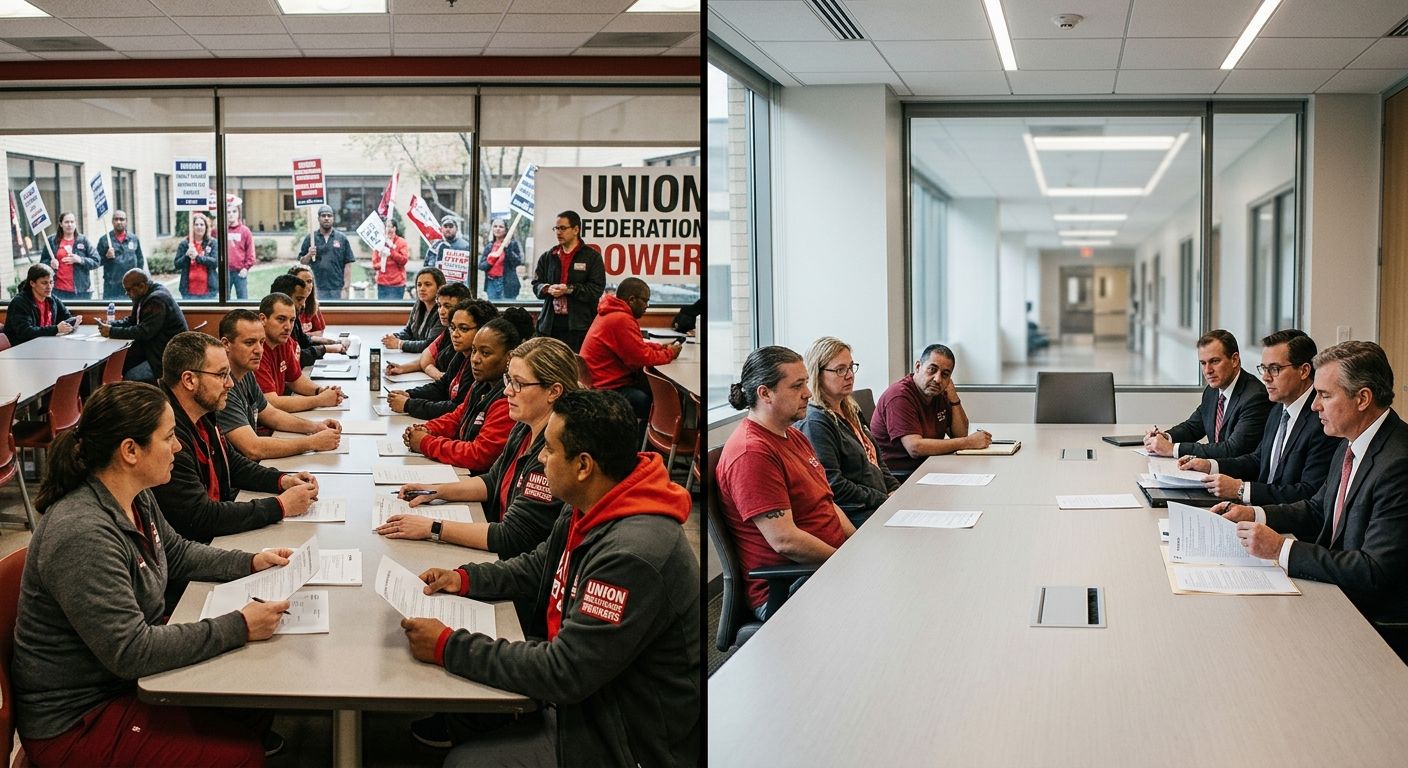
Professor Valeria Pulignano at KU Leuven has argued that uncoordinated decentralization, especially without clear rules on union representativeness, intensifies workplace fissuring and increases inequality. The lesson for U.S. healthcare workers is direct: going alone doesn't just mean losing organizing resources. It means entering a negotiating environment where the employer has every structural advantage and the union has stripped itself of the tools that might level the field.
Why Workers Keep Choosing Independence Anyway
Knowing all this, you might wonder why any group of healthcare workers would still choose to go independent. The reasons are real, and dismissing them would be dishonest.
National unions have, at times, earned their reputations for being unresponsive. Workers at small facilities describe calling their regional office for help with a grievance and waiting weeks for a callback. They describe watching their dues fund political campaigns they didn't vote for. They describe national staff who show up for the organizing drive and disappear after the election. When we explored why organizers who assume workers' needs lose campaigns, we documented how top-down approaches breed exactly the kind of distrust that pushes workers toward independence.
The union structure question is genuinely hard. Federations aim to balance power between central authority and constituent parts, but that balance tips unevenly. Small healthcare locals within large nationals sometimes have meaningful voice; sometimes they don't. A 40-person bargaining unit at a rural clinic doesn't carry much weight inside a union of 1.2 million members. That math isn't lost on workers.
And some independents do succeed. Units with strong internal leadership, access to pro bono legal help, or workers with prior organizing experience can build durable independent unions. The problem is that these conditions are rare, and they're getting rarer as employer spending on anti-union consultants keeps climbing.
Models That Split the Difference
Some healthcare worker groups are experimenting with middle paths. Solidarity networks, where independent unions share bargaining data, legal resources, and training without formal affiliation, have emerged in several metro areas. These arrangements preserve local union autonomy while addressing the worst of the resource gap.
The Emergency Workplace Organizing Committee functions as another partial solution, offering training and support to independent worker groups without requiring affiliation. Regional labor councils sometimes play a similar role, connecting independent locals with resources from affiliated unions on an informal basis.
These models have real limits. They depend on volunteer energy and goodwill. They can't replicate the strike funds, legal departments, and research capacity of a national union. But for healthcare workers who've decided that full federation membership is a nonconsideration, partial coordination beats total isolation.
The challenge for organized labor's union federation strategy going forward is making affiliation attractive enough that healthcare workers don't feel forced to choose between autonomy and survival. That means national unions need to rebuild trust with small locals by answering the phone, respecting local priorities, and demonstrating that dues money produces tangible returns at the workplace level. Unions that can't make that case will keep losing potential affiliates to independence, and those independents will keep paying the price at the bargaining table.
The Open Threads
Several questions remain unresolved. Can solidarity networks and informal resource-sharing arrangements scale enough to give independent healthcare unions meaningful bargaining power, or will they always be a poor substitute for formal federation resources? Will national unions reform their internal governance to give small healthcare locals genuine voice, or will the structural incentives keep favoring large, high-dues-paying units? And as corporate safety policies continue to fall short of protecting workers, will the staffing and safety consequences of weak independent contracts eventually force a reckoning?
The data points in one direction. Coordinated bargaining structures produce better employment outcomes, stronger contracts, and more durable unions than decentralized ones. That finding holds across industries, across countries, and across decades of research. Healthcare workers who choose independence are making a rational response to real failures of national union governance. But rationality at the local level can produce collective outcomes that hurt everyone, including the workers who made the choice. The tension between local autonomy and coordinated power is as old as the labor movement itself, and nobody has solved it yet. What's clear is that ignoring it comes with a cost that healthcare workers and their patients can't afford.
The Union Edge Staff
Also in the paper