
The Stress-to-Strike Pipeline: How Psychosocial Hazards Become Organizing Opportunities
Fifty percent. That's the share of therapists' workdays that Kaiser Permanente claimed the National Union of Healthcare Workers wanted devoted to non-patient care during their contract dispute. Kaiser framed the number as outrageous.

The Stress-to-Strike Pipeline: How Psychosocial Hazards Become Organizing Opportunities
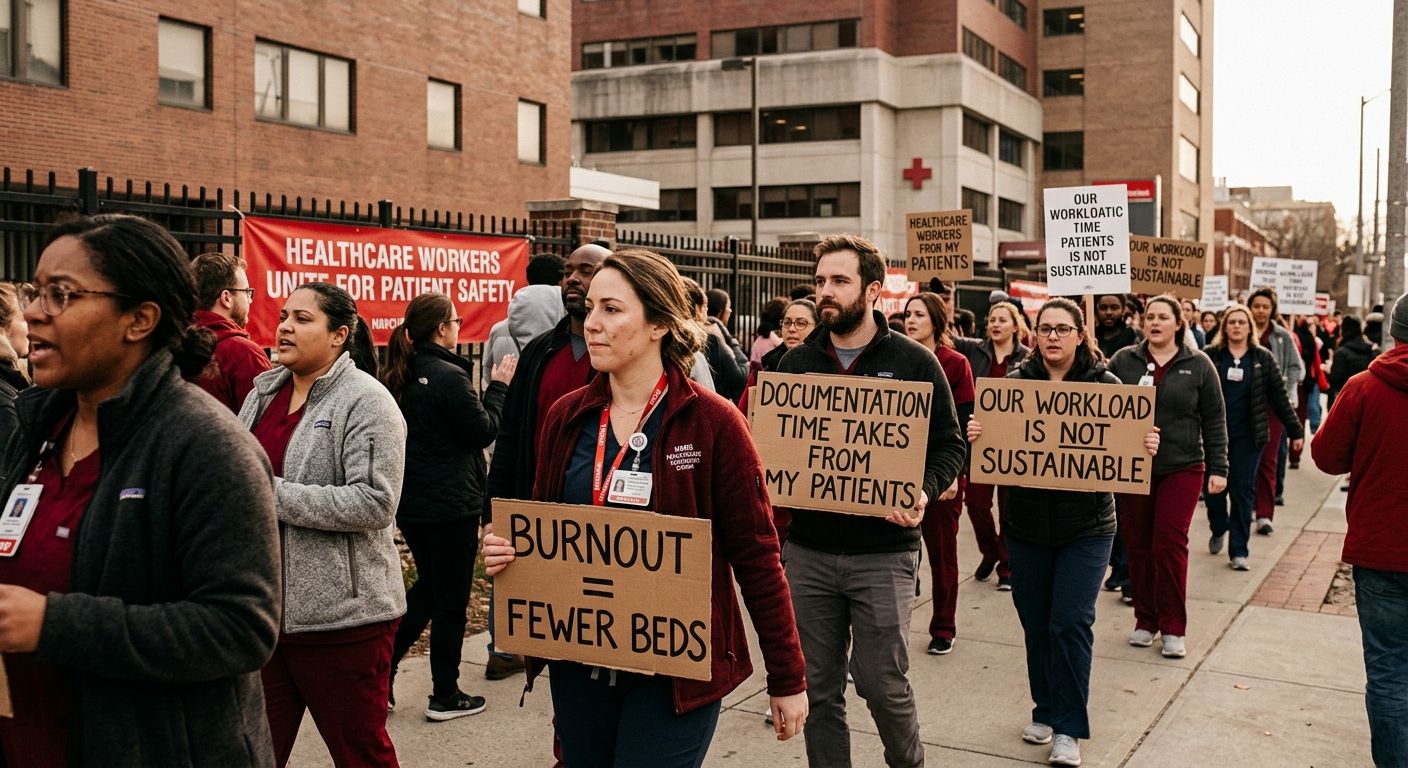
Fifty percent. That's the share of therapists' workdays that Kaiser Permanente claimed the National Union of Healthcare Workers wanted devoted to non-patient care during their contract dispute. Kaiser framed the number as outrageous. The therapists who struck for ten weeks in 2022, then again in a months-long action that included a hunger strike beginning April 8, 2025, described it as survival: guaranteed time between sessions for documentation, follow-up care, and the basic cognitive recovery that prevents burnout from becoming a clinical safety risk.
That fight previewed something the rest of the world is now confronting in hard data. On April 22, the International Labour Organization released a report finding that psychosocial hazards at work kill approximately 840,000 people every year through cardiovascular disease and mental health disorders. The economic damage amounts to 1.37% of global GDP. Thirty-five percent of workers globally log more than 48 hours per week. Twenty-three percent report experiencing violence or harassment on the job.
These numbers confirm what organizers on the ground already know: psychosocial hazards — the features of work design, management, and social conditions that cause psychological or physical harm — are among the most powerful organizing issues available to the labor movement right now. Workers who won't openly gripe about wages will talk for an hour about the scheduling system that gives them migraines, the understaffing that makes them dread Mondays, or the supervisor whose volatility has them checking job boards every night.
The question for unions and workers weighing their options is strategic: what's the best route to turn this widespread suffering into protections that actually stick? Three distinct approaches are competing for attention this week. Each carries real tradeoffs.
Push for Regulatory Standards
The regulatory path got a significant boost this week from two directions. The ILO report calls explicitly for national roadmaps to address psychosocial risks, including stress, harassment, bullying, and violence, with improved protections for workers in non-standard employment. And in Australia, New South Wales just updated its workplace health and safety laws to require businesses to assess and manage psychosocial risks created by AI and digital work systems, covering algorithmic monitoring, workload management tools, and automated decision-making.
The ILO's framework on this isn't new in concept. The Occupational Safety and Health Convention of 1981 (No. 155) established the principle that occupational health includes psychosocial dimensions. What's different now is the body count attached to the data, and the political pressure that creates. When a UN agency publishes a report saying 840,000 workers die annually from conditions their employers could prevent, legislators pay more attention than they do to abstract policy recommendations.
Where This Approach Wins
Regulatory standards create a floor. Once a jurisdiction mandates psychosocial risk assessment, every employer in the territory has to comply, whether they have a union or not. That's particularly valuable in industries with low union density where contract bargaining isn't an option for most workers. The NSW model is worth watching closely because it specifically names AI-driven monitoring and scheduling as psychosocial risk factors, which addresses the way modern surveillance technology reshapes the experience of work.
ILO workplace safety standards also provide organizers with internationally recognized language and benchmarks. When you're building a case that your employer's scheduling practices are hazardous, citing the ILO carries weight that a union pamphlet alone may not.
Where It Falls Short
Regulatory change is slow, subject to political reversal, and enforcement-dependent. In the United States, OSHA still lacks a general standard for psychosocial hazards. The agency has moved on workplace violence protections in specific sectors like healthcare, but a broad psychosocial standard remains years away at best. And even where laws exist, the gap between written policy and shop-floor reality is enormous. Workers in jurisdictions with strong regulations still need the confidence to report violations, and the fear of retaliation continues to suppress reporting across industries.
For U.S. workers especially, waiting on regulation means waiting a long time.
Bargain It Into the Contract
The second approach bypasses legislation entirely and puts psychosocial protections directly into collective bargaining agreements. This is where the Kaiser Permanente mental health workers' fight becomes a template worth studying closely.
What NUHW members demanded wasn't abstract. They wanted guaranteed time between therapy sessions for documentation and follow-up care, equitable pay, and reinstated pension benefits that had been stripped from new employees in 2015. Kaiser pushed back hard, characterizing the scheduling demand as therapists wanting to spend almost half their time in non-patient care, according to Modern Healthcare's coverage of the negotiations. The workers and their union saw it as a workload issue: without documentation time, therapists were either staying late unpaid or entering the next session carrying cognitive load from the previous one. The cumulative effect was burnout, turnover, and deteriorating patient outcomes.
After the 2022 strike ended, one NUHW representative told CNN: "We stood up to the biggest nonprofit HMO in the nation, and we made gains that will help us better serve our patients and will advance the cause of mental health parity throughout the country." The dispute flared again in 2024, leading to a six-month labor action that escalated to include a hunger strike. Work condition issues like scheduling, safety, and giving workers a voice in how work is done have become major factors in the rise of union organizing campaigns across the country, and the Kaiser fight is the clearest example of how mental health contract demands can anchor an entire campaign.
Where This Approach Wins
Contract clauses have teeth because they're enforceable. A provision that mandates minimum staffing ratios, caps mandatory overtime, requires break time between high-stress tasks, or establishes a joint labor-management committee on workload design gives workers a grievance mechanism when management violates the standard. Regulation says "you should." A contract says "you must, and here's what happens when you don't."
This approach also builds solidarity in a way regulation can't. The process of identifying psychosocial hazards, debating which protections to prioritize, and striking over those demands transforms individual stress into collective action. That transformation is the core of any effective union negotiation strategy, and it produces a bargaining unit that's more cohesive after the fight than before it.
Where It Falls Short
You need a union to bargain a contract. In the U.S., union membership sits around 10% of the workforce. For the roughly 90% of workers without collective bargaining rights, contract-based psychosocial protections are unreachable. And for unions that do exist, getting management to treat psychosocial hazards as a bargaining subject requires education and sustained pressure. Many employers will argue that workload design and scheduling are management prerogatives, not mandatory subjects of bargaining. Winning these clauses often requires the kind of prolonged, costly fights that Kaiser's therapists waged over years.
Organize Around the Stress Itself
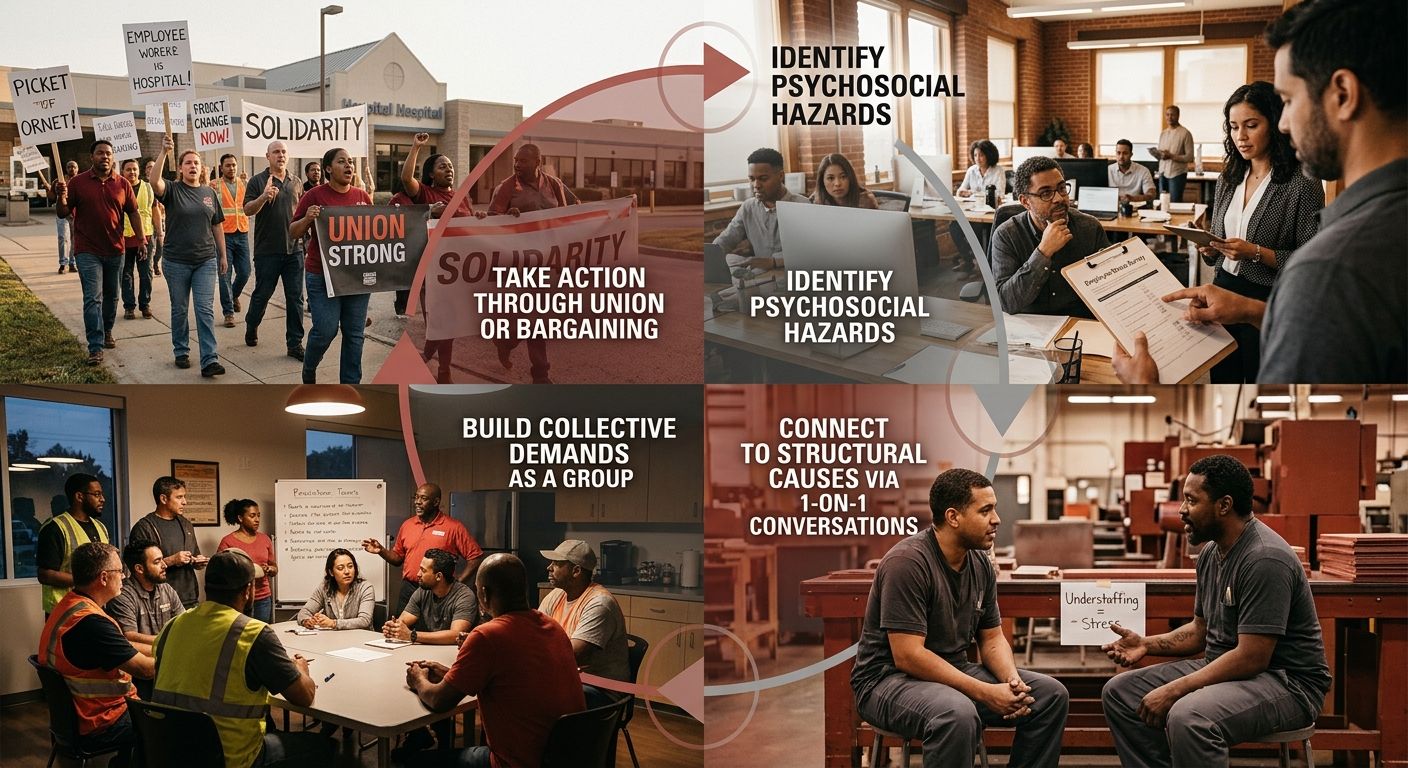
The third approach uses psychosocial hazard awareness as fuel for new organizing campaigns. This is the most direct path from workplace stress to organized workplace power, and it's the one we think deserves the most attention from workers who don't yet have a union.
Here's why it works. The ILO defines psychosocial hazards as anything in the design or management of work that causes psychological or physical harm. That definition covers an enormous range of workplace conditions: unpredictable scheduling, chronic understaffing, unreasonable performance metrics, lack of autonomy, poor communication from leadership, and exposure to harassment or violence. Research published this year in the Economic and Labour Relations Review by Vassiley, Barratt, Dayaram, and Burgess emphasizes that "organizational participation and involvement" with employees and unions about stress prevention is a core component of what scholars call psychosocial safety climate.
When organizers sit down with workers in unorganized shops and ask open-ended questions about daily experience, psychosocial hazards dominate the conversation. People don't always use that language. They say "this place is killing me" or "I can't sleep on Sunday nights" or "management doesn't care if we burn out as long as the numbers look good." The organizer's job is to listen to those stories carefully and help workers connect their individual suffering to structural causes that collective action can address.
Where This Approach Wins
Workplace stress organizing reaches people who think unions are about wages and nothing else. When a coworker says "I filed a safety report about our staffing levels and nothing happened," that's an opening to talk about what a contract could require. When three people on the same shift are all on anxiety medication they started after a management change, that's a pattern that an organizing committee can name and act on.
The ILO data released this week makes the health stakes vivid and specific. Telling a coworker that psychosocial hazards kill 840,000 people a year grounds the conversation in documented harm. Connecting that global number to the specific conditions in your workplace makes the abstract concrete and gives the campaign moral authority that's hard for management to dismiss as griping.
Where It Falls Short
Organizing campaigns take time, and employer resistance is fierce. Workers who raise psychosocial concerns during an organizing drive may face the same retaliation they'd face raising any other issue. And there's a real risk of management framing workplace stress organizing as a complaint about feelings rather than a response to documented health hazards. Organizers need the ILO data, specific injury and illness records, and the documented connection between work conditions and health outcomes to make the case hold up under scrutiny from skeptical coworkers and hostile management.
There's also the question of what comes after the election win. Organizing around psychosocial hazards generates energy for a campaign, but translating that energy into contract language that actually protects workers requires sustained pressure through first-contract bargaining. Many campaigns lose momentum in that transition.
How to Choose Between These Three
These three strategies reinforce each other, and the strongest campaigns use all of them at different stages. But your starting point depends on where you are right now.
If you don't have a union, start with organizing. Map the psychosocial hazards in your workplace by talking to coworkers about their daily experience. Document everything: the staffing levels, the scheduling changes, the incident reports that went nowhere, the turnover rates. The ILO report that dropped this week gives you global data to back up what you already feel in your body at the end of every shift. Reach out to a union that organizes in your industry, or contact the Emergency Workplace Organizing Committee if you don't know where to start.
If you have a union approaching contract negotiations, push hard on bargaining. Bring the ILO data to your bargaining committee. Draft specific contract proposals that address workload design, scheduling predictability, minimum staffing, break time between high-intensity tasks, and joint labor-management committees on psychosocial safety. Study the Kaiser mental health workers' fight to understand both how difficult and how consequential these demands can be.
If you're in a jurisdiction where regulatory change is possible, advocate for legislation alongside the other two approaches. The NSW model in Australia is worth studying as a template, particularly its inclusion of AI and algorithmic management as psychosocial risk factors. Push for ILO workplace safety standards to be reflected in domestic law. And keep in mind that regulation without enforcement amounts to decoration: any legislative push should include provisions for worker participation in inspections and strong anti-retaliation protections.
The ILO's report this week put a death toll on what workers have been describing in break rooms and organizing conversations for years. Corporate wellness programs and stress management workshops won't close this gap. Collective bargaining, regulatory standards with real enforcement, and organized worker power are the three tools that might.
The Union Edge Staff
Also in the paper