
Bank Workers Launch Three-Day Strike Across India Over Five-Day Work Week Demand
Bank workers represented by the United Forum of Bank Unions launched a three-day nationwide strike on September 28, 2026, demanding that all Saturdays be declared holidays as part of a five-day banking schedule, according to The Economic Times.
Bank Workers Launch Three-Day Strike Across India Over Five-Day Work Week Demand
Bank workers represented by the United Forum of Bank Unions launched a three-day nationwide strike on September 28, 2026, demanding that all Saturdays be declared holidays as part of a five-day banking schedule, according to The Economic Times. The work stoppage, which runs through September 30, affects public sector banks including State Bank of India, Punjab National Bank, Bank of India, Central Bank of India, Union Bank of India, and Indian Bank, while major private lenders are expected to operate normally.
The strike follows a conciliation meeting held on September 22 involving the Indian Banks' Association, the Department of Financial Services, and bank management that did not resolve the unions' workplace demand. UFBU had previously staged a one-day nationwide strike on September 11. C H Venkatachalam, general secretary of the All India Bank Employees' Association, said employees remain aggrieved over the lack of progress on the five-day banking demand.
What's Driving the Strike
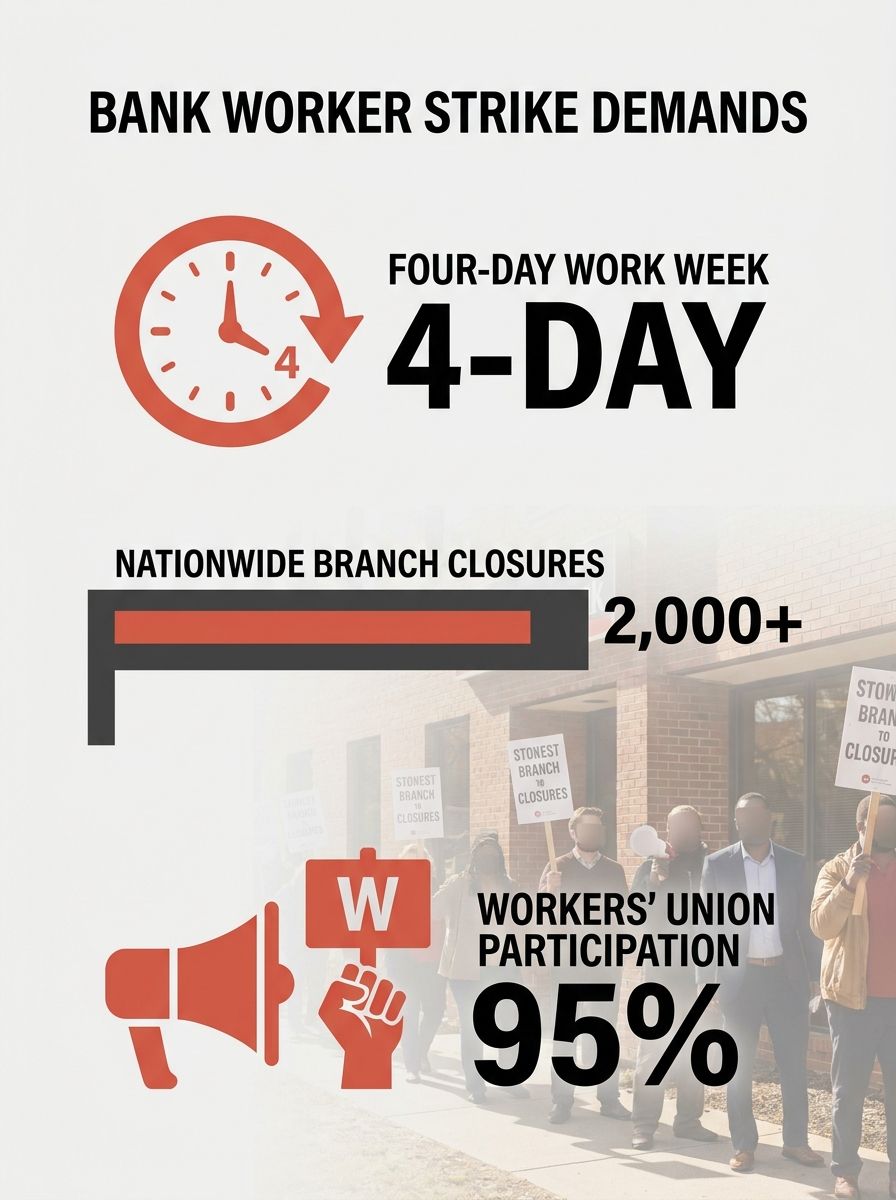
The unions are demanding that bank branches operate Monday through Friday only, with all Saturdays declared holidays for employees. Under current practice, branches close on the second and fourth Saturdays of each month. The demand stems from the 12th Bipartite Settlement signed with the Indian Banks' Association in March 2024, but unions maintain the agreement has not received the required government notification to take effect.
Under the proposed five-day banking system, daily working hours would increase by 40 minutes to maintain total weekly service hours. UFBU argues that the extended Saturday workdays create scheduling and staffing challenges, particularly for employees balancing family responsibilities with rotating weekend shifts.
The September 22 conciliation meeting included representatives from the Indian Banks' Association, Department of Financial Services, and individual bank managements, but concluded without agreement on the Saturday holiday issue.
Which Banks Are Affected
State Bank of India issued an advisory stating that "some services at branches and offices could be affected during the proposed strike and may cause inconvenience to customers." The bank waived ATM charges during the three-day strike period and urged customers to complete essential branch-related transactions before the strike dates.
Punjab National Bank, Bank of India, and Central Bank of India issued similar advisories. All three banks instructed customers to use ATMs, mobile and internet banking, business correspondent points, and unified payments interface channels wherever possible during the strike period.
Major private sector lenders including ICICI Bank, HDFC Bank, and Axis Bank are not part of UFBU and are expected to function normally. These banks operate under separate employment agreements and their workers are represented by different unions or no unions at all.
Impact on Customers
Branch-based services requiring staff assistance will face delays or unavailability at participating public sector banks from September 28 through September 30. Services likely to be affected include cash deposits and withdrawals at teller windows, cheque processing, account opening, loan applications, and other transactions requiring physical documentation or staff authorization.
Digital banking services, ATMs, automated deposit and withdrawal machines, internet banking, mobile banking apps, and UPI transactions are expected to remain operational throughout the strike. State Bank of India specifically directed customers to its YONO platform and other digital channels for routine transactions.
The Controller General of Accounts directed that September salaries, wages, and pensions for central government employees—including those in Defence, Posts, and Telecommunications—be drawn and disbursed on September 25 rather than at month-end, to avoid payment delays caused by the strike.
What Comes Next
UFBU announced an indefinite nationwide strike beginning October 26, 2026, if the five-day banking demand remains unresolved after the September action. The October strike would continue without a predetermined end date until union demands are met or a settlement is reached.
The unions' escalation strategy mirrors tactics used in previous banking sector disputes in India, where limited-duration strikes build public and government pressure before launching sustained work stoppages. Bank workers last staged a multi-day nationwide strike in 2021 over privatization concerns.
The Indian Banks' Association has not publicly commented on whether it will return to negotiations before the October 26 deadline. The Department of Financial Services, which oversees public sector banks, would need to approve any five-day banking schedule before banks could implement the change.
The Takeaway
The three-day strike demonstrates organized labor's continued use in India's public banking sector, where government ownership gives workers greater negotiating power than their private-sector counterparts. The 12th Bipartite Settlement's failure to produce a government notification shows how labor agreements can stall in bureaucratic processes even after management signs them—a pattern that drives workers toward escalating job actions when administrative delays block negotiated gains.
For union strategists watching cross-border organizing tactics, the staged escalation from one-day strikes to three-day actions to threatened indefinite work stoppages offers a case study in building strike momentum while maintaining public support. The October 26 deadline creates pressure on both bank management and government officials to resolve the dispute before customer disruption becomes sustained.
The Union Edge Staff
Related Articles

Biomedical Science Workers at Lancashire Hospitals Launch 20-Day Strike Over Holiday Pay Dispute
Biomedical science workers at Blackburn and Burnley hospitals will conduct 20 days of strikes between June 15 and July 10 over thousands of pounds in unpaid holiday pay, according to Unite union. The strikes will occur in four separate periods across blood testing departments at both Lancashire Teac

Massachusetts Nurses Launch Largest Health Care Strike in State History Over Stalled Wage Talks
More than 4,000 nurses at Brigham and Women's Hospital will walk off the job on July 8 in what the Massachusetts Nurses Association calls the largest health care worker strike in state history, according to NBC Boston. The strike follows months of stalled contract negotiations over cost-of-living in

Brigham and Women's Hospital Refuses Returning Strikers Until Monday, Extending Work Stoppage to Five Days
Brigham and Women's Hospital told approximately 4,000 striking nurses they cannot return to work until Monday morning, extending what was planned as a one-day strike to a five-day lockout, according to NBC Boston. The nurses walked off the job Tuesday and planned to end their strike at 6:59 a.m.
Also in the paper