
Minimum Wage Los Angeles: 2024 Rates & Requirements
The minimum wage in Los Angeles is $17.28 per hour for workers within city limits, effective July 1, 2024. That rate comes from a city ordinance layered on top of California's $16.00 statewide floor and the federal minimum of $7.

Minimum Wage Los Angeles: 2024 Rates & Requirements
The minimum wage in Los Angeles is $17.28 per hour for workers within city limits, effective July 1, 2024. That rate comes from a city ordinance layered on top of California's $16.00 statewide floor and the federal minimum of $7.25, creating a system where three separate laws overlap and the highest applicable rate always wins.
What the Los Angeles Minimum Wage Ordinance Covers
The Los Angeles Minimum Wage Ordinance, codified in Section 187.02 of the L.A. Municipal Code, requires all employers to pay workers at least $17.28 per hour as of July 1, 2024. The ordinance applies to every employee who performs at least two hours of work per week within the city's geographic boundaries, regardless of where the employer is headquartered. There is no small-business exemption. A five-person bakery and a 50,000-employee corporation face the same rate.
The city adopted this ordinance in 2015, phasing increases in over several years. After the phase-in ended in 2021, the rate switched to an automatic annual adjustment tied to inflation. The Office of Wage Standards administers enforcement, investigates complaints, and publishes the updated rate each February 1 for the July 1 effective date.
Los Angeles County passed a parallel ordinance covering unincorporated areas of the county, setting a nearly identical rate of $17.27 per hour effective July 1, 2024. The $0.01 difference between city and county rates reflects their independent CPI calculations.
This layered structure matters because it determines which workers get protected and which fall through to lower state or federal floors. Understanding the mechanism means understanding which law applies where and when.
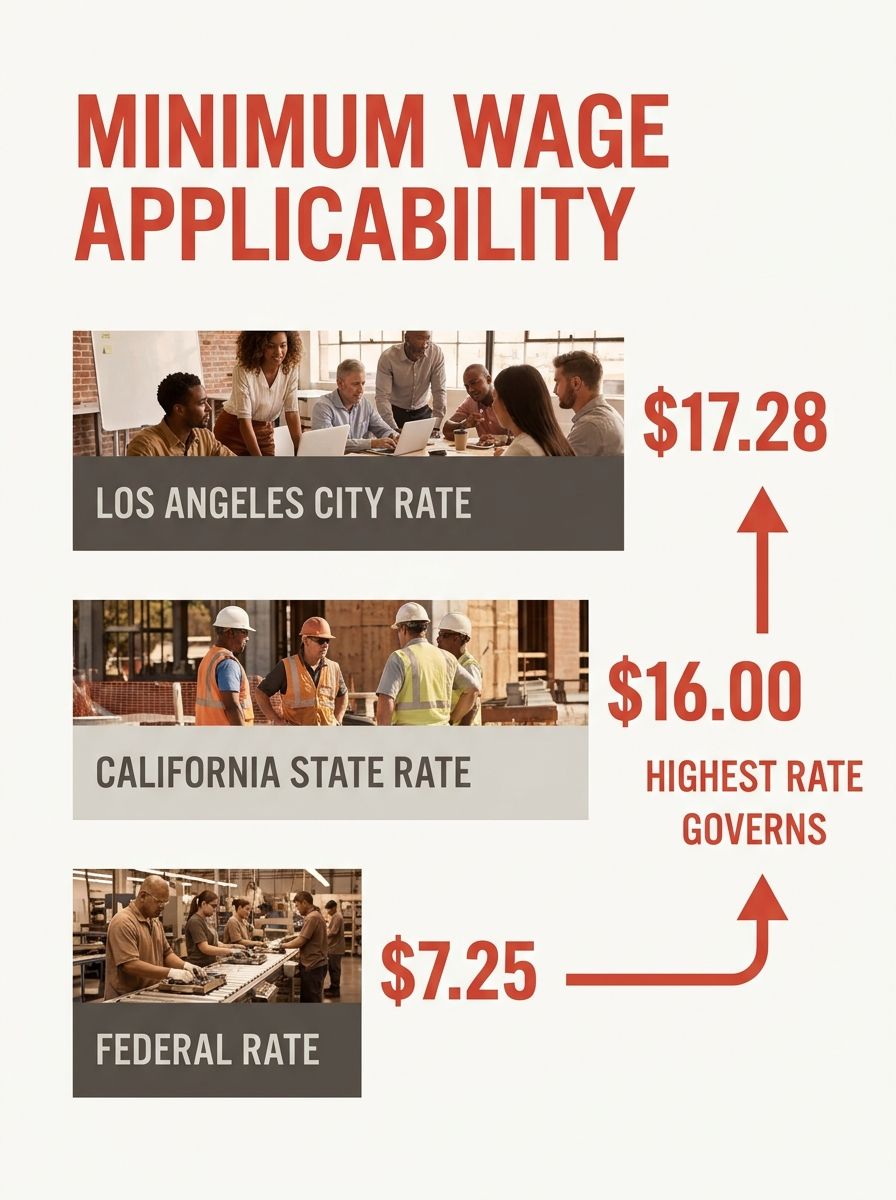
Three Layers of Law, One Paycheck
The wage a Los Angeles worker receives depends on geography and industry, filtered through three separate legal frameworks that stack on top of each other. The federal Fair Labor Standards Act sets the absolute floor at $7.25 per hour, a rate unchanged since 2009. California's statewide minimum, raised to $16.00 per hour on January 1, 2024, overrides the federal rate for every worker in the state. The City of Los Angeles ordinance then overrides the state rate for anyone working within city limits.
The legal principle at work is simple: when multiple minimum wage laws apply simultaneously, the employer must pay whichever rate is highest. A dishwasher working in downtown L.A. doesn't earn $7.25 federal, or $16.00 state. They earn $17.28 under the city ordinance.
Workers in unincorporated Los Angeles County earn $17.27 per hour under the county's separate ordinance. Workers in incorporated cities within L.A. County that haven't adopted their own local minimum wage, places like Pomona or Downey, fall to the state rate of $16.00 unless an industry-specific law applies.
The contrast with states that have no local wage authority highlights what this layered system does for workers. Compare the $17.28 L.A. floor to the situation in Texas, where the state minimum mirrors the federal $7.25. The gap between those two rates, nearly $10 per hour, translates to roughly $20,800 in annual earnings difference for a full-time worker.
Jurisdiction | 2024 Rate | Effective Date | Applies To |
|---|---|---|---|
Federal (FLSA) | $7.25/hr | Since 2009 | All covered employers nationally |
California (state) | $16.00/hr | Jan 1, 2024 | All employers statewide |
CA Fast Food Workers | $20.00/hr | Apr 1, 2024 | Fast food chains with 60+ locations nationally |
LA County (unincorporated) | $17.27/hr | Jul 1, 2024 | Employers in unincorporated county areas |
City of Los Angeles | $17.28/hr | Jul 1, 2024 | Employers in city limits |
LA Hotel Workers | $20.32/hr | Jul 1, 2024 | Hotel employees in city limits |
LAX Airport Workers | $19.28/hr | Jul 1, 2024 | Workers at LAX plus health benefit |
Industry-Specific Rates Above the Baseline
Several sectors in Los Angeles have their own wage mandates that exceed even the $17.28 city rate. These carve-outs reflect organizing pressure and legislative action targeting industries with historically high rates of wage theft and worker exploitation.
Fast food workers statewide earn a minimum of $20.00 per hour under AB 1228, effective April 1, 2024. The law covers employees at fast food chains with 60 or more locations nationally, as confirmed by the California Department of Industrial Relations. This rate applies uniformly across the state, meaning a fast food worker in rural Bakersfield earns the same $20.00 minimum as one in Beverly Hills.
Hotel workers in the City of Los Angeles earn at least $20.32 per hour as of July 2024. The hotel worker rate emerged from Measure HH, a ballot initiative backed by UNITE HERE Local 11, and represents one of the highest sector-specific floors in the country.
Los Angeles International Airport workers earn $19.28 per hour plus a health benefit payment. The LAX rate has its own adjustment schedule and reflects the high cost of living in the Westside neighborhoods surrounding the airport.
Healthcare workers fall under a separate statewide framework. California passed SB 525, implementing phased minimum wages for healthcare facility employees starting at $18–$23 per hour depending on facility type, with the first phase effective June 1, 2024. The law was structured after significant lobbying from SEIU-UHW and other healthcare unions.
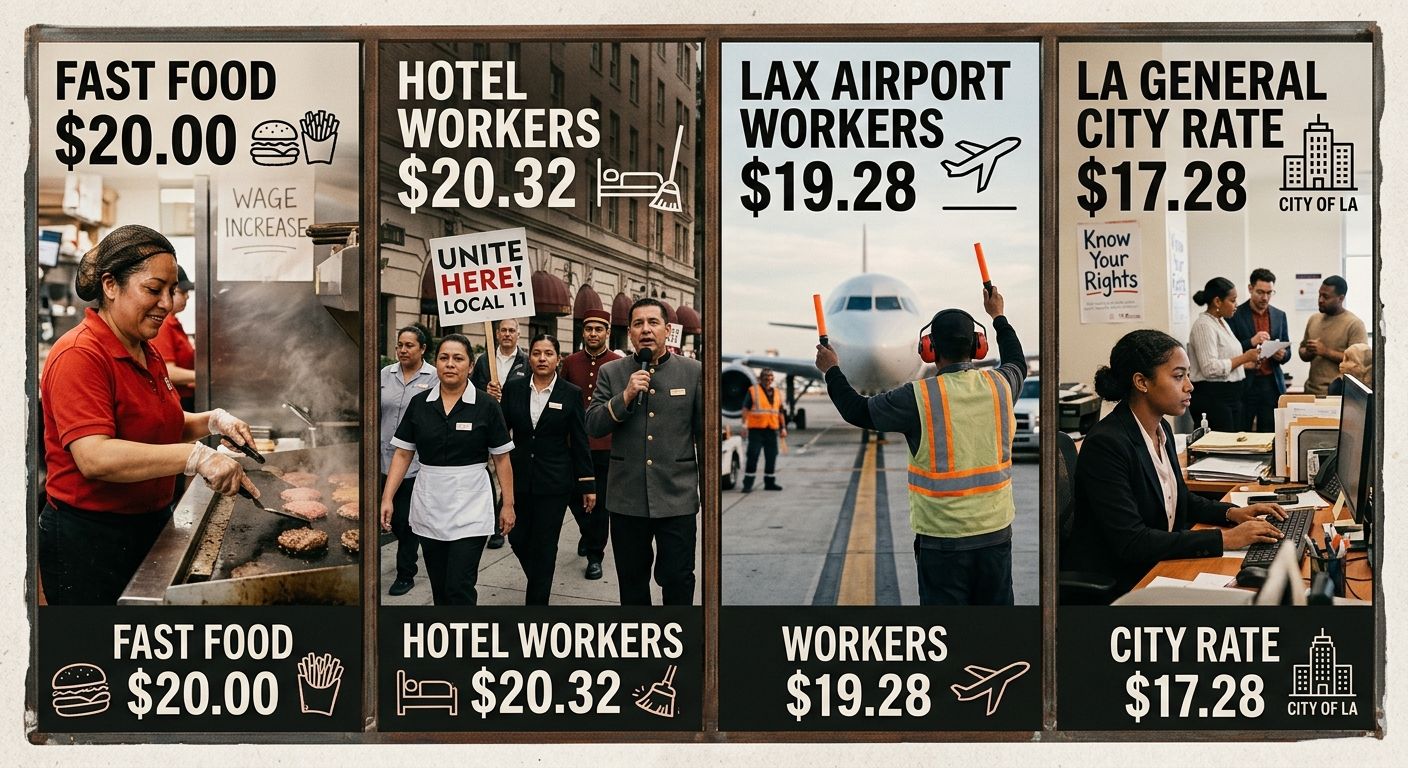
These industry rates interact with the general minimum wage in a straightforward way: a fast food worker in L.A. city limits earns $20.00, not $17.28, because the sector rate is higher. If the general city rate ever exceeded the sector rate (an unlikely scenario given current trajectories), the general rate would apply instead.
How the Annual CPI Adjustment Works
The City of Los Angeles updates its minimum wage annually using a formula tied to the Consumer Price Index for Urban Wage Earners and Clerical Workers (CPI-W) for the Los Angeles metropolitan area, published by the Bureau of Labor Statistics. The city announces the new rate on February 1 and makes it effective the following July 1.
This automatic indexing mechanism is the structural backbone of the ordinance. Without it, the rate would erode in real purchasing power every year inflation outpaces legislative action, the exact dynamic that's frozen the federal minimum at $7.25 for over 15 years. The CPI-W tracks spending patterns for hourly and clerical workers specifically, making it a closer proxy for the cost pressures that minimum wage earners face compared to broader inflation indices.
The mechanism has a built-in ceiling: the ordinance caps annual increases at a percentage tied to CPI, which means the rate rises gradually rather than in large jumps. In practice, this has produced steady increases. The rate moved from $16.78 in 2023 to $17.28 in 2024, a $0.50 increase reflecting a 2.98% CPI adjustment. By 2026, the rate has risen to $17.87 per hour, while California's statewide rate climbed to $16.90.
States that rely on legislative action to raise the minimum wage instead of automatic indexing tend to see long periods of stagnation. Connecticut and Massachusetts both use scheduled statutory increases rather than CPI adjustment, which means their rates need fresh legislation every few years to keep pace with inflation.
Employer Obligations and Posting Requirements
Every employer operating within L.A. city limits must comply with a specific set of administrative requirements beyond simply paying the correct rate. Failure to meet these obligations can trigger enforcement action independent of any wage underpayment.
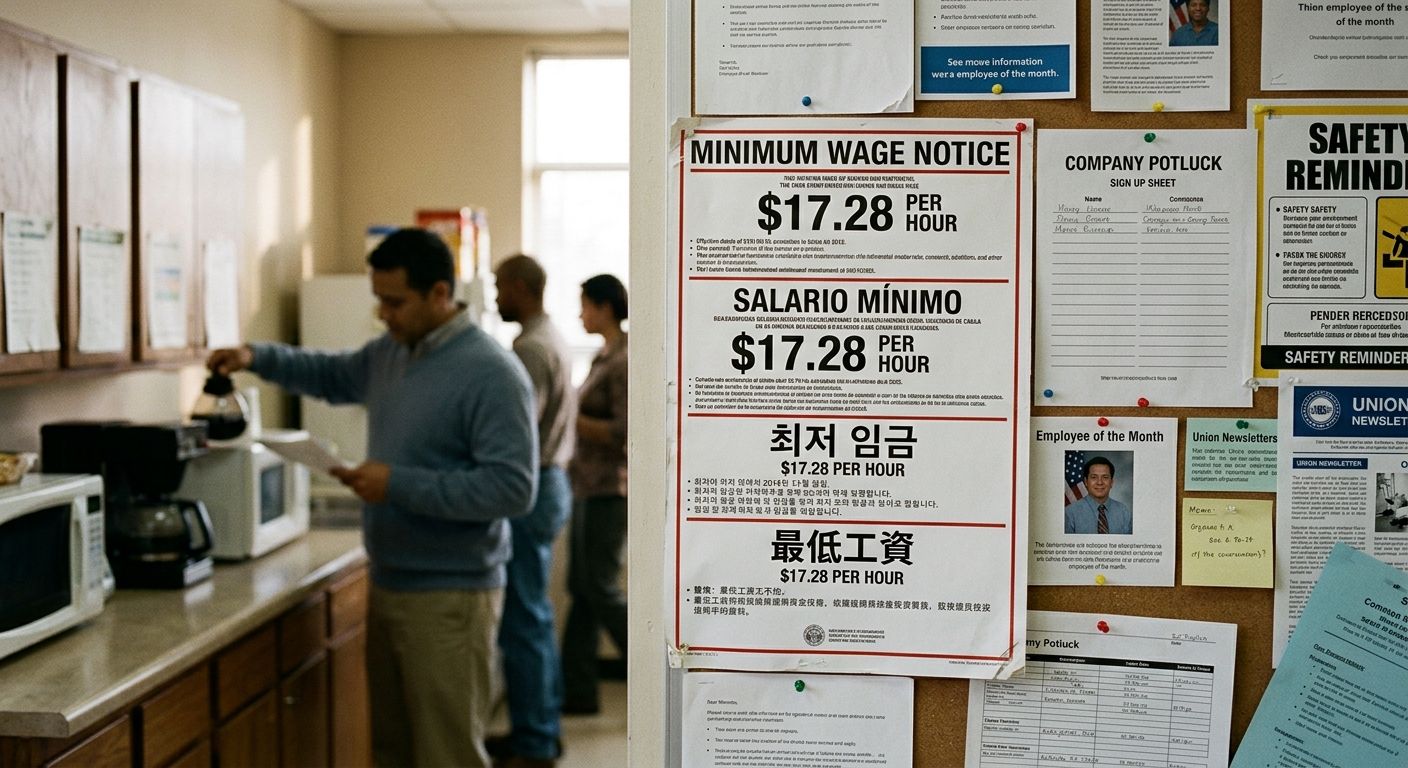
Posting notices is the most basic requirement. Employers must display the official Minimum Wage and Paid Sick Leave notice in English and in any language spoken by at least 5% of their workforce. In a city where 48.5% of residents speak Spanish at home and significant populations speak Korean, Mandarin, Tagalog, and Armenian, this requirement carries real weight. An employer with 30 workers, six of whom speak Tagalog as their primary language, must post the notice in both English and Tagalog.
No tip credits. Unlike the federal system, which allows employers to pay tipped workers as little as $2.13 per hour and count tips toward the minimum wage obligation, California and Los Angeles prohibit tip credits entirely. A server at a restaurant in Los Angeles earns the full $17.28 per hour before tips. This provision disproportionately protects women, who hold roughly 66% of tipped positions nationally, and workers of color in the service industry.
Anti-retaliation protections are written into the ordinance. Employers cannot fire, demote, reduce hours, or otherwise punish a worker who asks about the minimum wage, files a complaint, or cooperates with an investigation. Retaliation itself constitutes a separate violation subject to its own penalties.
The Living Wage Ordinance applies a higher standard for workers on City of Los Angeles contracts. Under the LWO, contractors and subcontractors must provide 96 compensated hours per year for sick leave, vacation, or personal necessity, plus 80 additional uncompensated hours for family needs. The living wage rate exceeds the standard minimum and includes a health benefit component.
The Gap Between the Minimum Wage and a Living Wage
A California Policy Lab study found that L.A.'s minimum wage increases raised earnings for low-wage workers without causing measurable negative employment effects. Specifically, a 1% increase in the minimum wage raised average weekly wages of food service workers by 0.21–0.32%. But even these verified gains leave a substantial gap between the legal floor and what it costs to live in Los Angeles.
MIT's Living Wage Calculator pegs the living wage for Los Angeles County at $27.81 per hour for a single adult with no children. That's $10.53 more per hour than the 2024 city minimum wage of $17.28. For a single parent with one child, the living wage jumps significantly higher. At 40 hours per week, the $17.28 minimum translates to roughly $35,942 per year before taxes, in a metro area where median rent for a one-bedroom apartment exceeds $2,000 per month.
This gap explains why union campaigns and worker organizing efforts in Los Angeles consistently push beyond the minimum wage floor. The hotel worker rate of $20.32, won through ballot initiative and union pressure, narrows the gap but doesn't close it. The broader fight for fair wages continues in council chambers, at the bargaining table, and in workplaces across the city.
Where the Model Breaks
The LA minimum wage system has real limitations and blind spots that workers should understand.
Geographic boundaries create arbitrary wage cliffs. A worker at a restaurant on one side of a street in West Hollywood (which has its own local minimum wage) earns a different rate than a colleague working two blocks away in an unincorporated part of LA County, who earns a different rate than someone three blocks further inside L.A. city limits. Employers with locations spanning multiple jurisdictions must track and apply different rates at each site.
Independent contractors fall outside the ordinance entirely. Gig workers, freelancers, and misclassified employees don't receive minimum wage protection under the ordinance. California's AB 5 law has tightened the definition of independent contractor status, but enforcement remains inconsistent, and companies continue to classify workers in ways that strip them of wage protections.
The CPI cap can lag behind cost-of-living spikes. Because the adjustment reflects the prior year's CPI data, the rate always reacts to inflation rather than anticipating it. During periods of rapid housing cost increases, like the 40%+ rent spikes parts of L.A. experienced between 2020 and 2023, the minimum wage adjustment arrives too late and too small to offset the damage.
Enforcement depends on workers filing complaints. The Office of Wage Standards investigates violations, but it operates reactively. Workers who don't know their rights, fear retaliation, or lack immigration documentation are less likely to file. The anti-retaliation provisions exist on paper, but enforcing them requires a worker willing to assert the claim, a calculation that involves risk, especially in industries with high turnover and employer-friendly power dynamics.
Sub-minimum wages for learners and disabled workers. Federal law still permits special certificates paying below the minimum wage to certain disabled workers, and California permits reduced wages for learners in some circumstances. These exceptions are narrow, but they exist.
Common Questions
Does the $17.28 rate apply to all employers in Los Angeles regardless of size?
Yes. The City of Los Angeles eliminated the two-tier system (which once set different rates for businesses with 25 or fewer employees versus larger employers) after the phase-in period ended in 2021. Every employer within city limits pays the same rate. This differs from some jurisdictions that maintain permanent small-business tiers.
Can my employer count tips toward the minimum wage in Los Angeles?
No. California law prohibits tip credits statewide, and the Los Angeles ordinance follows this rule. Tipped employees must receive the full $17.28 per hour in direct wages from their employer. Tips belong entirely to the worker and cannot be used to offset the employer's wage obligation.
What if I work in Los Angeles but my employer is headquartered in another city?
The location of your employer's headquarters is irrelevant. The ordinance covers any employee who performs at least two hours of work per week within L.A. city limits. If you commute into L.A. from the Inland Empire and work your shift within the city, you're covered by the $17.28 rate for those hours.
How do I file a wage complaint in Los Angeles?
Contact the Office of Wage Standards through the WagesLA website or call their office directly. For workers in unincorporated county areas, the LA County Office of Labor Equity handles enforcement. State-level complaints go through the California Division of Labor Standards Enforcement (DLSE). Filing a complaint is protected activity, your employer cannot legally retaliate against you for doing so.
Has the rate changed since July 2024?
Yes. The CPI adjustment mechanism raised the City of Los Angeles minimum wage to $17.87 per hour effective July 1, 2025, and the California statewide rate increased to $16.90 per hour effective January 1, 2026. The annual adjustment cycle continues, with each year's new rate announced on February 1 and taking effect the following July 1.
The Union Edge Staff
Frequently Asked Questions
- What is the minimum wage in Los Angeles for 2024?
- The minimum wage in Los Angeles is $17.28 per hour for workers within city limits, effective July 1, 2024. This rate is set by a city ordinance and applies to all employers regardless of size.
- Does the Los Angeles minimum wage apply to small businesses?
- Yes, there is no small-business exemption. Both a five-person bakery and a 50,000-employee corporation must pay the same $17.28 per hour rate for workers within city limits.
- Can employers count tips toward minimum wage in Los Angeles?
- No. California law prohibits tip credits statewide, so tipped employees must receive the full $17.28 per hour in direct wages from their employer, and tips belong entirely to the worker.
- What is the living wage in Los Angeles versus the minimum wage?
- MIT's Living Wage Calculator pegs the living wage for Los Angeles County at $27.81 per hour for a single adult with no children, which is $10.53 more per hour than the 2024 city minimum wage of $17.28.
- How much do fast food workers earn in Los Angeles?
- Fast food workers in California earn a minimum of $20.00 per hour under state law AB 1228, effective April 1, 2024, which applies to chains with 60 or more locations nationally.
- How does the Los Angeles minimum wage adjust each year?
- The city updates its minimum wage annually using a formula tied to the Consumer Price Index for the Los Angeles metropolitan area, announced on February 1 and effective the following July 1.
- What languages must minimum wage notices be posted in Los Angeles?
- Employers must display the minimum wage notice in English and in any language spoken by at least 5% of their workforce, which in Los Angeles includes languages like Spanish, Korean, Mandarin, Tagalog, and Armenian.
- Do hotel workers in Los Angeles earn more than the standard minimum wage?
- Yes, hotel workers in the City of Los Angeles earn at least $20.32 per hour as of July 2024, which exceeds the standard city minimum wage.
Related Articles

Minimum Wage by County in California 2024
California operates at least 40 distinct minimum wage floors simultaneously. The statewide base of $16.00 per hour that took effect January 1, 2024, functions as a starting point from which dozens of cities, counties, and industry-specific mandates build upward, creating gaps as wide as $4.
Minimum Wage in California 2026: What to Know
California's minimum wage in 2026 operates as a three-tier system: a CPI-indexed statewide floor of $16.90 per hour, local city and county rates reaching $20.34 in Emeryville, and industry-specific mandates pushing healthcare workers to $25.00 per hour.

Minimum Wage in California: 2024 Rules & Requirements
California's minimum wage is a formula-driven system that recalculates every January 1 based on changes in the Consumer Price Index, capped at 3.5% annually. The statewide floor rose from $16.00 per hour in 2024 to $16.
Also in the paper