
WNBA Collective Bargaining Agreement Explained
The WNBA collective bargaining agreement is a seven-year labor contract between the league and the Women's National Basketball Players Association (WNBPA) that sets salaries, working conditions, and player rights for every athlete on a WNBA roster.

WNBA Collective Bargaining Agreement Explained
The WNBA collective bargaining agreement is a seven-year labor contract between the league and the Women's National Basketball Players Association (WNBPA) that sets salaries, working conditions, and player rights for every athlete on a WNBA roster. The 2026 CBA introduced the first revenue-sharing model in women's professional sports, guaranteeing players 20% of gross league revenue and projecting over $1 billion in total compensation through 2032.
How the WNBA CBA Came Into Being
The WNBPA was founded in 1998 as the first labor union for professional women's basketball players. Its legal foundation comes from the National Labor Relations Act, which, as the University of Miami Law Review documented, gave workers "the right to self-organize and associate to collectively negotiate terms and conditions of employment." That federal statute is the same law that governs NLRB proceedings affecting unions across industries.
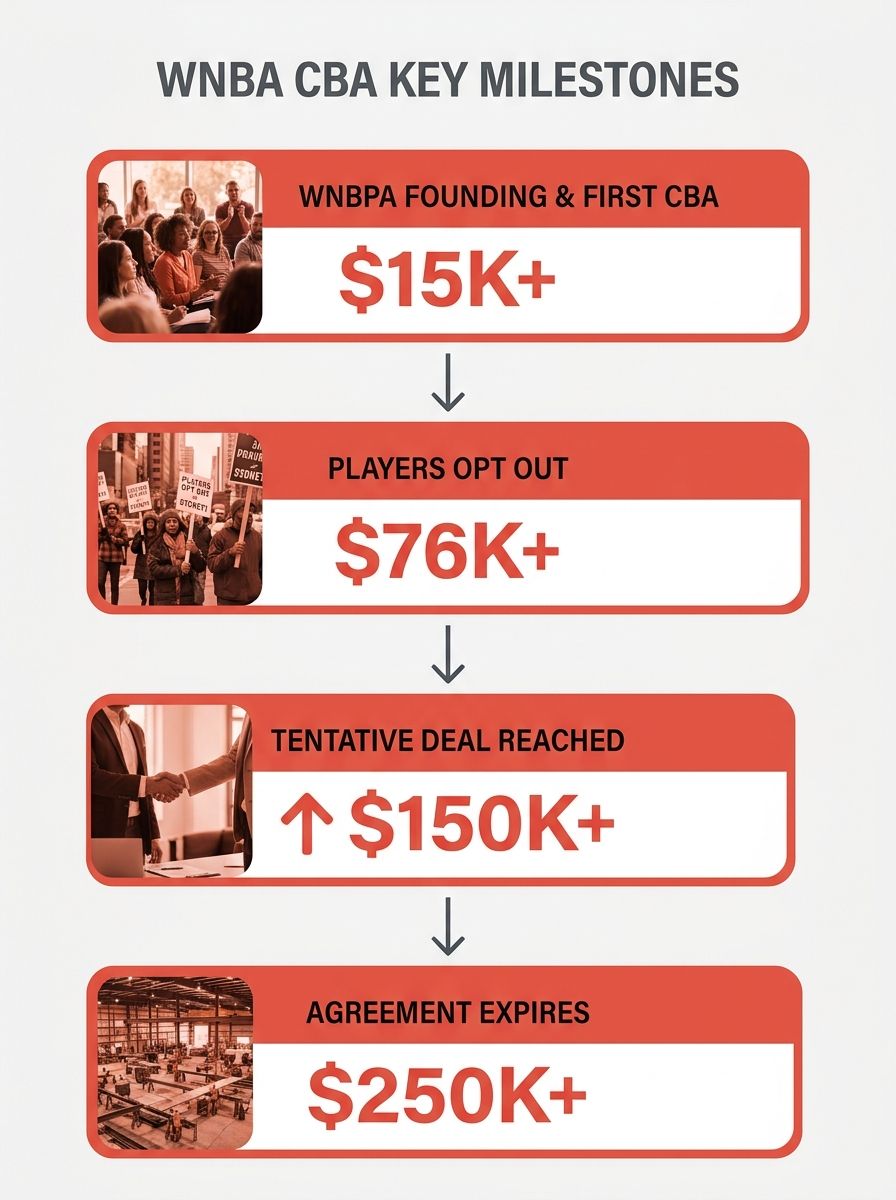
The current CBA resulted from a 17-month negotiation process. Players opted out of the previous agreement in October 2024. Talks stretched through 2025, with sessions lasting dozens of hours per day for four consecutive days at critical points, as The Athletic reported. The WNBA and WNBPA announced a tentative deal on March 20, 2026, and the Board of Governors unanimously ratified the terms shortly after. The agreement runs through the 2032 season.
Under the prior CBA, players received approximately 9.3% of league revenue. The new deal more than doubles that share to 20% of gross revenue. The gap between 20% and the NBA's roughly 50% split reflects the WNBA's financial history of operating at a loss, subsidized by NBA ownership. But the structural change matters: pay is now tied directly to commercial growth rather than set at management's discretion.
The Revenue-Sharing Formula
The salary cap for the 2026 season is $7.0 million per team, up from approximately $1.5 million in 2025. That number adjusts annually based on league and team revenue growth. If WNBA broadcasting deals and sponsorship income grow as projected, the cap is expected to exceed $11 million by 2032.
This mechanism is the engine that makes the rest of the contract work. Rather than fixing dollar amounts for each year and renegotiating when they become outdated, the CBA pegs the salary cap to actual revenue. Players benefit directly when the league signs bigger media deals, adds expansion teams, or grows attendance. If revenue contracts, the cap adjusts downward, a risk the players accepted in exchange for participation in the upside.
The 20% revenue share is split across guaranteed salaries, performance bonuses, and benefits. The formula creates a predictable financial relationship: teams know their maximum payroll obligation, and players know the floor beneath their collective compensation. This structure mirrors mechanisms in other North American sports CBAs, though the percentage itself reflects the WNBA's earlier stage of revenue development compared to leagues where players have fought for decades to increase their share. The principle that strong labor contracts lock in economic gains for workers rather than leaving them to employer goodwill is the same one operating here.
Salary Tiers and Contract Structure
The WNBA CBA establishes four distinct compensation tiers that determine how salary cap dollars get distributed across rosters.
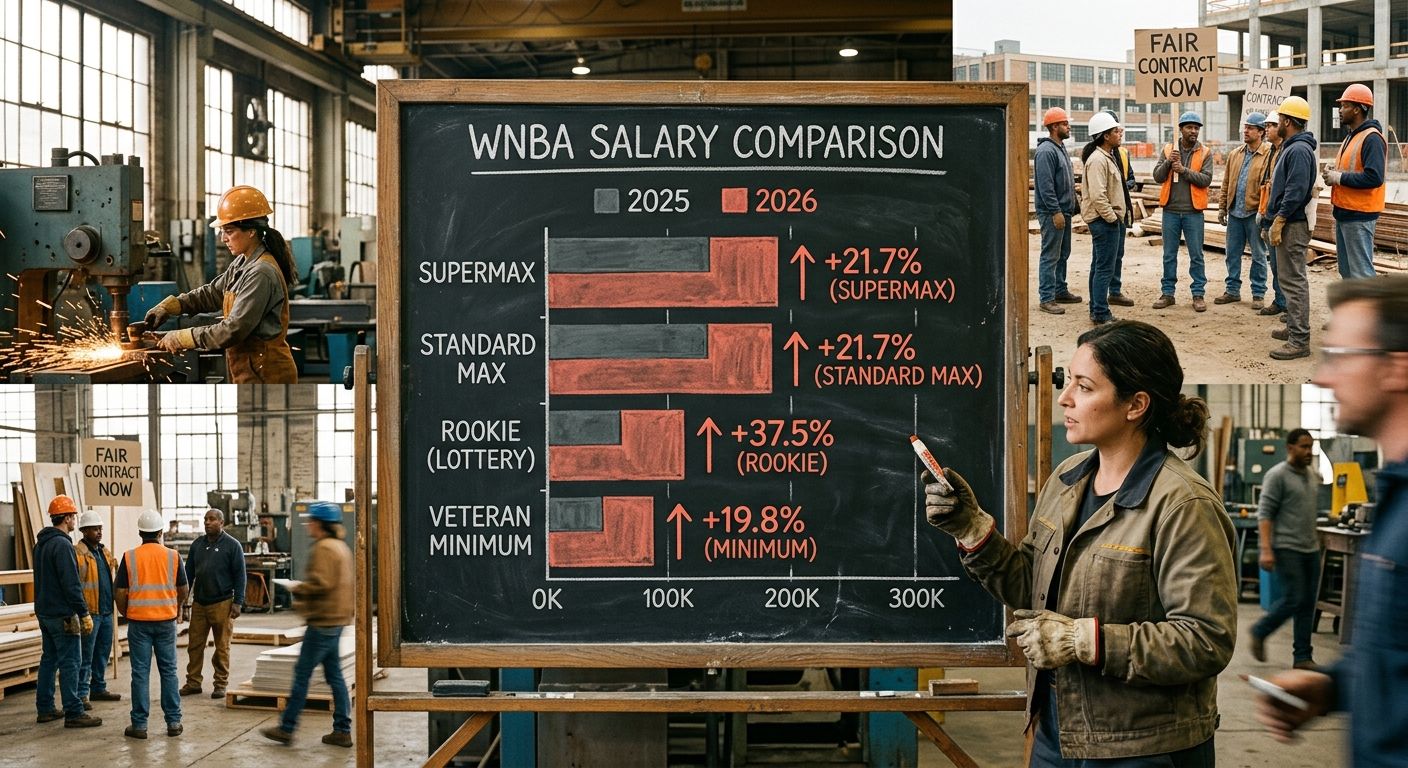
Supermax contracts represent the top tier. For the first time in WNBA history, players can sign multi-million-dollar deals. The highest-paid players now earn more than $1 million annually on supermax contracts, with projections reaching $1.4 million. Eligibility requires specific performance benchmarks like MVP awards or All-WNBA selections.
Standard maximum contracts sit below the supermax, offering the highest salary a team can pay under normal circumstances without the exceptional-performance triggers.
Minimum salaries saw some of the most dramatic increases. Players at the floor went from $66,079 in 2025 to between $270,000 and $300,000 in 2026, roughly a four-fold raise. This increase is the provision most likely to reduce the financial pressure that has historically pushed WNBA players to compete overseas during the off-season to make a living wage.
Rookie scale contracts lock in salaries for drafted players. The No. 1 overall pick is projected to earn $500,000 in 2026, with an expedited pathway to maximum contracts for rookies who win MVP or earn All-WNBA honors.
The average WNBA salary across all tiers is projected at approximately $600,000 for 2026, with expectations to surpass $1 million by 2032. Performance bonuses add to base compensation: the MVP bonus alone rose to $60,000, nearly quadruple the previous amount.
Salary Tier | 2025 Approximate | 2026 Under New CBA | Notes |
|---|---|---|---|
Supermax | ~$250,000 | $1,000,000+ | Requires MVP or All-WNBA selection |
Standard Maximum | ~$200,000 | Set by cap formula | Adjusted annually with revenue |
Minimum Salary | $66,079 | $270,000–$300,000 | Four-fold increase |
No. 1 Draft Pick | ~$76,000 | ~$500,000 | Expedited max eligibility for top performers |
Average Salary | ~$120,000 | ~$600,000 | Projected to exceed $1M by 2032 |
Player Movement: Free Agency and the Core Designation
The CBA governs how players change teams through a layered system of restricted and unrestricted free agency, qualifying offers, and the Core Designation.
Restricted free agents can negotiate with any team, but their previous team holds a right of first refusal, meaning it can match any offer sheet the player signs elsewhere and retain her. Teams create restricted free agents by extending a qualifying offer, which remains on the table unless the team revokes it or it hits an expiration date set by the CBA. Beginning in 2027, qualifying offers can be sent during a narrow window from January 30 to February 3.
The Core Designation functions similarly to the NFL's franchise tag. Once a team designates a player as a Core player, that athlete loses the ability to negotiate openly with rival clubs, and the designating franchise holds exclusive signing rights during the entire free agency period. The new CBA restricts this power starting in 2027: players with seven or more years of service cannot be cored. This change was a significant union win, since the Core Designation had been one of the most contentious mechanisms limiting player autonomy under the previous agreement.
Teams must now carry a minimum of 12 players, up from previous flexible limits, with two additional developmental roster spots that don't count against the salary cap. The regular season expands from 44 games in 2026 to 50 games in 2027-2028 and 52 games from 2029 through 2032.
Workplace Protections Written Into the Contract
Why do workplace protections belong in a sports CBA? Because the same dynamic that drives labor disputes in the airline industry drives them in professional basketball: workers need enforceable guarantees, and verbal promises from management aren't worth the air they travel on.
Pregnancy and family protections were among the most closely watched provisions. The agreement codifies that teams must obtain a pregnant player's consent before trading her. It introduces a pregnancy and childbirth salary cap exception, so teams aren't financially penalized for supporting players through pregnancy. Players with two or more years of service gain access to family planning benefits covering adoption, surrogacy, and fertility treatments for themselves and their partners. Non-birthing partners receive two weeks of paid leave, and teams must allow dependent children aged 13 or younger to travel with players.
Health and medical staffing requirements are now specified in the contract rather than left to individual team budgets. Each team must employ two athletic trainers, two team physicians, a strength and conditioning coach, a physical therapist, a massage therapist, and a nutritionist. Mental health reimbursement reaches $2,250 per season by 2027.
Travel standards are codified: charter flights are now a contractual right league-wide, ending years of players flying commercial while male athletes in comparable leagues traveled by charter. Housing is guaranteed for all players through 2028 and for those earning under $500,000 through 2030. The NWSL, by comparison, ratified a CBA in 2024 that phases out its housing requirement by 2027.
Retiree recognition is a notable addition. Any player who retired before the 2026 season and won MVP at least once receives a one-time payment of $100,000. Other retired players with at least five years of service receive payments ranging from $30,000 for 5-7 years of service to the full $100,000 for 12 or more years. The union fought to include players who built the league before major revenue arrived, ensuring they share in its financial growth.

What the CBA Can't Fix
The 20% revenue share, while a dramatic improvement over 9.3%, still falls far short of the NBA's roughly 50% split. Players accepted a lower percentage in exchange for guaranteed minimums and structural protections, betting that league growth will make 20% of a much larger pie worth more in absolute dollars. If revenue growth stalls or media deal renewals disappoint, the cap adjustments that make the system work become constraints.
The Core Designation, despite the seven-year service restriction, remains a tool that limits player agency. A player in her fourth or fifth season can still be locked to a team against her preference, with no ability to test the open market. The union traded away full elimination of the tag for gains elsewhere in the deal.
Schedule expansion from 44 to 52 games by 2029 increases revenue but also increases injury risk and reduces the overseas playing windows that many athletes still rely on for supplementary income. The CBA doesn't address overseas play directly, leaving a tension between the league's desire for year-round player availability and athletes' financial need to play abroad, especially for those below the supermax tier.
Housing guarantees phase out in stages, fully expiring for higher-earning players after 2028. In cities with high housing costs, this timeline could create financial pressure earlier than the salary figures suggest, a concern familiar to workers across industries who've seen cost-of-living adjustments lag behind real expenses.
And the agreement's seven-year term is itself a tradeoff. Players locked in terms through 2032, securing stability and historic gains. But if WNBA revenue growth accelerates beyond current projections, the players will find themselves unable to renegotiate until the contract expires, potentially leaving significant money on the table during the league's most explosive growth period.
Common Questions
How long does the current WNBA collective bargaining agreement last?
The agreement covers seven seasons, from 2026 through 2032. The WNBA Board of Governors unanimously ratified the terms after the WNBA and WNBPA reached a tentative deal on March 20, 2026. Negotiations ran for 17 months following the players' opt-out in October 2024.
What is the WNBA salary cap under the new CBA?
The 2026 salary cap is $7.0 million per team, up from approximately $1.5 million in 2025. It adjusts annually based on league and team revenue growth, with projections putting it above $11 million by 2032. The cap is tied directly to the 20% gross revenue share guaranteed to players.
Do WNBA players get charter flights under the CBA?
Charter travel is a contractual right codified in the CBA for all teams league-wide. Under previous agreements, charter flights were provided inconsistently at team discretion. The new CBA makes them mandatory, removing the possibility that teams could revert to commercial travel.
What happens to retired WNBA players under this agreement?
Retired players with at least five years of WNBA service receive one-time recognition payments ranging from $30,000 (for 5-7 years of service) to $100,000 (for 12 or more years of service, or any retired player who won MVP). These payments acknowledge athletes who built the league before its current revenue growth materialized.
Can WNBA teams still use the Core Designation?
Teams can still designate one player as a Core player, giving the franchise exclusive negotiating rights during free agency. Starting in 2027, players with seven or more years of service are exempt from the Core Designation, restoring free agency rights for the league's most experienced athletes.
The Union Edge Staff
Frequently Asked Questions
- What percentage of WNBA league revenue do players get under the new CBA?
- Players receive 20% of gross league revenue under the 2026 CBA, up from approximately 9.3% under the previous agreement. This is the first revenue-sharing model in women's professional sports.
- What is the WNBA minimum salary for 2026?
- The minimum salary for 2026 is between $270,000 and $300,000, a four-fold increase from $66,079 in 2025. This dramatic raise is expected to reduce the financial pressure that historically pushed WNBA players to compete overseas during the off-season.
- How much can WNBA supermax players earn?
- Supermax contract players can now earn more than $1 million annually, with projections reaching $1.4 million by 2032. Eligibility requires specific performance benchmarks like MVP awards or All-WNBA selections.
- How long does the new WNBA collective bargaining agreement last?
- The agreement runs for seven years, from 2026 through 2032. The WNBA Board of Governors unanimously ratified the deal on March 20, 2026, after a 17-month negotiation process.
- Do WNBA teams have to provide charter flights?
- Yes, charter flights are now a contractual right for all WNBA teams league-wide under the new CBA. This ends years of players flying commercial while male athletes in comparable leagues traveled by charter.
- What is the Core Designation in the WNBA CBA?
- The Core Designation functions similarly to the NFL's franchise tag, allowing teams to lock a player to exclusive negotiating rights during free agency. Starting in 2027, players with seven or more years of service cannot be designated as Core players.
- What pregnancy and family protections are in the new WNBA CBA?
- Teams must obtain a pregnant player's consent before trading her and cannot be financially penalized for supporting players through pregnancy. Players with two or more years of service gain access to family planning benefits covering adoption, surrogacy, and fertility treatments.
- Do retired WNBA players receive payments under the new CBA?
- Retired players with at least five years of service receive one-time recognition payments ranging from $30,000 to $100,000 depending on years of service or MVP status. This acknowledges athletes who built the league before its recent revenue growth.
Related Articles

Benefits of Collective Bargaining Agreement Explained
A collective bargaining agreement (CBA) is a legally binding contract between an employer and a union that sets wages, benefits, working conditions, and dispute resolution procedures for every covered worker.

Collective Bargaining Agreement Contracts: A Guide
A collective bargaining agreement contract is the legally binding document that sets wages, benefits, hours, and working conditions between a union and an employer, protected under Section 7 of the National Labor Relations Act.

Examples of Collective Bargaining Success
At nearly 3am on November 25, 2024, graduate workers at the University of Minnesota and university administrators finalized a tentative first collective bargaining agreement after more than 30 hours of continuous mediation over two days, according to UE News.
Also in the paper