
Massachusetts Nurses Launch Largest Health Care Strike in State History Over Stalled Wage Talks
More than 4,000 nurses at Brigham and Women's Hospital will walk off the job on July 8 in what the Massachusetts Nurses Association calls the largest health care worker strike in state history, according to NBC Boston. The strike follows months of stalled contract negotiations over cost-of-living in

Massachusetts Nurses Launch Largest Health Care Strike in State History Over Stalled Wage Talks
More than 4,000 nurses at Brigham and Women's Hospital will walk off the job on July 8 in what the Massachusetts Nurses Association calls the largest health care worker strike in state history, according to NBC Boston. The strike follows months of stalled contract negotiations over cost-of-living increases at the flagship Boston teaching hospital.
The work stoppage marks a significant escalation in labor tensions within the Mass General Brigham health system, which reported $35.8 billion in assets and $2.4 billion in net gains last year. Union leadership says the hospital has refused to offer wage adjustments that match the region's rising cost of living, despite the system's financial position.
The Core Dispute: Wages Versus Hospital Finances
The Massachusetts Nurses Association framed the conflict as a stark divide between institutional wealth and worker compensation. "A healthcare system with $35.8 billion in assets and $2.4 billion in net gains last year is telling the nurses who generate its success that they deserve nothing to keep pace with the cost of living," union leadership wrote in a letter to the hospital's board.
The union says Mass General Brigham refused to budge on wage increases during months of negotiations. On June 2, MGB representatives informed the union they would not issue a new compromise proposal ahead of the planned strike, according to the nurses association.
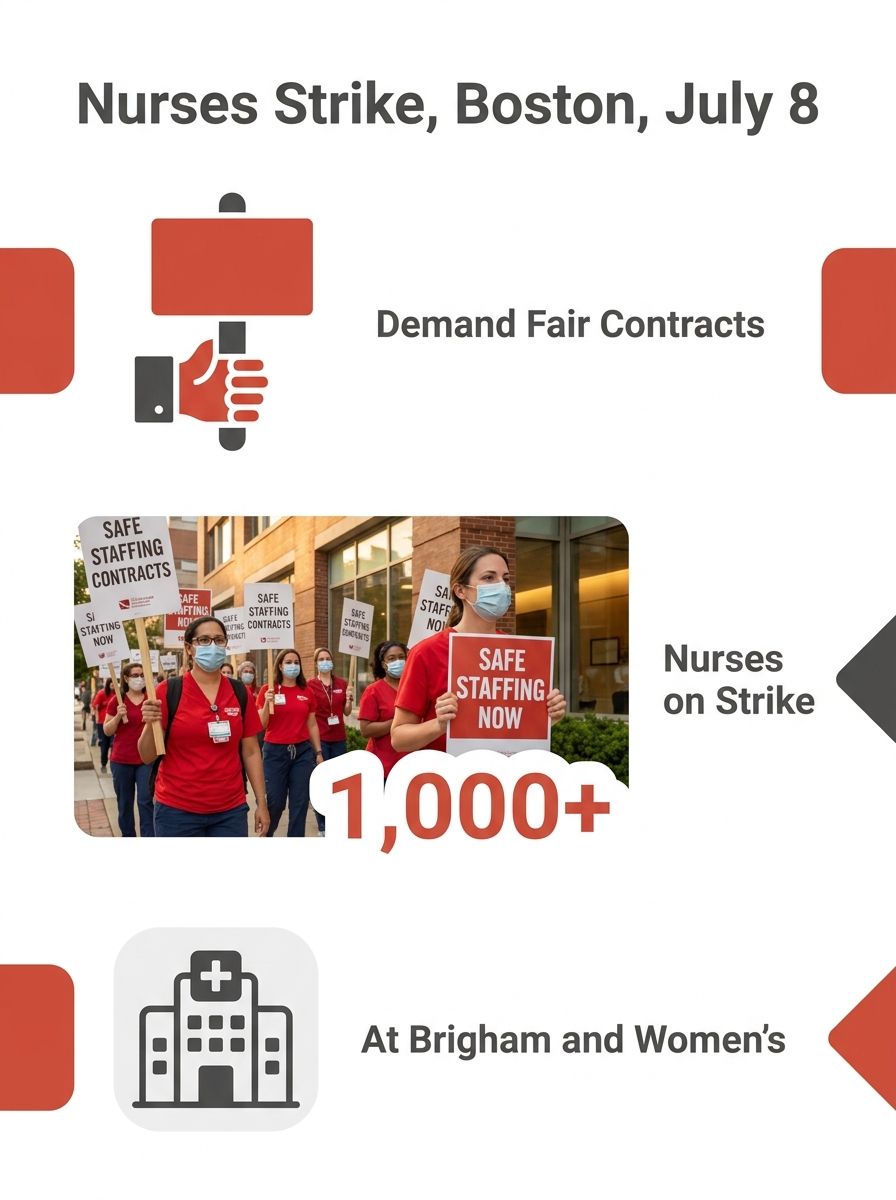
The work stoppage comes as Massachusetts nurses intensify workplace actions across multiple facilities. In late June, UMass University Campus nurses voted 99 percent to authorize a 14-day strike over staffing ratios and safety concerns, signaling broader momentum in the state's health care labor movement.
Strike Mechanics and Hospital Response
Brigham nurses will strike on July 8 and then face a four-day lockout through July 12, the union said. The lockout stems from Mass General Brigham's contractual obligation to provide temporary replacement nurses with five consecutive days of work, according to the Boston Globe. The hospital told the newspaper it has secured temporary nursing staff to maintain operations during the strike.
Separately, MGB Home Care clinicians will conduct a seven-day strike running concurrently with the Brigham action, expanding the scope of the work stoppage across the health system.
MGB board chair Scott Sperling told the Globe the hospital still seeks a negotiated settlement. "We continue to believe that the best outcome for patients, nurses, and the broader community is one achieved through continued negotiations and without a work stoppage," Sperling wrote. "The decision regarding whether to proceed with a strike rests with the MNA and its membership, and we sincerely hope that path can be avoided."
Scale and Strategic Timing
The 4,000-nurse figure represents the largest single health care facility strike in Massachusetts history, surpassing previous nursing actions at other Bay State hospitals. The timing boosts pressure on Mass General Brigham during peak summer operations, a period when temporary staffing costs typically run higher and patient volumes remain elevated.
The strike follows established patterns in high-stakes health care labor disputes, where unions use collective bargaining pressure through coordinated work stoppages at critical operational moments. The Massachusetts Nurses Association has coordinated similar actions at other MGB facilities in recent months, testing the system's capacity to sustain operations with replacement staff across multiple sites simultaneously.
The union's public emphasis on MGB's $2.4 billion net gain figure reflects a broader strategic shift in health care organizing, where labor groups increasingly frame wage demands against hospital system financial performance rather than budget constraints. This approach has gained traction in post-pandemic negotiations as nurses cite elevated workloads and retention challenges.
The Takeaway
The Brigham strike arrives at a pivotal moment for health care labor organizing in Massachusetts, where nurses are testing how much use concentrated work stoppages can generate against well-capitalized hospital systems. The Massachusetts Nurses Association's ability to mobilize 4,000 nurses at a single flagship facility, while simultaneously coordinating actions at MGB Home Care and having recently secured a 99 percent strike authorization at UMass, demonstrates organizational capacity that extends beyond isolated workplace disputes.
For union organizers beyond health care, the Brigham action offers a template for framing wage demands against employer financial strength rather than accepting austerity narratives. The MNA's public messaging strategy, anchoring wage demands to MGB's $2.4 billion annual gain rather than to abstract cost-of-living metrics, provides a clear counter-narrative that resonates with workers across sectors facing similar disconnects between employer profitability and wage stagnation.
The four-day lockout following the strike also reveals the tactical constraints hospitals face when deploying replacement workers. MGB's contractual obligation to temporary nurses creates a fixed cost and timeline that limits management flexibility, turning what might be a one-day warning strike into a week-long disruption. That dynamic shifts strike math for both sides and suggests longer work stoppages may carry less incremental cost for unions than conventional wisdom assumes.
The Union Edge Staff
Related Articles

Brigham and Women's Hospital Refuses Returning Strikers Until Monday, Extending Work Stoppage to Five Days
Brigham and Women's Hospital told approximately 4,000 striking nurses they cannot return to work until Monday morning, extending what was planned as a one-day strike to a five-day lockout, according to NBC Boston. The nurses walked off the job Tuesday and planned to end their strike at 6:59 a.m.

UMass University Campus Nurses Vote 99 Percent to Authorize 14-Day Strike Over Staffing and Safety Concerns
Registered nurses at UMass Memorial Medical Center's University Campus voted 99 percent in favor of authorizing a 14-day strike on July 1, escalating a contract dispute over staffing ratios, workplace safety, and retention issues at Massachusetts' only academic Level 1 Trauma Center, according to th

Hospital Workers Strike Over Workplace Violence as Injury Rates Hit Seven Times National Average
Hundreds of hospital workers at Henry Ford Genesys Hospital in Michigan have been on strike since September 1, 2025, with workplace violence and chronic understaffing at the center of their demands, according to NPR.
Also in the paper