
Benefits of Collective Bargaining Agreement Explained
A collective bargaining agreement (CBA) is a legally binding contract between an employer and a union that sets wages, benefits, working conditions, and dispute resolution procedures for every covered worker.

Benefits of a Collective Bargaining Agreement Explained: How the Mechanism Actually Works
A collective bargaining agreement (CBA) is a legally binding contract between an employer and a union that sets wages, benefits, working conditions, and dispute resolution procedures for every covered worker. Union members working under CBAs earn 18–20% more than non-union counterparts doing comparable work, according to the AFL-CIO, and the protections extend well beyond the paycheck into healthcare, retirement, safety, and job security.
What a Collective Bargaining Agreement Actually Is
Under Section 8(d) of the National Labor Relations Act, a CBA is the written product of mandatory negotiations between an employer and the exclusive representative of a bargaining unit. The National Labor Relations Board defines the obligation clearly: your union and employer must bargain in good faith about wages, hours, and other terms and conditions of employment until they agree on a labor contract or reach a stand-off known as "impasse."
The Office of Labor-Management Standards within the U.S. Department of Labor collects all collective bargaining agreements covering 1,000 or more workers, excluding railroads and airlines, and provides public access to these contracts. Roughly three-quarters of private-sector workers and two-thirds of public employees in the United States hold the legal right to collective bargaining, according to the AFL-CIO.
A CBA typically runs for two to five years. It covers everything from hourly pay scales and overtime rules to health insurance contributions, pension formulas, scheduling practices, safety protocols, and the step-by-step grievance process that governs workplace disputes. The contract binds both parties equally. Management cannot unilaterally change any term covered by the agreement during its duration, and workers agree to defined procedures before walking off the job.
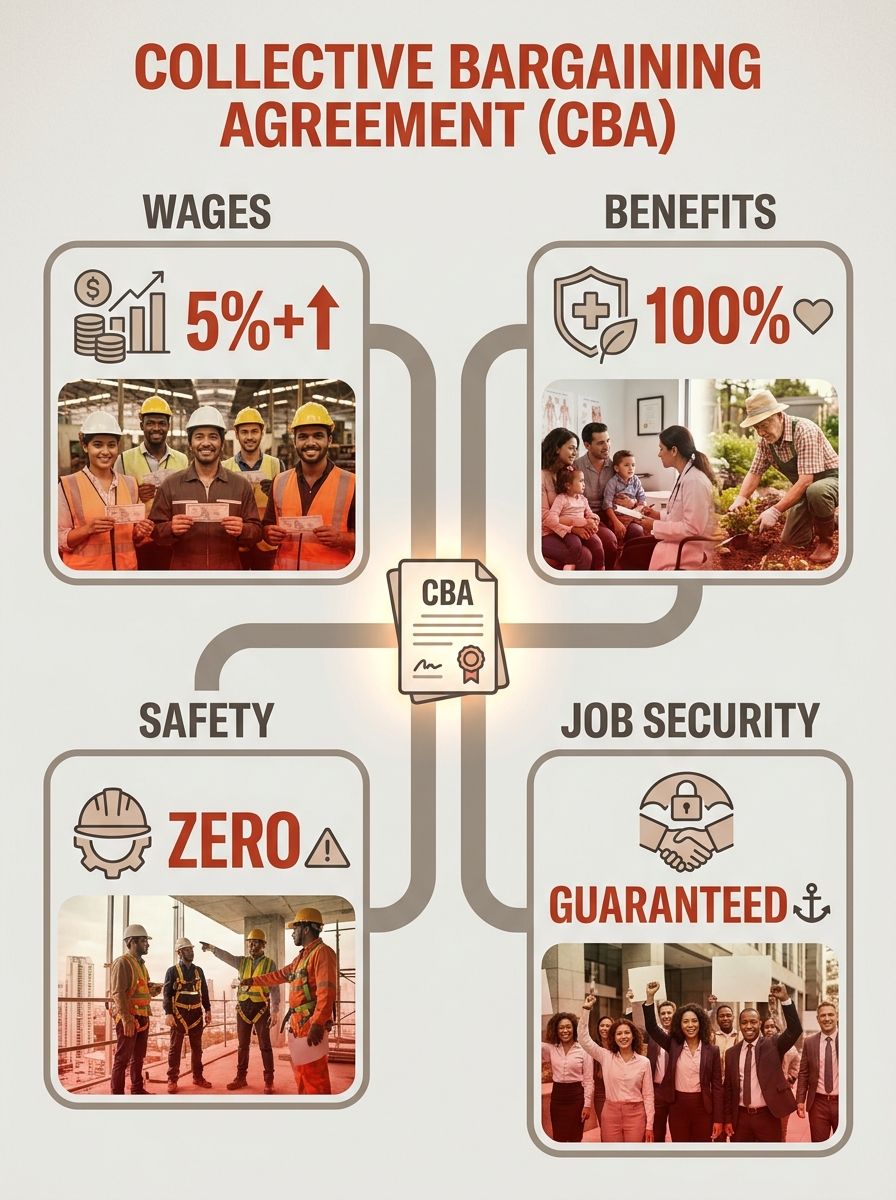
Understanding the benefits of a collective bargaining agreement requires examining each of these four mechanisms individually, because they reinforce each other in ways that single-issue negotiations cannot replicate.
The Wage Premium and How It Compounds
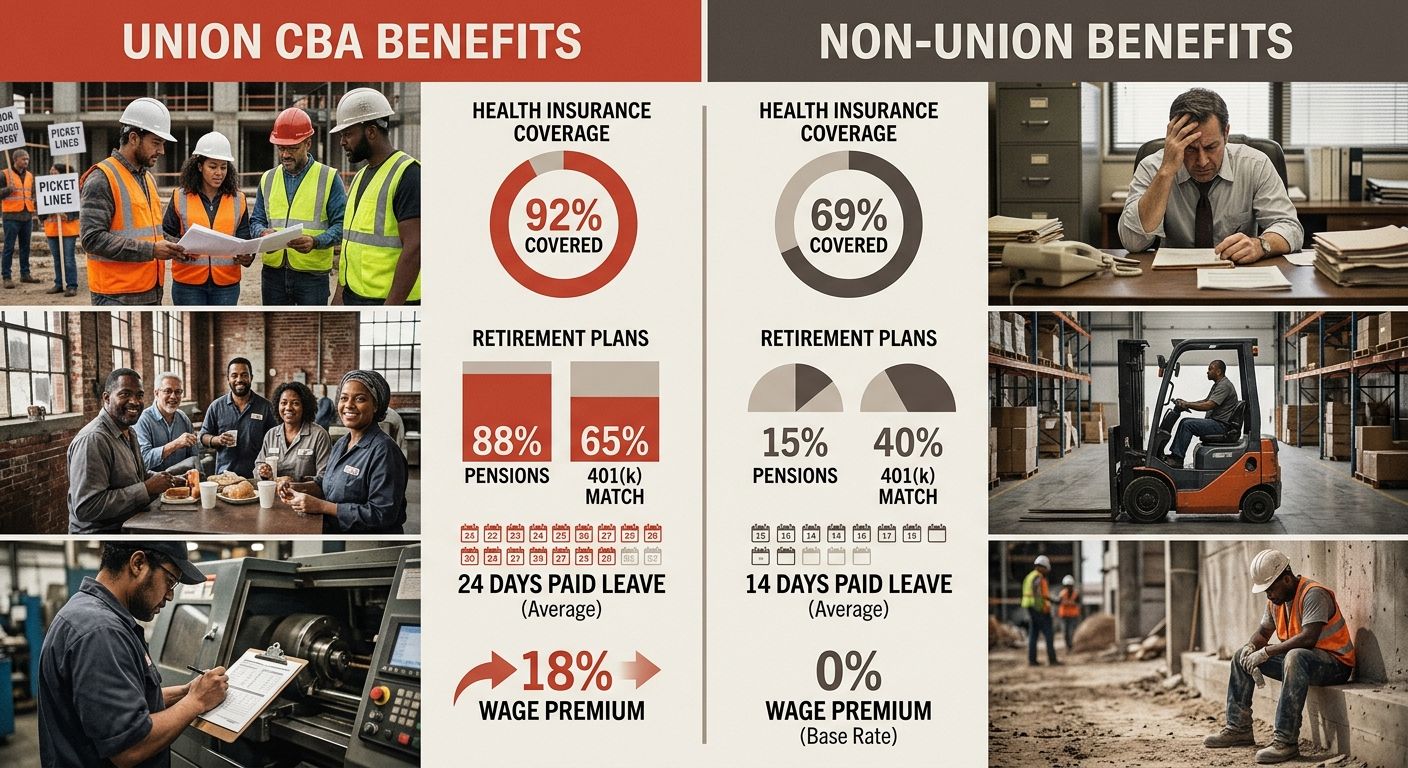
The most visible benefit of collective bargaining is the union wage premium. Workers covered by CBAs earn 18–20% more than non-union workers in comparable roles. That premium is an average; in certain industries like construction, hospitality, and healthcare, the gap runs wider. The premium compounds over a career because CBAs typically include annual step increases, cost-of-living adjustments, and defined wage scales that reward tenure.
Among workers whose contracts include cost-of-living adjustments, 91% have payments tied directly to the Consumer Price Index, which means inflation cannot silently erode purchasing power between contract cycles. Non-union workers have no comparable automatic protection. Their raises depend entirely on individual negotiations with managers who hold all the information about the company's compensation structure.
CBAs also compress wage structures within a workplace. Transparent pay scales, published in the contract and available to every member, reduce disparities across gender, race, and employment type. When everyone can see what the job pays at each step, favoritism and unconscious bias have fewer places to hide. Research cited by the AFL-CIO indicates that declining unionization accounts for roughly 35% of the drop in mean hourly wages between 1980 and 2010, a finding that reflects how strong union presence in a region or industry raises non-union wages through competitive pressure.
This "spillover effect" matters for workers beyond the bargaining unit. When a hospital's unionized nurses negotiate a $38-per-hour floor, the hospital's non-union techs and administrative staff often see their wages adjusted upward to prevent turnover. The CBA sets a local standard that radiates outward, which is why the benefits of collective bargaining agreement protections extend to communities, not just card-carrying members. We've seen this dynamic play out in recent healthcare contract fights, including situations where hospital workers have struck over unsafe conditions and pay that affected union and non-union staff alike.
Health Insurance, Retirement, and the Benefits Package
CBAs lock employer contributions to health insurance and retirement plans into enforceable contract language. The difference between a CBA benefit and a company-announced benefit is enforceability: an employer can change or cancel a non-union benefit plan with a memo to HR, but altering a CBA benefit requires returning to the bargaining table and securing union agreement.
Union members are 18% more likely to receive employer-sponsored health insurance than non-union workers. They are also significantly more likely to have defined-benefit pension plans rather than defined-contribution 401(k) plans. The distinction matters because a defined-benefit pension guarantees a monthly payment in retirement regardless of stock market performance, while a 401(k) shifts all investment risk onto the individual worker.
The U.S. Department of Labor's Fact Sheet 85 on collective bargaining agreements under the Service Contract Act illustrates another layer of protection: when a federal service contract changes hands, the successor contractor cannot pay employees less than the wages and fringe benefits set forth in the predecessor's CBA, even if the area-wide wage determination for that locality contains lower rates. Section 4(c) of the Service Contract Act is self-executing, meaning it applies automatically without any worker having to file a claim. The CBA follows the work, protecting workers even when their employer changes.
Beyond insurance and pensions, CBAs routinely secure paid sick leave, paid family leave, vacation accrual schedules, bereavement leave, and tuition reimbursement. Each of these provisions appears as contract language with specific dollar amounts, eligibility dates, and enforcement mechanisms. When a manager denies a benefit the contract guarantees, the grievance procedure kicks in immediately.
Just Cause Protection and the Grievance Machine
Perhaps the most structurally significant benefit of a collective bargaining agreement is the shift from at-will employment to just-cause protection. In an at-will arrangement, which covers the vast majority of non-union American workers, an employer can terminate someone for any reason or no reason, as long as it doesn't violate specific anti-discrimination statutes. Under a CBA, the employer must demonstrate just cause for discipline or termination, meaning documented reasons that follow progressive discipline procedures spelled out in the contract.
The grievance procedure is the enforcement engine. A typical CBA grievance process has three to four steps: an informal discussion between the worker and supervisor, a written grievance filed with the union steward, escalation to higher management and union leadership, and final binding arbitration before a neutral third-party arbitrator. The arbitrator's decision is enforceable in federal court.
This structure matters because it removes the power asymmetry that defines individual employment disputes. A single worker challenging a termination faces the company's legal department alone. A grievance filed under a CBA carries the institutional weight of the union, its legal counsel, and decades of arbitration precedent. We reported on exactly this dynamic when Boeing engineers rejected a contract offer and authorized strike action because the proposed terms failed to meet the standards their bargaining unit demanded.
Just-cause protection also shapes employer behavior before disputes arise. Supervisors who know that every termination decision can be challenged through binding arbitration tend to document more carefully, apply rules more consistently, and think twice before retaliating against workers who raise safety concerns or file complaints.
Workplace Safety Standards Above the Legal Floor
Joint labor-management safety committees appear in 29% of large private-sector CBAs, and those committees set enforceable safety standards that exceed federal OSHA minimums. OSHA establishes a regulatory floor, but the agency inspects only a fraction of American workplaces each year. A CBA safety committee meets regularly, conducts walkthroughs with worker representatives who know the actual hazards, and can trigger contractual remedies when management fails to correct dangerous conditions.
The right to refuse unsafe work, which exists in limited form under OSHA regulations, becomes significantly stronger when written into a CBA. Contract language can specify exact procedures for reporting hazards, define timelines for employer response, prohibit retaliation for safety complaints, and establish paid time for safety training. The contract converts vague legal rights into specific, enforceable obligations with defined consequences.
The connection between bargaining power and physical safety is most visible in high-hazard industries. When Encore Boston Harbor workers authorized a strike, working conditions and safety staffing levels were central bargaining demands alongside wages. And healthcare workers have documented injury rates hitting seven times the national average in facilities where workplace violence protections were inadequate, driving those bargaining units to demand stronger contractual safety standards.
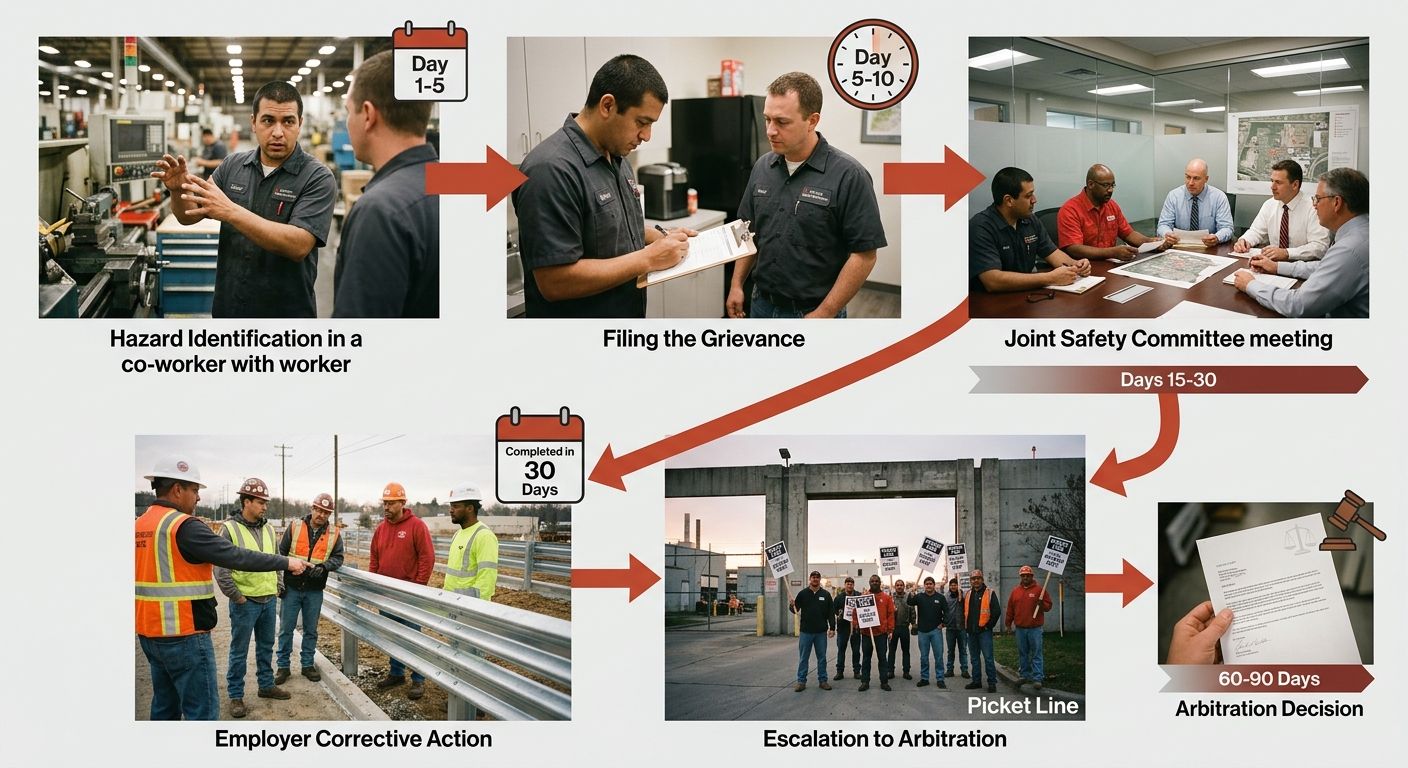
Safety provisions in CBAs also create documentation trails. Every reported hazard, committee meeting, and corrective action gets recorded. These records protect workers in future disputes and provide evidence for OSHA investigations. The CBA turns safety from a management-controlled initiative into a shared governance structure where workers have equal authority to identify and address risks.
Where the CBA Model Breaks Down
The collective bargaining mechanism has real structural limitations that organizers and workers should understand clearly.
Coverage gaps are enormous. Union density in the American private sector sits at roughly 6%, meaning 94% of private-sector workers have no CBA protections at all. The legal framework that supports collective bargaining has eroded steadily since the Taft-Hartley Act of 1947, and right-to-work laws in more than half of U.S. states allow workers in bargaining units to opt out of paying dues while still receiving CBA benefits, which weakens the union's financial capacity to negotiate and enforce contracts.
First contracts are brutally difficult to win. Winning a union election is only the first step. Employers frequently stall first-contract negotiations for months or years, using legal delays to demoralize the new bargaining unit. Workers who voted for representation can wait 18 months or longer before seeing any contractual benefit, and some units never reach a first agreement at all.
Gig economy and independent contractor classifications exclude millions. Workers classified as independent contractors have no right to collective bargaining under the NLRA. The growth of app-based work, freelance arrangements, and misclassification schemes has placed a growing share of the workforce outside the CBA model entirely. States like California and New Jersey have moved to tighten gig worker classification rules, but federal law still leaves major gaps.
Industry-specific rigidity can emerge. A poorly negotiated CBA can lock in suboptimal terms for the full contract duration. Seniority-based systems, while protecting against favoritism, can also create friction for newer workers who feel trapped at the bottom of a rigid pay scale. And some CBAs have historically failed to address emerging issues like algorithmic management, remote work policies, and climate-related workplace hazards until contract reopener windows arrive years later.
Employer retaliation remains common despite being illegal. The NLRB's enforcement capacity is limited. Unfair labor practice charges take months to resolve, and the penalties for illegal retaliation are weak enough that many employers treat them as a cost of doing business rather than a genuine deterrent.
None of these limitations negate the measured benefits of collective bargaining agreements. They define the boundaries of the mechanism and highlight where policy reform, creative organizing strategies, and new legal frameworks are needed to extend CBA-like protections to the millions of workers currently excluded.
Common Questions
Do CBAs only benefit union members?
CBAs directly cover every worker in the defined bargaining unit, whether or not they are dues-paying union members. Beyond the unit itself, strong CBAs create a spillover effect that raises wages and standards for non-union workers in the same industry and geographic area. Employers competing for labor against unionized shops often match CBA wage floors to retain staff. Research shows that declining unionization accounts for about 35% of the drop in mean hourly wages between 1980 and 2010.
Can an employer change CBA terms during the contract period?
An employer cannot unilaterally modify any term covered by the CBA while the agreement is in force. Changes require mutual agreement through the bargaining process. If management violates a contract provision, the union can file a grievance and escalate through binding arbitration. Under the Service Contract Act's Section 4(c), even a successor employer taking over a federal service contract must honor the predecessor's CBA wage and benefit rates.
How long does it take to negotiate a first CBA after a union election?
Timelines vary widely, but first-contract negotiations frequently take 12 to 24 months. Employer delay tactics are common, and the NLRB's enforcement mechanisms move slowly. Some bargaining units reach agreement within six months when both parties engage in good faith. Others face years of stalling. Workers should prepare for a sustained effort and maintain organizing momentum throughout the negotiation period.
What happens when a CBA expires?
When a CBA expires, most of its terms remain in effect as the status quo until a new agreement is ratified or the parties reach genuine impasse. The employer cannot simply revert to pre-contract conditions on the expiration date. The duty to bargain in good faith continues, and workers retain their union representation rights throughout the negotiation of a successor contract.
Are there workers who can't get CBA protections?
Independent contractors, agricultural workers, domestic workers, and supervisors are excluded from the NLRA's collective bargaining protections. Public-sector workers' rights vary by state, with some states granting full bargaining rights and others prohibiting public-sector unions entirely. Gig workers classified as independent contractors have been a major battleground, with several states moving to reclassify them as employees eligible for collective bargaining.
The Union Edge Staff
Frequently Asked Questions
- How much more do union workers earn compared to non-union workers?
- Union workers covered by collective bargaining agreements earn 18–20% more than non-union workers doing comparable work, according to the AFL-CIO. This wage premium compounds over a career through annual step increases, cost-of-living adjustments, and defined wage scales that reward tenure.
- What is just-cause protection in a collective bargaining agreement?
- Just-cause protection shifts employment from at-will arrangements to a system where employers must demonstrate documented reasons for discipline or termination following progressive discipline procedures. Workers can challenge termination decisions through a binding grievance arbitration process enforced in federal court.
- Do collective bargaining agreements protect benefits like health insurance and pensions?
- Yes, CBAs lock employer contributions to health insurance and retirement plans into enforceable contract language. Union members are 18% more likely to have employer-sponsored health insurance and significantly more likely to have defined-benefit pension plans that guarantee monthly retirement payments regardless of stock market performance.
- How long does a collective bargaining agreement typically last?
- A CBA typically runs for two to five years and covers wages, hours, health insurance, pensions, safety protocols, scheduling practices, and grievance procedures. Once in effect, an employer cannot unilaterally change any term covered by the agreement during its duration.
- What percentage of private sector workers are covered by collective bargaining agreements?
- Union density in the American private sector sits at roughly 6%, meaning 94% of private-sector workers have no CBA protections. However, roughly three-quarters of private-sector workers and two-thirds of public employees have the legal right to collective bargaining.
- How do collective bargaining agreements improve workplace safety?
- Joint labor-management safety committees in 29% of large private-sector CBAs set enforceable safety standards that exceed OSHA minimums. CBAs specify procedures for reporting hazards, define timelines for employer response, prohibit retaliation for safety complaints, and establish paid time for safety training with documented records.
- How long does it take to negotiate a first collective bargaining agreement after a union election?
- First-contract negotiations frequently take 12 to 24 months, with employer delay tactics being common. Some bargaining units reach agreement within six months with good faith engagement, while others face years of stalling before securing their first contract.
- Do non-union workers benefit from collective bargaining agreements?
- Yes, strong CBAs create a spillover effect that raises wages and standards for non-union workers in the same industry and geographic area. Employers competing for labor against unionized shops often match CBA wage floors to retain staff, and research shows declining unionization accounts for roughly 35% of the drop in mean hourly wages between 1980 and 2010.
Related Articles

Collective Bargaining Agreement Contracts: A Guide
A collective bargaining agreement contract is the legally binding document that sets wages, benefits, hours, and working conditions between a union and an employer, protected under Section 7 of the National Labor Relations Act.

Examples of Collective Bargaining Success
At nearly 3am on November 25, 2024, graduate workers at the University of Minnesota and university administrators finalized a tentative first collective bargaining agreement after more than 30 hours of continuous mediation over two days, according to UE News.

Binding Arbitration vs. Strike Rights: Which Dispute Resolution Path Better Protects Healthcare Workers?
The Ontario Hospital Association has not freely negotiated a contract with hospital nurses in more than fifteen years, relying on binding arbitration to set terms for roughly 62,000 workers.
Also in the paper