
Examples of Collective Bargaining Success
At nearly 3am on November 25, 2024, graduate workers at the University of Minnesota and university administrators finalized a tentative first collective bargaining agreement after more than 30 hours of continuous mediation over two days, according to UE News.

How Graduate Workers Won Their First Contract at 3am — and What It Proves About Bargaining
At nearly 3am on November 25, 2024, graduate workers at the University of Minnesota and university administrators finalized a tentative first collective bargaining agreement after more than 30 hours of continuous mediation over two days, according to UE News. The deal arrived one day before a scheduled strike authorization vote.
The Minnesota case is one of the strongest examples of collective bargaining in recent years because every obstacle that usually kills a first contract was present: a sprawling public employer, workers spread across dozens of departments, and an administration that had stalled for months. What made it succeed deserves close study. Among full-time workers nationally, union members earned 18% more per week on average than non-union workers in 2022, according to the Bureau of Labor Statistics. But getting to a first contract is where the hardest fight lives, and most new units never clear that bar.
UE and the Problem of Organizing Across Departments
Graduate workers at large public universities face a particular structural challenge when they try to organize. Teaching assistants, research assistants, and graduate instructors work in silos. They report to different faculty advisors. Their pay scales vary by department. Their funding sources range from state appropriations to federal grants to private endowments. Building a single bargaining unit out of these fragmented workplaces requires organizers to map every department individually, identify leaders in each one, and create communication systems that connect workers who might never cross paths on campus.
The University of Minnesota's graduate workers chose UE (United Electrical, Radio and Machine Workers of America) as their representative. UE has long experience with decentralized workforces, and this mattered. The union's organizing model pushes decision-making down to rank-and-file members instead of concentrating power in paid staff. For a bargaining unit where every chemistry lab, English seminar, and engineering workshop has its own culture, that model fit.
Recognition came after a sustained card-signing campaign, but as anyone familiar with how collective bargaining agreements get structured knows, winning recognition is the beginning, not the end. The university acknowledged the union. Then the real clock started ticking.
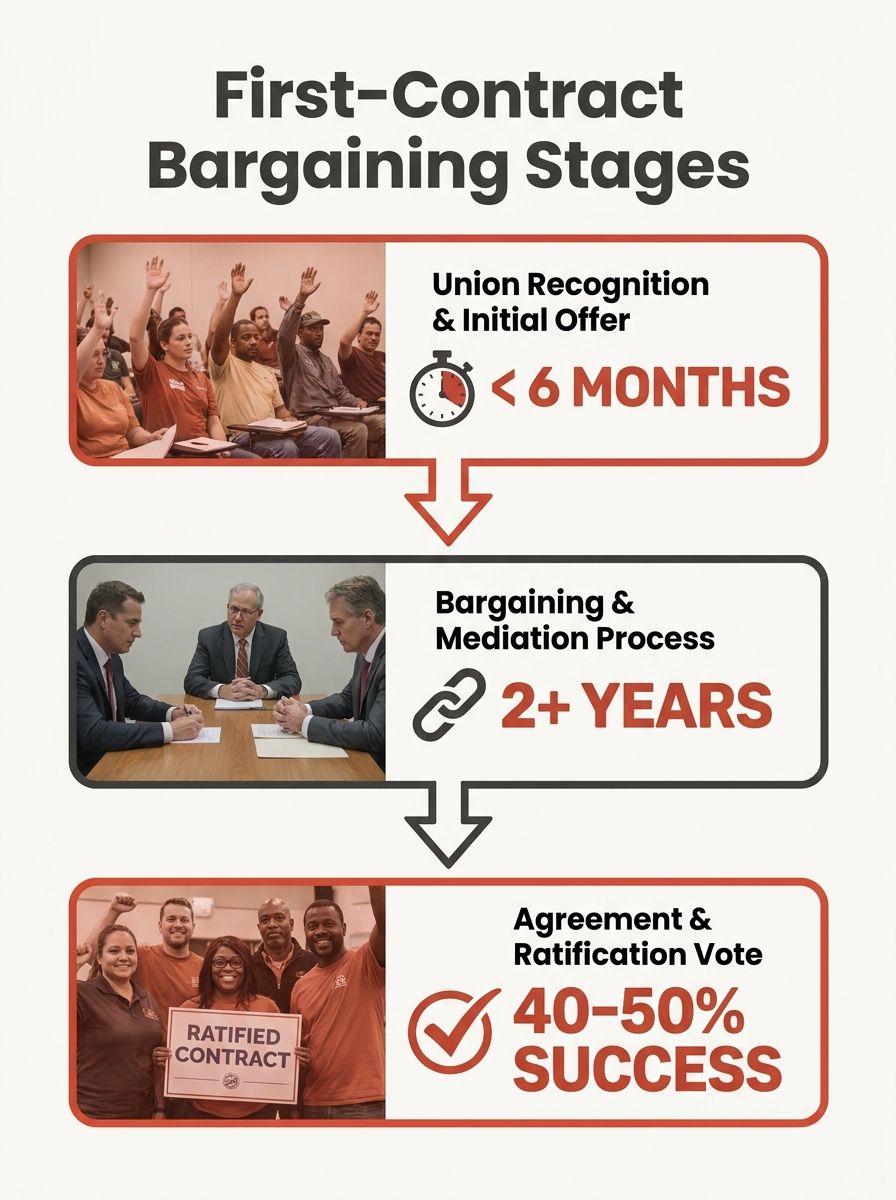
By 2024, the national picture gave these workers reason for both hope and urgency. Workers won 72% of union representation elections in 2022, and 71% of Americans expressed support for unions in polling. But first contracts remained the chokepoint. Research on private-sector bargaining from the Office of Justice Programs has documented how employers use delay as a strategy, dragging out negotiations until worker enthusiasm fades. The Minnesota administration followed this script almost perfectly.
Thirty Hours at the Mediation Table
Negotiations stalled through much of 2024. The university's bargaining team moved slowly on core economic issues: wages, benefits, workload protections. Graduate worker bargaining committees reported that sessions felt performative, with management presenting proposals that addressed minor procedural items while sidestepping pay.
The breakthrough only came when a mediator entered the picture and both sides committed to marathon sessions. Over two consecutive days, the bargaining committee and administration representatives sat across from each other and worked through issue after issue. Thirty hours of continuous mediation is grueling under any circumstances. For graduate workers who were simultaneously teaching classes, grading papers, and conducting research, the physical and mental toll was enormous. UE reported that bargaining committee members were "left exhausted after a grueling two days of mediation, but held their heads high."
This kind of bargaining marathon is common in high-stakes negotiations, and it reveals something important about power dynamics. Employers with full-time labor relations staff can rotate fresh negotiators into the room. Workers, by contrast, often rely on the same small committee members for every session. The stamina required from rank-and-file bargainers is a hidden cost that rarely gets discussed. Unions that prepare members for this reality, including through strike fund planning and readiness protocols, give their committees a critical advantage.
The Minnesota committee pushed through. By 2:30am on November 25, the outlines of a deal had taken shape. By nearly 3am, both sides had a tentative agreement on the table.
The Strike Authorization Deadline
The timing of the deal was no accident. A strike authorization vote had been scheduled for the very next day. This detail matters enormously, because it shows the mechanism that actually forced the university to bargain seriously.
Strike action is a collective protest by workers who cease work to negotiate with employers, typically for better wages and improved working conditions, as EBSCO research defines it. But a strike authorization vote does work even before a single worker walks off the job. The vote itself is a signal. It tells management that the workforce is unified enough to absorb the costs of a stoppage. For a university that depends on graduate labor to run hundreds of courses every semester, the threat of a mid-year walkout represents a direct operational crisis.
The Minnesota case follows a pattern visible across other recent collective bargaining examples. The UAW's negotiations at AM General produced what the union called its strongest contract in decades. Dave Green, UAW Region 2B Director, said: "We won a contract that not only makes no concessions to the company, but delivers incredibly strong wage and pension increases for the membership," according to UAW's announcement. At UPS, Teamsters President Sean O'Brien described the 2023 deal as "the best contract in the history of UPS," a deal that secured air-conditioned vehicles and protections against forced overtime. United Airlines pilots won raises of up to 40% over four years.
In each of these cases, the employer moved meaningfully at the table only after workers demonstrated genuine willingness to strike. The lesson from Minnesota and these parallel fights is blunt: employers respond to economic pressure. Polite requests don't move management. Credible threats to operations do.
This is why the history of American labor is inseparable from the history of strike action. Steelworkers in the early 20th century fought for the eight-hour day and the right to bargain collectively. Their tools were the same ones graduate workers used in Minneapolis in 2024: solidarity, organization, and the willingness to withdraw their labor.
What the Contract Delivered
While the full terms of the Minnesota agreement haven't been broken down in public reporting to the same degree as some private-sector deals, the significance of reaching any first contract at a large public university can't be overstated. Most new bargaining units that fail to secure a first contract within two years of recognition lose momentum permanently. The Minnesota workers beat that clock.
The broader landscape puts their achievement in context. An AFL-CIO report from May 2026 documented a wave of landmark agreements that delivered an average raise of 11.5%, additional annual wage increases, student debt support, and fully employer-paid health insurance premiums. IATSE members at 2K's motion capture studio in Petaluma, California, ratified their own first collective bargaining agreement, covering workers behind titles like NBA 2K and WWE 2K. SEIU Local 32BJ has negotiated agreements for roughly 75,000 commercial cleaners across the East Coast, binding employers in New York, Philadelphia, and Miami to consistent standards.
Each of these is a concrete example of collective bargaining producing measurable gains. But the Minnesota contract carries a specific symbolic weight because graduate workers have long been told they aren't "real" workers. They're students, the argument goes. They're apprentices learning a trade. They should be grateful for their stipends. The university used variations of this framing throughout negotiations. Winning a binding contract rejected that framing in the most concrete way possible: by producing a legal document that treats graduate workers as employees with enforceable rights.
The contract also established grievance procedures, which research has consistently identified as one of the most valuable features of any collective bargaining agreement. Cornell labor economist Harry C. Katz has noted that unions provide a critical "voice" in discipline and work organization. Without grievance procedures, a graduate worker who faces retaliation from a faculty advisor has limited recourse. With them, there's a formal process, a paper trail, and representation.
Minnesota as a First-Contract Blueprint
The Minnesota case offers a template that other graduate worker unions and newly organized units in any sector can study. The elements that made it work are replicable:
Department-by-department organizing that built a majority in a fragmented workplace, rather than relying on a single mass rally or petition
A union structure (UE's rank-and-file model) that matched the workplace, distributing authority to the people who understood each department's specific conditions
Marathon mediation willingness, with bargaining committee members prepared for the physical reality of 30-hour sessions
A strike authorization vote timed to create genuine operational pressure on the employer
Rejection of the "you're not real workers" frame through the act of bargaining itself
The broader pattern is unmistakable. Whether it's graduate workers in Minneapolis, autoworkers at AM General, motion capture performers in Petaluma, or warehouse workers at UPS, the same sequence produces results: organize, bargain hard, demonstrate strike readiness, and refuse to accept an employer's timeline.
Federal workers facing their own bargaining challenges should pay attention. The push for expanded federal bargaining rights draws on the same principle that powered the Minnesota victory: workers with a credible voice at the table get better outcomes than workers who rely on management's goodwill.
None of this happened because administrators woke up generous at 2am. It happened because workers organized well enough that the university's calculus changed. The cost of settling became lower than the cost of a strike. That math is the engine behind every successful collective bargaining example in the historical record, and it ran exactly as expected in Minneapolis on November 25, 2024. The graduate workers who walked out of that room at 3am, bleary-eyed and drained, had built something their university can't take back: a contract that proves the model works.
The Union Edge Staff
Related Articles

5 First-Contract Bargaining Mistakes That Destroy New Unions — and How to Recover From Them
Workers at The New Yorker, Pitchfork, and Ars Technica voted to join the NewsGuild of New York in 2018. Their first contract didn't arrive until June 2021.

From First Contact to First Contract: The Hidden Gaps in Union Organizing Timelines and How to Navigate Them
Winning a union election takes weeks. Reaching a first contract takes 465 days on average, according to Bloomberg Law's analysis of federal labor databases.

University of California Averts Strike With Last-Minute Deal for 40,000 Healthcare Workers
The University of California and AFSCME Local 3299 reached a tentative labor agreement late on May 13, preventing a planned strike by more than 40,000 healthcare and service workers hours before a May 14 walkout deadline, according to Bloomberg Law. The deal secures minimum wage increases to $30.10
Also in the paper