
Binding Arbitration vs. Strike Rights: Which Dispute Resolution Path Better Protects Healthcare Workers?
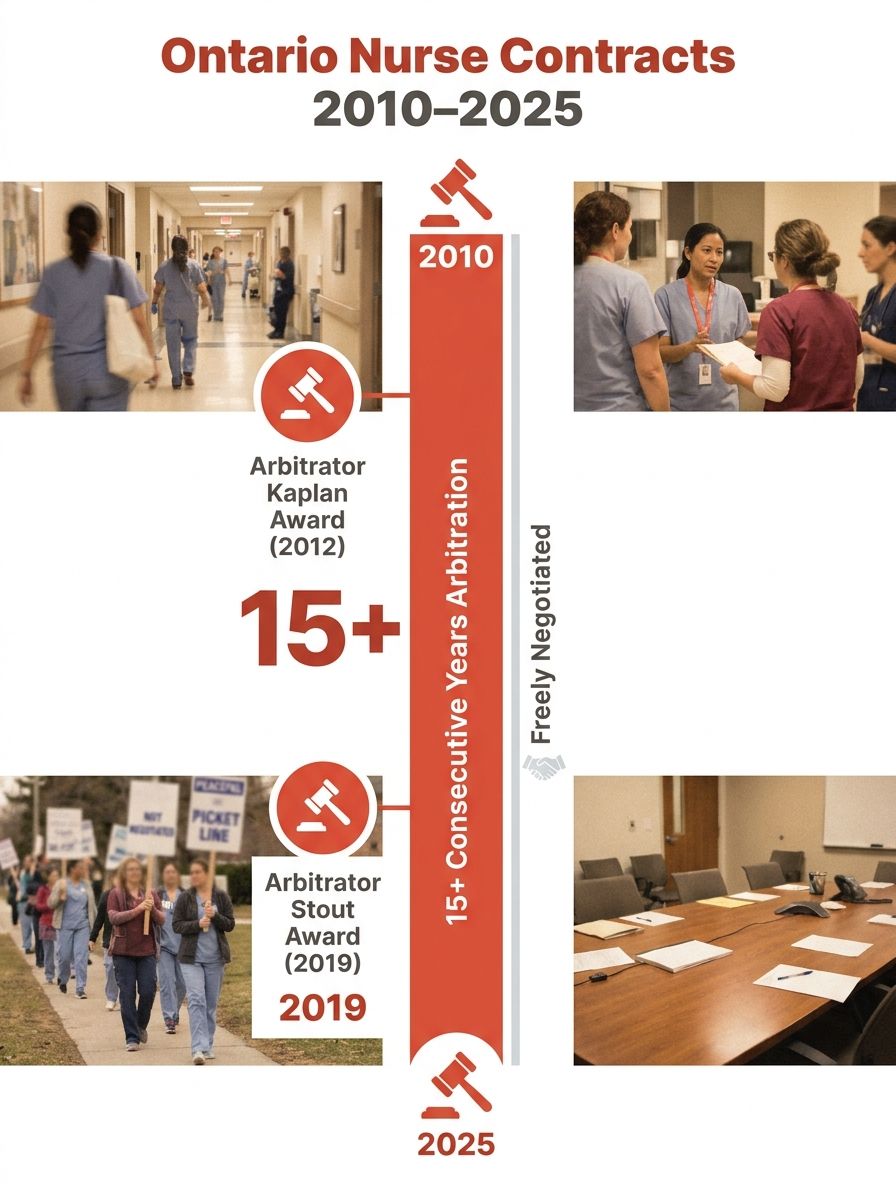
The Ontario Hospital Association has not freely negotiated a contract with hospital nurses in more than fifteen years, relying on binding arbitration to set terms for roughly 62,000 workers.

Binding Arbitration vs. Strike Rights: Which Dispute Resolution Path Better Protects Healthcare Workers?
The Ontario Hospital Association has not freely negotiated a contract with hospital nurses in more than fifteen years, relying on binding arbitration to set terms for roughly 62,000 workers. That record illustrates the central divide in healthcare labor disputes: binding arbitration healthcare conflicts resolve quietly, but healthcare worker strike rights remain the sharper instrument for winning meaningful economic gains and public accountability.
The Fifteen-Year Stalemate in Ontario
Why has Ontario become the defining case study for interest arbitration in healthcare? Because the province stripped hospital nurses of strike rights decades ago, replaced them with mandatory binding arbitration, and the results have played out over a generation.
The Ontario Nurses' Association described the consequences directly in their constitutional challenge announcement: the Ontario Hospital Association "has failed to meaningfully bargain with a solution-focused approach to enter a freely negotiated settlement with hospital nurses in more than 15 years." Binding arbitration, the ONA said, "has been the relied-upon method of choice sought by these employers, shutting down open communication and a collaborative interest-based approach to collective bargaining."
On September 3, 2025, Arbitrator Sheri Price and nominees Philip Abbink (ONA) and Brett Christen (OHA) issued a provincial interest arbitration award covering approximately 62,000 nurses across participating hospitals. The award settled "provincial terms" of collective agreements — wages, benefits, scheduling language — that the two sides could not agree on at the table. By April 17, 2025, the same arbitration panel had already been convened for additional disputes in the ongoing bargaining cycle.
The pattern is instructive. When employers know a neutral third party will eventually impose terms, the incentive to bargain genuinely collapses. Hospital management in Ontario has essentially outsourced its labor relations to arbitrators for a generation. Nurses get a contract. But they get it on terms shaped by an arbitrator's reading of comparators and precedent, not by the economic pressure nurses could apply through withholding their labor.
This is the fundamental problem with interest arbitration as a long-term dispute resolution mechanism: it works as a safety valve, but when it becomes the default, the bargaining relationship atrophies. And once that atrophy sets in, reversing it requires something dramatic — like a constitutional challenge.
When Employers Weaponize Healthcare Coverage Against Strikers
The threat of losing health insurance is the single most powerful deterrent employers hold over healthcare workers considering a strike. Some employers have been willing to deploy it explicitly.
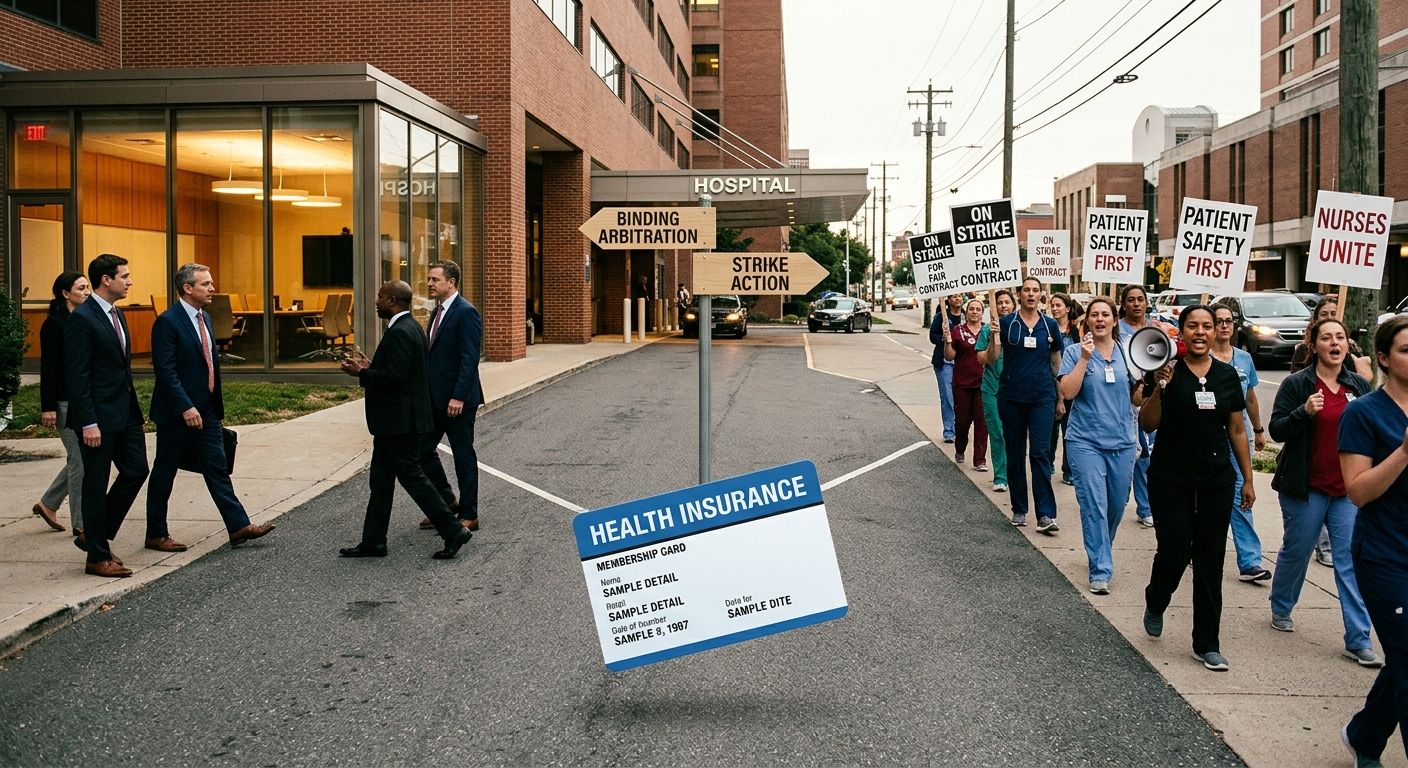
PeaceHealth, a major hospital system operating across Washington, Oregon, and Alaska, was barred from threatening to revoke health insurance from workers who engaged in strike activity. The Washington State Nurses Association filed an unfair labor practice charge in October 2023 after PeaceHealth made those threats during a period of union activity. As a condition of the settlement, PeaceHealth was required to post an official signed notice by April 15 in every facility across all three states, listing workers' rights under the National Labor Relations Act and stating the company would not threaten workers' health insurance benefits for engaging in union activity, including striking.
The PeaceHealth case exposes a structural vulnerability in nurse contract disputes across the United States. Under current law, employers can legally terminate health coverage for striking workers in many circumstances. The threat alone functions as a de facto no-strike clause, even when the actual contract doesn't contain one. Workers who are themselves healthcare providers face the particular cruelty of potentially losing access to the very system they staff.
This is where the debate over healthcare worker strike rights gets concrete. You can have a legal right to strike on paper, but if exercising that right means your family loses medical coverage the day you walk out, the right is hollow. Employers who understand that dynamic have little reason to make serious offers at the bargaining table — they know the strike threat carries less weight than it should.
The NLRB's enforcement action against PeaceHealth was significant because it drew a line: threatening coverage loss as retaliation for protected activity violates the NLRA. But the ruling addressed threats, not the actual practice of coverage termination during a lawful strike. The gap between those two things is enormous, and it shapes every nurse contract dispute where a strike is on the table.
The Legislative Push to Close the Coverage Gap
Recognition of this gap pushed federal lawmakers to act. Senators Sherrod Brown (D-OH) and Bob Casey (D-PA) introduced the Striking Workers Healthcare Protection Act, which would require employers to continue providing health insurance to workers exercising their right to strike. Senator Alex Padilla (D-CA) introduced companion legislation, framing the revocation of health coverage during strikes as economic coercion that undermines the collective bargaining process.
The legislation hasn't passed. But its introduction marks an important shift in how Congress frames the relationship between binding arbitration healthcare disputes and strike activity. The implicit argument: if you want workers to have a genuine choice between arbitration and economic action, you can't let employers punish one path so severely that it ceases to be a real option.
For healthcare workers navigating a collective bargaining impasse, the coverage question often determines which dispute resolution path their union pursues. A union representing 500 nurses, many of whom have children on employer-sponsored plans, faces an existential calculation when strike authorization comes up. If the Striking Workers Healthcare Protection Act were law, that calculation changes dramatically. The strike becomes a credible threat again, which paradoxically makes it less likely to happen — credible threats produce better pre-strike offers and genuine engagement at the bargaining table.
The NLRA's Special Rules Tilting the Scale
The National Labor Relations Act treats healthcare differently from every other industry, and those differences shape the arbitration-versus-strike calculus in specific, measurable ways.
Under Section 8(d) of the NLRA, healthcare employers face a 90-day notice requirement before contract expiration, compared to 60 days for other industries. Healthcare unions must give 10 days' advance notice before striking. The statute requires notice to federal and state mediators within 30 days for most employers, but extends that window to 60 days for healthcare employers. An employer who initiates contract modification without providing proper mediator notice cannot legally lock out employees.
These extended timelines were designed to protect patients, and that's a legitimate concern. But they also give healthcare employers more runway to prepare contingency staffing, hire temporary replacements, and launch anti-union communications campaigns that erode strike support during the mandatory waiting period. The 10-day strike notice requirement, unique to healthcare, eliminates the element of surprise that gives work stoppages their economic bite in other industries.
The result is a system tilted toward arbitration by design. When the legal framework makes strikes slower to execute, easier to prepare for, and potentially devastating to workers' own insurance coverage, binding arbitration starts to look like the only practical path — even when it produces weaker outcomes year after year, as Ontario demonstrates.
Understanding when a collective bargaining impasse has actually been reached matters enormously here. As labor law experts at Kauff McGuire & Margolis have noted, impasse is evaluated issue by issue: "you may be bargaining wages, hours, and health insurance. If you are at loggerheads on health insurance, yet the other issues are still in negotiation, that generally does not mean there is an impasse." Employers who declare impasse prematurely can face unfair labor practice charges, a dynamic we've covered in our guide to filing ULP charges.
Two Paths Compared
The choice between binding arbitration and strike action involves tradeoffs that shift depending on the size of the bargaining unit, the state's legal framework, and the specific issues in dispute.
Factor | Binding Arbitration | Strike Action |
|---|---|---|
Time to Resolution | 6–20 months depending on complexity | Weeks to months, but preceded by 90-day notice period for healthcare |
Cost to Workers | Low direct cost; employer often pays arbitrator fees | High — lost wages, potential insurance loss, legal expenses |
Long-Term Bargaining Power | Diminishes over time; Ontario's 15-year record illustrates this | Strengthens if credible; a strike threat alone often produces better offers |
Public Visibility | Private proceedings; no public record or media pressure | High visibility; community and patient awareness creates political leverage |
Precedent Effect | Awards are private; no binding precedent for future rounds | Successful strikes set de facto industry standards |
Risk to Employment | Minimal — workers remain on the job throughout | Employers can hire permanent replacements during economic strikes |
Patient Safety Framework | Employers prefer it on patient safety grounds | 10-day notice requirement allows hospitals to arrange coverage |
RAND's research has found that binding arbitration is not frequently used to resolve healthcare disputes in the U.S. context, even as anecdotal evidence suggests health plans and providers are increasingly turning to alternative dispute resolution. Ontario's mandatory system, where arbitration is the sole mechanism for 62,000 nurses, remains an outlier — and a cautionary one.
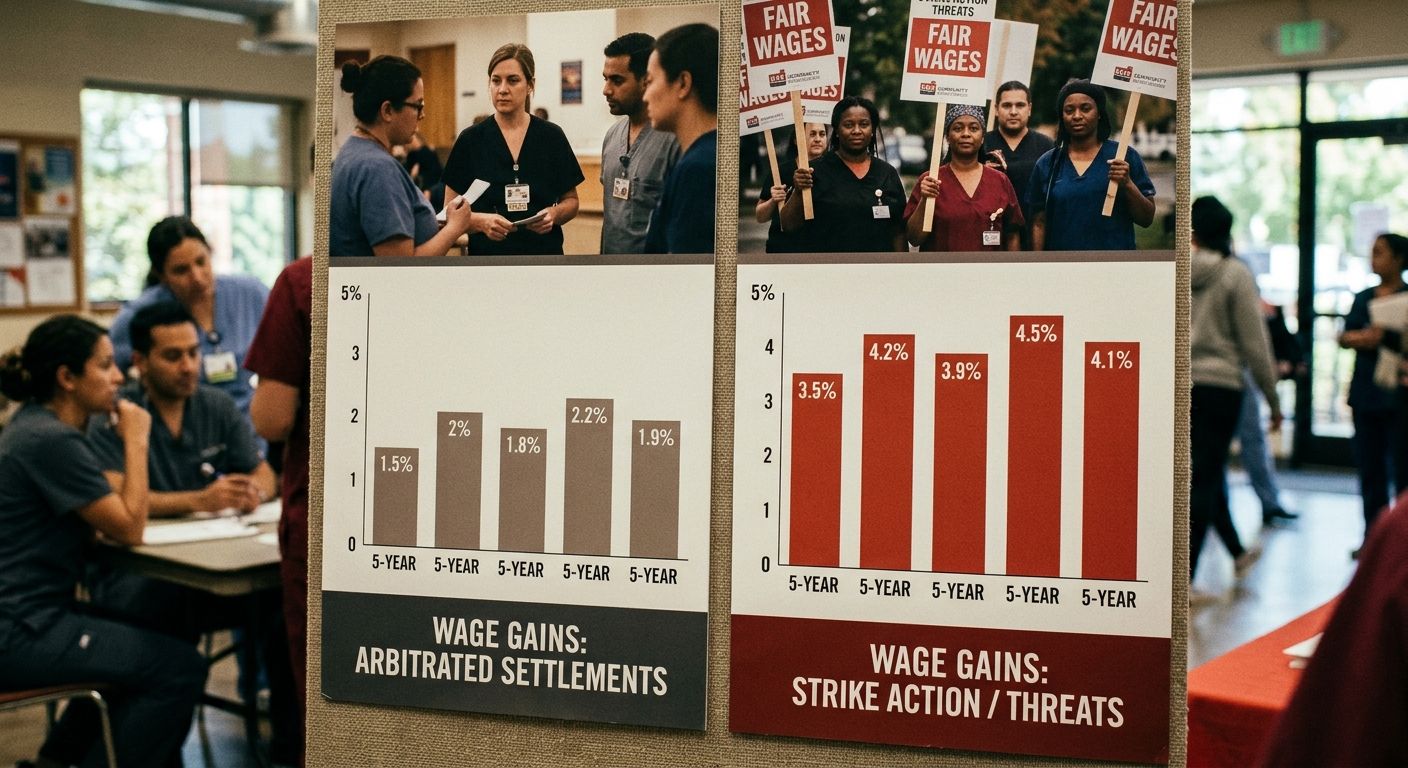
The comparison reveals why employer spending on anti-union activity so often focuses on steering workers toward arbitration. Arbitration is private, predictable, and preserves management's information advantage. Strikes are public, volatile, and shift leverage toward workers who've built community support.
The Constitutional Challenge and What It Signals
Ontario's nurses decided the arbitration-only model had run its course. The ONA and allied healthcare worker unions announced a constitutional fight to restore their right to meaningful collective bargaining and job action, arguing that mandatory interest arbitration violates their Charter rights.
Their argument is straightforward: a "right" to collective bargaining that permanently removes the option of economic pressure is not a meaningful right. When the hospital association knows an arbitrator will eventually impose a settlement, there's no reason to make the difficult compromises that freely negotiated agreements require. The ONA frames mandatory arbitration as the mechanism that allows employers to avoid genuine engagement with workers' demands.
A favorable ruling would force Ontario to either restore limited strike rights for hospital nurses — with appropriate patient safety protections — or fundamentally restructure how arbitration panels operate. The case connects to a broader pattern we've tracked in post-election bargaining breakdowns: when the structural incentives of a dispute resolution system favor one party, the process itself becomes the barrier.
The State of Play
The evidence from Ontario, PeaceHealth, and stalled federal legislation converges on a single conclusion: binding arbitration shields healthcare workers from the immediate risks of a work stoppage, but over years and decades, it erodes the bargaining leverage that produces stronger contracts. Healthcare worker strike rights, despite their costs and complications, remain the more effective path to real economic gains — provided workers can actually afford to exercise them.
That affordability question is doing heavy lifting. Until Congress passes legislation like the Striking Workers Healthcare Protection Act, the choice between arbitration and strikes will remain distorted by the coverage threat. Unions navigating a collective bargaining impasse in healthcare need to build strike funds large enough to cover members' insurance premiums during a walkout, negotiate COBRA continuation clauses into their contracts, and develop the kind of community support networks that can sustain a longer action.
The Ontario constitutional challenge may take years to resolve. The PeaceHealth settlement established a boundary around employer threats but didn't change the underlying economics. And the 62,000 nurses covered by the September 2025 arbitration award received their contract terms from a panel rather than winning them through direct economic pressure. Each of those outcomes tells the same story: the dispute resolution path that actually protects healthcare workers is the one that preserves their ability to say no, and makes the refusal carry real economic consequences for the employer across the table.
The Union Edge Staff
Related Articles

Ontario Nurses Launch Constitutional Challenge to Overturn 59-Year-Old Strike Ban
The Ontario Nurses' Association announced a constitutional challenge on May 11, 2026, to strike down a 1965 law that bans job action for more than 90% of Ontario healthcare workers and forces contract disputes into binding arbitration, according to a press release from the union.

Hospital Workers Strike Over Workplace Violence as Injury Rates Hit Seven Times National Average
Hundreds of hospital workers at Henry Ford Genesys Hospital in Michigan have been on strike since September 1, 2025, with workplace violence and chronic understaffing at the center of their demands, according to NPR.

More Than Two-Thirds of Ohio Nurses Experienced Workplace Violence in Past Year, New Report Finds
Nearly 69 percent of direct care nurses in Ohio experienced workplace violence, including verbal abuse, threats, or physical assault, in the past 12 months, according to the Registered Nurses Association of Ohio's 2026 Workplace Safety Report released today.
Also in the paper