
Collective Bargaining Agreement Contracts: A Guide
A collective bargaining agreement contract is the legally binding document that sets wages, benefits, hours, and working conditions between a union and an employer, protected under Section 7 of the National Labor Relations Act.

Collective Bargaining Agreement Contracts: 6 Rules Every Bargaining Committee Should Follow
A collective bargaining agreement contract is the legally binding document that sets wages, benefits, hours, and working conditions between a union and an employer, protected under Section 7 of the National Labor Relations Act. The difference between a contract that protects workers and one that traps them comes down to how carefully the bargaining committee drafts six specific provisions.
The U.S. Department of Labor maintains a public archive of every private-sector CBA covering 1,000 or more workers. Browse those files and a pattern becomes clear. Contracts that hold up under pressure share structural features. Contracts that collapse under the first grievance usually failed at one of six points during negotiations. The AFL-CIO defines collective bargaining as "the process in which working people, through their unions, negotiate contracts with their employers to determine their terms of employment, including pay, benefits, hours, leave, job health and safety policies, ways to balance work and family, and more." That's the textbook answer. The practical answer is harder: a collective bargaining contract is only as good as its weakest article.
These six rules won't cover every scenario your bargaining committee will face. They will keep you from making the errors we've seen destroy first contracts, weaken mid-contract enforcement, and leave workers exposed during the exact moments they need protection most.
Know your legal floor before you negotiate a single clause
Section 8(d) of the NLRA requires both parties to bargain in good faith over mandatory subjects: wages, hours, and conditions of employment. Section 8(a)(5) makes it an unfair labor practice for an employer to refuse to bargain with a certified union. These aren't abstract principles. They define what your employer is legally required to discuss and what you can file charges over if they stonewall.
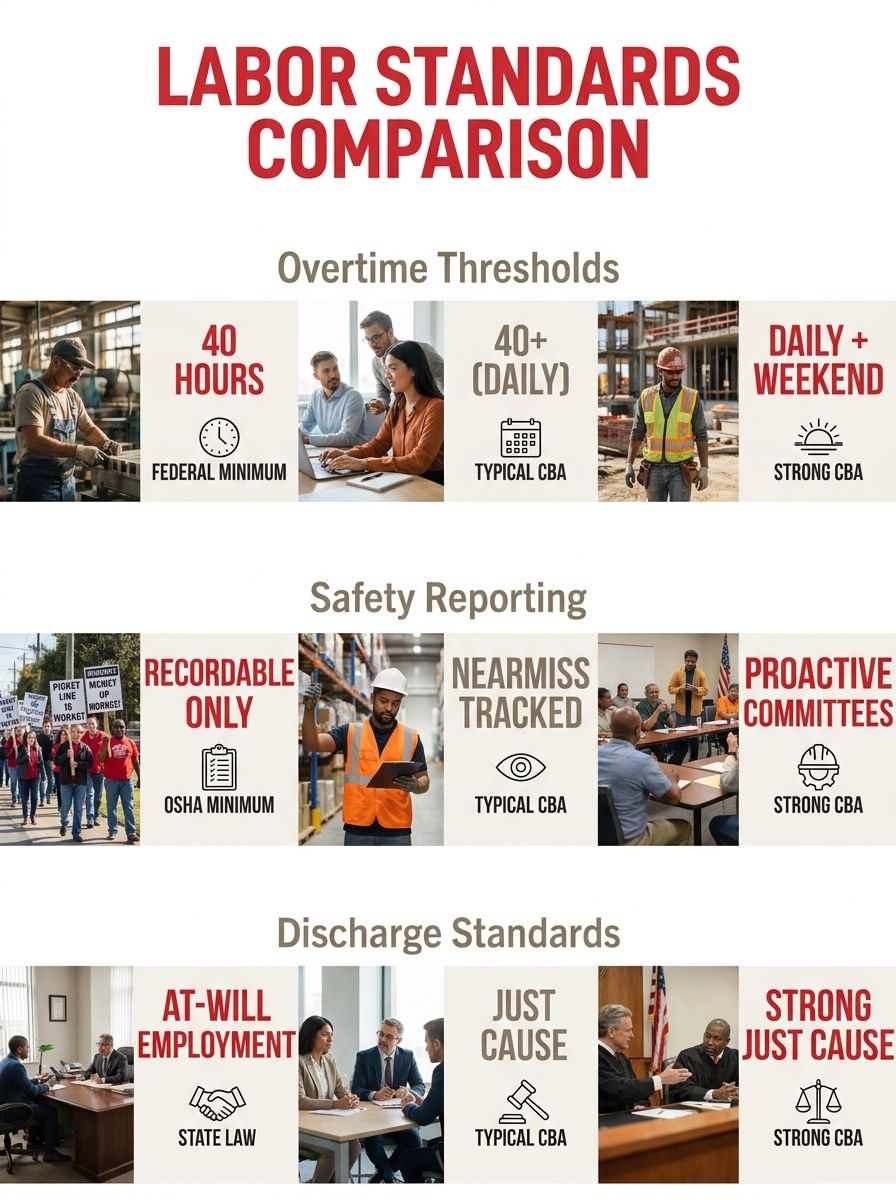
A CBA cannot reduce protections below what federal or state law already provides. As legal analysts at LawInfo have documented, "a CBA does not give an employer the right to reduce safety standards or take any other action that would violate OSHA regulations or any state or federal employment law." That means your contract should build above the legal minimum, not restate it. If your employer's proposal on overtime merely restates the Fair Labor Standards Act's existing 40-hour threshold, they're offering you nothing. Workers already covered by prevailing wage laws have a floor set by government surveys, and the CBA should exceed it.
Before your committee sits down at the table, compile three documents: the applicable OSHA standards for your industry, the current NLRA mandatory bargaining subjects list (approximately 70 recognized topics according to NLRB case law), and any state-specific labor protections that apply. Everything in your contract should add rights above what those documents already guarantee.
Write "just cause" protections with surgical precision
The just cause clause is the most important sentence in any collective bargaining agreement contract. U.S. CBAs commonly include "a 'just cause' clause limiting employee dismissals, seniority rules, detailed job classifications, and a no-strike/no-lockout pledge during the contract term," as labor law analysts at Brynq have summarized. Without just cause language, your employer can fire union members under at-will employment doctrines that exist in 49 out of 50 states. With vague just cause language, arbitrators will interpret ambiguity in whatever direction their own instincts lead.
A strong just cause article specifies 7 elements, often called the "seven tests" derived from arbitrator Carroll Daugherty's 1964 framework: advance notice of rules, reasonable rules, adequate investigation, fair investigation, proof of violation, equal treatment, and proportionate discipline. If your contract says "employees shall be discharged only for just cause" and stops there, you've left the definition to whoever sits in the arbitration chair. Spell out each test. Reference the progressive discipline steps (verbal warning, written warning, suspension, termination) and attach specific timelines. Many strong CBAs require that disciplinary records older than 12 or 18 months cannot be cited in future actions.
The bargaining committee members who've made the most common first-contract mistakes often accept generic just cause language because it sounds protective. It sounds protective until the first termination grievance, when the employer argues that "just cause" means whatever management says it means.
Never separate the grievance procedure from the economics
Bargaining committees often divide their proposals into "economic" issues (wages, health insurance premiums, pension contributions) and "non-economic" issues (grievance procedures, seniority, scheduling). This division is a tactical error that we've watched play out in contract after contract. The grievance procedure determines whether every economic gain in the contract is actually enforceable. A 4% annual wage increase means nothing if the employer can reclassify workers into lower pay grades without a functioning grievance mechanism to challenge it.
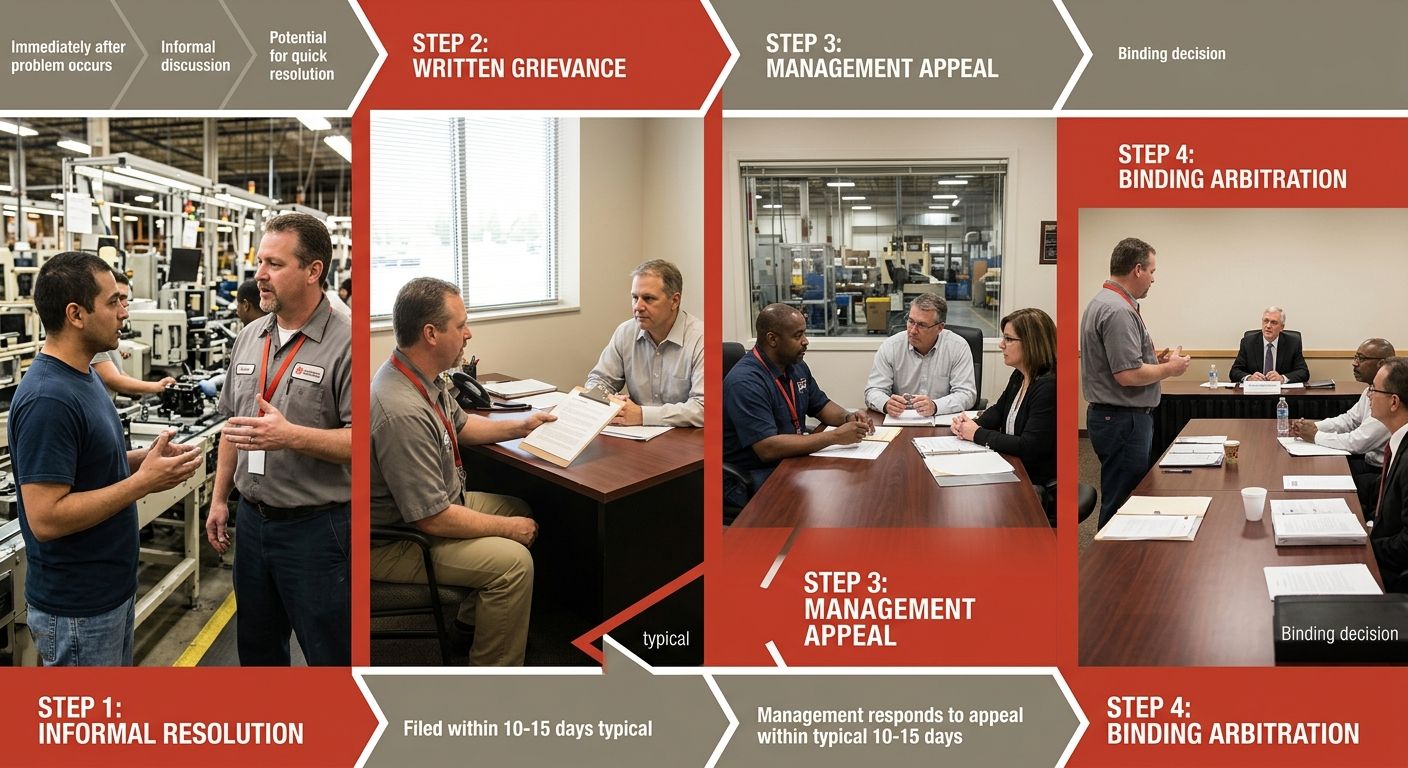
The standard CBA grievance procedure runs 3 to 4 steps: informal resolution with the immediate supervisor (Step 1), written grievance to a department head within 5 to 15 calendar days (Step 2), appeal to a senior management panel or labor relations office within 10 to 30 days (Step 3), and binding arbitration as the final step (Step 4). The critical variable is Step 4. Binding arbitration, where a neutral third party issues a decision both sides must follow, is the enforcement mechanism that gives every other article in your contract teeth. Advisory arbitration, where the arbitrator's decision is non-binding, gives your employer a veto over every grievance outcome.
For workers weighing whether binding arbitration or strike rights offer better protection, the answer often depends on the industry. Healthcare and public-sector workers frequently face legal strike restrictions, making binding arbitration their primary enforcement tool. Construction and manufacturing workers with fewer legal barriers may prefer retaining broader strike rights. Either way, the grievance procedure's strength determines how much of the contract actually functions between negotiations.
Treat the management rights article as contested ground
Every employer proposal will include a management rights clause. The standard version reserves to the employer all rights not explicitly limited by the CBA, including the right to hire, direct the workforce, determine production methods, and set operational policies. The broader the management rights language, the narrower the union's ability to grieve workplace changes during the contract's term, which typically runs 3 to 5 years.
Your bargaining committee should approach management rights the same way the employer approaches economic proposals: line by line. If the clause says management retains the right to "determine staffing levels," that means they can cut your crew sizes without bargaining over the change. If it says management retains the right to "introduce new technology," that could mean algorithmic surveillance tools deployed without union input. Every phrase in a management rights clause is a door the employer can walk through for the entire contract term.
Why does this article matter so much in practice? Because as the Cornell Legal Information Institute defines it, collective bargaining governs "the terms and conditions of the workers' employment," and management rights clauses that swallow the entire scope of working conditions defeat that purpose. The strongest CBAs include a "zipper clause" that limits management rights to those specifically listed, rather than using open-ended "including but not limited to" language. They also include a "past practice" provision stating that established work practices continue unless explicitly changed through bargaining. Without these two protections, the management rights article can undo the rest of the contract by stealth.
Build no-strike clauses with explicit exceptions
U.S. CBAs commonly include a no-strike/no-lockout pledge during the contract term. This is standard practice. The mistake is agreeing to a blanket no-strike clause without carving out specific exceptions. A CBA that prohibits all work stoppages "for any reason during the life of this agreement" means your members cannot honor a sister local's picket line, cannot refuse unsafe work as a group action, and cannot walk out even if the employer violates the contract's core terms.
The exceptions to negotiate include 3 critical carve-outs: the right to honor lawful primary picket lines (sometimes called a "sympathy strike" clause), the right to refuse work that poses an imminent danger under OSHA's Section 11(c) protections, and the right to strike if the employer commits a material breach of the CBA itself. Some contracts also include a "safety strike" exception that permits work stoppages over conditions that violate the contract's health and safety article. Your strike fund readiness planning should account for these exceptions so your local knows exactly which scenarios permit action during the contract period.
The no-lockout provision is the employer's mirror obligation. Make sure it matches the scope of the no-strike clause. If your no-strike language has 3 exceptions, the no-lockout language should have 3 parallel exceptions. Employers who push for a broad no-strike clause while resisting an equally broad no-lockout clause are telling you exactly how they plan to use the imbalance. Pay attention to what they resist. The places where management fights hardest to keep vague language are the places where they intend to act.
Use pattern bargaining to raise standards across the sector
Pattern bargaining is one of the most powerful structural tools available to unions negotiating a collective bargaining contract. Under this strategy, the union negotiates a strong contract with one employer and then uses that settlement as the template for negotiations with competitors in the same industry. The Economic Policy Institute documents that the most well-known example involves "the United Auto Workers union and General Motors, Ford, and Fiat-Chrysler," where the UAW negotiates a "target" contract with one automaker and applies those terms across the Big Three.
Pattern bargaining works because it removes the employer's primary objection to higher standards: competitive disadvantage. If every major employer in a sector pays the same wage scales, contributes the same pension percentages, and follows the same safety protocols, no single company bears a disproportionate cost. The UAW's 2023 Stand Up Strike demonstrated this when the union won 25% wage increases over the 4.5-year contract term at all three automakers, plus the elimination of wage tiers that had suppressed starting pay by roughly 45% compared to top-tier rates.
Your bargaining committee should research what other unions in your sector have won. The DOL's collective bargaining agreements archive is a starting point for private-sector contracts covering 1,000 or more workers. Cornell University's ILR School maintains additional CBA databases, including federal-sector agreements tracked through the Federal Labor Management Information System. When you walk into negotiations with 5 comparable contracts from your industry showing specific wage rates, benefit structures, and scheduling provisions, you shift the conversation from "what we want" to "what the industry standard already is."
When These Rules Collide
No bargaining committee has unlimited power at the table, and these six rules will sometimes conflict with each other. You may need to accept a broader management rights clause to win a stronger grievance procedure. You may trade a blanket no-strike pledge for a higher wage package. You may find that pattern bargaining data from your industry sets standards lower than what your specific local could win independently.
The principle that holds these rules together: every concession in one article should be offset by a gain in another, and the trade should always favor enforceability over aspiration. A 3% raise you can grieve and defend is worth more than a 5% raise in a contract with no binding arbitration. With U.S. employers spending $1.7 billion on anti-union efforts while union membership climbs, the pressure on bargaining committees to accept weak contracts and call them victories will only increase.
Your collective bargaining agreement contract will govern every workday for the next 3 to 5 years. The clauses your committee writes now determine whether your members have real protections or paper ones. Read the contract the way the employer's lawyers will read it, looking for gaps, ambiguities, and loopholes. Then close every one you find before you sign.
The Union Edge Staff
Related Articles

Benefits of Collective Bargaining Agreement Explained
A collective bargaining agreement (CBA) is a legally binding contract between an employer and a union that sets wages, benefits, working conditions, and dispute resolution procedures for every covered worker.

5 First-Contract Bargaining Mistakes That Destroy New Unions — and How to Recover From Them
Workers at The New Yorker, Pitchfork, and Ars Technica voted to join the NewsGuild of New York in 2018. Their first contract didn't arrive until June 2021.

From Recognition to Results: The Post-Election Bargaining Roadmap Unions Get Wrong
Forty-four percent of newly certified unions between 1999 and 2004 never reached a first contract, according to a study of more than 8,000 successful elections by sociologist John-Paul Ferguson. The election was the easy part.
Also in the paper