
What Is the State of Florida Minimum Wage
Amendment 2, ratified by Florida voters in November 2020, embedded a minimum wage escalator directly into Article X of the state constitution, removing the rate from legislative control entirely. The current floor is $14.00 per hour for non-tipped workers and $10.

What Is the State of Florida Minimum Wage?
Amendment 2, ratified by Florida voters in November 2020, embedded a minimum wage escalator directly into Article X of the state constitution, removing the rate from legislative control entirely. The current floor is $14.00 per hour for non-tipped workers and $10.98 for tipped workers, with the final scheduled increase to $15.00 taking effect September 30, 2026.
What Amendment 2 Actually Changed
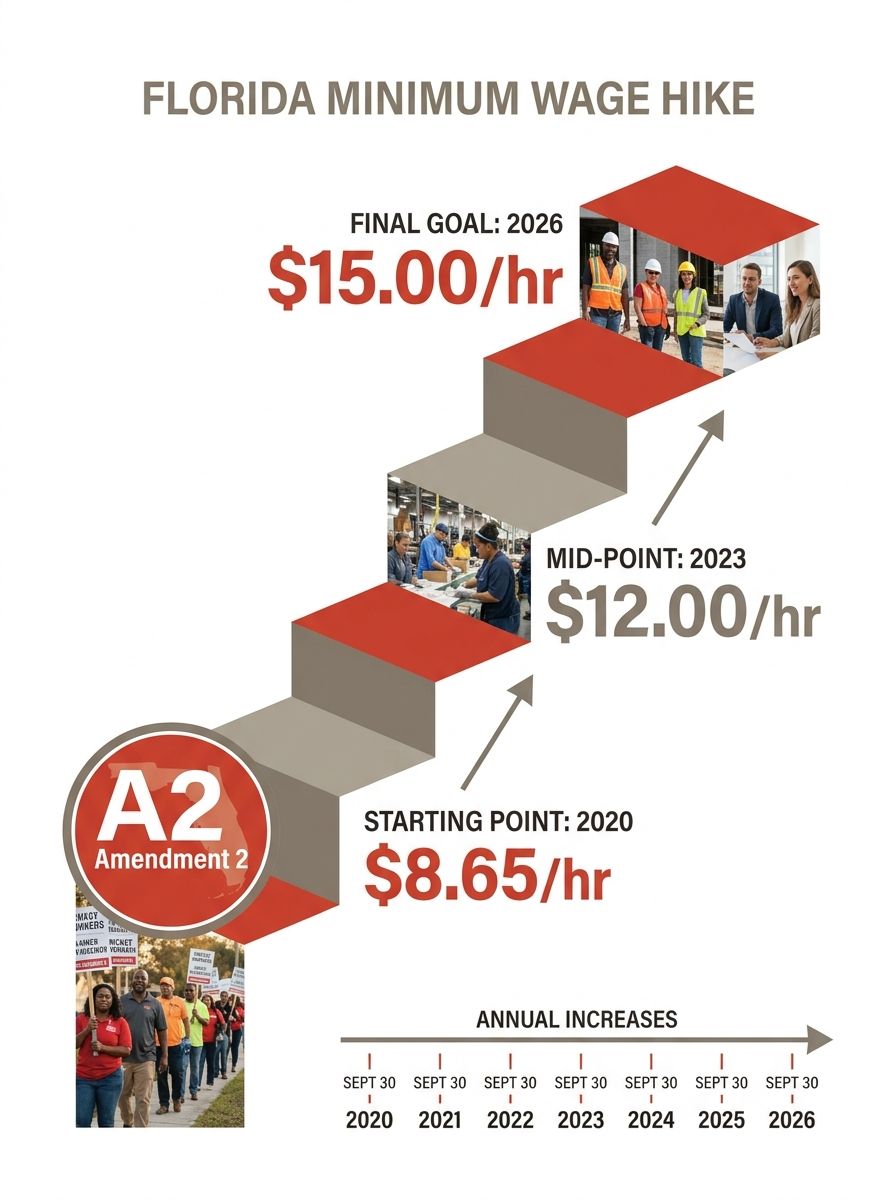
Before November 2020, Florida's minimum wage sat at $8.65 per hour, tethered to a modest annual inflation adjustment that had been in place since a 2004 constitutional amendment. Amendment 2 replaced that formula with a fixed-dollar escalator: $1.00 increases every September 30, starting at $10.00 in 2021 and reaching $15.00 in 2026. The Florida Department of Economic Opportunity confirms this schedule was written into the constitution itself, which means no governor's veto, no committee burial, and no legislative session can alter the trajectory.
The distinction between a statutory minimum wage and a constitutional one is critical for workers. In states where the wage floor exists only in statute, a single legislative session can freeze, delay, or reduce scheduled increases. Florida voters foreclosed that possibility. The only way to change Amendment 2's terms is through another constitutional amendment, requiring either a citizens' initiative petition or a supermajority legislative referral followed by 60% voter approval.
The first phase went into effect in 2021, jumping the rate from $8.65 to $10.00, a single-year increase of $1.35. Every subsequent increase has been exactly $1.00:
Effective Date | Non-Tipped Rate | Tipped Rate |
|---|---|---|
September 30, 2021 | $10.00 | $6.98 |
September 30, 2022 | $11.00 | $7.98 |
September 30, 2023 | $12.00 | $8.98 |
September 30, 2024 | $13.00 | $9.98 |
September 30, 2025 | $14.00 | $10.98 |
September 30, 2026 | $15.00 | $11.98 |
The $14.00 Floor and the Federal Gap
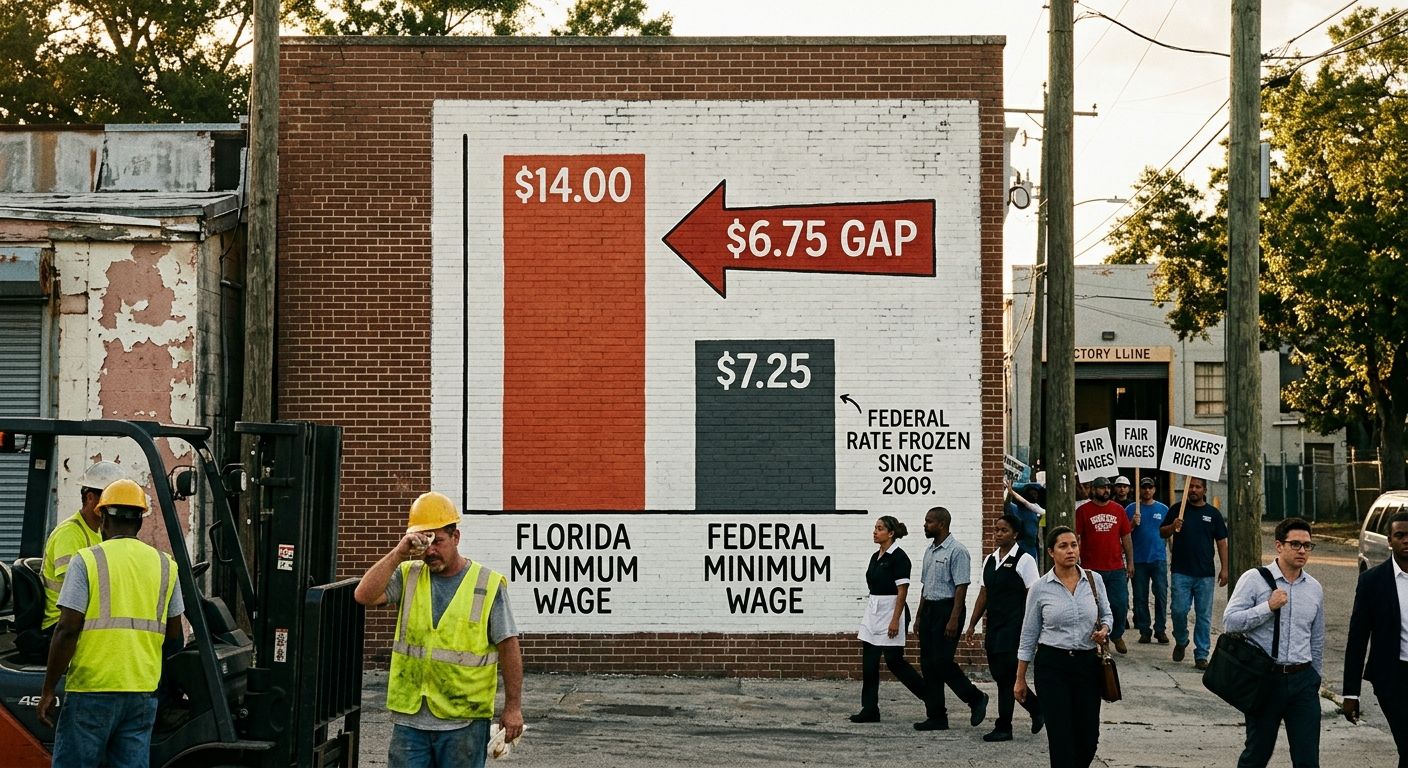
Florida's current $14.00 rate is $6.75 higher than the federal minimum wage of $7.25 per hour, which has remained frozen since July 2009. When the $15.00 rate takes effect on September 30, 2026, Florida's minimum wage will be more than double the federal floor. The U.S. Department of Labor's state wage comparison confirms that when state and federal rates differ, employers must pay whichever rate is higher, making the federal rate functionally irrelevant for Florida workers right now.
This gap illustrates why state-level wage campaigns have become the primary battlefield for workers seeking livable pay. Congress hasn't raised the federal minimum in over 17 years. States like Florida, along with others that have enacted their own escalators, have effectively abandoned the federal floor as a meaningful standard. We've covered similar dynamics in our breakdown of Michigan's minimum wage structure and New Jersey's wage escalator, where voter-driven and legislatively mandated increases have created a patchwork of state floors that range from $7.25 to well above $15.00.
Tipped Workers and the $3.02 Tip Credit
The state of Florida minimum wage operates on a two-tier system. The current tipped cash wage is $10.98 per hour, exactly $3.02 below the full minimum wage. That $3.02 gap is the "tip credit," the amount an employer is legally permitted to count from a worker's tips toward meeting the full minimum wage obligation.
The tip credit has remained fixed at $3.02 throughout the entire Amendment 2 escalator. As the full minimum wage rises by $1.00 each year, the tipped cash wage rises by the same $1.00, preserving the constant dollar gap. On September 30, 2026, the tipped rate will reach $11.98.
Employers carry a legal obligation that many violate in practice. If a tipped worker's tips combined with the $10.98 cash wage do not equal or exceed $14.00 per hour in any given workweek, the employer must make up the difference. Workers who don't track their hours and tip income closely can lose money they're owed without ever realizing it. This is one of the most common wage violations in Florida's hospitality and food service sectors, industries where wage theft remains a persistent problem.
The tip credit framework is worth thinking about in terms of what we call the three-layer wage floor: the constitutional base rate, the tip credit gap, and the preemption barrier that prevents local governments from addressing either layer. Each layer interacts with the others, and each one creates a different set of risks for different categories of workers.
Florida's Preemption Wall
Florida law prohibits cities and counties from enacting their own minimum wage rates that differ from the state minimum wage. Every employer in every jurisdiction across all 67 counties must comply with the single statewide rate. Miami, Orlando, Tampa, Jacksonville: the floor is $14.00 everywhere, regardless of local cost of living.
This matters because the cost of living in Miami-Dade County and the cost of living in rural Panhandle counties are dramatically different realities. A $14.00 wage in Tallahassee stretches further than $14.00 in downtown Miami, where median rents have risen sharply in recent years. Several Florida municipalities have expressed interest in setting higher local floors, but the state's preemption statute blocks them entirely.
The preemption fight mirrors conflicts in other states. Colorado and Washington have navigated similar tensions between statewide uniformity and local economic conditions. For Florida workers in high-cost metro areas, the uniform statewide floor leaves no room for the kind of localized adjustments that could bridge the gap between a mandated minimum and actual living costs.
What Happens After September 2026
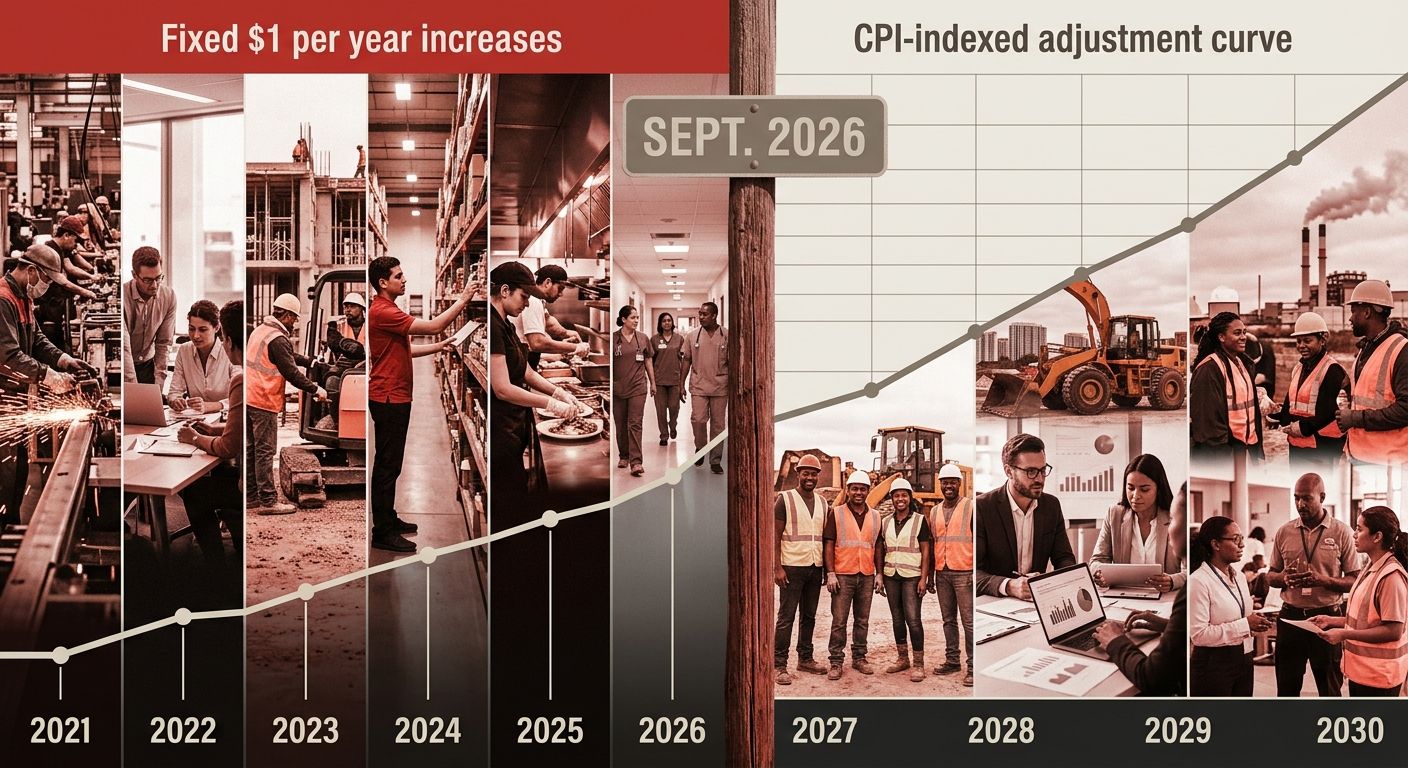
The $15.00 rate arriving on September 30, 2026, is the last fixed-dollar step in the Amendment 2 schedule. After that, the mechanism changes. Starting in 2027, Florida's minimum wage will adjust annually based on the Consumer Price Index, returning to the same type of inflation-indexed formula that governed the wage floor before Amendment 2, though from a much higher starting point of $15.00 rather than $8.65.
CPI-based adjustments prevent the wage from being frozen the way the federal minimum has been, but they come with a significant limitation: the CPI tracks price increases that already happened. Workers absorb rising costs first, then receive an adjustment months later. And if inflation runs low in a given year, the adjustment can be negligible. The mechanism protects against total stagnation but does not guarantee meaningful annual gains in purchasing power.
There's another structural concern. The CPI formula adjusts for general inflation but doesn't account for productivity growth or changes in local housing costs, two factors that have driven the gap between minimum wages and living wages in most major Florida metro areas. A $15.00 wage indexed to CPI will hold its value against general price changes but won't close the gap if housing, healthcare, and childcare costs continue to outpace the broader CPI basket.
Where the Mechanism Breaks Down
Amendment 2 solved one problem definitively: it took the wage floor out of the hands of a legislature that had shown no interest in raising it. But the mechanism has blind spots that affect the workers it was designed to protect, and understanding them is essential to knowing what the state of Florida minimum wage can and cannot do for you.
The enforcement gap is the largest. Florida has the highest minimum wage violation rate among the ten most populous states. The state has no dedicated state-level enforcement agency for minimum wage complaints; workers must file with the federal Wage and Hour Division or pursue private legal action. That's a high bar for a worker earning $14.00 an hour, especially one without union representation or legal resources. A constitutional right to a minimum wage means less when the machinery for enforcing it is underfunded and difficult to access.
The preemption barrier compounds this. Workers in high-cost cities cannot advocate for a local wage that reflects their actual expenses. And the fixed $3.02 tip credit creates a two-tier system where tipped workers depend on customer behavior to reach the same floor that non-tipped workers receive automatically.
The CPI indexing that kicks in after 2026 will preserve the $15.00 floor against inflation erosion, but it won't push the wage upward in real terms. For workers who need the wage floor to function as a path toward economic stability, the mechanism delivers a better baseline than what existed before 2020 while stopping well short of what labor economists define as a living wage in most Florida metro areas. Organized workplaces with collective bargaining agreements are the primary avenue for pushing wages above the constitutional floor, which is why the right to organize remains inseparable from the right to a minimum wage.
Common Questions
Does the Florida minimum wage apply to all workers?
The $14.00 rate applies to all employees covered under the Fair Labor Standards Act who work in Florida. Tipped employees receive a lower cash wage of $10.98, with employers required to ensure total compensation (cash wage plus tips) meets or exceeds $14.00. Certain narrow categories, including some student workers and workers with disabilities under specific federal certificates, may have different rules, but the general coverage is broad.
Can my city or county set a higher minimum wage?
No. Florida law explicitly prohibits local governments from establishing minimum wage rates above the state rate. The $14.00 floor (rising to $15.00 on September 30, 2026) applies uniformly across all 67 Florida counties, regardless of local cost-of-living differences.
What happens if my employer doesn't pay the minimum wage?
Workers can file a complaint with the U.S. Department of Labor's Wage and Hour Division or pursue a private cause of action under Florida's constitution. Amendment 2 includes provisions allowing workers to recover back wages plus liquidated damages. Documenting your hours, pay stubs, and tip records independently is critical to a successful claim, especially given Florida's lack of a state-level wage enforcement body.
Will the minimum wage keep rising after $15.00?
Yes, but through a different mechanism. After September 30, 2026, annual adjustments will be calculated using the Consumer Price Index rather than fixed $1.00 increases. The wage will rise with measured inflation but won't see the guaranteed dollar-amount jumps that characterized the 2021-2026 period.
How does Florida's rate compare to neighboring states?
Florida's $14.00 rate is well above Georgia and Alabama, which default to the federal minimum of $7.25 per hour. When the $15.00 rate takes effect in September 2026, Florida will hold the highest minimum wage in the Southeast, though it will still trail states on the West Coast and in the Northeast.
The Union Edge Staff
Frequently Asked Questions
- What is the current Florida minimum wage in 2024?
- Florida's current minimum wage is $14.00 per hour for non-tipped workers and $10.98 per hour for tipped workers, as set by Amendment 2 ratified in November 2020.
- When will Florida minimum wage reach $15 per hour?
- Florida's minimum wage will reach $15.00 per hour on September 30, 2026, which is the final scheduled fixed-dollar increase under Amendment 2.
- How much is the Florida tip credit?
- Florida's tip credit is $3.02, meaning employers can count $3.02 of a tipped worker's tips toward meeting the full minimum wage obligation, with the tipped cash wage currently at $10.98 per hour.
- Can Florida cities set their own minimum wage?
- No, Florida law explicitly prohibits cities and counties from establishing minimum wage rates above the state rate, so the $14.00 floor applies uniformly across all 67 counties regardless of local cost of living.
- What happens to Florida minimum wage after September 2026?
- After September 30, 2026, Florida's minimum wage will adjust annually based on the Consumer Price Index rather than fixed dollar increases, starting from the $15.00 base.
- How much higher is Florida's minimum wage than the federal minimum?
- Florida's current $14.00 minimum wage is $6.75 higher than the federal minimum wage of $7.25 per hour, which has remained frozen since July 2009.
- What should I do if my employer doesn't pay Florida minimum wage?
- You can file a complaint with the U.S. Department of Labor's Wage and Hour Division or pursue a private cause of action under Florida's constitution, and it's critical to document your hours, pay stubs, and tip records independently.
Related Articles

Minimum Wage in Florida: 2024 Rate Changes
Before 2004, Florida had no state minimum wage at all. Voters fixed that twice through constitutional amendments, the second of which created a fixed $1.00-per-year escalator that brought the minimum wage in Florida to $13.00 per hour on September 30, 2024, with a $15.

What is the Minimum Wage in Florida
Unlike most state wage floors, which legislatures can freeze or repeal at will, Florida's minimum wage is locked into the state constitution. The current rate is $14.00 per hour, climbing to $15.

Minimum Wage at Florida: 2024 Guide & Updates
Amendment 2 to Florida's constitution, approved by voters on November 3, 2020, hardwired a $1.00-per-year minimum wage escalator into state law that bypasses the legislature entirely. That mechanism set the minimum wage in Florida at $13.
Also in the paper