
How to File an Unfair Labor Practice Charge: A Step-by-Step Guide for Frontline Organizers
Amazon warehouse workers at the JFK8 fulfillment center on Staten Island filed their first unfair labor practice charge months before the April 2022 election that made them famous.

How to File an Unfair Labor Practice Charge: A Step-by-Step Guide for Frontline Organizers
Amazon warehouse workers at the JFK8 fulfillment center on Staten Island filed their first unfair labor practice charge months before the April 2022 election that made them famous. The charges documented mandatory anti-union meetings, confiscated organizing materials, and retaliatory discipline against pro-union employees. Those NLRB filing decisions shaped the entire campaign and eventually produced federal settlements. The JFK8 case shows, step by step, how a well-built unfair labor practice charge works in practice.
The Violations That Triggered the First Charge
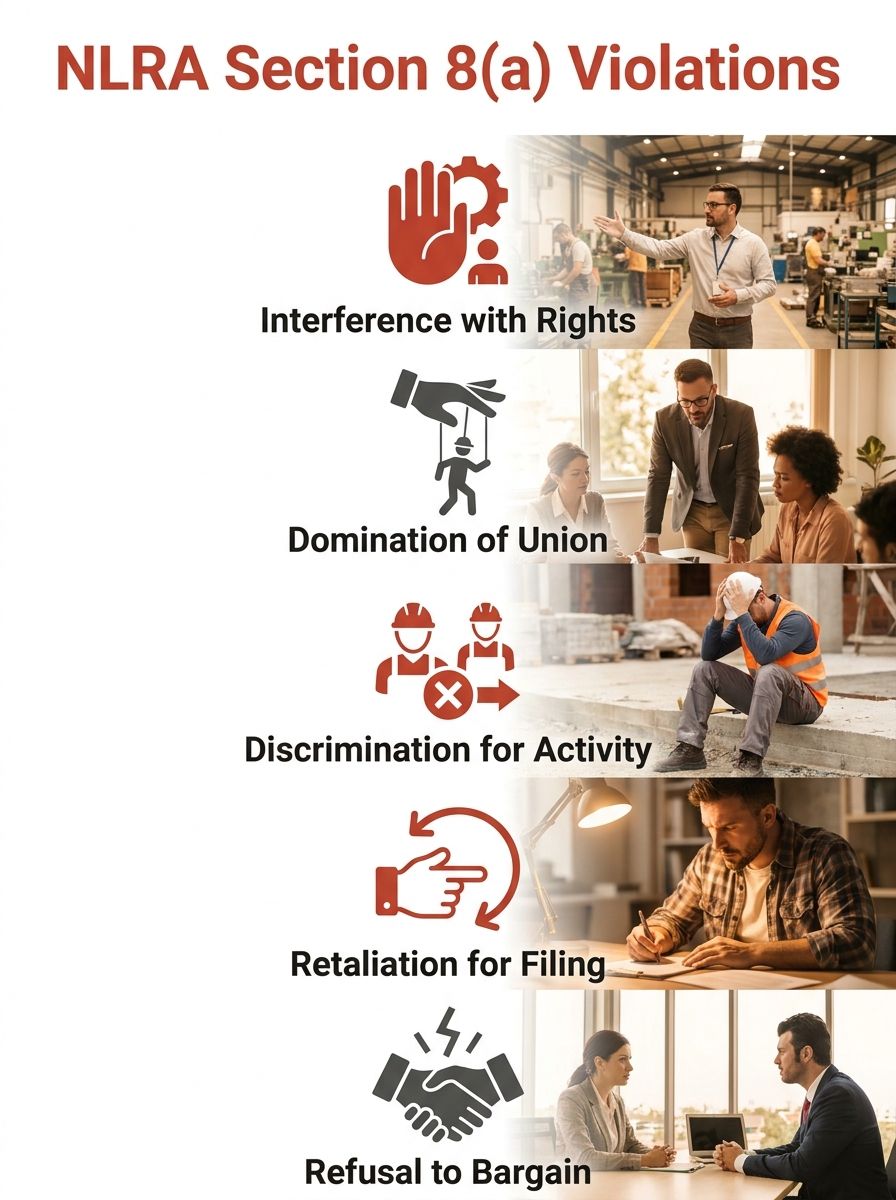
Section 7 of the National Labor Relations Act guarantees every worker in the private sector "the right to self-organization, to form, join, or assist labor organizations, to bargain collectively through representatives of their own choosing, and to engage in other concerted activities for the purpose of collective bargaining or other mutual aid or protection," according to the NLRB's own published guidance. When an employer violates those Section 7 rights, the violation falls under Section 8(a) of the NLRA, which breaks down into five categories: 8(a)(1) for interference with protected activity, 8(a)(2) for dominating a labor organization, 8(a)(3) for discrimination against union supporters, 8(a)(4) for retaliation against employees who file charges, and 8(a)(5) for refusal to bargain in good faith.
At JFK8, Amazon's conduct hit multiple categories simultaneously. Management held what organizers described as "captive audience" meetings, pulling workers off the floor during shifts for presentations about the risks of unionizing. Supervisors interrogated workers about their union sympathies in one-on-one conversations. Pro-union flyers were removed from break rooms while anti-union materials remained posted. Workers who wore union buttons or spoke openly about organizing reported sudden write-ups for infractions that had previously gone unnoticed.
These behaviors map directly onto the NLRB's categories of union election interference. The Board has stated that "results of an election will be set aside if conduct by the employer or the union created an atmosphere of confusion or fear of reprisals and thus interfered with the employees' freedom of choice," per its published election standards. This language matters because it sets the bar for what counts as employer retaliation during an organizing drive. You don't need a termination to have a valid charge. Schedule changes, reduced hours, reassignment to less desirable tasks, increased surveillance, or sudden enforcement of previously ignored rules all qualify when they correlate with protected union activity.
The NLRB receives between 20,000 and 30,000 unfair labor practice charges annually, and research compiled by LaborLab shows that 41.5% of all union election campaigns involve at least one ULP charge. These numbers tell us two things: filing charges is common, and employer violations during organizing drives are disturbingly routine. U.S. employers spent an estimated $1.7 billion in 2025 on anti-union consultants and attorneys, which means the legal infrastructure designed to discourage organizing is well-funded and aggressive.
Documenting the Evidence Before Filing
The JFK8 organizers did something that separated their charges from the thousands that get dismissed each year: they kept meticulous, contemporaneous records. The NLRB charge form (Form NLRB-501 for charges against employers) requires a "clear and concise statement of the facts constituting the alleged unfair labor practices," and the form itself carries a federal warning that "willful false statements on this charge can be punished by fine and imprisonment" under U.S. Code, Title 18, Section 1001. That warning isn't decorative. It means every claim on the form needs backing.
Here's what solid documentation looks like, drawn from what worked at JFK8 and in other successful NLRB filing cases:
Incident logs with dates, times, and locations. Each entry should name the supervisor or manager involved, describe the specific conduct, and note who witnessed it. "My supervisor told me to take off my union button during a shift on March 12, 2022, at approximately 2:15 PM near Dock 4" is useful. "Management has been hostile to the union" is not.
Witness statements with contact information. The NLRB agent assigned to investigate your charge will want to interview witnesses. Having names, phone numbers, and email addresses ready speeds the investigation and strengthens the case. Workers who are willing to provide written statements should write them in their own words, sign, and date them.
Copies of written communications. Emails, text messages, Slack messages, posted memos, disciplinary notices, schedule changes. If your employer put anything in writing that relates to union activity, save copies outside of company systems. Company email accounts and internal messaging platforms can be restricted or wiped.
Photographs of physical evidence. Pictures of removed union materials, posted anti-union flyers, surveillance cameras placed near organizing areas, or changed working conditions. Metadata on digital photos includes timestamps, which adds credibility.
Comparison records. If an employer suddenly starts enforcing attendance policies or dress codes against union supporters, records showing that the same rules weren't enforced against non-supporters become critical evidence of discriminatory treatment under Section 8(a)(3).
The organizers at JFK8 used personal phones, notebooks, and group chats to compile evidence across dozens of workers. They built their approach around deep listening to coworkers' experiences, then channeled what they heard into structured documentation. This distributed approach meant no single person held all the evidence, reducing the risk that a targeted firing could destroy the record.

Filing the Charge at the Regional Office
The actual NLRB filing process is less complicated than most organizers expect, though it carries procedural traps that can gut a case. You file a charge at the NLRB Regional Office that covers the geographic area where the alleged violation occurred. There are 26 regional offices and 22 sub-regional and resident offices across the country. If the violation happened in more than one region, you can file in any region where it occurred.
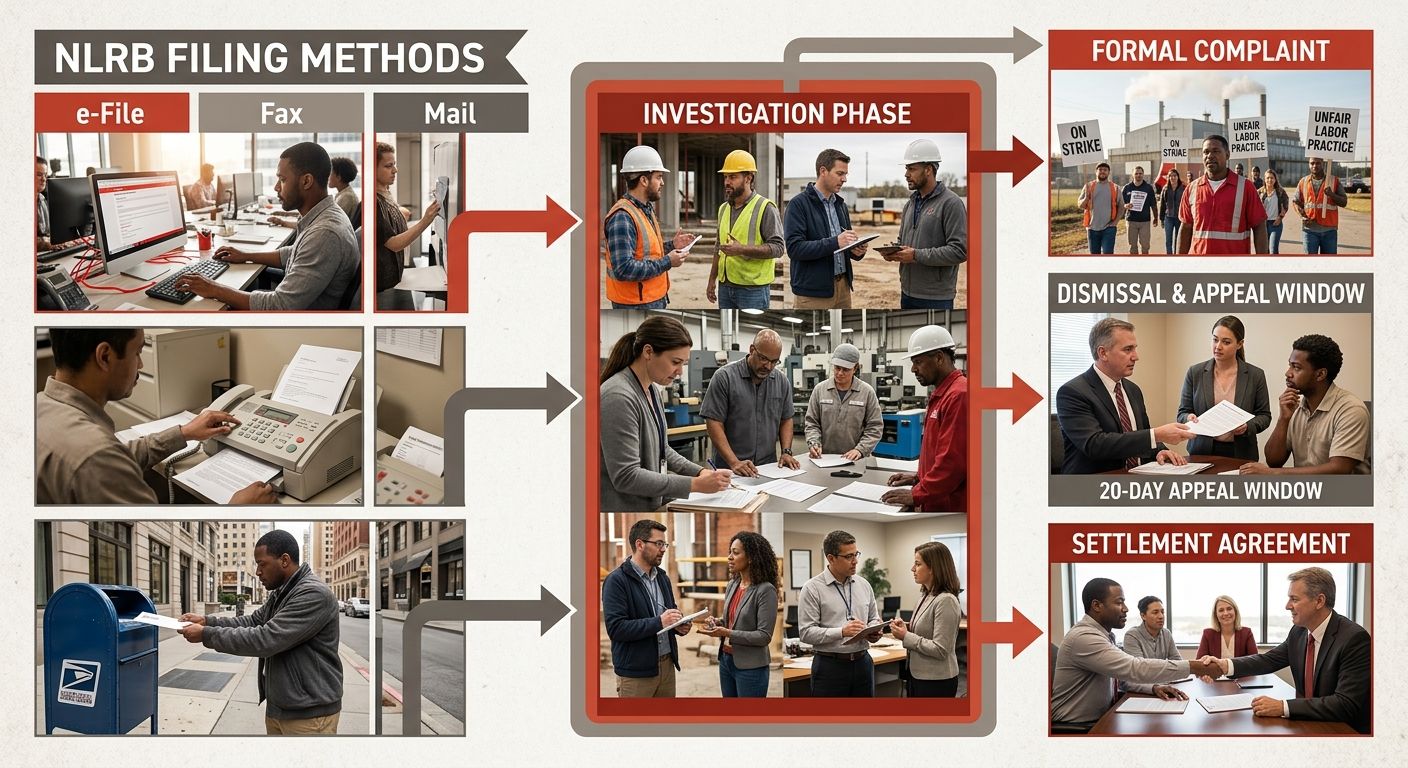
You have three filing options:
Electronic filing (e-File) through the NLRB website. This is the NLRB's preferred method and creates an automatic timestamp proving when you filed.
Fax to your nearest Regional Office.
Mail to your nearest Regional Office, though this adds transit time that eats into your six-month window.
The charge form itself, NLRB-501, asks for basic information: the name and address of the employer (the "charged party"), the name and contact information of the person or organization filing, and the statement of facts. Any individual employee can file a charge. A union can file on behalf of employees. Even a third party who has knowledge of the violation can file, though the charging party must have standing.
Here's where organizers commonly stumble. The "statement of facts" section is the heart of the charge, and it needs to cite specific conduct tied to specific NLRA sections. Writing "Amazon violated our rights" gets nowhere. Writing "On March 12, 2022, Supervisor John Doe directed employee Jane Smith to remove a union button from her vest during her shift at the JFK8 facility, in violation of Section 8(a)(1) of the NLRA" gives the regional office something to investigate. Each distinct type of violation should be listed separately.
After you file, the NLRB serves a copy of the charge on the employer, who then knows exactly what's been alleged. The regional office assigns a Board agent to investigate. That agent will contact you, request evidence, interview witnesses, and review documents. The investigation phase typically takes 7 to 14 weeks, though complex cases involving multiple violations across a large workforce can run longer.
The regional office then makes one of three decisions. It can issue a formal complaint, which means the NLRB's attorneys believe the evidence supports the charge and will prosecute it. It can dismiss the charge if the evidence doesn't support a violation. Or it can encourage a settlement between the parties. If your charge is dismissed, you have 20 days to appeal to the NLRB's Office of Appeals in Washington, D.C.
Understanding the distinction between private-sector and public-sector jurisdiction prevents a common filing error. The NLRB covers private-sector workers under the National Labor Relations Act (29 U.S.C. § 151 et seq.). Federal employees fall under a different statute, the Federal Service Labor-Management Relations Statute, and file with the Federal Labor Relations Authority (FLRA) instead. State and local public employees are covered by state-level public employment relations boards (PERBs), each with its own procedures and deadlines. Filing with the wrong agency wastes weeks, and those weeks count against your deadline.
How JFK8 Charges Became Federal Pressure
At JFK8, the NLRB found merit in multiple charges against Amazon. The Board's regional office determined that Amazon had violated Section 8(a)(1) by interrogating workers about union activities, by threatening employees with loss of benefits if they voted to unionize, and by surveilling organizing activity. Additional charges alleged Section 8(a)(3) violations for disciplining and terminating workers because of their union support.
The NLRB's complaint process created cascading pressure. Once the Board issued formal complaints, Amazon faced the prospect of hearings before an administrative law judge, with potential remedies including reinstatement of fired workers with back pay, rescission of unlawful disciplinary actions, and mandatory posting of notices informing all employees of their Section 7 rights. Under 42 U.S.C. § 2000e-5(g)(1), remedies for retaliation can include reinstatement, back pay, and "any other equitable relief as the court deems appropriate," with the 1991 amendments adding compensatory and punitive damages.
Amazon's case followed a pattern visible in other high-profile ULP battles. The Kellogg Company's attempt to permanently replace striking workers who were protesting unfair labor practices triggered political backlash in 2021, including direct pressure from the White House. That case demonstrated how ULP charges create political and public-relations leverage that extends far beyond the administrative hearing room. An employer retaliation charge during an organizing campaign draws public attention, attracts media coverage, and signals to workers on the fence that the law recognizes what management is doing.
The JFK8 settlements required Amazon to take specific corrective actions at the facility. These outcomes mirrored what the NLRB typically seeks in successful ULP cases: cessation of the illegal conduct, remediation for affected workers, and notification to the entire workforce about their protected rights. For organizers running campaigns at workplaces where employers are spending heavily on anti-union consultants, this sequence of charge, investigation, complaint, and settlement creates concrete accountability that internal grievances alone cannot deliver.
The JFK8 experience also illustrates why ULP charges work best as part of a broader organizing strategy rather than as isolated legal actions. Workers at the facility didn't file charges and wait. They continued organizing, building support for the election while the charges moved through the federal process. The charges reinforced the broader campaign structure by demonstrating to undecided coworkers that management's conduct was serious enough to warrant federal investigation.
The Six-Month Line Between Accountability and Nothing
The single most important procedural detail in any unfair labor practice charge is the 180-day filing window. Every other element of the process, from evidence quality to witness availability to the strength of the legal theory, becomes irrelevant if the charge arrives at the regional office on day 181. Organizers at JFK8 understood this and filed charges promptly as violations occurred rather than waiting to compile a comprehensive case. You can always file additional charges as new violations happen. You cannot file retroactively for violations you sat on.
This approach, filing early and filing often, also creates a documented pattern. A single charge alleging that a supervisor made one threatening comment might be difficult to prove. Five charges filed over three months, each documenting a separate incident by a different supervisor, establish a pattern of employer retaliation that the regional office takes seriously. The pattern strengthens every individual charge because it rebuts the employer's inevitable argument that each incident was isolated and unrelated to union activity.
For workers considering whether to file, a few practical points deserve emphasis. First, you don't need a lawyer to file an unfair labor practice charge. The NLRB's information officers at regional offices are available to help. Second, filing a charge is itself protected activity under Section 8(a)(4) of the NLRA, meaning your employer cannot lawfully retaliate against you for filing. If they do, that retaliation becomes the basis for an additional charge. Third, if your workplace is in the middle of an organizing drive, consult with your campaign's organizing committee about the timing and strategic value of each charge.
The Amazon workers at JFK8 proved that unfair labor practice charges are functional tools for shifting power during an organizing fight. Their charges didn't exist in a legal vacuum. Each filing reminded coworkers that federal law backed their right to organize, documented management's illegal conduct for the historical record, and forced a trillion-dollar company to answer to a federal agency. The six-month window is the boundary between having that tool available and losing it permanently. Track every incident. File on the ones that matter. Don't let the clock run out.
The Union Edge Staff
Related Articles

When Employers Fight Back: Recognizing and Countering Union-Busting Tactics During Your Organizing Campaign
U.S. employers are charged with violating federal law in 41.5% of all union election campaigns, according to a study from the Economic Policy Institute. The violations follow a predictable script.

NLRB: What Employers and Employees Need to Know
The National Labor Relations Board is the independent federal agency that decides whether your employer broke the law when it fired you for talking about wages, interrogated you about a union meeting, or refused to bargain after workers voted to organize.
NLRB Wagner Act: What You Need to Know
The National Labor Relations Act of 1935, commonly called the Wagner Act, is the federal statute that guarantees private-sector employees the right to organize unions, bargain collectively, and strike.
Also in the paper