
The Employer Compliance Trap: Why Documentation Failures Cost More Than You Think
Federal courts have a straightforward rule for employers who show up without proper timekeeping records: the worker's word becomes the evidence.

The Employer Compliance Trap: Why Documentation Failures Cost More Than You Think
Federal courts have a straightforward rule for employers who show up without proper timekeeping records: the worker's word becomes the evidence. The Fifth Circuit made this explicit when it ruled that incomplete payroll records shift FLSA liability onto the employer, allowing employees to use their own reasonable estimates of hours worked to recover back wages. That ruling didn't invent new law. It restated something that's been true since the 1946 Supreme Court decision in Anderson v. Mt. Clemens Pottery Co.: when employers fail to keep the records the law requires, they forfeit the right to dispute what workers say they're owed. And yet, employer documentation failures remain epidemic across industries, hitting hardest in the sectors where workers are already the most vulnerable.
This isn't a paperwork problem. It's a civil rights problem. When records are missing, incomplete, or contradictory, workers lose the trail of evidence they need to prove wage theft, challenge discriminatory discipline, and enforce the rights guaranteed to them under federal and state labor law. The gap between what employers are required to document and what they actually document creates a zone of impunity where violations go undetected and unpunished. For organizers, understanding how these failures work is essential to building campaigns that stick. For workers, knowing what your employer is supposed to be recording about you is the first step toward holding them accountable.
The Recordkeeping Gap Nobody Talks About
The Fair Labor Standards Act is clear about what employers must document. Every covered employer is required to maintain records of each employee's hours worked per day, total hours per workweek, regular rate of pay, total overtime compensation, and deductions from wages. The Department of Labor's Wage and Hour Division enforces these requirements, and the statute gives employees the right to file private lawsuits to recover unpaid wages, liquidated damages, attorney's fees, and court costs when employers fail to comply. On paper, it's a system designed to protect workers. In practice, the enforcement gap is enormous.
The most common violations in wage and hour compliance aren't dramatic acts of fraud. They're mundane failures of record-keeping: time clocks that round down in the employer's favor, managers who edit timesheets after the pay period closes, payroll systems that don't capture pre-shift or post-shift work, and records that simply aren't kept at all for workers classified (often incorrectly) as independent contractors or exempt employees. According to guidance from HR compliance experts, overtime pay miscalculations are among the top causes of wage and hour violations, frequently triggering costly audits and litigation. These aren't edge cases. They're patterns that repeat across warehouses, restaurants, construction sites, home care agencies, and retail chains, and they disproportionately affect workers of color, immigrants, and women in low-wage jobs.
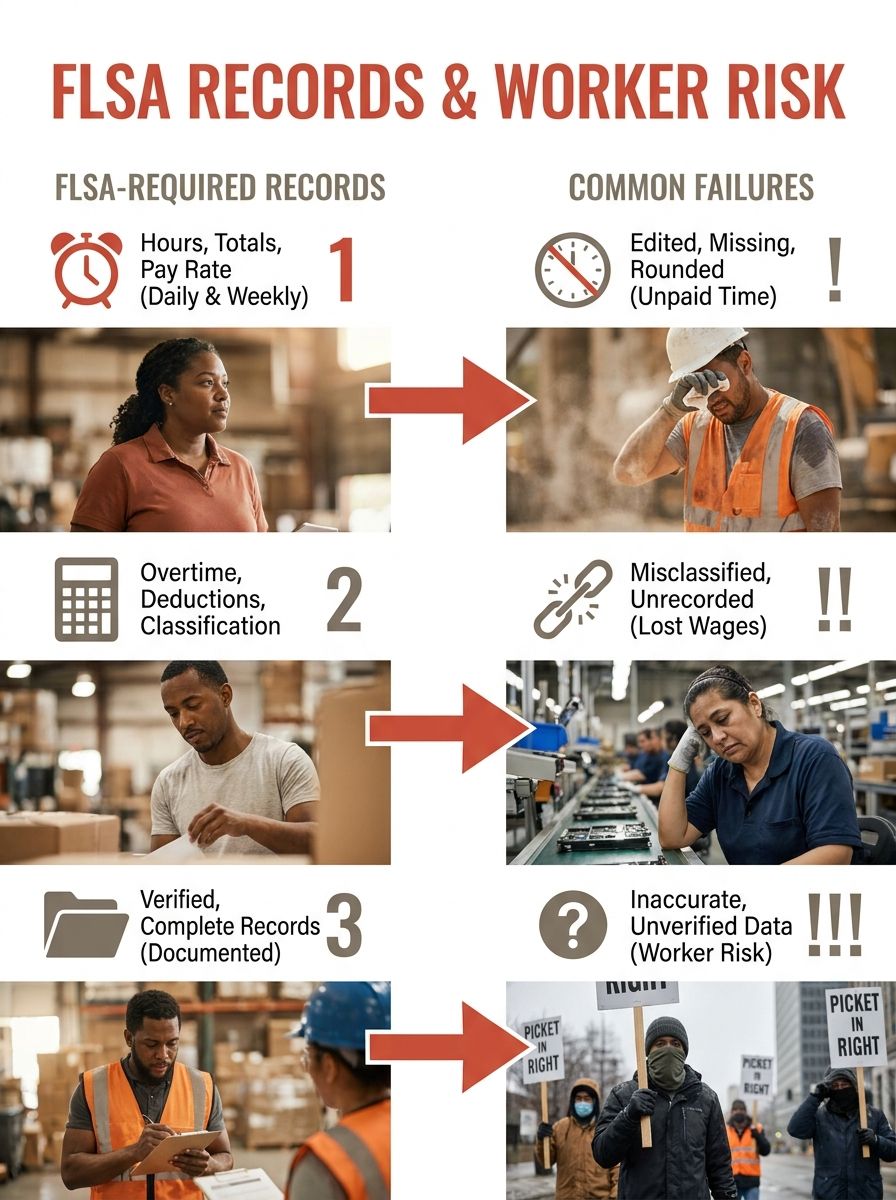
What makes these failures so damaging is their compounding effect. A single missing timesheet is annoying. Three years of incomplete records, which is the statute of limitations for willful FLSA violations, can mean tens of thousands of dollars in unpaid wages per worker. Multiply that across a workforce of fifty or a hundred employees, and you're looking at the kind of liability that can reshape a company's entire financial outlook. The consequences of non-compliance include back wages, liquidated damages that can double the amount owed, and DOL injunctions that force employers into court-supervised compliance. Employers who are caught with inaccurate records face federal fines, and the reputational damage can follow a company for years. Connecticut's recent labor bill addressing wage theft in construction, which we covered in our report on the state's landmark legislation, shows how legislatures are increasingly closing these gaps at the state level.
When Disciplinary Records Tell on the Employer
Disciplinary records occupy a peculiar space in employment law. They're supposed to protect both the employer and the worker by creating a documented trail of workplace conduct, expectations, and consequences. In reality, they often become the employer's weakest point in any legal challenge. The reason is simple: most employers are terrible at maintaining consistent discipline files, and that inconsistency becomes powerful evidence of discrimination, retaliation, or bad faith.
Consider the scenario employment lawyers encounter constantly. A worker receives a satisfactory annual performance review in January. By March, the same worker begins talking to coworkers about wage concerns or safety conditions. By April, management issues a written disciplinary notice alleging performance deficiencies that weren't mentioned three months earlier. As employment law practitioners have documented, contradicting previous documentation is one of the most damaging mistakes an employer can make in the disciplinary process. If an employee's annual review says they're meeting all goals, a disciplinary report two weeks later claiming they've failed to meet standards becomes almost impossible to defend. That contradiction doesn't just weaken the employer's case in a wrongful termination suit. It creates an inference of pretext, which is the legal term for a made-up reason hiding the real, unlawful motivation.
This is where employer documentation failures cross from a compliance headache into a civil rights violation. Federal anti-discrimination statutes, including Title VII, the ADA, and the ADEA, all rely on workers being able to show that their employer's stated reason for an adverse action was pretextual. Sloppy, inconsistent, or missing disciplinary records make that showing far easier. When an employer disciplines a Black worker for an infraction that white coworkers have committed without consequence, and when the only documentation in the file is the write-up for the Black worker while the other personnel files are empty, the pattern speaks for itself. The documentation gap becomes the evidence of discrimination. Workers and organizers who understand this dynamic can use it to challenge unfair treatment through grievance procedures, EEOC complaints, and collective bargaining demands for transparent, consistent discipline policies.
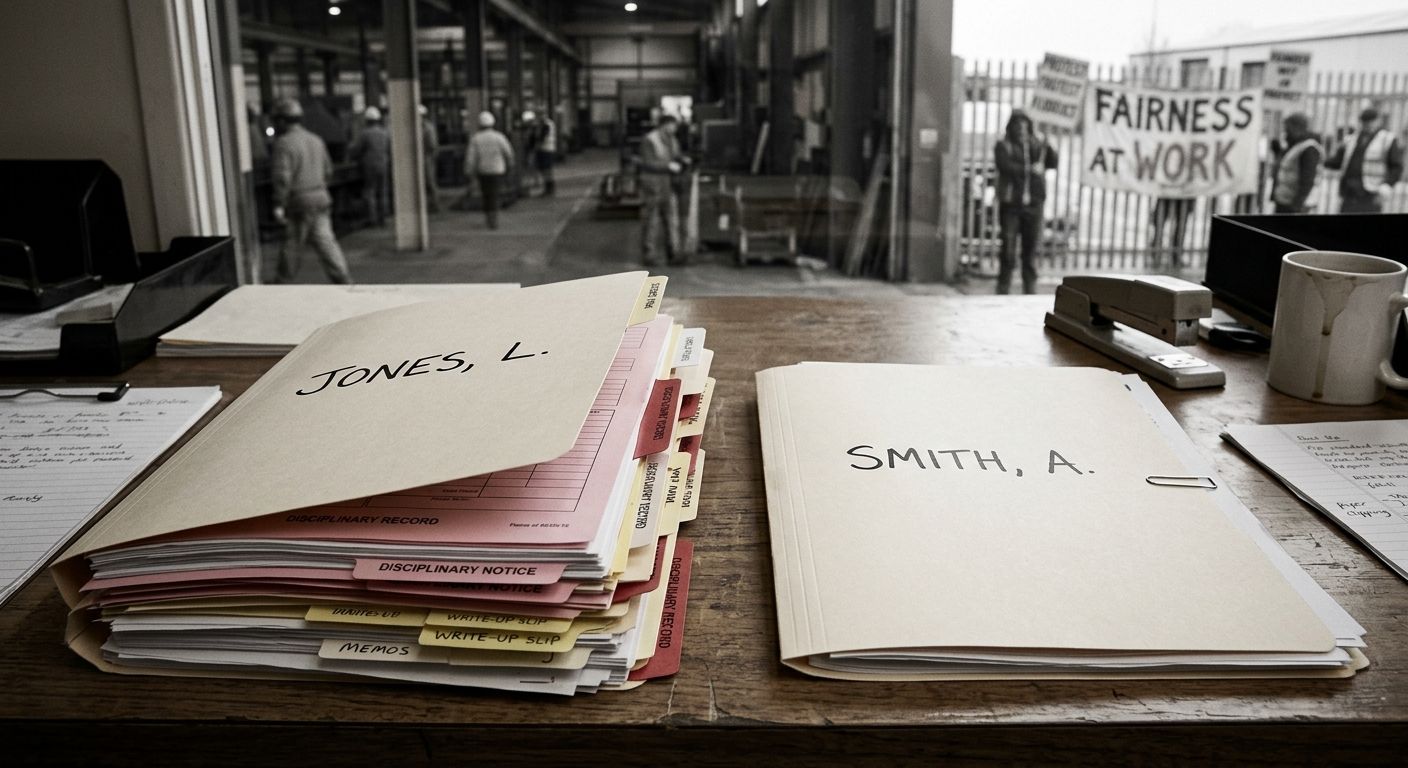
The disciplinary process itself, as federal personnel guidance describes it, can range from informal supervisor admonishments to formal HR actions including reprimand letters, suspension, or separation. Each of those steps is supposed to be documented. Each document is supposed to be consistent with previous records. When employers skip steps, manufacture paper trails after the fact, or apply discipline unevenly across racial, gender, or age lines, they create the very evidence that workers need to prove labor law violations. Organizers should be training stewards and committee members to spot these inconsistencies, because they're often hiding in plain sight.
Documentation Failures as Organizing Fuel
Every broken record, every missing timesheet, every contradictory write-up is an organizing conversation waiting to happen. We've seen this pattern across dozens of campaigns: the employer's own documentation failures become the most persuasive argument for why workers need collective representation. When you can show a coworker that the company isn't even keeping the records the law requires, the argument for a union stops being abstract. It becomes concrete and personal. What else are they cutting corners on? What else don't you know about?
The connection between union organizing leverage and documentation gaps runs deeper than most campaign manuals acknowledge. Workplace mapping, which is the process of identifying which coworkers are supportive, opposed, or undecided about organizing, becomes more productive when organizers can point to specific, documented failures that affect people's paychecks and job security. As organizing strategists have noted, targeted conversations built around concrete workplace problems are far more effective than abstract appeals to solidarity. And few problems are more concrete than an employer who can't prove they paid you correctly for the hours you worked.
The real power, though, comes after the election. As we've explored in our coverage of what happens between an election win and a first contract, the organizing campaign doesn't end when the NLRB certifies the union. It intensifies. And this is where documentation demands become a core bargaining tool. A union can negotiate contract provisions requiring the employer to provide workers with copies of their own time records, mandating consistent progressive discipline with written documentation at each step, and establishing joint labor-management review of record-keeping practices. These provisions don't just protect individual workers. They create an institutional check on the kind of sloppy, selective, and sometimes deliberately incomplete record-keeping that enables wage theft and discriminatory discipline.

Building a campaign around documentation failures also has a practical advantage: it's legally protected activity. Workers who raise concerns about wage and hour violations, who request copies of their time records, or who file complaints about inconsistent discipline are engaging in concerted protected activity under Section 7 of the National Labor Relations Act. Employers who retaliate against these workers face unfair labor practice charges on top of whatever underlying violations prompted the complaints in the first place. This is why we encourage organizers to make record-keeping demands part of their earliest conversations, well before any formal campaign begins. Workers who start asking questions about their own documentation learn quickly whether their employer has something to hide. Those conversations, documented carefully by the workers themselves, build the evidentiary foundation for everything that follows, from NLRB petitions to contract negotiations to building digital compliance infrastructure that keeps the employer honest over the long term.
What Remains Unresolved
The legal framework for employer record-keeping is well-established. The enforcement apparatus exists. The penalties are real. And yet, wage theft remains the largest form of theft in the United States, dwarfing all property crime combined. Documentation failures continue to shield discriminatory discipline from scrutiny. Workers in the most precarious jobs are the least likely to have access to their own employment records, and the most likely to face retaliation for asking. Something in the system isn't working, and better laws alone won't fix it.
Part of the problem is structural. The Wage and Hour Division has seen its investigator headcount decline relative to the size of the workforce for decades. As we documented in our reporting on falling federal enforcement while workplace deaths rise, the capacity gap between what agencies are supposed to do and what they can actually accomplish is widening. Individual workers who try to enforce their rights through private lawsuits face enormous barriers of cost, time, and legal complexity. And the workers who are most affected by documentation failures, including undocumented immigrants, workers in the gig economy, and employees misclassified as independent contractors, are often the ones with the least access to legal representation.
Unions remain the most effective private enforcement mechanism for workplace rights. A steward who knows what records the employer is required to keep, who can spot contradictions in a discipline file, and who can file a grievance backed by documentary evidence is worth more than any compliance audit. But the question we keep circling back to is whether the current legal framework can survive a sustained political effort to weaken it. The protections that make documentation demands possible, from the FLSA's recordkeeping requirements to the NLRA's protection of concerted activity, depend on enforcement agencies with adequate resources and courts willing to apply the law as written. When those institutional supports erode, the burden falls even more heavily on workers themselves to identify, document, and challenge the failures that affect their daily lives. That's an unfair distribution of responsibility, and acknowledging it honestly is a prerequisite for figuring out what comes next.
The Union Edge Staff
Also in the paper