
Fair Work Commission Grants 4.75% Minimum Wage Increase to 2.7 Million Australian Workers
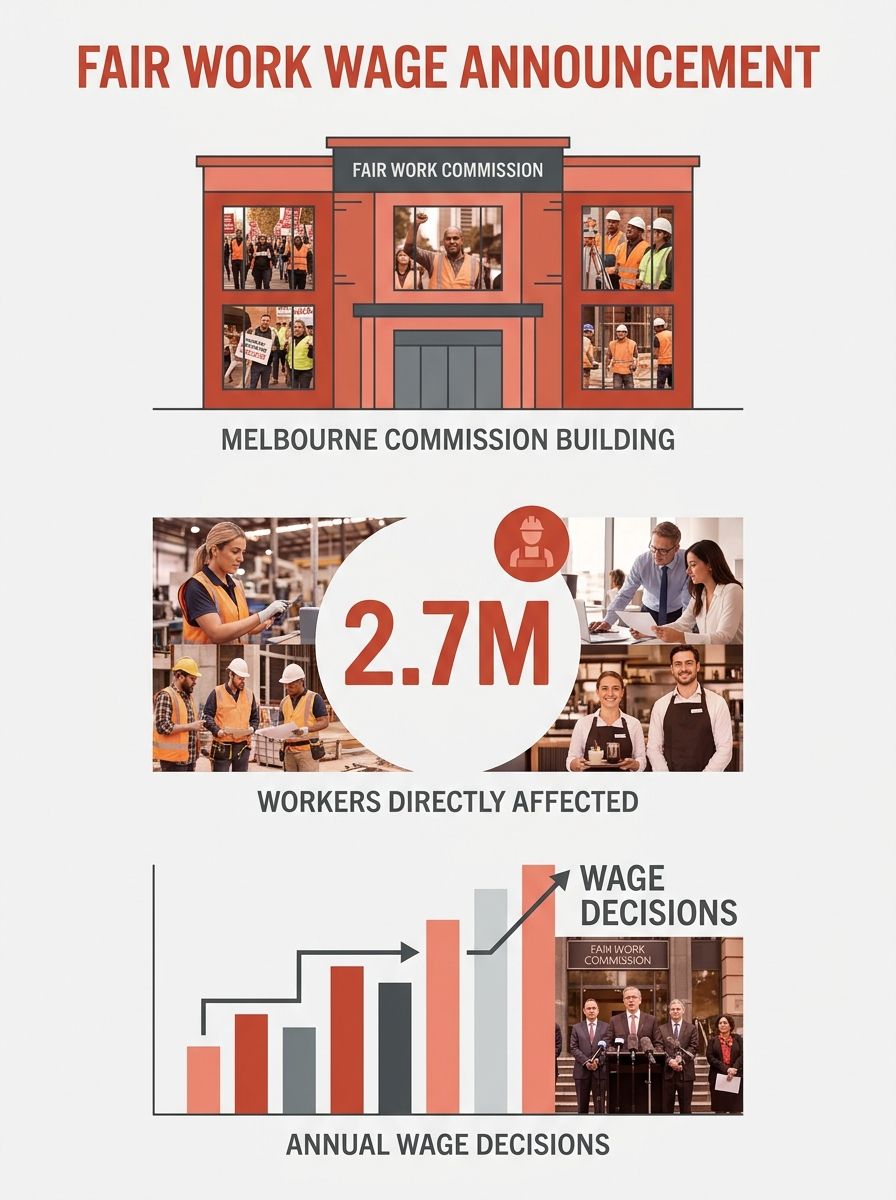
Australia's Fair Work Commission ruled June 2 that 2.7 million workers on award wages will receive a 4.75% pay increase effective July 2026, with an additional 100,000 lowest-paid employees receiving a 6% structural adjustment, according to The Guardian. The decision affects roughly one in five Aust

Fair Work Commission Grants 4.75% Minimum Wage Increase to 2.7 Million Australian Workers
Australia's Fair Work Commission ruled June 2 that 2.7 million workers on award wages will receive a 4.75% pay increase effective July 2026, with an additional 100,000 lowest-paid employees receiving a 6% structural adjustment, according to The Guardian. The decision affects roughly one in five Australian employees and marks the commission's annual minimum wage review amid 4.2% inflation.
The Wage Adjustment Details
The Fair Work Commission president Adam Hatcher announced the hourly minimum wage will climb from $24.95 to $26.44 for the lowest-paid classification, translating to a weekly increase from $948 to $1,005 for a standard 38-hour workweek. The 6% adjustment for 100,000 employees represents the commission's first structural intervention for the lowest tier since the post-COVID inflation surge eroded purchasing power beginning in mid-2021.
Hatcher said the 2026 decision was "particularly challenging" due to Middle East conflict-driven oil shocks that pushed fuel costs higher. The commission's ruling comes as Reserve Bank of Australia forecasts project inflation hitting 4.8% by June 2026—nearly double the official 2.5% target—while last year's 3.5% minimum wage increase trailed the 4.2% inflation rate recorded through April by the Australian Bureau of Statistics.
"It would now take a wage increase of well over 5% to close the real wage gap," Hatcher said in the ruling, noting that wage rates for most employees on modern awards remain below mid-2021 levels even after multiple annual adjustments.
Government Endorsement and Economic Impact
Treasurer Jim Chalmers defended the wage ruling as striking "a very effective balance" and rejected concerns that the increase would fuel inflation or force interest rate hikes. "We see decent pay as part of the solution, not part of the problem," Chalmers said, adding that minimum wage has climbed 30% since Labor took power in May 2022, or 12% after adjusting for cost-of-living increases.
Australian Council of Trade Unions secretary Sally McManus welcomed the decision and countered business objections by noting that workers are also customers. "If they go backwards, and if they have to cut back, they're going to cut back on spending," McManus said, arguing wage stagnation poses its own economic risks.
The ruling affects approximately 2.9 million workers total but represents only 11% of the national wages bill, according to commission data. Unions had pushed for a full 6% increase across all classifications during the annual review process, citing persistent erosion of purchasing power for low-wage workers since pandemic-era inflation began.
Employer Resistance and Rate Hike Warnings
David Alexander, policy director at the Australian Chamber of Commerce and Industry, warned the increases "could be the tipping point for some businesses" unable to pass labor costs to customers. "This is not good news for the business community," Alexander said, singling out retail, hospitality, and accommodation sectors as particularly vulnerable to the July wage adjustment.
AMP economist My Bui projected the ruling would add 0.6 percentage points to wages growth in the 2026-27 financial year but cautioned it could trigger larger pay demands across other sectors. "Wage pressures will add to already sticky services inflation, as businesses pass on higher labour and input costs," Bui said, revising her forecast to predict a Reserve Bank rate hike to 4.85% by November 2026.
The wage floor adjustment arrives as debates over minimum wage policy intensify globally, with Oklahoma voters deciding June 16 whether to raise their state minimum wage from $7.25 to $15 in a ballot measure affecting 357,700 workers in one of the United States' most conservative states.
Context and Outlook
The Fair Work Commission's decision illustrates how union advocacy shapes wage policy outcomes even in centralized industrial relations systems. The ACTU's sustained campaign for above-inflation adjustments—backed by detailed submissions documenting real wage erosion since 2021—pushed the commission beyond last year's 3.5% floor and secured the 6% structural tier for lowest-paid workers.
Australian unions use the annual review process as a public pressure campaign, submitting economic research, worker testimony, and inflation data to counter employer submissions arguing wage restraint prevents price spirals. The 30% cumulative minimum wage increase since May 2022 demonstrates how coordinated union pressure through regulatory forums can deliver material gains for millions of workers simultaneously, offering a model distinct from enterprise-by-enterprise bargaining that dominates North American labor strategy.
The ruling's timing—as global inflation remains elevated and central banks weigh further tightening—will test whether wage-floor adjustments can restore purchasing power without triggering the monetary policy responses employers predict. For organizers, the outcome validates strategic focus on policy forums where unions can advocate for entire wage classes rather than fragmenting resources across thousands of separate workplace campaigns.
The Union Edge Staff
Related Articles

Australia's Fair Work Commission Sets Minimum Pay and Insurance Standards for Gig Delivery Workers
Australia's Fair Work Commission approved minimum pay rates and personal accident insurance requirements for food and grocery delivery workers on August 12, establishing a A$31.30 ($22.

Oklahoma Voters to Decide Ballot Measure That Would Nearly Double State Minimum Wage to $15
Oklahoma voters will decide June 16 whether to raise the state's minimum wage from $7.25 to $15 per hour over three years, a measure affecting an estimated 357,700 workers in one of the nation's most conservative states, according to CNBC. State Question 832 would increase the wage floor to $12 in 2

state of arizona minimum wage 2024 Guide
Arizona's state minimum wage in 2024 is $14.35 per hour, set by an automatic inflation-adjustment formula that voters embedded in state law through Proposition 206 in 2016.
Also in the paper