
state of arizona minimum wage 2024 Guide
Arizona's state minimum wage in 2024 is $14.35 per hour, set by an automatic inflation-adjustment formula that voters embedded in state law through Proposition 206 in 2016.

State of Arizona Minimum Wage 2024: How the Automatic Adjustment Formula Works
Arizona's state minimum wage in 2024 is $14.35 per hour, set by an automatic inflation-adjustment formula that voters embedded in state law through Proposition 206 in 2016. Because the formula is voter-enacted, the Arizona legislature cannot lower or freeze the rate with a simple majority vote, which makes this mechanism fundamentally different from how most states handle wage floors.
What the Fair Wages and Healthy Families Act Established
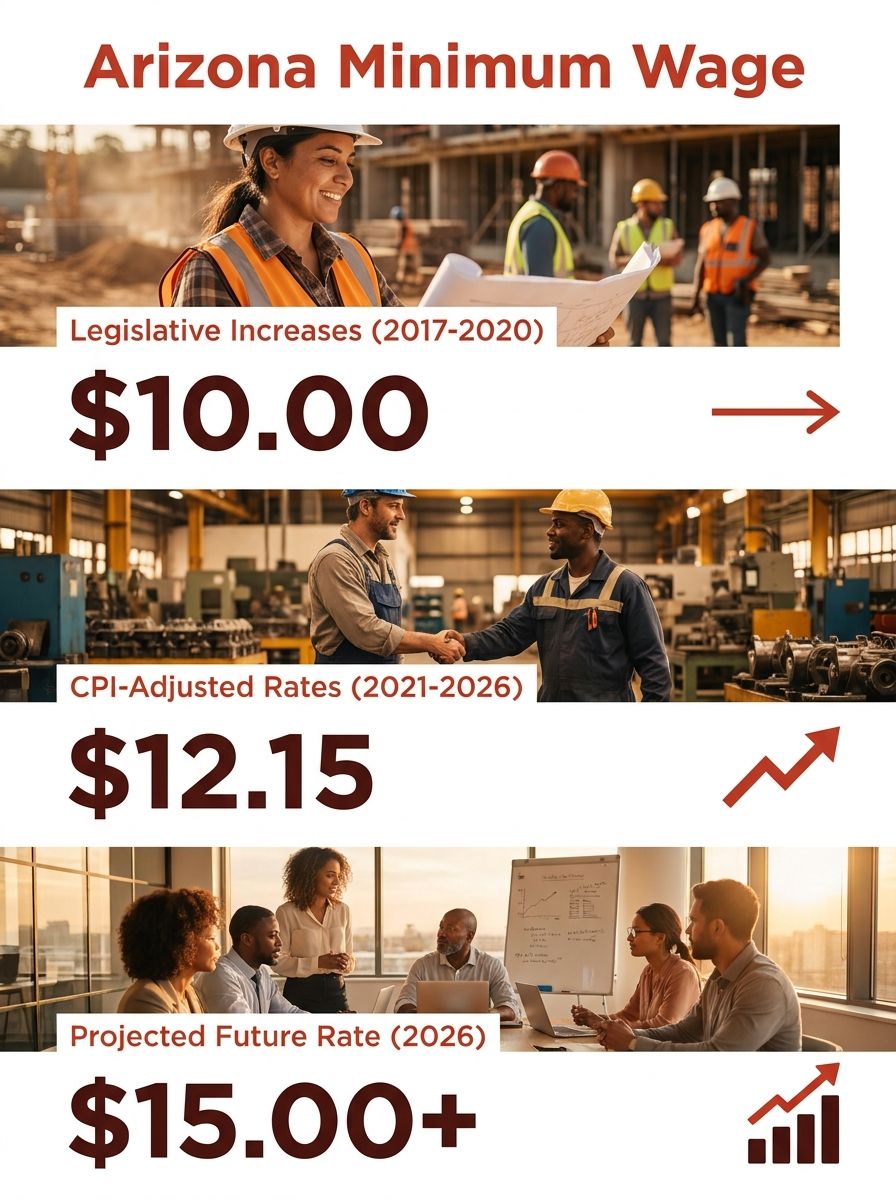
Proposition 206, officially titled the Fair Wages and Healthy Families Act, passed in November 2016 with 58.33% of the vote. The Industrial Commission of Arizona holds enforcement authority over both the minimum wage provisions and the earned paid sick time requirements the Act created. Under A.R.S. § 23-363, the Act set a phased schedule of base rate increases from 2017 through 2020 and then locked in an annual CPI-based adjustment starting in 2021.
The phased schedule looked like this:
Year | Minimum Wage | Increase |
|---|---|---|
2017 | $10.00 | +$1.50 from $8.50 |
2018 | $10.50 | +$0.50 |
2019 | $11.00 | +$0.50 |
2020 | $12.00 | +$1.00 |
2021 | $12.15 | First CPI adjustment |
2022 | $12.80 | +$0.65 (CPI) |
2023 | $13.85 | +$1.05 (CPI) |
2024 | $14.35 | +$0.50 (CPI) |
That trajectory matters for workers in healthcare, food service, retail, and other low-wage sectors across the state. Each step reflects real inflation data, and the 2023 jump of $1.05 was the largest single CPI-driven increase in the Act's history, driven by the inflationary spike that hit grocery and housing costs hardest for hourly workers.
A key structural feature: because Proposition 206 was a voter initiative, any legislative change to its terms requires either a three-fourths supermajority in both chambers of the Arizona legislature or another statewide ballot measure. Bills like HB 2127 and HB 2292 have proposed modifications to tipped wage calculations, but that three-fourths threshold has proven a significant barrier. The Voter Protection Act, enshrined in the Arizona Constitution, is what creates this supermajority requirement, and it applies to all voter-approved measures in the state.
How the CPI Adjustment Formula Calculates Each Year's Rate
The annual adjustment under A.R.S. § 23-363(B) works through a specific formula. The Industrial Commission of Arizona compares the CPI-W index value published by the U.S. Bureau of Labor Statistics for August of the current year against the August value from the prior year. The percentage change between those two figures is applied to the current minimum wage, and the result is rounded up to the nearest $0.05 increment.
Here's the actual math for the 2024 rate: the CPI-W increased by approximately 3.6% between August 2022 and August 2023. Applied to the 2023 minimum wage of $13.85, that yielded roughly $0.50, producing the 2024 rate of $14.35 per hour. As Jaburg Wilk's employment law analysis noted, this rate took effect on January 1, 2024 and remains in effect through December 31, 2024.
The formula has a built-in floor: if the CPI-W decreases year-over-year (deflation), the minimum wage stays at its current level rather than dropping. Workers never lose ground under this mechanism. The wage can only go up or stay flat, never decline. This one-directional ratchet is a design feature that distinguishes Arizona's approach from hypothetical pure-indexing models where deflation would reduce wages.
The pattern across recent years tells a story about inflation's real impact on Arizona workers:
Adjustment Year | CPI-Driven Increase | Approximate CPI-W Change |
|---|---|---|
2022 | +$0.65 | ~5.3% |
2023 | +$1.05 | ~8.2% |
2024 | +$0.50 | ~3.6% |
2025 | +$0.35 | ~2.4% |
2026 | +$0.45 | ~3.1% |
The 2023 adjustment of $1.05 stands out. That was the year grocery prices, fuel costs, and rent hit Arizona households hardest, and the formula captured the severity of that squeeze. But a CPI-driven minimum wage increase always runs one year behind the inflation it's responding to. Workers felt the 8.2% CPI spike in real time during 2022; the wage adjustment compensating for it didn't arrive until January 2023. This lag is the most significant structural weakness in the formula, and it's worth understanding why it exists. The BLS publishes the August CPI-W data in September, and the Industrial Commission needs time to calculate and announce the new rate before it takes effect in January. The timeline creates an unavoidable delay.
The Tipped Wage Calculation
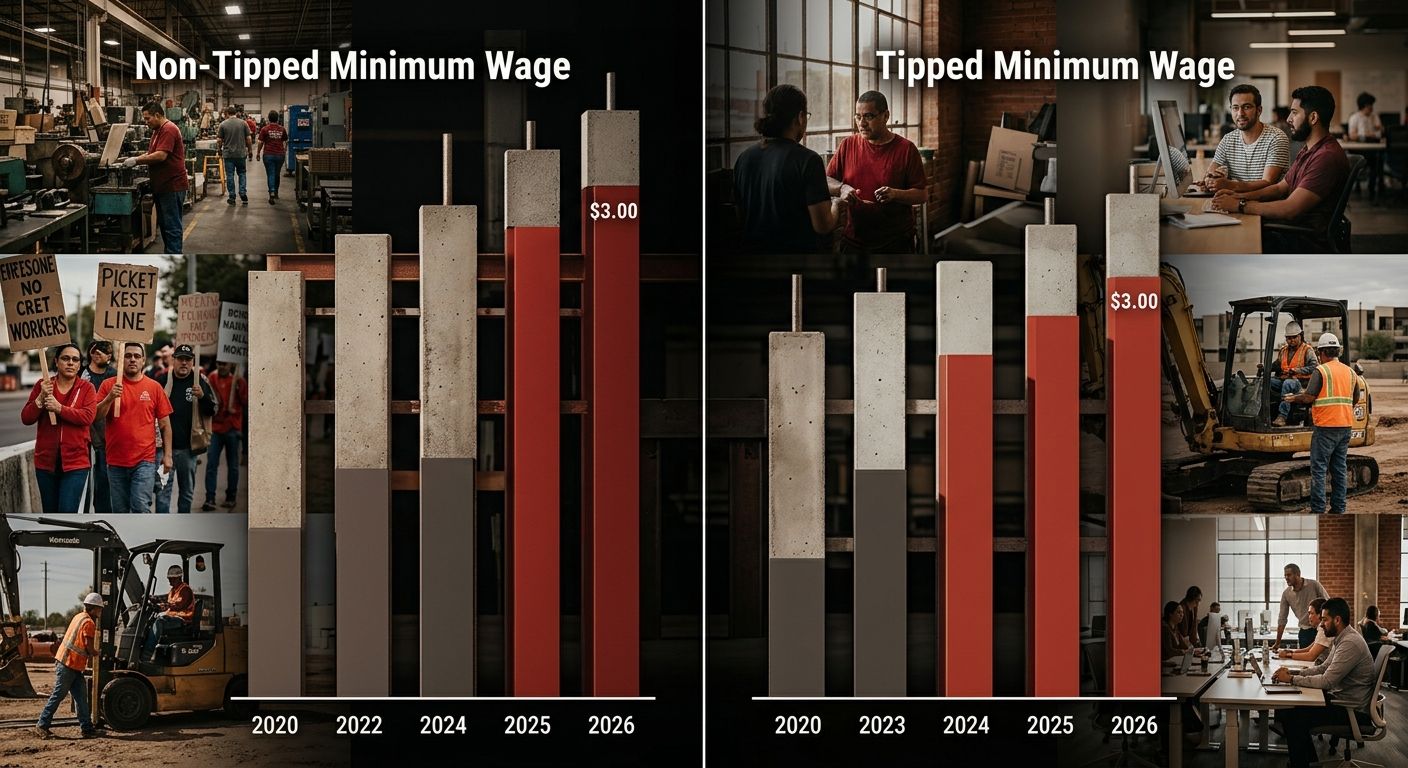
Arizona law allows employers to pay tipped employees $3.00 per hour less than the state minimum wage, provided the employee's total compensation (cash wage plus tips) meets or exceeds the full minimum wage for every hour worked. In 2024, that means a tipped worker's base cash wage is $11.35 per hour ($14.35 minus $3.00). The $3.00 tip credit has remained constant since Proposition 206 was enacted; it doesn't adjust with inflation.
This creates an interesting dynamic. As the base minimum wage rises each year, the $3.00 tip credit represents a shrinking percentage of total compensation. In 2017, when the minimum was $10.00, the $3.00 credit was 30% of the total wage. By 2024, at $14.35, it's approximately 20.9%. By 2026, at $15.15, it will be 19.8%. The tip credit is slowly eroding as a share of the wage floor, even without any legislative action.
Compliance is determined by averaging tips over the employer's payroll period, according to A.R.S. § 23-363. If the average falls short, the employer must make up the difference. Workers in healthcare-adjacent food service roles, such as cafeteria staff in hospitals and assisted living facilities, are often affected by this provision. When patient volumes shift or facility hours change, tip income fluctuates, and the makeup-pay obligation kicks in. Understanding how your tips are averaged across a pay period, and what collective bargaining can do to set clearer standards, is important for any tipped worker in the state.
Where Local Ordinances Override the State Floor
The state of Arizona minimum wage of $14.35 is the floor, but two cities enforce higher local rates. Flagstaff's minimum wage in 2024 reached $17.40 per hour, with a tipped minimum of $15.90 per hour. That's $3.05 higher than the state rate. Tucson's minimum wage matched the state rate of $14.35 in 2024 but rose to $15.00 per hour on January 1, 2025, pulling ahead of the state's $14.70 rate for that year.
These local ordinances add a layer of complexity. Employers in Flagstaff pay 21.3% more per hour than the state minimum requires. For healthcare workers, home health aides, and medical office support staff in Flagstaff, that $3.05 difference adds up to roughly $6,344 per year for a full-time worker. Tucson's ordinance, while closer to the state rate, signals the kind of municipal wage activism that has reshaped minimum wage policy in states like Colorado and New Jersey.
Arizona's preemption landscape is complicated. The state legislature has attempted to restrict local minimum wage ordinances, but Proposition 206's voter-protection status limits what lawmakers can do without clearing that three-fourths threshold. Flagstaff's wage ordinance survived legal challenges and continues to operate independently of the state formula. Workers in the Phoenix metro area, which includes Mesa, Chandler, Scottsdale, and Tempe, are covered by the state minimum of $14.35 with no local supplement.
How Arizona's Rate Compares to Neighboring States and the Federal Floor
Arizona's $14.35 rate in 2024 sat nearly double the federal minimum wage of $7.25 per hour, which has remained unchanged since 2009. The comparison to neighboring states provides useful context:
State | 2024 Minimum Wage | Adjustment Mechanism |
|---|---|---|
Arizona | $14.35 | CPI-W indexed |
California | $16.00 | Legislative + CPI |
Colorado | $14.42 | CPI indexed |
Nevada | $12.00 | Flat rate (2024) |
New Mexico | $12.00 | Flat rate |
Utah | $7.25 | Federal rate only |
Arizona and Colorado ran nearly identical rates in 2024, both using CPI-indexed formulas. The contrast with Utah, which defaults to the federal $7.25, illustrates the practical difference between voter-enacted protections and legislative inaction. A full-time minimum wage worker in Arizona earned approximately $29,848 per year in 2024. The same worker in Utah earned $15,080. That $14,768 annual gap has direct consequences for healthcare access, since workers earning below certain thresholds qualify for different tiers of Medicaid and marketplace subsidies.
The relationship between minimum wage rates and healthcare coverage is especially visible in states like Florida and Virginia, where lower wage floors push more workers into coverage gaps. Arizona's Medicaid expansion under the Affordable Care Act covers adults up to 138% of the federal poverty level, and minimum wage increases push some single workers above that threshold, creating a complicated interaction between wage gains and benefit eligibility.
Where the Model Breaks
Arizona's CPI-indexed minimum wage formula is one of the better-designed automatic adjustment mechanisms in the country. It still has structural weaknesses that affect workers disproportionately.
The one-year lag is the most consequential flaw. When inflation spiked to 8.2% in 2022, Arizona workers absorbed higher costs for an entire year before the January 2023 adjustment partially compensated them. During that gap, real purchasing power dropped significantly. The formula responds to inflation; it doesn't prevent the damage inflation causes in real time. For healthcare workers, home health aides, and hospital support staff living paycheck to paycheck, a 12-month wait for a cost-of-living correction is a real hardship.
The $3.00 flat tip credit is another pressure point. Because it doesn't index to inflation, tipped workers receive a rising proportion of their guaranteed wage in cash over time, which is good. But the credit's existence still means employers in Arizona's restaurant, hotel, and healthcare food service sectors pay tipped employees $11.35 per hour in cash wages during 2024. If tip income drops because of seasonal slowdowns, construction detours that reduce foot traffic, or shifts in patient census at a hospital cafeteria, the makeup-pay provision theoretically protects workers. Enforcement, however, depends on workers knowing the rule exists and being willing to challenge their employer.
The formula also cannot account for regional cost-of-living variation within the state. The CPI-W is a national index, not an Arizona-specific one. Housing costs in Scottsdale bear little resemblance to housing costs in Yuma, but both cities operate under the same $14.35 rate. Flagstaff addressed this through local ordinance, but most Arizona municipalities have not.
And the supermajority requirement cuts both ways. It protects the formula from legislative rollback, which is important. But it also makes it extremely difficult to strengthen the formula, raise the base rate faster than CPI allows, or reduce the tip credit. Workers who want more than CPI-paced increases face the same three-fourths barrier that blocks employers who want to weaken the law.
Common Questions
Does Arizona's minimum wage apply to all workers?
The Fair Wages and Healthy Families Act covers most employees in Arizona, including part-time and temporary workers. Exemptions exist for workers employed by a parent or sibling, babysitters who work in the employer's home, and workers employed by the state of Arizona or the federal government. Small businesses are not exempt; the law applies regardless of employer size, unlike some states that set different rates for businesses with fewer than a certain number of employees.
What happens if my employer doesn't pay the Arizona minimum wage?
Under A.R.S. § 23-364, employees can file a complaint with the Industrial Commission of Arizona. The employer must pay the difference between what was earned and what the minimum wage requires, and may face additional penalties. Workers can also file a private lawsuit. The Industrial Commission of Arizona publishes complaint forms and investigation procedures on its website.
How does Arizona's earned paid sick time connect to the minimum wage law?
Proposition 206 bundled minimum wage and earned paid sick time into a single ballot measure. Employers with 15 or more employees must provide 40 hours of paid sick time per year; employers with fewer than 15 employees must provide 24 hours. Sick time accrues at one hour for every 30 hours worked and must be paid at the employee's regular rate, which cannot be below the state minimum wage of $14.35 in 2024.
Will Arizona's minimum wage keep rising after 2026?
The CPI-W adjustment formula has no expiration date. As long as Proposition 206 remains in effect, the Industrial Commission of Arizona will calculate and announce a new rate each fall for the following January 1. The announced 2026 rate of $15.15 per hour reflects continued application of the formula. Future increases depend entirely on CPI-W movement.
Can Arizona cities set their own minimum wage above the state rate?
Yes. Flagstaff and Tucson have both enacted local minimum wage ordinances above the state floor. Employers in those cities must pay the higher local rate. Workers in Phoenix and other cities without local ordinances are covered by the state rate of $14.35 in 2024.
The Union Edge Staff
Frequently Asked Questions
- What is Arizona's minimum wage in 2024?
- Arizona's state minimum wage in 2024 is $14.35 per hour, adjusted automatically based on the Consumer Price Index for Urban Wage Earners and Clerical Workers (CPI-W). This rate was set through Proposition 206, a voter-approved measure that established an automatic inflation-adjustment formula.
- How does Arizona's minimum wage automatically adjust each year?
- The Industrial Commission of Arizona compares the CPI-W index value published by the U.S. Bureau of Labor Statistics for August of the current year against the prior year's August value, applies the percentage change to the current minimum wage, and rounds the result up to the nearest $0.05 increment. The wage can only stay the same or increase, never decrease.
- What is the tipped minimum wage in Arizona for 2024?
- Tipped workers in Arizona receive the state minimum minus $3.00, which equals $11.35 per hour in 2024. Employers must ensure that tipped employees' total compensation (cash wage plus tips) meets or exceeds the full minimum wage through a makeup-pay obligation if tips fall short.
- What are the highest minimum wage cities in Arizona?
- Flagstaff has the highest local minimum wage at $17.40 per hour in 2024, while Tucson's rate increased to $15.00 per hour on January 1, 2025. Both cities' local ordinances override the state minimum wage floor.
- Can the Arizona legislature lower or freeze the minimum wage?
- No. Because Proposition 206 was voter-enacted, any legislative change to its terms requires either a three-fourths supermajority in both chambers of the Arizona legislature or another statewide ballot measure, making it extremely difficult for the legislature to lower or freeze the rate.
- What will Arizona's minimum wage be in 2025 and 2026?
- Arizona's minimum wage will be $14.70 per hour in 2025 and $15.15 per hour in 2026, based on CPI-W adjustments calculated by the Industrial Commission of Arizona.
- How does Arizona's minimum wage compare to the federal minimum wage?
- Arizona's $14.35 minimum wage in 2024 is nearly double the federal minimum wage of $7.25 per hour, which has remained unchanged since 2009. A full-time Arizona worker earned approximately $29,848 annually at the state minimum compared to $15,080 under the federal rate.
- What is the main weakness of Arizona's minimum wage formula?
- The formula operates with a one-year lag—inflation that workers experience in real time doesn't result in a wage adjustment until the following January. For example, workers felt the 8.2% CPI spike during 2022, but the wage adjustment compensating for it didn't arrive until January 2023.
Related Articles

Minimum Wage Arizona: 2024 Rates & Requirements
Arizona's minimum wage is $14.35 per hour, effective January 1, 2024, governed by an automatic annual formula tied to the Consumer Price Index that no legislature and no governor can override without a three-quarters supermajority vote.
Arizona Minimum Wage 2026: What's Changing
Proposition 206, the ballot initiative Arizona voters passed in 2016, built an automatic escalator into state law: each year, the minimum wage adjusts based on Consumer Price Index changes. That formula pushed the az minimum wage 2026 rate to $15.15 per hour on January 1, a $0.45 increase from $14.

State of Colorado Minimum Wage 2024: Rates & Changes
Colorado's state minimum wage rose to $14.42 per hour on January 1, 2024, set automatically by a Consumer Price Index formula that removes the state legislature from annual rate decisions entirely.
Also in the paper