
Card Check vs. NLRB Election: Which Recognition Path Gives Unions a Better Chance in 2025?
Signed authorization cards, not secret ballot elections, are now the National Labor Relations Board's preferred method for establishing union representation. The NLRB's August 2023 Cemex decision made majority sign-up the primary recognition path.

Card Check vs. NLRB Election: Which Recognition Path Gives Unions a Better Chance?
Signed authorization cards, not secret ballot elections, are now the National Labor Relations Board's preferred method for establishing union representation. The NLRB's August 2023 Cemex decision made majority sign-up the primary recognition path. Employers who want a traditional election must petition for one within 14 days of a union's demand.
Before Cemex: How the Election Path Dominated for Decades
For most of the National Labor Relations Act's 90-year history, the NLRB secret ballot election was the standard route to union recognition. Workers gathered signatures on authorization cards, filed a petition with the Board showing at least 30% support, and then waited for the government to schedule a vote. Card check recognition existed as an alternative, but as Reed Smith LLP noted in its legal analysis, it was "a viable alternative to the traditional NLRB process, but only if a union can persuade an employer to agree to it." Few employers agreed.
The election became the bottleneck where organizing campaigns lived or died. Research from the UC Berkeley Labor Center found that employers used every available procedural tool to delay elections. Those delays had a direct, measurable effect on outcomes. Political economist Gordon Lafer of the University of Oregon, whose findings are cited in the Berkeley study, documented how companies stretched the timeline between petition and vote to run aggressive counter-campaigns that "extend the exposure of employees to an anti-union campaign and thereby suppress union support."
The spending numbers confirm the pattern. Employers hired anti-union consultants in an estimated 75% of organizing campaigns, feeding what has grown into a $1.7 billion annual industry dedicated to defeating union drives. The longer the gap between a petition filing and the actual vote, the more money companies poured into changing workers' minds.
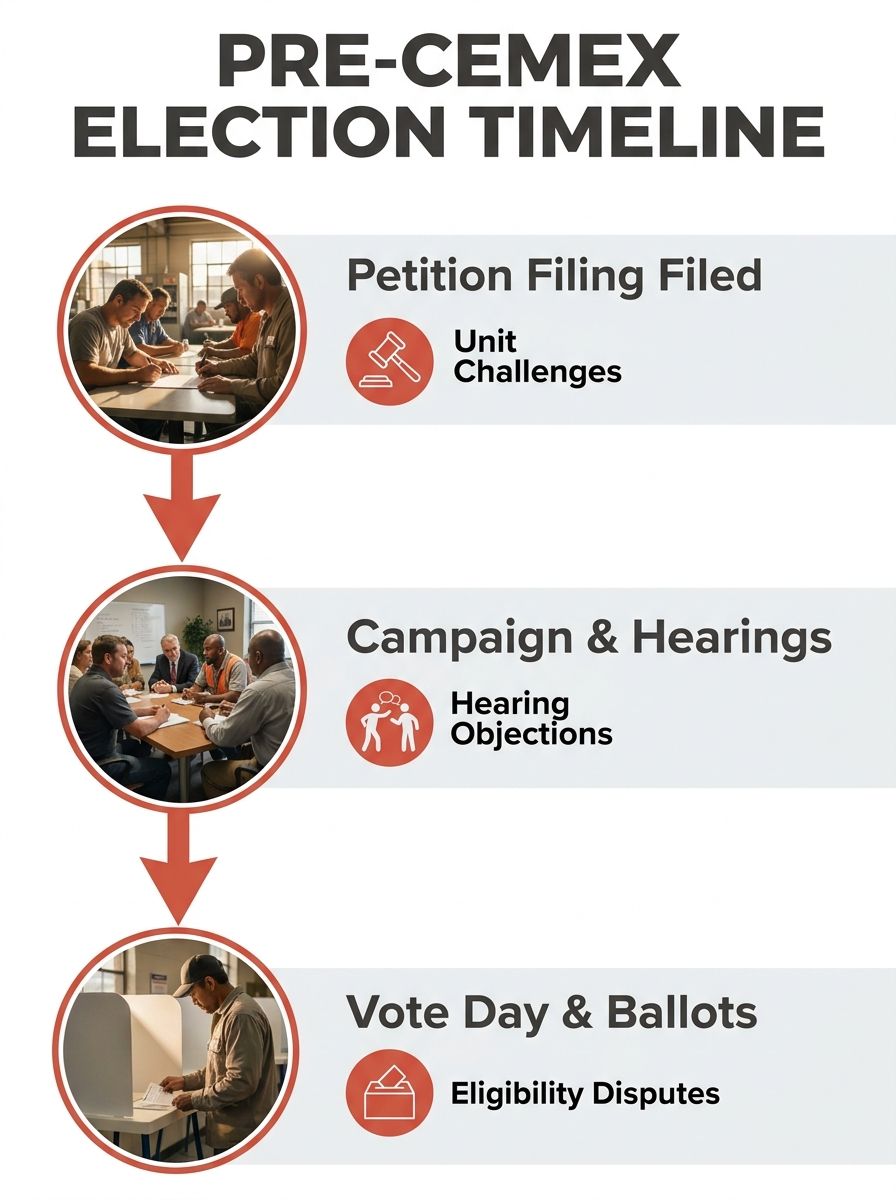
The Campaign Period: Where Elections Broke Down
What happened between the petition and the ballot box consistently favored employers. Once an election petition was filed, the employer gained something unions couldn't match: a captive audience.
Workers showed up every day to the same building, on the employer's clock, under the employer's supervision. Companies used this access to run scripted anti-union meetings that workers were required to attend, sometimes daily, during the weeks before a vote. These captive audience meetings are deployed in roughly 89% of union organizing campaigns. The data shows they cut union election win rates from 73% down to 47%.
And the delays got worse. Jackson Lewis, a management-side labor law firm, acknowledged in its analysis of NLRB procedures that blocked elections "can result in election delays stretching over years." Workers who started the organizing drive might leave the company before any vote was held. Momentum faded. Fear set in.
Election delay tactics became so routine they functioned as a script. Employers challenged the composition of the bargaining unit. They disputed individual voter eligibility. They filed appeals that pushed vote dates back by months. Each delay gave the company another round of mandatory meetings, another chance to pull workers into one-on-one sessions with supervisors. The union-busting consulting industry built its entire business model around exploiting this window of time.
Card check recognition avoided all of that. When workers signed authorization cards and a majority was verified, there was no campaign period, no captive audience meetings, no months of procedural delay. But under the old rules, card check required the employer's consent, and employers had every incentive to refuse.
August 25, 2023: The Board Rewrites the Rules
The NLRB issued its Cemex Construction Materials Pacific decision on August 25, 2023. Baker Donelson, a management-side law firm, described the ruling and a companion decision issued the day before as "a one-two punch to nonunion employers."
The Cemex framework changed the union recognition strategy equation in three concrete ways.
First, when a union presents evidence of majority support through signed authorization cards, the employer must either recognize the union immediately or file its own petition for an NLRB election within 14 calendar days. The old system let employers stall for months or years. Under Cemex, the clock starts the moment cards land on the employer's desk.
Second, if the employer files for an election but commits any unfair labor practice that interferes with the vote, the Board skips the election entirely and orders the employer to recognize and bargain with the union based on the card majority. No rerun election. No second chance. A single violation can close the election path permanently.
Third, as Miller Nash noted in its analysis: "The NLRB has now made signed authorization cards the preferred method for unions to gain recognition." The burden flipped. Unions no longer had to petition for an election. Employers had to petition against recognition, and they had to run a spotless campaign to keep that election on track.
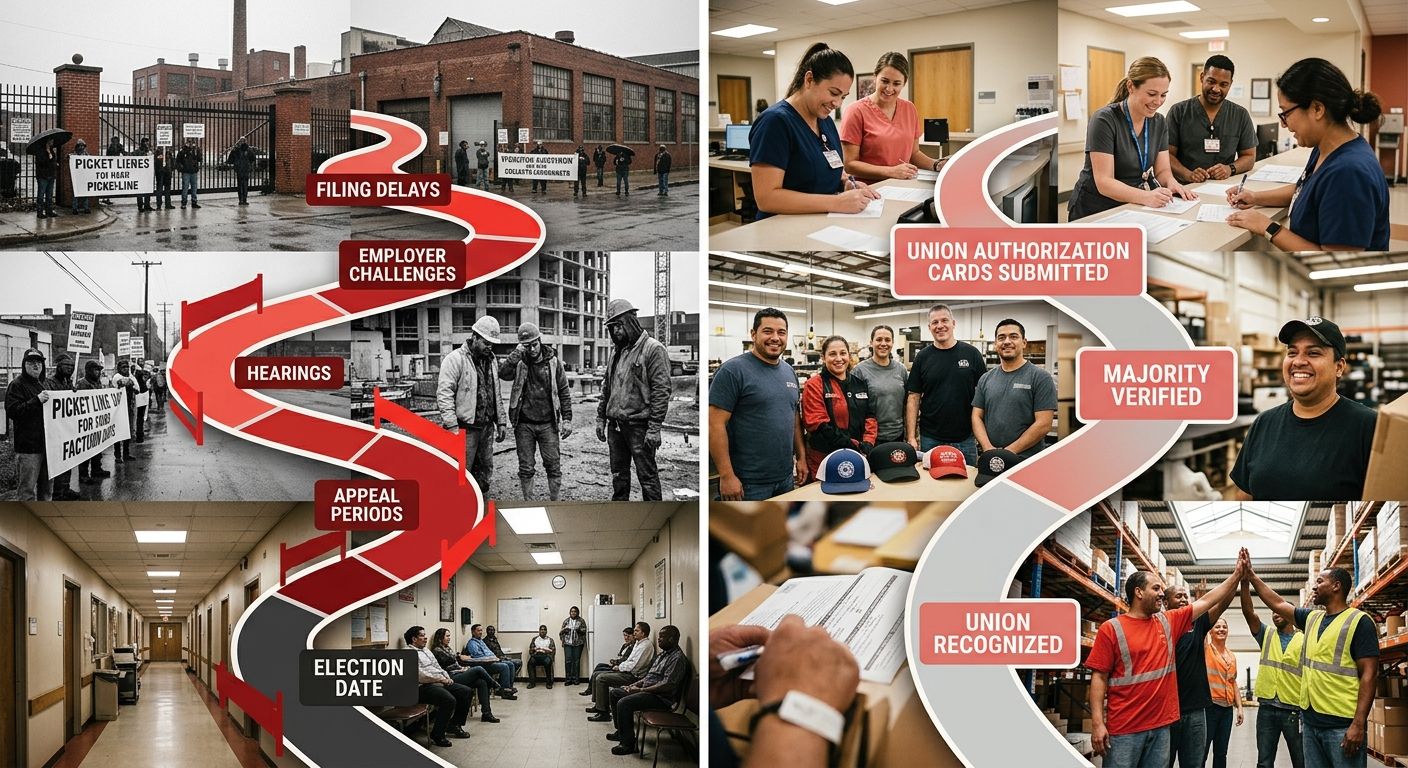
What Changed on the Ground
The Cemex framework altered organizing campaigns in ways that went beyond legal theory.
Under the old system, organizers focused enormous energy on surviving the election campaign. They built committees, trained workers to handle captive audience meetings, prepared for months of delay, and hoped enough momentum would survive to win a 50%+1 vote. The entire union recognition strategy centered on endurance.
After Cemex, the strategic center of gravity shifted to the card-signing phase. If organizers got more than 50% of workers in the bargaining unit to sign authorization cards, they held the stronger position regardless of what happened next. Employer recognition meant an immediate win. An employer petition followed by a single unfair labor practice meant a bargaining order, which also meant a win.
This changed how organizers approached their daily work. The card-signing conversation became the decisive moment in a campaign, not a procedural step on the way to something else. Every employee has a protected legal right to decide whether to sign a union authorization card free from threats, coercion, or misrepresentation. Organizers learned to document that right carefully, keeping records of when and where each card was signed in case the employer later challenged validity.
The shift also created new pressure on employers. Companies that had relied on the campaign period to erode union support faced a 14-day deadline to file for an election and a zero-tolerance standard for misconduct during that election. Firing a union supporter, threatening plant closure, or interrogating workers about organizing activity could each trigger a bargaining order. The kind of conduct that NLRB judges have repeatedly found unlawful at companies like Amazon became grounds for automatic recognition.
The Employer Counteroffensive
Management-side law firms responded to Cemex with urgent advisories to clients. The message was consistent: treat every recognition demand as a 14-day countdown and run the cleanest campaign in the company's history.
Some employers adapted by training supervisors to avoid any statement or action that could constitute an unfair labor practice. Others invested in pre-emptive strategies, running ongoing "employee engagement" programs and monitoring workforce sentiment long before any cards appeared.
The more aggressive response came through litigation. Employer groups challenged the Cemex framework's legality, arguing it effectively eliminated the secret ballot election. Opponents of card check recognition have long contended that the card-signing process is vulnerable to peer pressure, and that workers deserve the protection of a private vote. The National Right to Work Foundation has maintained that every employee's decision about signing a card must be "free from threats, restraint, harassment, coercion, or misrepresentation."
But the data on elections complicates that argument about which process actually produces coercion. When employers spend billions running mandatory anti-union meetings, threatening job losses, and filing charges as delay tactics, the "laboratory conditions" the Board requires for fair elections don't exist. The election becomes a managed outcome rather than a free choice.
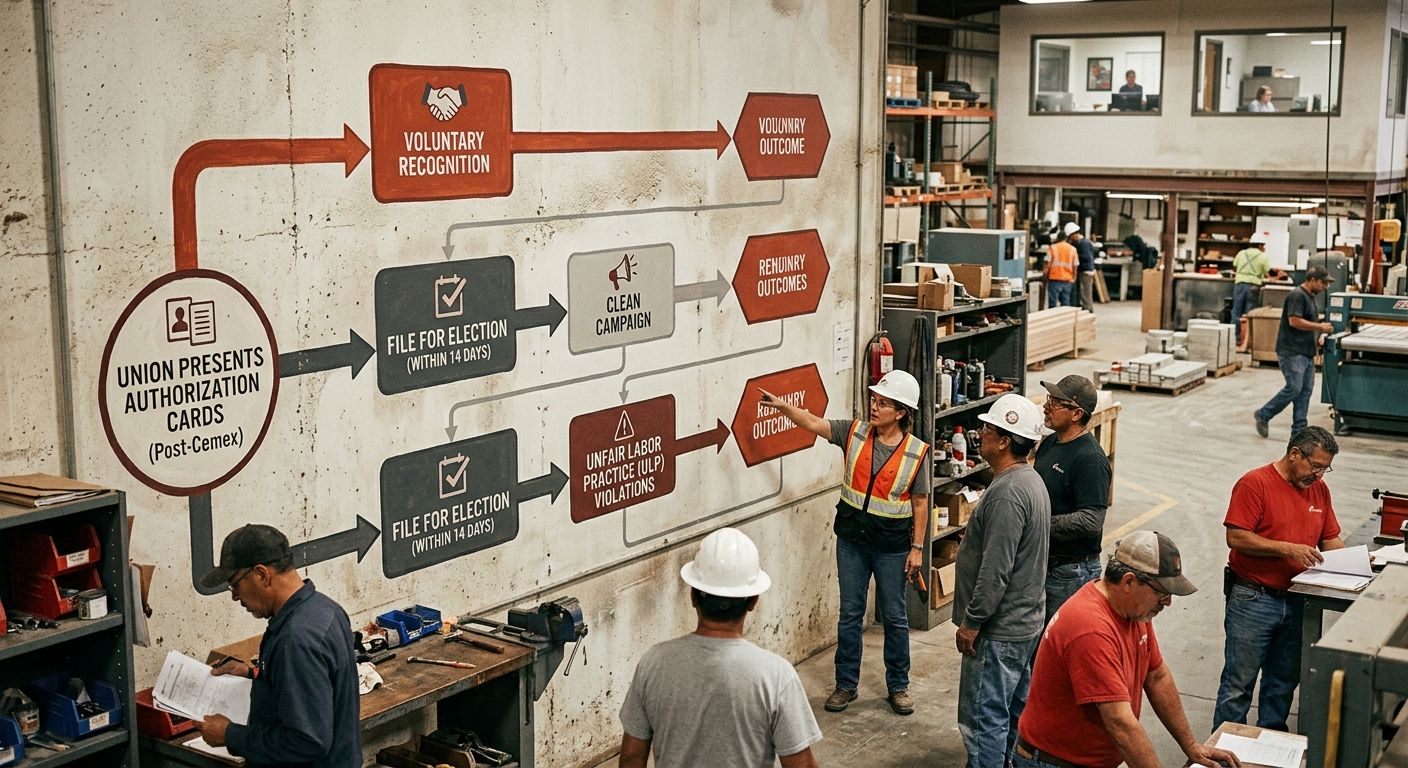
Where the Law Stands Today
The Cemex framework remains the governing standard for union recognition at the NLRB. Despite ongoing legal challenges and political uncertainty about Board composition, the precedent continues shaping how campaigns play out.
For organizers weighing their union recognition strategy, the practical comparison between the two paths breaks down like this:
Factor | Card Check (Majority Sign-Up) | NLRB Secret Ballot Election |
|---|---|---|
Threshold required | 50%+ signed authorization cards | 50%+ of votes cast in election |
Employer consent needed | No (post-Cemex) | No, but employer can trigger one |
Campaign period | None if employer recognizes | Weeks to months, historically years with delays |
Employer counter-campaign window | Minimal (14-day filing deadline) | Extensive (daily captive audience meetings, supervisor sessions) |
Vulnerability to delay tactics | Low | High |
Effect of employer ULP | Strengthens recognition claim | Can result in automatic bargaining order |
Union win rate impact | Removes 89% captive-meeting tactic | Win rates drop from 73% to 47% when employers deploy full toolkit |
The majority sign-up path gives unions a structural advantage the election path does not. Every week of delay between a petition and an election is a week the employer can spend money, run meetings, and apply pressure. Card check recognition compresses the timeline and removes the campaign period where employer opposition hits hardest.
But the card check path carries its own demands. Organizers need genuine, well-documented majority support before presenting cards. They need workers who understand what they're signing and who will maintain their commitment if the employer files for an election anyway. Building that depth of support requires the patient, relationship-driven work that defines strong organizing models.
The fight over how unions get recognized has always been a fight over time. Employers want more of it. Workers want less. Cemex handed workers the shorter clock, and the results are still playing out in break rooms, parking lots, and NLRB regional offices across the country.
The Union Edge Staff
Related Articles

NLRB General Counsel Targets Union Card-Check Rule in August Memo, Setting Up Precedent Reversal
The National Labor Relations Board's General Counsel Crystal Stowe Carey issued a memo on August 26 identifying the Cemex precedent—a Biden-era rule enabling unions to organize through card-check campaigns—as a target for reversal, according to FreightWaves.

The 30% Authorization Card Threshold: Why This Legal Checkpoint Determines Your Organizing Campaign's Fate
The National Labor Relations Board requires signed authorization cards from at least 30% of workers in a proposed bargaining unit before it will schedule an election. That threshold appears in every organizing manual, on every union website, and in every introductory labor law course.

From Recognition to Results: The Post-Election Bargaining Roadmap Unions Get Wrong
Forty-four percent of newly certified unions between 1999 and 2004 never reached a first contract, according to a study of more than 8,000 successful elections by sociologist John-Paul Ferguson. The election was the easy part.
Also in the paper